
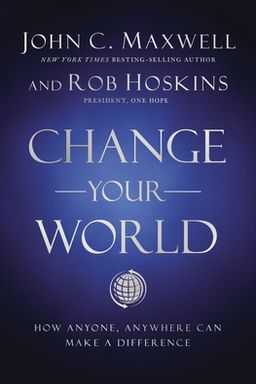
Change Your World cover

Change Your World

by John C Maxwell and Rob Hoskins

Change Your World is a practical guide for those seeking to make a meaningful difference. Through compelling stories and actionable insights, Maxwell and Hoskins inspire readers to take small steps toward transformation, emphasizing the power of hope, teamwork, and values-based leadership. Ignite change in yourself and your community today.

Anyone, Anywhere Can Change Their World

Have you ever looked around and thought, “Something needs to change”? In Change Your World, John Maxwell and Rob Hoskins argue that every person—no matter their background, influence, or resources—has the power to create positive transformation. They contend that world change doesn’t begin with governments or institutions; it begins when ordinary people decide to act intentionally and live out good values.

According to Maxwell, transformation starts with a single decision—a conversation, a small act of service, or a courageous step of forgiveness—and grows outward, person by person. The book is both an inspiring guide and a practical roadmap for anyone who wants to move from awareness of problems to personal and communal action. Throughout, Maxwell and Hoskins trace their decades of leadership and global community work to uncover the simple truth: change is possible, but you must be the catalyst.

Why Change Can’t Wait

Maxwell opens with urgency: our world is fractured, families are breaking, and communities are hungry for hope. Waiting for governments, schools, or organizations to fix things leads only to frustration. Drawing on stories from everyday people—like Missy Hammerstrom, who noticed hungry children and began feeding thousands from her garage—the authors show that transformation starts with awareness and action, not waiting.

They emphasize two essential forces that drive movement: anger and courage. Anger fuels the desire to reject injustice, and courage provides the strength to move toward solutions. Change is not an abstract idea—it’s deeply personal. Before altering the world around you, you must change how you think, shifting from hopelessness to possibility. “For things to change, first I must change,” Maxwell reminds readers.

Becoming a Catalyst for Transformation

The authors invite readers to turn personal conviction into contagious action. They introduce examples ranging from Nobel laureate Norman Borlaug, whose agricultural innovations helped feed millions, to a twelve-year-old girl named Tiffany in Peru who founded a school for impoverished children. These stories share a common blueprint: care, cause, collaboration, and courage. Maxwell defines a catalyst as someone whose actions spark change in others—regardless of scale.

Using principles similar to those in The 21 Irrefutable Laws of Leadership, he explains that genuine leadership is not about position but influence. A catalyst acts on good intentions, takes ownership of their dream, invites others into the mission, and focuses on good actions rather than endless planning. “Deciding is not doing,” Maxwell’s father used to say—a reminder that transformation requires deliberate follow-through.

Connection and Collaboration: We Need Each Other

In later chapters, collaboration becomes the lifeline for sustained change. Maxwell’s “Law of Significance” declares, “One is too small a number to achieve greatness.” Real transformation multiplies when individuals join hands—like Sam Yoder’s factory workers who turned a shutdown into a face-shield assembly line during the COVID-19 crisis. These examples demonstrate that shared values, teamwork, and partnership transform isolated efforts into movements.

Whether it’s businesses uniting with schools to fight poverty, soccer teams working together despite rivalries in Paraguay, or families rebuilding trust through forgiveness, the pattern is consistent: transformation is relational. You don’t need to be famous or wealthy—you only need to say yes to working with others fueled by integrity, humility, and generosity (three values Maxwell calls the “legs of trust”).

The Value of Values

Values are the backbone of change. In every story Maxwell tells—from young Cristian Molina in Costa Rica who overcame abuse by learning the value of a positive attitude, to entire companies that transformed cultures by teaching core principles—good values provide stability and trust. Borrowing from the timeless “Golden Rule” that appears across global faiths (“Do to others as you would have them do to you”), Maxwell argues that ethical living transcends culture and builds bridges.

Without values, organizations collapse—just like Enron, whose stated ethics never matched reality. Good values, by contrast, multiply impact. They empower people to lead with integrity, generosity, and humility, forming what Maxwell terms “a culture of transformation.”

Transforming One Table at a Time

Perhaps the most actionable idea in the book is the Transformation Table method: small groups that meet regularly to discuss and apply values such as respect, forgiveness, and perseverance. Using stories from Guatemala, Costa Rica, and Paraguay, Maxwell and Hoskins reveal how structured conversations around these values lead to individual and cultural renewal. “Talking can transform minds, which can transform behaviors, which can transform institutions,” writes Sheryl Sandberg—a sentiment the authors echo.

Transformation tables combine proximity, environment, and repetition—three elements of sustained habit change (similar to principles in James Clear’s Atomic Habits). Change becomes communal, measurable, and continual.

From Talking to Doing

In the final chapters, Maxwell turns action into measurement. He introduces Hoskins’s “Five Ds”—Discover, Design, Deploy, Document, Dream—a cycle where learning, action, and reflection accelerate results. Transformation, they insist, is both an emotional experience and a data-driven process. “What gets done gets measured.” Finally, the authors issue a personal challenge to every reader: don’t wait for change—start it. It might begin at your kitchen table or in your community, but once it starts, it can spread across nations. This book doesn’t just teach leadership—it teaches stewardship of hope. If you’re willing to live good values, value people, and take courageous action, you can indeed change your world, one decision at a time.


Becoming a Catalyst for Change

John Maxwell defines a catalyst as someone whose actions accelerate transformation. Rather than waiting for government programs or grand reforms, a catalyst takes small, meaningful actions that trigger broad results. He uses the example of Norman Borlaug, an Iowa farm boy whose experiments with wheat eventually helped feed billions. Borlaug worked quietly for decades, proving that persistent action—rooted in care and conviction—matters far more than recognition.

From Caring to Cause

Maxwell explains that change starts when you care enough to act. Caring transforms into a cause—something specific you’re willing to fight for. This progression mirrors Gandhi’s principle that “every great dream begins with a dreamer.” Whether feeding local children like James Crocker donating blood plasma during COVID-19 or founding global movements like Tyler Perry using creativity and ownership to empower others, transformation grows from small, consistent efforts.

Being a catalyst doesn’t require wealth or authority. It requires urgency and ownership—what Maxwell calls moving “from good intentions to good actions.” Good intentions imagine change; good actions make it happen. He contrasts dreamers and doers using Brad Montague’s insight: “Dreamers are many, but doers are few.”

Steps to Be a Catalyst

  • Shift from passive optimism to active hope—believe together that change can happen.
  • Own your vision. Like Tyler Perry, become “the owner of your dream,” building influence instead of waiting for permission.
  • Invite others to join you. Leadership is influence—nothing more, nothing less.
  • Take consistent small steps. “Do not despise small beginnings.” Incremental actions compound over time.

Maxwell and Hoskins illustrate these principles through Maria Conceição’s remarkable journey from poverty in Portugal to activism in Bangladesh. With no athletic background, Maria set world records climbing Mount Everest and running ultramarathons to raise funds for slum children. “Action is what gets things done,” she concluded—echoing Maxwell’s mantra that catalysts act before they feel ready.

Possibility Thinking and Ownership

Hoskins introduces Hans Rosling’s concept of being a “possibilist”—someone who sees problems but also the potential for progress. Possibilists believe things can be both bad and better, staying hopeful yet practical. This mindset frees you from cynicism while encouraging creative action. Maxwell reinforces this through his “I did it, so you can too” philosophy, rooted in personal transformation.

Ultimately, catalysts embody three interconnected changes: they experience a personal shift (“I change”), share that shift (“you change”), and facilitate others’ transformation (“others change”). The book’s message is clear: you don’t need permission to start. You simply need commitment and courage—the willingness to plant yourself in purpose and move forward. As Mother Teresa said, “Together we can do great things.”


Collaboration: We All Need One Another

If change begins with one person, it accelerates through collaboration. Maxwell and Hoskins highlight that transformation is not a solo pursuit—it’s a team endeavor. The story of Sam Yoder’s furniture factory in Ohio, which repurposed its operations to manufacture face shields during the COVID-19 pandemic, embodies this principle. When the community gathered around a common purpose, productivity soared and morale flourished. “The only thing that limits us in a crisis,” Sam said, “is our lack of creativity—and not realizing we all need one another.”

Why Teams Multiply Impact

The authors build on Maxwell’s Law of Significance: “One is too small a number to achieve greatness.” Using nature metaphors—geese flying in formation and redwoods with interlocking roots—they show how unity increases strength and reach. Research backs this: teams where members hold each other accountable are 95% more likely to achieve goals. Transformation thrives when individuals shift from “me” to “we.”

Finding the Right Partners

Choosing collaborators means prioritizing character and shared values over convenience. Maxwell warns against gathering people who merely fill seats but fail to row—like unengaged team members in a boat. The focus must be “making a difference with people who want to make a difference.” Trust and alignment are non-negotiable. Brené Brown’s reflection on Roosevelt’s “Man in the Arena” speech captures this perfectly: true partners fight with you, not observe from the stands.

Across chapters, shared values emerge as the bond that turns cooperation into collaboration. Rival soccer teams in Paraguay—Cerro Porteño and Club Olimpia—joined forces to teach respect and integrity to players, transforming competition into community. As Maxwell puts it, “Shared values define the team.”

Collaboration versus Cooperation

Maxwell distinguishes cooperation (“let’s just get along”) from collaboration (“let’s work together because this must be done”). Cooperation prevents conflict; collaboration creates solutions. He connects this to John Kania’s “collective impact” framework used globally to tackle complex social issues—requiring a common agenda, shared measurements, reinforcing activities, continuous communication, and a support team. Each element ensures sustained momentum.

Business leader Casey Crawford exemplifies collective collaboration. After retiring from the NFL, he founded Movement Mortgage and reinvested profits into schools, clinics, and affordable housing. By partnering with hospitals, developers, and churches, he built a model where transformation ripples through whole communities. “We can’t change everything,” he said, “but we can change something.”

Collaboration is contagious. It transcends rivalry, as Benjamin Franklin once noted at the signing of the Declaration of Independence: “We must all hang together, or we shall all hang separately.” Working together not only lightens the load—it elevates everyone. When individuals unite around shared values and complementary skills, transformation becomes unstoppable.


The Value of Values

At the heart of every movement lies an invisible engine: values. Maxwell calls them “the soul of transformation.” Vision and mission may guide direction, but values feed character and sustain growth. Without them, even brilliant strategy collapses—the fall of Enron serves as the cautionary tale. With them, ordinary people become extraordinary change agents.

From Ethics to Everyday Living

After the Enron scandal, Maxwell was asked to write on ethics. His conclusion was simple: authentic ethics require good values, and the most universal one is the Golden Rule. Found in nearly every culture—from Christianity to Buddhism and Hinduism—it empowers empathy and guides action. Values make ethical living practical; they translate lofty ideals into daily decisions.

Why Values Matter

Values guide relationships, leadership, and self-worth. Maxwell defines them as principles that “bring benefits but never harm.” They strengthen trust and build stability, especially in times of crisis. He shares stories of individuals transformed by this discovery—like Cristian Molina, a Costa Rican teenager once bullied and demeaned, who learned through roundtables that a positive attitude could redefine his future. Values, he realized, are personal weapons for peace.

Organizations thrive when leaders model values publicly. Maxwell cites Bantrab, a Guatemalan bank that adopted transformation tables for employees, teaching forgiveness, integrity, and service. Within one year, employee satisfaction and productivity soared, family relationships improved, and the company became one of Central America’s best workplaces. Values, he concludes, make people—and companies—more valuable.

Living the Golden Rule

Living good values means treating others with fairness, humility, and love. Maxwell calls this the triple foundation of trust: generosity gives resources, humility gives influence, and integrity gives reliability. These traits transform communities faster than policy or money ever could. As Proverbs teaches: “A generous person will prosper; whoever refreshes others will be refreshed.”

Values, then, are not abstract—they are lived. In Change Your World, Maxwell urges readers to actively practice them: choose forgiveness to break cycles of hate, show respect even when others don’t, and consistently model responsibility. When enough people do, culture shifts—from cynicism to hope, from egocentricity to service. “Transformed people transform communities,” he writes.

Ultimately, good values make life meaningful. They ground your decisions, shape your relationships, and give you stability amid chaos. Whether it’s a corporation rebuilding trust or an individual overcoming despair, values anchor both spirit and society. They are the bedrock of lasting transformation.


Transformation Happens One Table at a Time

Transcendent change doesn’t happen in conference halls—it happens around tables. Maxwell’s most practical contribution to community transformation is the concept of Transformation Tables: small, value-based discussion groups that empower ordinary people to grow together. He argues that “talking can transform minds, which can transform behaviors, which can transform institutions.” This approach distills decades of leadership training into a simple model of shared conversation and accountability.

Why Tables Work

Tables provide proximity (“you can only impact people up close”), environment (“you become like those you gather with”), and repetition (“change requires frequent practice”). Mirroring James Clear’s insights in Atomic Habits, Maxwell explains that repeating small discussions around values creates identity-based growth—shifting from “I want to change” to “I am changing.” Each session links awareness to application: participants rate how well they live a value, discuss ways to improve, commit to a weekly action, and check progress the following week.

Stories of Transformation

The results are dramatic. In Guatemala, over half a million students have participated in iLEAD roundtables, learning responsibility and initiative; dropout rates fell, and communities began to heal. In Costa Rica, women like Juanita García discovered courage to pursue education after years of poverty. “I experienced the greatest change of my life,” she said, after attending a table focused on initiative. In Paraguay, teachers who participated found reconciliation replacing workplace conflict. Change starts individually but multiplies outward.

Tracking Transformation

Maxwell connects transformation tables to measurable outcomes through the Law of Process: leaders and communities develop daily, not in a day. Progress is tracked through consistency and reflection—the same principle Benjamin Franklin used with his daily virtues. Regular meetings become rhythmic growth checkpoints that sustain motivation. Transformation tables aren’t theoretical; they’re practical systems for continuous self-improvement embedded in community support.

The tables also help answer three relational questions: Do you care for me? Can you help me? Can I trust you? When the answer is yes, people thrive. Maxwell concludes simply: “Life is better at the table.” By inviting others into honest dialogue about values and personal growth, you become a living example of transformation—one meeting, one decision, and one story at a time.


What Gets Done Gets Measured

Transformation requires more than emotion—it requires metrics. Maxwell and Hoskins insist that good intentions must lead to measurable action. Borrowing John Doerr’s principle from Measure What Matters, they illustrate that meaningful change thrives on clear goals and data. “If you don’t measure what you’re doing,” writes Maxwell, “you won’t know whether it’s working.”

Why Measurement Matters

People value what they measure. Just as doctors track health indicators or businesses track profits, communities must track transformation. Hoskins learned this the hard way in Swaziland when an educational program failed to reduce HIV rates. The lesson: activity isn’t achievement. Data reveals truth, even when uncomfortable. As Peter Drucker said, “In God we trust; all others must bring data.”

The Five Ds Framework

Hoskins developed a simple cycle for sustainable change:

  • Discover: Research the real problem before acting—seek truth over assumptions.
  • Design: Create a plan that begins with the end in mind; build on strengths, not weaknesses.
  • Deploy: Launch action, starting small and adjusting quickly.
  • Document: Track outcomes and learn from failures.
  • Dream: Use lessons learned to expand and refine efforts—then start again.

This circular model mirrors Jim Collins’s Flywheel Effect: momentum builds through consistent improvement until transformation becomes inevitable. Measurement is thus both motivational and developmental.

Data with Heart

Measuring transformation means honoring both progress and people. Whether tracking how many children eat through Missy Hammerstrom’s “Blessings in a Backpack” or how many leaders are trained in EQUIP programs, numbers tell stories. Yet Maxwell cautions against letting data replace compassion. True measurement celebrates outcomes without depersonalizing lives. When you document with empathy, numbers inspire purpose.

Ultimately, measurement turns hope into evidence. By transforming results into stories and stories into strategies, you create a ripple of accountable change. “Transformation,” Maxwell concludes, “is within reach of anyone willing to live good values and keep track of their impact.”


The Power of Transformational Conversations

In the penultimate concept, Maxwell and Hoskins highlight communication as the fuel that sustains transformation. “We are today where our conversations have brought us,” Maxwell writes. Ideas change lives only when voiced, shared, and believed. Every great movement—from civil rights to community revival—begins with conversation. Through real stories, the authors show that hope is spread person to person through words.

From Crisis to Communication

Roy Moore’s story illustrates this power. After discovering his son was suicidal from bullying, Roy began speaking publicly and founded Be Strong, a nationwide movement teaching resilience. His family’s pain became a message of healing for millions. Maxwell calls this living “on the other side of yes”—choosing possibility and hope over silence and fear. Transformational conversations confront reality yet pivot toward possibility.

Characteristics of Transformative Dialogue

  • They start with honesty—acknowledging problems without denial.
  • They create new ideas—dialogue produces innovation (“polylogue beats monologue”).
  • They offer hope—people with high hope see obstacles and act to overcome them (as psychologist Shane Lopez writes, hope differs from optimism because it demands participation).
  • They celebrate success through stories—connecting emotion to meaning.
  • They build supportive communities—where encouragement replaces isolation.

Stories That Inspire

Throughout the book, storytelling emerges as a revolutionary act. Vanessa Boris described stories as tools that unite culture and ideas; Maxwell applies this through examples of personal transformation—Gaby Teasdale inspiring Paraguay’s national program, Deborah learning to listen and heal her marriage, and Verónica Chávez forgiving her parents and earning a university degree. Each story proves one truth: transformation is contagious when spoken aloud.

Ultimately, conversational hope activates potential. The gardener parable Morgan Jackson shared with Rob Hoskins—“Are you potted or planted?”—changed Hoskins’s life and anchored his purpose. Words plant seeds that outgrow despair. When you engage in honest, hopeful dialogue and keep talking, you not only create understanding, you awaken possibility—the essence of changing your world.


It’s Your Turn to Change Your World

In the final chapter, Maxwell and Hoskins turn inspiration into invitation. They distill the book’s journey into a four-phase roadmap: Want to make a difference → Work with others who make a difference → Live values that make a difference → Take actions that make a difference. Whether blazing your own path or joining their global movement, the authors insist the question isn’t “How big can you change?” but “How soon will you start?”

Blaze Your Trail

Charlee Tchividjian-Sherry’s story embodies this call. A high school dropout turned nonprofit founder, she began helping struggling mothers after witnessing poverty in Africa. Her organization, Ēma, later prevented hundreds of children from entering foster care. Charlee didn’t wait for permission; she simply chose to act, showing how personal conviction builds lasting impact. Maxwell likens this to Nelson Mandela’s leadership principle: “Make people feel they are important.”

Join a Movement

For those seeking a simpler entry point, Maxwell offers a ready-made platform: ChangeYourWorld.com. There, you can access free tools to start transformation tables and join a global network of leaders focused on values-based change. Becky Bursell’s journey demonstrates this path—from corporate success to fulfillment through facilitating thousands of transformation tables. Her formula: facilitate, live, share, invite, and repeat.

The authors emphasize that there is no single mold for change. Transformation should align with your gifts and passions. “These values are allowing me to become the greatest version of me,” Becky notes, proving that purpose evolves with practice.

Start Now

Maxwell concludes with an empowering truth: the world doesn’t need more dreamers—it needs dream makers. You don’t need authority, wealth, or power. You need intentionality. By living good values, valuing people, and collaborating with others, you become the spark that ignites transformation. The invitation is simple yet profound: take your turn. As Andy Warhol wrote, “Time changes things—but you actually have to change them yourself.”

Dig Deeper

Get personalized prompts to apply these lessons to your life and deepen your understanding.

Go Deeper

Get the Full Experience

Download Insight Books for AI-powered reflections, quizzes, and more.