
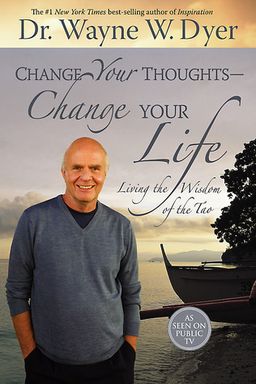
Change Your Thoughts - Change Your Life cover

Change Your Thoughts - Change Your Life

by Dr Wayne W Dyer

Change Your Thoughts - Change Your Life explores the profound teachings of the Tao Te Ching, offering practical ways to apply ancient wisdom for personal transformation. Dr. Wayne W. Dyer provides insights into living harmoniously by embracing paradoxes, reducing desires, and embodying flexibility and strength.

Living the Tao: Returning to the Source Within

How can you live in harmony with life’s invisible order rather than struggle against it? In Change Your Thoughts, Change Your Life, Wayne Dyer builds his reflections on Lao‑tzu’s Tao Te Ching to answer that question. He argues that human peace and effectiveness arise from aligning with the Tao—the nameless Source behind all forms—and releasing the ego’s compulsive need to control, accumulate, and define. This book is both a commentary and a practical manual: it shows you how to practice non‑forcing, humility, forgiveness, and presence so that your daily actions mirror nature’s effortless intelligence.

Dyer’s approach centers on paradox: you are simultaneously an embodied person and a manifestation of the infinite Source. If you cling only to form, you miss the mystery; if you chase the mystery without engaging form, you become detached. Tao practice lies in inhabiting both perspectives gracefully. Across the seventy‑eight verses he distills Lao‑tzu’s wisdom into modern life lessons—quiet power, serving without ego, returning to nonbeing, and reducing the clutter of desire.

The Nameless Source and Paradox

Everything issues from an unnameable Source that resists mental capture. Dyer revisits the opening lines: “The Tao that can be told is not the eternal Tao.” This paradox invites you to stop labeling existence and instead trust the invisible intelligence behind appearances. He makes the distinction embodied: desire prepares the soil, while desirelessness allows growth. You prepare and then let go—effort and surrender form a continuum, not opposites.

From Duality to Paradoxical Unity

Lao‑tzu’s second verse declares that opposites exist only in relation. Beauty needs ugliness, good implies evil. Dyer translates this into daily practice: see others and yourself as unfolding wholes instead of moral categories. Western thought trains you to divide, but Taoist unity invites you to hold opposites until they fuse. In doing so, judgment loses its grip, and you live with greater compassion. As he puts it, “Be an otter just living your otterness.”

Wu‑Wei and Effortless Action

The Tao “does nothing yet leaves nothing undone.” Dyer calls this wû‑wei, or effortless action—performing without egoic force. You act when action appears naturally right, not under inner compulsion. Water becomes his master metaphor: it nourishes all things by flowing quietly to low places. This teaches you to act from stillness, align rather than push, and discover that fewer gestures accomplish more when they are Source‑guided.

Choosing Softness Over Struggle

The soft overcomes the hard. Dyer’s hot‑yoga, surfing, and golfing examples show that relaxed, fluid movement yields best results. He calls this the 'watercourse way': live softly, respond flexibly, and let tension dissolve. Societal admiration of force—control, speed, aggression—often produces resistance; but when you act with softness, people and circumstances yield naturally. Lao‑tzu’s ancient insight becomes a modern performance principle.

Emptiness and the Useful Void

The hub’s hole makes the wheel useful; the jar’s emptiness allows containment. Dyer teaches that absence is not lack—it’s potential space. By embracing silence, by creating internal emptiness, you allow creativity and perception to arise. Meditation and mindful pauses train you to perceive this void: in listening, in art, in work. The most productive people, he says, are those comfortable with quiet between actions.

Yielding, Returning, and Nonbeing

“Returning is the motion of the Tao.” Dyer interprets this as a call to yield ego and rediscover origin. He draws comparisons from particle physics and Christian mysticism—being arises from nonbeing, power from surrender. You practice yielding through concrete acts: place a yield sign to remind yourself to cede, switch from talking to listening, or ask, “Am I returning to my Source?” In yielding repeatedly, life reorganizes around inner stillness.

Serving Without Ego and Leading by Following

The Tao gives without preference; the sage leads invisibly. Dyer’s interpretation of verses 5, 7, and 17 becomes ethical counsel: give freely, treat all beings without hierarchy, and govern by trust. The best leaders are like the sea—low, receptive, drawing all rivers. He offers applications for families and organizations: lighten restrictions, lead by example, and let others feel “We did it ourselves.” True power emerges in humility.

Nonviolence and Forgiveness

“There is no greater misfortune than feeling ‘I have an enemy.’” Dyer transforms that into an everyday ethic. Compassion replaces retaliation. His story of the Amish forgiving a murderer and his own response to killing a bee remind you: aggression fractures harmony. By practicing forgiveness and choosing kindness, you become invulnerable in Taoic terms—no one’s hostility can find a target in you.

Living Small and Returning to Enough

Verses on contentment and decreasing form the Taoist antidote to endless acquisition. Dyer teaches “stop the chase.” Reduction—giving away objects, acting in small steps, anticipating instead of reacting—restores balance. You learn that “He who knows when to stop is preserved from peril.” Act before chaos, simplify tasks, and notice how spaciousness appears. The paradox of the Tao: decreasing becomes true increase.

Through this tapestry of paradoxes—effort in non‑effort, power in softness, emptiness as utility, giving as gain—Wayne Dyer shows that living the Tao is an embodied art. You cooperate with the rhythms of nature, yield to the Source that birthed you, and discover that peace is not a distant goal but the quiet center always available beneath your striving.


Paradox and Non‑Dual Perception

Dyer begins with the tension between naming and the nameless, form and Source, good and bad. These opposites are not enemies but mirrors. Verse 1 invites you to see the world as two layers—visible form and invisible origin—while Verse 2 teaches that dualities co‑define. The Tao is the inclusive field in which contradictions coexist.

Living the Paradox

You practice by allowing paradox instead of resolving it. When you feel irritation, notice both your desire and the deeper stillness behind it. Dyer’s practical “Do the Tao Now” exercises train you to name the feeling, breathe through sensation, and observe without reaction. That simple pause unifies desiring and desireless awareness.

Unity of Opposites

You learn to hold beauty and ugliness, success and failure, praise and blame together. The Tao’s balance discourages judgment; instead, you choose wholeness. As with nature’s cycles—trees shedding leaves, seas ebbing and flowing—contrast sustains creation. In accepting duality, you enter non‑duality: you realize there is nothing outside the Tao to oppose you.

(Note: Dyer often compares this paradoxical unity to mystic traditions: Hafiz’s poetry and the Psalmist’s “Be still and know.” The resonance shows how universal Lao‑tzu’s wisdom remains.)


Wu‑Wei and Effortless Flow

Wu‑wei, or non‑forcing action, is Lao‑tzu’s solution to exhaustion. Dyer clarifies that 'not doing' is aligned doing. When you act from ego, you create friction; when you wait for natural timing, everything settles into its perfect place. He likens wu‑wei to surfing—catching the wave at the right moment rather than fighting the ocean.

How It Looks in Practice

You approach tasks by pausing, listening inwardly, and moving from calm guidance rather than urgent craving. He describes his Maui writing routine—reading a verse, meditating, then letting words flow in automatic writing—as an example of action born from stillness. Productivity increases because resistance vanishes.

Active Non‑action

Non‑action isn’t passivity; it’s discrimination between ego‑driven hustle and Tao‑aligned responsiveness. You still act—shop, create, converse—but you do so when the Tao moves through you. This quality of presence reduces waste and deepens cooperation. (Note: Dyer contrasts Western busy‑ness with Taoist sufficiency—achieving more by doing less.)

When you synchronize with the flow, fear and control drop away, leaving clarity. Wu‑wei teaches that your ambition fulfills itself when detached from personal strain.


Soft Power and Water Wisdom

Water is the Tao’s living analogy. It nourishes without striving, takes the low places, adapts to all conditions, and erodes stone through persistence. Dyer turns this into a philosophy of flexibility and humility—success lies in bending, not resisting.

Becoming Like Water

Practically, this means being gentle during conflict, practicing mindful gratitude as you drink water, and allowing emotions to flow rather than harden. The palm tree bending in hurricanes symbolizes resilience through flexibility. Strength appears in softness: the rigid tree breaks; the pliant survives.

Softness Overcoming Hardness

Verse 43 confirms this paradox. Dyer compares relaxed masters—athletes, dancers—whose skill looks effortless because they stopped forcing. Power arises from relaxation. He recommends silent days or gentle persistence to feel the watercourse within. (Note: Alan Watts’s commentary on 'the watercourse way' parallels Dyer’s insight: flow replaces resistance as personal strength.)

Living water‑like transforms relationships and work: you communicate calmly, welcome low positions, and nourish quietly. This soft power becomes the Tao’s signature in action.


The Fertile Void and Creative Silence

Verse 11 teaches that usefulness depends on emptiness—the space within the wheel or the jar. Dyer interprets this as a spiritual and creative law: the unseen open space is the vital center. When you cultivate inner emptiness, ideas, empathy, and renewal arise spontaneously.

Understanding Emptiness

Emptiness is not void of value but full of potential. Like silence between notes creating melody, the gap empowers all form. Dyer recommends subtractive meditation—fifteen minutes a day ignoring roles or labels—to feel the fertile void. As you sit, you notice that usefulness depends on what isn’t.

Social and Creative Application

In conversation, leave spaces; in work, stop filling every silence. His writing emerged from such stillness—automatic words flowing after quiet contemplation. Emptiness is the Tao’s womb of creation, not nihilism. When you begin to honor the unmanifest, you restore balance and invite insight, innovation, and empathy into your life.

This practical emptiness reframes productivity: less filling equals more function. Your value grows not through accumulation but through spacious awareness.


Impartial Service and Humble Leadership

Heaven and Earth are impartial; they give without preference. Dyer translates this into modern ethics of service. The enlightened person sees the same divine pattern in all beings and therefore acts without hierarchy—no specialness, no superiority. Service becomes your natural expression of Tao.

Serving Without Ego

When you ask “How may I serve?” instead of “What can I gain?”, fulfillment arises effortlessly. Verse 7 teaches that the sage acts for others and therefore succeeds himself. Dyer mirrors this insight with leadership models drawn from families and organizations: trust people, give space, and watch autonomy bloom.

Leading by Following

The sea gains power by being low. Dyer invites you to embody this metaphor—lower your stance, listen deeply, and let others find their authority. Moderating rules, reducing interference, and showing by example foster harmony. Leading becomes following the Tao’s rhythm rather than commanding outcomes.

Serving is both the Tao’s morality and its efficiency: impartial giving regenerates cycles. The paradox is clear—you ascend by lowering yourself.


Nonviolence and No‑Enemy Living

Lao‑tzu warns: “The violent do not die a natural death.” Dyer expands this into the core moral lesson of Tao practice—nonviolence in thought, word, and deed. Enmity blocks flow; forgiveness restores it. You cannot align with the Tao while opposing reality.

Transforming Reaction

When anger arises, respond with kindness. His exercise: carry this experiment for one day and note peace levels. He echoes the Amish school tragedy, where victims’ families forgave the killer—living proof of “no enemies.” Even small acts—gentle words, avoiding violent entertainment—weaken hostility’s grip.

Practical Forgiveness

Visualize a shield that repels harm but lets love pass through; choose restraint over revenge. Dyer’s anecdote of crushing a bee and losing his game dramatizes energy imbalance after violence. When you stop making enemies, you become impervious—the world’s aggression finds no purchase on peaceful ground.

Nonviolence here is active spiritual hygiene: mercy as energetic armor. Practicing this daily raises not moral status but inner coherence with the Tao’s compassion.


Contentment and Practicing Enough

Decreasing is the Tao’s path to abundance. Dyer’s verses on enoughness and simplicity (44, 46, 48) invert modern logic: gain less to live more. Possessions demand maintenance; letting go restores liberty. This portion teaches the art of stopping—the wisdom to recognize sufficiency before excess becomes peril.

How to Practice Decreasing

Start small: give away five items, leave the store early, stop eating when comfortable. These micro‑renunciations retrain appetite and cultivate ease. Dyer’s personal story of his son’s spontaneous gift—a T‑shirt—illustrates joyful detachment and connectedness through giving.

Inner and Outer Freedom

By reducing, you free time, attention, and creativity. Verse 48 says, “He who practices the Tao decreases day by day.” Each act of subtraction moves you closer to unburdened living. Contentment reveals wealth already present. (Note: Emerson and Kabir echoed this law—happiness arises from sufficiency, not accumulation.)

Enoughness is not scarcity; it is elegant sufficiency. When you honor the stop, the Tao preserves you from peril and restores spacious joy.


Seeing the Hidden Virtue

Lao‑tzu calls the Tao “hidden and nameless,” and what it births “the Mother of the world.” Dyer interprets this maternal image as the core of spiritual ethics—creation without possession. Hidden virtue (Te) is the quiet nourishment behind visible strength.

Cultivating Hidden Virtue

You trust invisible goodness within yourself and others instead of superficial merit or status. Observe life’s small miracles—a spider weaving its web, a child at play—to remember that real power hides in vulnerability. Ram Dass after his stroke, Walt Whitman’s openness, and Helen Keller’s insights all model this invisible strength through limitation.

Return to the Mother

Dyer’s exercises—guarding speech, retreating into silence, fostering rather than owning—invoke the maternal Tao that gives life yet lets go. Seeing the Mother restores reverence for ordinary acts and cultivates protective compassion. Hidden virtue silently sustains all creation without acclaim.

Living from hidden virtue unites strength with tenderness. You become a transmitter of the Tao’s nourishing light simply by allowing life’s quieter power to work through you.


Act Small and Anticipate with Presence

The Tao’s practicality emerges in verses 47, 63, and 64: know the world without leaving your room; prevent disorder before it starts. Dyer translates this into a mindful productivity ethic—be present, act small, and foresee rather than react.

Small Steps and Daily Practice

He recounts his own creative discipline: writing one verse each morning. Incremental actions accumulate effortlessly. When you live one moment at a time—exercise briefly, speak kindly, handle tasks calmly—you mirror your heart’s steady rhythm, which works continuously without strain.

Anticipation over Reaction

“Act before things exist; manage them before there is disorder.” That is Lao‑tzu’s formula for wisdom. Dyer advises simple foresight rituals—pause before transactions, discuss problems while small, adjust lifestyle for prevention. Presence prevents crisis. (Note: this anticipatory wisdom links with Stoic prudence and mindfulness psychology.)

You discover that mastery comes from small constancies. Acting early, gently, and consciously replaces struggle with grace. The Tao finishes what you begin when you stay quietly attentive.

Dig Deeper

Get personalized prompts to apply these lessons to your life and deepen your understanding.

Go Deeper

Get the Full Experience

Download Insight Books for AI-powered reflections, quizzes, and more.