
Idea 1
Change Proof: Turning Uncertainty into Resilience
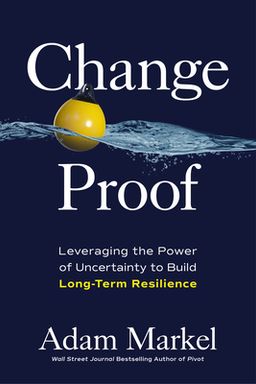
How do you thrive when the world keeps changing faster than you can catch your breath? That unsettling question lies at the heart of Adam Markel’s Change Proof: Leveraging the Power of Uncertainty to Build Long-Term Resilience. Markel argues that uncertainty is no longer a passing condition—it's a permanent feature of modern life. Every new day, from volatile markets to shifting personal priorities, demands a capacity not only to withstand change but to use it as fuel for growth.
Markel contends that resilience isn’t about simply “bouncing back.” True resilience is about bouncing forward; it’s the practice of turning stress, upheaval, or even loss into greater capacity, wisdom, and future strength. The book draws heavily from Markel’s personal experiences—as an attorney on the brink of burnout, an ocean lifeguard learning life-or-death discipline, and a CEO navigating professional reinvention—to reveal how embracing change requires a radical rethinking of what it means to be prepared.
The Core Argument: Change is Constant, Resistance is Fatal
At its core, Markel’s thesis dismantles the myth that change is something you either endure or avoid. He believes that in today’s world, change has become chronic. The old model of occasional career pivots or major life shifts no longer holds; instead, micro-pivots—minute, daily adjustments—are now part of the fabric of existence. Like swimmers caught in a rip current, those who panic, fight, and exhaust themselves succumb; those who learn to pause, float, and adjust survive and thrive. The key, he explains, is learning to make friends with change rather than treating it as an enemy.
The metaphor of the rip current—“the Suck”—threads throughout the book, illustrating how people mistakenly burn energy fighting against inevitable forces instead of redirecting their focus. For Markel, the way out of chaos isn’t to swim harder; it’s to get strategic. You need to Pause, Ask, Choose: stop resisting long enough to orient yourself, ask for meaning and opportunity in the moment, and then make choices that reflect adaptability instead of desperation.
A Lifeguard’s Lens on Leadership
Markel learned these lessons young on the beaches of Long Island, where his mentor, Captain Bob, taught him the power of composure and teamwork after a fatal rescue attempt. The lesson was simple: no one goes down on our watch. That mantra became not just a code for lifeguarding but a guiding ethos for resilience itself. To Markel, resilience is about community as much as character—having each other's backs multiplies strength. In organizations, he shows how this lifeguard philosophy applies: leaders must build “got your back” cultures that enable recovery, reflection, and trust, rather than fear-driven performance.
(Comparable insight: Brené Brown’s discussions of vulnerability and psychological safety in teams align with Markel’s idea that collective resilience begins with emotional transparency and trusted recovery routines.)
The Resilience Framework: Harmony Over Balance
Markel introduces the concept of harmony—not balance—as the real goal of well-being. Balance, he says, is static and unattainable; harmony is dynamic, like the shifting tides or a symphony’s rhythm. Resilience plays through four dimensions—the physical, mental, emotional, and spiritual “rooms” of life. Each needs regular “airing,” much like Rumer Godden’s metaphor that a person is a house with four rooms. When you constantly move through each room—exercise, mindset, emotions, and purpose—you maintain adaptive harmony. Neglect any room, and your inner structure falters under pressure.
Throughout the book, you learn how to deposit energy into what Markel calls the Resilience Bank Account. Just like a financial account, resilience grows with consistent deposits of rest, recovery, gratitude, and healthy routines—and drains away when you withdraw incessantly through stress, overwork, and fear. Making conscious deposits, from simple pauses during the day to mindfulness practices and emotional transparency, ensures you have reserves for life’s toughest moments.
Why It Matters Now
The arrival of COVID-19 magnified Markel’s argument: 2020 was a “global rip current.” Everyone, regardless of status, was pulled into uncertainty and required resilience at scale. He uses stories—from grieving parents to business leaders navigating existential crises—to illustrate how meaning-making transforms adversity into endurance. The most resilient individuals, he found, don’t only survive storms—they learn how to sail better because of them.
Ultimately, being “change proof” isn’t a state of invincibility; it’s a practice of continuous recalibration. Markel’s system invites you to see uncertainty not as something to fear but as the creative medium of growth. It’s mindfulness applied strategically to life: rather than sweating out the chaos, you leverage it. It’s a manual for anyone who’s ever felt caught in the undertow of change—and wants to learn to ride it instead of drown in it.