
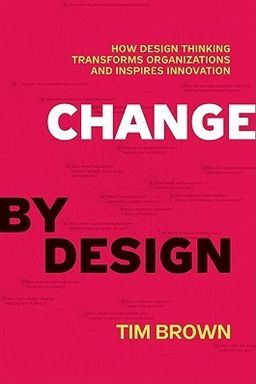
Change by Design cover

Change by Design

by Tim Brown

Change by Design by Tim Brown offers a comprehensive guide to harnessing design thinking for impactful innovation. This book provides actionable insights into integrating creativity with practical solutions, enabling organizations to develop transformative products and services that truly meet user needs.

Design Thinking as a Way to Change the World

Have you ever wondered why so many products, services, and systems—despite all our technology—don’t actually make life easier, more inspiring, or more sustainable? Tim Brown’s Change by Design argues that the solution lies not in more technology but in a new way of thinking: design thinking. Rather than limiting design to making things attractive, Brown expands it into a holistic approach to solving problems, uniting creativity and logic, empathy and analysis. His claim is simple but radical: everyone can and should think like a designer—and doing so could help us address everything from business stagnation to global challenges like sustainability and poverty.

In a world that often separates creativity from practicality, Brown contends that design thinking bridges the gap. It combines the designer’s empathy for users, the engineer’s technical skill, and the business leader’s understanding of viability. This triad—desirability, feasibility, and viability—guides design thinking toward real-world impact. It’s not just about products, but about systems, services, and human experiences. The result is a method that embraces constraints, welcomes iteration, and prizes curiosity as the fuel for innovation.

The Human Side of Innovation

At the heart of Brown’s philosophy is the conviction that design must begin with people. Observing how people actually live, improvise, and solve their own problems reveals hidden needs—what he calls latent needs—that data and focus groups often miss. This insight-driven process leads to breakthroughs like Shimano’s “coasting” bicycles, designed not for athletes but for adults who wanted to rediscover the childhood joy of cycling. Instead of cramming more gears and technology into bikes, Brown’s team simplified the experience. This human-centered approach reconnects creativity to meaning, moving innovation beyond profit toward purpose.

From Object to Experience

Design thinking extends beyond physical products to the design of experiences. Brown shows how United Airlines, Mayo Clinic, Four Seasons, and Marriott used design thinking to transform interactions into memorable experiences by focusing on emotional connection. Small details—like the moment a traveler exhales upon entering their hotel room—can become opportunities for innovation. Using empathy, storytelling, and prototyping, organizations learn to orchestrate experiences that feel personal and authentic, turning mundane transactions into moments of delight.

Design Thinking in Business and Society

But Brown doesn’t stop at business. He demonstrates how design thinking reshapes large, complex systems—from health care to education to climate sustainability. In Chapter Eight, he argues for a “new social contract” where companies and consumers co-create value, rather than acting as seller and buyer. This participatory world calls for leaders who listen, empower, and let go of control. The same approach applies globally: design thinking can address poverty, disease, and education by engaging local communities, as seen in the Aravind Eye Hospital in India or the IDE irrigation innovations.

Why It Matters Now

We live in an era of abundance and anxiety: too many choices, too much complexity. Design thinking offers clarity. It teaches you to focus on human meaning, to embrace experimentation, and to turn empathy into action. It’s not an artistic luxury—it’s a practical necessity for any leader or citizen who wants to build a better world. As Brown writes, “Design is too important to be left to designers.” Whether you’re running a corporation or raising a family, you can practice design thinking by observing deeply, prototyping quickly, and learning relentlessly. The rest of this summary unpacks those habits and shows how they can transform the way you work and live.


Putting People First: The Core of Innovation

Tim Brown insists that the secret to real innovation is human empathy. In a world obsessed with data, revenue targets, and algorithms, design thinking brings us back to the human essence. Brown argues that innovation begins when you put people first—when you learn to observe, empathize, and design from the point of view of real human experience. This is the foundation of human-centered design.

Insight: Seeing Beyond the Obvious

Design thinkers search for insights—deep revelations about what people actually need, often hidden beneath the surface of their routines. Brown describes a travel agent who avoided her office phone system by arranging multiple receivers on her desk, each for a different caller. This “thoughtless act” revealed a pain point that traditional surveys would miss. Real innovation, he explains, comes not from focus groups but from noticing the inventive ways people adapt to their obstacles. Like Henry Ford’s famous quip—“If I’d asked people what they wanted, they’d have said ‘a faster horse’”—good design sees beyond stated desire toward latent needs.

Observation: Watching What People Don’t Say

The next step is observation. Design thinkers leave their offices and immerse themselves in their users’ worlds. Brown shares how IDEO’s team for the kitchen brand Zyliss studied both children and professional chefs—not the target market, but extreme users. Children revealed ergonomics issues that adults masked, and chefs exposed design shortcuts that saved time. The result was a line of kitchen tools that balanced usability with performance, proving that observation—not intuition—is the designer’s greatest asset.

Empathy: Understanding the Lives of Others

Empathy turns observation into insight. In one powerful example, IDEO designer Kristian Simsarian pretended to be a patient in an emergency room to truly feel what patients experience—fear, confusion, helplessness. This immersive empathy led to system changes that improved communication and reduced anxiety. It’s a reminder that innovation isn’t just about better performance—it’s about human dignity. Empathy sparks imagination by letting you feel what others feel, creating solutions with emotional as well as functional value.

“Empathy moves us beyond thinking of people as data points. It lets us design for their lives, not just their needs.” – Tim Brown

Through insight, observation, and empathy, Brown transforms research into connection. You begin to see that every design—from a toothbrush to a hospital—must be about humans creating for humans. That is what makes innovation meaningful and, ultimately, sustainable.


Prototyping and the Power of Play

One of the most distinctive elements of design thinking, according to Brown, is prototyping. It’s the principle of “thinking with your hands.” Instead of over-planning or analyzing an idea to death, design thinkers build, play, and test quickly. This is how ideas evolve from vague notions to tangible solutions. Brown argues that prototypes are not about perfection—they’re about learning.

Experimentation over Perfection

Brown recounts IDEO’s work with surgical instrument maker Gyrus ACMI. When a surgeon awkwardly described a pistol-grip tool he envisioned, an IDEO designer immediately grabbed a marker, film canister, and clothespin to mock it up. That rough prototype clarified more in minutes than meetings could in weeks. The lesson: quick, low-fidelity models create momentum, uncover assumptions, and invite everyone into the design process.

Just Enough Prototyping

Prototypes, Brown emphasizes, must be “just enough.” Too much polish discourages feedback; too little detail causes confusion. The goal is to learn, not to impress. IDEO’s rule—“fail early to succeed sooner”—turns prototyping into a habit of discovery rather than judgment. Whether you’re designing a gadget, a service experience, or a new business model, the faster you make ideas tangible, the faster they can improve.

Prototyping the Intangible

Not all prototypes are physical. Brown illustrates this through Marriott’s TownePlace Suites, where designers used foam-core walls and role-play to act out the guest experience. The point was to test feelings, not furniture. Similarly, virtual prototypes—like Starwood Hotels’ digital mock-up inside Second Life—help organizations test concepts before real-world launch. From Legos to 3D printing to mock “future rooms,” prototyping makes imagination concrete and teamwork dynamic.

Ultimately, Brown sees prototyping as a mindset for organizations, too—IDEO itself redesigned its structure as a living prototype. Every prototype teaches you something about your users, your team, or yourself. The power of play isn’t childish; it’s how we learn to think like innovators.


Designing Experiences, Not Just Products

According to Brown, modern consumers don’t just buy products—they seek experiences. Whether you’re boarding a plane or sipping coffee, you’re not only performing a function but also living through an emotion. Companies that understand this—like United’s Premium Service, Whole Foods, or the Mayo Clinic—compete by orchestrating emotional journeys, not just product performances.

From Function to Emotion

Brown aligns with Joseph Pine and James Gilmore’s idea of the “experience economy.” Once basic needs are met, people crave meaning. That’s why Whole Foods designs stores that invite participation: you can sample, learn, and feel part of a community. United’s redesigned flight experience didn’t just add legroom—it changed how boarding felt. The design made social connection easier, shifting flying from frustration to pleasure. Experiences, Brown writes, should engage your emotions as well as your senses.

Participation and Authenticity

The key to crafting meaningful experiences is participation. Disney built a world where visitors co-create the magic. The Mayo Clinic’s SPARC Innovation Program created a lab where doctors, designers, and patients test new clinical experiences together. Accomplishing this requires embedding design thinking into the organization’s DNA—so employees, not just designers, can act as co-creators. At Four Seasons, staff are trained to improvise rather than script their interactions, enhancing authenticity. These examples show how experience is a living system, not a marketing slogan.

Engineering Experiences with Precision

To design experiences systematically, Brown introduces the idea of the experience blueprint—the emotional equivalent of an engineering plan. Marriott used this tool to discover that “check-in” satisfaction depended less on the friendly clerk than on the unspoken “exhale moment” when guests first relax in their rooms. By refocusing on this moment, Marriott enhanced comfort and loyalty. Experience blueprints help identify where emotion meets interaction—transforming routines into rituals that build trust and joy.

Designing experiences reminds you that every interaction—whether digital, physical, or human—is an opportunity to delight. In your business or personal life, you can create better experiences by asking: how do they feel? Not what do they do, but how do they make someone’s day different?


Cultivating Innovation Through Creative Cultures

Brilliant ideas don’t emerge from sterile cubicles. They arise in environments that celebrate curiosity, experimentation, and optimism. Brown calls this a culture of innovation—a mindset companies must design intentionally. Whether you work at Google, Steelcase, or a small nonprofit, innovation flourishes where people feel safe to explore the unknown.

Balancing Divergent and Convergent Thinking

Innovation thrives on two cognitive dances: divergence and convergence. Divergent thinking multiplies options; convergent thinking refines them. Brown compares this rhythm to Linus Pauling’s dictum: “To have a good idea, you must first have lots of ideas.” This balance of exploration and focus characterizes design thinking at its core. Like creative ecosystems in nature, organizations need both chaos and structure to evolve new possibilities.

Experimentation and Psychological Safety

Brown cites Chuck House’s story at Hewlett-Packard—defying orders to pursue a risky project that later changed visual computing—as proof that experimentation requires tolerance for failure. IDEO’s “fail early to succeed sooner” motto captures this spirit. Experiments, when guided by an overarching purpose, transform failure into knowledge. John Mackey of Whole Foods, for instance, allows teams to experiment with local product displays and share what works across the organization.

Optimism as Corporate Strategy

Optimism, Brown insists, is the lifeblood of creativity. Apple’s comeback under Steve Jobs exemplified this: when Jobs compressed 15 product lines into four, he aligned employees around possibility instead of fear. Optimistic cultures encourage play, storytelling, and “serious fun.” They replace bureaucracy with curiosity, turning offices—from Pixar’s “beach huts” to IDEO’s prototype labs—into living studios for discovery.

You can nurture creativity in your team the same way: clear shared goals, safe spaces for failure, and mutual trust. In Brown’s terms, innovation is less about genius and more about gardening—planting many small ideas, letting some bloom, pruning others, and celebrating the growth together.


Design Thinking Meets the Corporation

How do large companies—often built on efficiency, not curiosity—embrace design thinking? Brown explores this in detail, showing how firms like Nokia, Procter & Gamble, and Steelcase reimagined their cultures by blending design, business, and empathy. The transformation requires leaders to promote design as a strategic mindset rather than a department.

From Product Thinking to System Thinking

Nokia’s pivot from hardware to service design exemplifies how design thinking scales. Facing declining phone sales, Nokia observed how users were forming communities around photo sharing and mobile apps. The result was Ovi, a digital platform that turned devices into portals for connection—a strategic reinvention rooted in user insight. Brown highlights this as design thinking’s power to reshape not just offerings, but business models.

Managing Innovation Portfolios

IDEO’s Diego Rodriguez and Ryan Jacoby created the “Ways to Grow” matrix, which classifies innovation into incremental (same users and products), evolutionary (new users or new products), and revolutionary (new users and new products). Successful firms, Brown explains, diversify across these quadrants to avoid stagnation. Toyota’s Prius (evolutionary) and Apple’s iPod (revolutionary) illustrate different zones of growth. The lesson: manage innovation like a portfolio, not a gamble.

Teaching Organizations to Fish

Brown’s story of Kaiser Permanente is inspiring. Instead of hiring IDEO permanently, Kaiser trained its own nurses and staff in design thinking to improve shift transitions. The results—shorter delays, higher morale, better patient care—proved that everyone, from doctors to clerks, could think like designers. Similarly, P&G’s “Innovation Gym” became a companywide incubator for experimentation. For Brown, these examples show the democratization of design thinking: give them the net, not the fish.

By transforming how organizations think about problems, design thinking converts creativity from a lucky spark into a replicable discipline. Any company willing to prototype its culture, listen to its people, and design “with” rather than “for” them can reinvent itself from the inside out.


Design Activism and the Global Good

In one of the book’s most inspirational sections, Brown demonstrates how design thinking can tackle humanity’s biggest challenges: poverty, disease, education, and sustainability. He calls this design activism—using the tools of creativity to fuel social innovation. These stories shift design from luxury to necessity, from style to survival.

Extreme Constraints Inspire Breakthroughs

Working under extreme limitations can unleash radical innovation. The Aravind Eye Hospital in India performs hundreds of thousands of surgeries annually by redesigning medical systems for efficiency and affordability. Using local production (through Aurolab) for $2 lenses rather than imported $200 ones, Aravind delivers world-class care sustainably. Brown sees this as the future of innovation: solving for constraint, not abundance.

Partnerships, Not Paternalism

Design activism rejects “charity” mindsets. Projects like IDE’s irrigation initiatives or Acumen Fund’s clean water programs succeed because they involve local users as co-designers. Whether redesigning microfinance in Uganda or drip irrigation systems in India, Brown shows that empathy and collaboration lead to scalable impact. The principle is mutual empowerment: designing with, not for.

A Global Network of Change

Organizations such as Architecture for Humanity, under Cameron Sinclair, demonstrate how design thinking can aggregate global creativity through open networks. Sinclair’s Open Architecture Network democratizes design challenges, connecting professionals to communities in crisis. Combined with tools like the UN’s Millennium Development Goals, such networks embody Brown’s belief that creativity scaled through collaboration can address humanity’s toughest systems.

These cases reveal design thinking not as corporate technique but as a social movement. You, too, can apply it by asking better questions: “How might we make healthcare accessible?” or “How might we reduce waste in daily life?” Every small experiment—like a compost initiative at work or a neighborhood education project—can ripple outward. In design terms, small prototypes make big change.


Designing Tomorrow—Designing a Life

Brown concludes with an inspiring challenge: apply design thinking to your own life. Whether you’re leading a corporation or shaping your personal journey, you can approach your choices as creative prototypes. Life, Brown argues, is the ultimate design project—an ongoing process of observation, iteration, and meaning-making.

Personal Design Thinking

Designing your life begins with the same principles as designing a product: empathy, experimentation, and storytelling. Brown urges you to ask “why” like a child—to challenge assumptions about what success means—and to “prototype” new routines or careers. Try small, safe-to-fail experiments before committing. The design thinker’s mindset turns uncertainty into adventure.

Building a Creative Habit

Brown advocates practices you can adopt today: observe the ordinary (“why are manhole covers round?”), draw your ideas (“don’t think—look”), and build on others’ insights. Each act reconnects you with your natural creativity—something adulthood often erases. Document your progress, keep a “prototype portfolio,” and celebrate learning, not just completion.

From Individual to Collective Change

Ultimately, when individuals live as design thinkers, society changes. Brown’s vision echoes thinkers like Buckminster Fuller and William Morris: creative citizens redefining what progress means. Design thinking fuses imagination with ethics—creating beauty, functionality, and empathy in all you do. Your home, your work, your choices—they’re all design spaces.

As Brown puts it, “Active participation in the process of creation is our right and our privilege.” When you design your life through curiosity and compassion, you’re not just solving problems—you’re shaping possibilities for others. Every sketch, prototype, or small idea expands the future.

Dig Deeper

Get personalized prompts to apply these lessons to your life and deepen your understanding.

Go Deeper

Get the Full Experience

Download Insight Books for AI-powered reflections, quizzes, and more.