
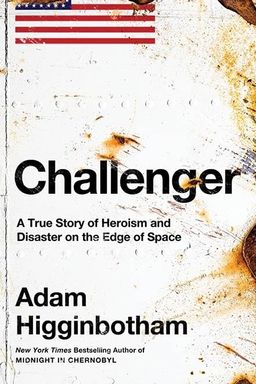
Challenger cover

Challenger

by Adam Higginbotham

The author of “Midnight of Chernobyl” chronicles the history of the space shuttle program with a focus on the 1986 disaster that killed all seven people on board.

Systems, Culture, and Catastrophe

How do complex organizations turn ambition into safe reality under political pressure and shifting requirements? In this book, the author argues that space disasters like Apollo 1 and Challenger are not random misfortunes but predictable products of interacting technical decisions, managerial incentives, and institutional culture. You see how design trade-offs, schedule pressure, and risk rhetoric intertwine until a tiny part — a hatch bolt, a gasket, an O-ring — becomes the fuse for catastrophe.

Two arcs anchor the story. First, you watch Apollo 1 expose NASA's early blind spots: a pure-oxygen cabin, flammable materials, poor wiring discipline, and an inward-opening hatch that trapped Gus Grissom, Ed White, and Roger Chaffee in a flash fire. The post-fire reforms were sweeping — mixed-gas testing, quick-release hatches, fire-hardened materials, and tougher oversight — and they helped put Apollo on surer footing. Second, you follow the Shuttle from an elegant spaceplane ideal to a compromised, multi-mission machine whose most controversial elements — solid-rocket boosters and a fragile tile skin — are chosen as much by budgets and Pentagon cross-range demands as by pure engineering logic.

From ideals to negotiated hardware

Maxime Faget's straight-wing orbiter (inspired by X-15 data) promised airline-like operations: reusable, simple, runway landings. But the Air Force's 1,000-mile cross-range requirement forced a heavy delta wing. Budget cuts slashed Tom Paine's more ambitious plan into a partly reusable stack: external tank plus two giant solid boosters. Those solids, cheaper to develop than liquid flyback boosters, came with non-throttleable, non-shutdown behavior and segmented joints sealed by elastomer rings — a brittle dependency you will see explode under cold.

Rituals of safety vs. the reality of risk

Flight Readiness Reviews (FRRs) are designed as the crucible of caution: anomalies debated, data weighed, signatures collected. Over time, they drift into ceremony. External analysts like J. H. Wiggins produce sobering failure probabilities for the solid rockets; managers massage the numbers toward comfort. The phrase acceptable risk starts appearing in charts about O-ring erosion. You see a shift from proving it is safe to fly to asking engineers to prove it is unsafe — a reversal with mortal consequences (compare to Diane Vaughan's concept of normalization of deviance in later scholarship).

People reshape the program — and feel its costs

The astronaut corps changes with the TFNGs — Sally Ride, Judy Resnik, Ron McNair, Ellison Onizuka, Guy Bluford, Fred Gregory — as mission specialists join pilots to operate a more complex vehicle. George Abbey curates assignments with a mix of mentorship and control, while Deke Slayton's old-guard instincts collide with affirmative action. Meanwhile, the Shuttle's image broadens through the Teacher in Space program: Christa McAuliffe becomes a national symbol, raising the political price of delay. The program promises quick turnarounds, cheap payloads, and routine access — a public narrative that quietly tightens the noose on engineering margins.

Tiny parts, gigantic consequences

You meet the Puzzle People who hand-fit 31,000 silica tiles because Columbia's aluminum frame cannot face reentry heat. Small chips or bad bonds can doom a vehicle. In the boosters, field joints flex at ignition, and O-rings must reseal in milliseconds. At low temperatures, rubber recovers too slowly; a brief gap becomes a blowtorch. The night before Challenger launches, Thiokol engineers, led by Roger Boisjoly and supported by Allan McDonald, warn of exactly this. A managerial caucus flips a unanimous no-go to a go after NASA's Larry Mulloy reframes the burden of proof. Cold air, ice on the pad, and frozen elastomer finish the setup; seventy-three seconds later, the stack breaks apart.

Thesis in one line

Catastrophes in high-risk systems emerge when engineering constraints, organizational incentives, and political narratives align against safety — and only structural reform, not heroism alone, can reset that alignment.

After the fireball: inquiry, evidence, reform

The ocean becomes the first lab: the Navy and Coast Guard recover computers, tapes, and, painfully, the crew cabin. Contact 131 — a burned segment from the right-hand booster — offers the smoking gun. The Rogers Commission turns closed interviews into public reckoning; Richard Feynman undermines magical statistics with ice-water and clarity: for a successful technology, reality must take precedence over public relations. Whistleblowers pay a human price; families grieve under the public gaze; settlements follow unevenly. NASA redesigns the booster joints, strengthens safety oversight, restores pressure suits, and returns to flight in 1988 — while the book warns that culture is the hardest part to fix (foreshadowing Columbia in 2003).

For you, the lessons are durable: design with politics in mind but protect engineering truth with independent checks; treat small anomalies as near-misses, not proof of robustness; and build rituals that surface dissent rather than smooth it away. The ghosts of Pad 34 and STS-51-L insist on nothing less.


Designing a Compromise Vehicle

The Space Shuttle is not a clean-sheet triumph of physics; it is a negotiated artifact shaped by the Air Force, Congress, and the White House. You begin with Maxime Faget's elegant spaceplane vision — a straight-wing orbiter validated by X-15 experience — and watch it morph under external demands into the delta-winged, partly reusable machine that flew. That mutation encodes risk: the choices made to satisfy stakeholders ripple into operations, maintenance, and safety decades later.

Faget's model vs. Pentagon cross-range

In April 1969, Faget shows a balsa model whose broad belly takes reentry heat before a runway landing. It is simple, light, and reusable. Then the Air Force requires a 1,000-mile cross-range to enable spy missions and one-orbit returns from polar flights. To meet it, NASA pivots to a heavy delta wing (closer to the canceled Dyna-Soar concept), increasing structural mass and thermal loads. The aerodynamic promise gives way to a vehicle that is harder to protect and land precisely across more flight profiles.

Budgets drive architecture

Tom Paine's $14 billion, two-vehicle, fully reusable stack — flyback booster plus orbiter — is slashed to about $5.5 billion. That gap kills the liquid flyback booster and births the external tank and twin solid rocket boosters (SRBs). Solids are cheaper and reusable after recovery, but once lit they cannot be throttled or shut down. Their segmentation introduces field joints that must seal perfectly as the steel casing flexes at ignition. In one stroke, cost savings concentrate risk in a handful of rubber rings.

Thermal protection as handcraft

You might expect the heat shield to be a factory part. Instead, Lockheed's silica tiles, each a unique shape, demand hand-fitting — some 31,000 tiles milled, densified, coated, and glued. When Columbia arrives at the Cape with thousands of dummy tiles still on, the Great Tile Caper begins. Kenny Kleinknecht enlists Larry Kuznetz's Pipeline to track progress, while thousands of Puzzle People tap-hammer bonds and rework edges (engineers call it 'gluing eggs to an anvil'). The manufacturing tail wags the program dog: schedule slips, cost overruns, and a fragile skin that can ruin a mission if a single tile loosens.

Crew escape and weight margins

Early ejection seats give way to deactivated systems as the orbiter grows heavier and the flight crew expands. Mass margins evaporate under cross-range and payload promises; robust escape options are trimmed. When risk migrates to ascent — the riskiest phase — the crew sits without meaningful escape from most failure modes. This is an ethical trade buried in a weight spreadsheet.

Multi-mission complexity and operations

The Shuttle becomes a jack-of-all-trades: satellite deployment, Spacelab science, DoD flights with classified profiles, and PR missions like Teacher in Space. To fulfill promises of low cost per pound, NASA pursues high flight rates — dozens per year — and turns Orbiter Processing into airline-like flow. Lockheed takes over ground ops; inspection steps shrink; technicians work twelve-hour shifts; cannibalization between orbiters covers spares shortfalls. Each move makes business sense — and erodes safety slack.

Compromise as a design force

What you fly is not what engineers first dream; it is what competing institutions can tolerate. Those tolerances set the boundaries of your future failures.

Why this matters beyond NASA

If you build systems in any regulated, political, or budget-limited domain, expect compromise to be your hidden co-designer. Translate stakeholder demands into explicit technical risks, and preserve safety features when margins thin. In the Shuttle, the cheap choice — segmented SRBs — created a single-point failure that demanded perfect behavior under extreme conditions. When winter came to Florida, that perfection failed.

(Note: You can read this as a companion to works like Henry Petroski's analyses of design failure or Langdon Winner on politics of artifacts; the Shuttle is their case study in orbit.)


When Rigor Becomes Ritual

Shuttle safety processes look exhaustive on paper — layers of reviews, signatures, and hazard analyses — yet the book shows how they can drift into ritual that validates pre-decided outcomes. You see this slippage in Flight Readiness Reviews (FRRs), in probabilistic risk numbers massaged toward optimism, and in euphemisms like allowable erosion that anesthetize alarm. Over months and years, that cultural drift — normalization of deviance — turns anomalies into background noise.

The FRR as political theater

An FRR convenes center directors, contractors, and subsystem leads to certify readiness. Managers must sign a Certification of Flight Readiness that is as much a political commitment as an engineering one. Under Administrator James Beggs and later Acting Administrator Bill Graham, the Shuttle program is expected to be America's routine highway to space. Reagan's backing of Teacher in Space and a crowded manifest raise the cost of 'no' votes. When independent analysts like J. H. Wiggins estimate scary SRB failure rates (e.g., once in tens of flights), internal committees push assumptions that dilute the numbers to once in ten-thousand. The ritual produces signatures; the system produces launches.

Normalization of deviance in practice

Thiokol engineers start finding soot and O-ring erosion in recovered boosters soon after first flights. Instead of treating each as a near-loss, teams label it self-limiting and acceptable. By 1984–85, the booster joint is recognized as Criticality 1 — a single-point failure — yet the language softens: 'acceptable risk' decorates charts. The history of damage, meant to warn, is reinterpreted as proof of tolerance. As Diane Vaughan later argues, deviance becomes the norm when organizations reward schedule compliance and reinterpret exceptions as the expected behavior of the system.

Leadership, incentives, and silence

The book names names. At Marshall, figures like Bill Lucas and Larry Mulloy expect launches unless engineers can deliver conclusive showstoppers. At Thiokol, managers like Jerry Mason and Bob Lund sit between engineers (Boisjoly, Ebeling, Thompson) and a customer that wants confidence. George Hardy questions the data's sufficiency. George Abbey, who shapes the astronaut office, also shapes the culture: excellence and loyalty are prized, dissent needs deft navigation. In that climate, Allan McDonald becomes a rare resistor: he refuses to sign the launch recommendation at the Cape. His integrity later becomes a fulcrum for the Rogers Commission — but in real time it cannot stop the countdown.

Media, PR, and the narrowing of options

Christa McAuliffe's selection magnifies public attention. The schedule includes tight turnarounds; Discovery and Challenger launch within seventeen days. Technicians work seven days a week; spares are cannibalized. The political optics of postponement worsen, especially for a teacher slated to broadcast lessons from space. Every delay chips prestige; every anomaly debate must now fight not just engineering habit but national expectation.

The subtle trap

When a review process must both guard safety and sustain a political promise, it tends to fulfill the promise. The guard falls asleep believing it is still awake.

What you can change in your world

Treat every anomaly as a near-miss that earns a pause, not a footnote. Make dissent an explicit track that requires upward escalation and astronaut-level notification for Criticality 1 concerns (General Kutyna's airline analogy drives the point). Demand unmassaged risk numbers with their assumptions listed. Rotate independent safety reviewers and give them veto authority insulated from program management. Above all, resist the seduction of ceremonies that feel like safety while serving schedule.

(Note: Feynman's Appendix F is your manifesto here; pair it with High Reliability Organization research to turn slogans into structure.)


The O‑Ring and Cold Reality

The O‑ring story is a masterclass in how a small component's physics can dominate a system's fate. Each solid rocket booster (SRB) is a stack of steel segments joined by a tang-and-clevis interface. Inside sits an elastomer O‑ring meant to be squeezed tight at assembly and blown harder into its groove at ignition. Under pressure spikes of hundreds of atmospheres within milliseconds, the ring must reseal as the steel tube flexes. At cold temperatures, that dance slows — and the seal fails just long enough for flame to escape.

Joint rotation and blow-by

Early Thiokol firings reveal a disquieting behavior: joint rotation. At ignition, the casing flexes, briefly gaping the interface so the primary ring loses contact; pressure then shoves the ring into the gap and usually reseals. Recovery inspections show soot past the primary ring and charring — evidence of blow-by — as early as 1981. On a recovered booster, a tiny blow-hole in the putty allows a focused jet to erode the ring. Procedures adjust — drier putty, cleaner assembly — but the underlying physics persists: milliseconds matter, and the ring is arriving late to the party.

Temperature dependence, the ignored cliff

Rubber's resiliency is temperature-dependent. Boisjoly's data show that at 100°F the O‑ring snaps back quickly; at 75°F it slows; near 50°F it barely recovers in the relevant time window. The testing regime never fully characterized this across pad conditions, and the FRR chain does not integrate the worst-case cold explicitly into launch criteria. The night of January 27, forecast lows dip below freezing; ice grows on the pad; the booster metal and grease are cold-soaked. Thiokol engineers set a recommended minimum at about 53°F at the joint — a line the morning's conditions do not meet.

Redundancy, but only in name

The joint carries a second O‑ring, a supposed backup. That would be comforting if both rings saw independent conditions. They do not. Joint rotation exposes both. A burnt primary and a delayed secondary under the same cold-driven slowness are not redundancy; they are serial vulnerability. As Feynman later dramatizes with his clamp-in-ice test, the elastomer's behavior is not a bureaucratic abstraction; it is tactile, slow, and indifferent to schedules.

Data, debate, and the seduction of survivorship

After flights with erosion but no loss, engineers and managers infer tolerances. The rings eroded before; the vehicle returned; therefore, the system can take it — a textbook survivorship fallacy. Mulloy emphasizes small sample sizes and cites vendor claims of low-temperature functionality. Allan McDonald and the engineers counter with field evidence: soot in joints at Hangar AF, worsening erosion patterns, and demonstrations of sluggish rebound at low temperature. The teleconference becomes a meta-argument about what counts as proof and who bears the burden.

Physics does not negotiate

You can argue about charts; you cannot argue rubber into moving faster at 30–40°F on millisecond deadlines.

Apply this logic where you work

Identify components with cliff-like performance curves (temperature, voltage, humidity). Test them at the edges you actually face, not the ones that feel comfortable. Demand independence in redundancy — diverse failure modes and environments — not duplicated vulnerability. Treat near-misses as accidents that just did not claim their full due, and reset your launch criteria accordingly. If a supplier's claim contradicts your field evidence, field evidence wins.

(Parenthetical note: This chapter echoes Charles Perrow's Normal Accidents — tight coupling and complex interactions create systems where milliseconds and millimeters dominate outcomes.)


The Night Before, The Morning Of

Challenger's last hours show how a single meeting and a cold dawn can decide a crew's fate. The January 27 teleconference is a crucible: Thiokol engineers in Utah present a unanimous no-launch call because booster joints will be too cold for O‑ring resilience. NASA Marshall managers challenge the basis, shift the burden of proof, and warn that changing temperature commit criteria will wreck schedules. A brief managerial caucus flips engineering dissent into a go. By sunrise, ice glitters on metal; at T+73 seconds, the stack disintegrates over the Atlantic.

Inside the teleconference

Roger Boisjoly, Arnold Thompson, and Brian Russell assemble data: erosion histories, cold-soak measurements, and the 53°F recommendation. Allan McDonald at the Cape backs them. Larry Mulloy and George Hardy press counterpoints: limited datasets, vendor assurances, and precedents of cold launches without incident. Crucially, they frame Thiokol's case as inconclusive: the absence of definitive proof of disaster becomes a perceived permission to fly. Thiokol executives Jerry Mason, Joe Kilminster, and Bob Lund retreat to caucus; when Mason asks Lund to 'take off his engineering hat and put on his management hat', the recommendation reverses. McDonald refuses to sign locally; Kilminster faxes the go from Utah.

A pad encased in winter

Overnight temperatures drop into the 20s. Water trickles left on for freeze protection create icicles on the fixed service structure. Ice coats catwalks and the sound suppression system; antifreeze congeals. The ice team warns of hazards to structures and possible foam shedding. Recovery ships turn back in heavy seas, imperiling booster recovery plans. Despite all this, the countdown resumes: politics, schedule compression, and the desire to prove routine cadence pull the decision forward.

Seventy-three seconds

At ignition, the right-hand booster’s aft field joint experiences blow-by past a stiffened primary ring; cold grease and metal temperatures slow the secondary. Black puffs appear on high-speed film. A temporary seal forms as exhaust particulates partially clog the gap — a brief reprieve. At about 58 seconds, under strong winds and dynamic pressure, the flame re-emerges as a focused plume near the aft strut. It impinges on the external tank, burning insulation, then penetrating the tank wall. Liquid hydrogen escapes and ignites; at ~72 seconds the external tank fails structurally. Aerodynamic loads tear the orbiter apart. The crew cabin separates largely intact.

The human minute

Evidence from Personal Egress Air Packs (PEAPs) later suggests someone activates air supply; breathing signatures last roughly the free-fall duration. Mike Smith's pack is found used, though his position makes it unlikely he activated it himself. The implication is haunting: at least some crew are alive after breakup, attempting what limited survival is possible. Seats are not ejection seats; there is no escape system. The ocean surface becomes the terminus of a two-minute attempt at life inside a shattered shell.

Decision mechanics matter

A rushed caucus, a reframed burden of proof, and the absence of escalation to astronauts turned a set of charts into a national obituary.

What you can operationalize

Codify that any Criticality 1 concern triggers an automatic hold and elevation to top leadership and crew, not a late-night debate under schedule duress. Require written, data-backed justifications to lift environmental constraints (e.g., temperature minima) — and make deviations auditable. Practice red-team teleconferences in peacetime to rehearse how to preserve engineering voice under pressure. Build abort capabilities and escape options into architectures even when they hurt mass; you buy breathing room when unknowns multiply.

(In aviation and nuclear operations, structured pre-mortems and authority-to-decline protocols formalize exactly what was missing that night.)


Investigation, Evidence, and the Long Shadow

After the plume fades, the ocean becomes a forensic lab and the hearing room a stage for accountability. The recovery, led by Navy and Coast Guard teams and orchestrated by figures like Captain C. A. 'Black Bart' Bartholomew, spans 420 square nautical miles, twenty-four ships, three submarines, and ten thousand personnel. Divers find the crew compartment and bring up the general-purpose computers and tape recorders; they also recover Contact 131 — a burned right-hand booster segment with a ragged hole near the aft field joint — the physical signature of the O‑ring failure.

What the sea gives back

Terry Bailey and Mike McAllister see white carbon fiber in murk; Lt. Cdr. John Devlin and flight surgeon Jim Bagian dive to confirm the cabin find in 87 feet of water. Personal items — patches, a jar of peanut butter, a school soccer ball — rehumanize the debris. The crew cabin's relative integrity deepens the hardest question: did anyone survive the breakup? PEAP evidence implies breathing during free fall. The recovery is not only technical closure; it is the beginning of family grief and national reckoning.

Rogers Commission: from closed doors to open truth

Chairman William P. Rogers, joined by Neil Armstrong, Sally Ride, and Richard Feynman, shifts from private interviews to public hearings when leaks reveal contradictions. Allan McDonald testifies that Thiokol initially recommended no-go and that NASA applied pressure; Jerry Mason's cross-examination falters under questions about overturning engineering consensus. Roger Boisjoly reads memos warning of 'loss of vehicle, mission, and crew.' Larry Mulloy struggles to justify why concerns never reached astronauts. General Kutyna's airline analogy crystallizes the ethical breach: if you'd argue with Boeing about a wing, wouldn't you tell the pilot?

Feynman makes physics visible

With a clamp and ice water, Feynman shows on television what charts could not: a cold O‑ring fails to spring back. He also skewers magical reliability numbers — the infamous one-in-100,000 estimate — by eliciting more realistic figures from working engineers (on the order of one-in-300) and juxtaposing them with managerial optimism. His Appendix F becomes the moral spine: 'For a successful technology, reality must take precedence over public relations.' The Commission's final report is unambiguous: the proximate cause is the failed O‑ring; the deeper cause is a flawed decision process and organizational culture.

Families, lawsuits, and memory

Behind the hearings, families navigate grief and glare. Jane Smith installs an answering machine to filter calls; June Scobee struggles to function. Some families sue NASA and Morton Thiokol; settlements vary and generate further pain. The Challenger Center and other memorials try to convert loss into learning. The human ledger — the private rituals, the Arlington ceremonies — reminds you that process failures are paid for in lives, not just reputations.

Reforms — and what persists

Redesigns follow: a new SRB joint, improved main engines, reinstated pressure suits, and more independent safety oversight. Personnel changes ripple: Jerry Mason retires early; Larry Mulloy is reassigned; McDonald and Boisjoly contribute to redesigns but endure ostracism. Discovery returns to flight on September 29, 1988. Yet the book warns — and history confirms with Columbia in 2003 — that structure without culture is fragile. Old incentives reassert; anomalies again tempt normalization. The long shadow is clear: vigilance must be continuous, and accountability must outlive headlines.

Enduring lesson

Evidence, transparency, and protected dissent are the only antidotes to organizational bravado in safety-critical work.

(Context: Compare the Rogers Commission to later the Columbia Accident Investigation Board; both converge on the same dual cause — technical failure riding on cultural failure.)

Dig Deeper

Get personalized prompts to apply these lessons to your life and deepen your understanding.

Go Deeper

Get the Full Experience

Download Insight Books for AI-powered reflections, quizzes, and more.