
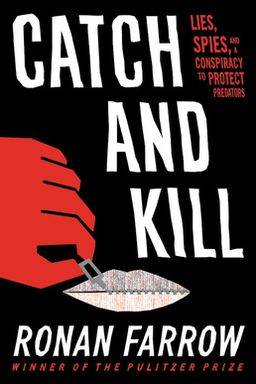
Catch and Kill cover

Catch and Kill

by Ronan Farrow

Catch and Kill is Ronan Farrow''s gripping account of exposing Harvey Weinstein''s predatory behavior and the powerful networks that protected him. This explosive investigation reveals the media''s complicity and the courage required to bring truth to light, sparking global conversations on sexual abuse.

Power, Silence, and the Struggle for Truth

How does truth survive when power organizes to suppress it? In this investigation, you see an anatomy of systemic silence — how a single case of abuse leads to corporate, legal, and intelligence countermeasures that reveal deep flaws in media accountability. The book follows Ronan Farrow as he pursues allegations against Harvey Weinstein, a producer whose influence reaches into film, politics, and television. As you track the reporting’s journey from NBC to The New Yorker, you uncover a larger story: how institutions protect reputation over justice and how journalists adapt when legal intimidation and corporate caution collide with public interest.

A web of influence and suppression

Weinstein’s case is not just about personal misconduct. It becomes a window into an ecosystem where executives, lawyers, tabloid editors, and private intelligence firms collaborate to neutralize threats. From settlements with nondisclosure agreements to surveillance orchestrated by firms like Black Cube, power operates through networks of money and silence. Every gate — legal, editorial, corporate — serves to convert exposure into delay. When the NBC legal department or executives like Andy Lack and Noah Oppenheim ordered a “pause,” the journalistic process froze. Cameras were canceled, sources withdrew, and evidence risked being buried indefinitely.

(Note: this mirrors the dynamic described in other media exposés like Ben Bagdikian’s The Media Monopoly, showing how ownership structures shape what can be published.)

The machinery of intimidation

Weinstein’s defense strategy was industrial-scale. Lawyers such as Charles Harder and David Boies issued demand letters claiming ownership of interviews to pressure NBC. Private investigators followed reporters, photographed sources, and compiled dossiers listing vulnerabilities. Tabloid connections with the National Enquirer and American Media Inc. added another shield, burying unfavorable stories — a practice known as “catch-and-kill.” These alliances transformed the media from watchdogs into transactional partners, trading silence for access. You watch how a single billionaire can manipulate legal, commercial, and editorial conduits to sustain impunity over decades.

Journalism under corporate hesitation

Inside NBC, Farrow’s team faces a system designed to minimize risk. Producers Rich McHugh and standards head Rich Greenberg push the story forward, but executives above them calculate exposure. Legal counsel Susan Weiner consults with NBCUniversal’s top lawyers, discussing tortious interference and indemnity. You see how a routine investigative process morphs into an internal dispute about liability. When the corporate hierarchy prioritizes caution over verification, reporting stops — not because facts are weak, but because risk feels unacceptable. This is what Farrow calls the editorial “pause,” a euphemism for control through bureaucracy.

The pivot to independence

Facing obstruction, Farrow builds redundancies. He backs up evidence in a safe-deposit box labeled “666,” prepares tapes and testimonies, and approaches The New Yorker’s editors. David Remnick’s “ocean liner” editorial philosophy — slow, methodical, legally fortified — becomes the antidote to corporate paralysis. The New Yorker’s fact-checking and external counsel provide refuge for risky truth. In that transition you see a key lesson: investigative reporting survives not through speed, but through institutional resilience and moral clarity. It’s a blueprint for how truth eventually breaks corporate containment.

Human and emotional dimension

Beyond tactics and institutions lies personal cost. Reporters face surveillance, threats, and emotional exhaustion. Sources like Rose McGowan and Ambra Gutierrez struggle with stigma and depression after settlements. Farrow’s calls to his partner, Jonathan, reveal tension and fear under sustained pressure. The book reminds you that journalism’s battles are fought not only with evidence but also with endurance and moral conviction.

The larger system of silence

Corporate media, intelligence contractors, and political donors form a feedback loop of privilege. NDAs, spiked stories, and political cover-ups show how secrecy becomes structural. From AMI’s buried stories for Trump to NBC’s denial of internal harassment cases, institutions behave consistently: protect leaders, silence accusers, redirect narrative. This continuity suggests that Weinstein’s story, while extreme, is a microcosm of how power replicates itself through information control.

Core takeaway

You discover that truth-telling in the modern media landscape demands parallel defenses — legal, emotional, and logistical — because power uses multi-channel suppression: corporate caution, legal intimidation, surveillance, and selective friendship with the press.

This first key idea brings you through the converging systems that shield abuse and the strategies journalists use to break them. It’s not a simple tale of one predator’s downfall; it’s a study in how courage and methodical preparation can overcome engineered silence.


The Architecture of Corporate Control

Inside major news institutions, you see how corporate hierarchies shape the fate of reporting. NBC’s legal and editorial chains reveal how decision-making flows upward through layers of caution. For journalists, this highlights an uncomfortable truth: accuracy alone doesn’t guarantee publication when business concerns and risk optics dominate the newsroom.

Inside NBC’s approval maze

Reporters like Ronan Farrow and Rich McHugh gather interviews, recordings, and corroboration. Their work passes through Rich Greenberg for standards review, then legal counsel Susan Weiner, and ultimately to executives such as Noah Oppenheim and Andy Lack. Above them sits Kim Harris, NBCUniversal’s general counsel, who links legal risk to corporate exposure. At each step, a new layer adds delay. When Oppenheim mandates a “pause,” sources lose faith; Rose McGowan withdraws from interviews amid fear of leaks; legal caution becomes a quiet veto disguised as process.

Editorial caution and economic calculus

Executives cite potential litigation by Harvey Weinstein’s attorneys Charles Harder and David Boies, referencing prior successes against Gawker. They also weigh relationships: Weinstein’s Hollywood ties, his role as Democratic fundraiser, and possible PR consequences. Audience risk and advertiser discomfort become rationales for inconclusive reviews. The corporation’s structural priority — risk management over truth — explains why investigative work often stalls within legacy outlets.

Consequences of institutional paralysis

The “pause” is a form of suppression that feels procedural but functions as censorship. Shoots are canceled, emails stall, and evidence sits unused. When Farrow stores materials in a safe to protect them, he’s responding to institutional fragility. You learn that in risk-averse organizations, survival depends on planning outside official channels.

Lesson

A pause in reporting is not neutrality — it’s a moment when hierarchy and fear decide what the public knows. Recognize these patterns to guard against internal censorship disguised as quality control.

You leave this section understanding how corporate systems create invisible censorship: not by rejecting facts, but by diverting responsibility upward until accountability disappears.


Weaponized Secrecy: NDAs and Settlements

Weinstein’s abuse thrived within a legal framework designed to conceal misconduct. You encounter the ubiquity of settlements and nondisclosure agreements — instruments that transform justice into silence. These contracts erase evidence and muzzle victims, revealing how law itself can be retooled to sustain predation.

The mechanics of NDAs

An NDA is presented as a confidentiality measure, but in practice it’s a straitjacket. Ambra Gutierrez’s one‑million‑dollar settlement required her to surrender recordings, passwords, and a pre‑signed denial statement. It made her legally complicit in erasing proof of assault. Other employees and assistants report similar agreements framed as severance packages — concealing harassment settlements under HR paperwork. The formality converts trauma into file entries, and companies build cultures of quiet protection.

Institutional complicity

Inside Weinstein’s company, HR acted as containment. Complaints vanished, payments flowed, and staff normalized misconduct. Assistants scheduled hotel “meetings” and cataloged targets under euphemisms. Irwin Reiter’s internal messages to Emily Nestor — admitting he had “fought him about mistreatment” — show reluctant insiders trapped within the system’s inertia. This bureaucratic normality makes serial abuse possible without alarms.

Silencing as a business model

Corporations, tabloids, and lawyers profit from secrecy. Paying for silence, trading it for favor, or packaging it as reputation management becomes standard currency. Weinstein’s settlements mirror AMI’s “catch-and-kill” transactions for political allies — both monetize suppression. You realize nondisclosure is not accidental; it’s strategic infrastructure for power.

Insight

When the law of confidentiality supersedes public accountability, justice becomes privatized. Transparency requires dismantling these instruments of silence, not merely exposing individual scandals.

This key idea shows how legal tools intended for discretion evolve into shields for systemic abuse — reminding you that reform in harassment reporting must include dismantling contractual secrecy.


Private Intelligence and Counter‑Journalism

When power feels threatened, it hires spies. Weinstein’s partnership with Black Cube exposes a thriving private-intelligence ecosystem where ex‑agents, operatives, and lawyers collaborate to counter reporting. Here, journalism meets espionage — each side collecting, surveilling, and securing data for opposing goals.

How private intelligence operates

Black Cube sells elite infiltration: ex‑Mossad officers, fake identities, social‑engineering “avatars,” and undercover agents like “Anna” (Stella Penn Pechanac). The July 2017 contract explicitly promises to stop negative articles and harvest unpublished material from a victim’s book. Subcontractors like InfoTactic carry out physical surveillance, tail reporters, and transmit GPS coordinates. Roman Khaykin and Igor Ostrovskiy follow Farrow across Manhattan; dossiers map relationships among journalists and sources. These operations blend intelligence tradecraft with corporate PR — the boundaries between politics, law, and spying dissolve.

The dossier as a weapon

Collected profiles analyze who knows whom, where pressure points lie, and how to discredit accusers. A “success fee” clause in Black Cube’s invoices ties payment to identifying the origins of negative campaigns — a monetized hunt for leaks. The psychological intent is clear: intimidate, distract, and derail reporting. Similar tactics later appear against journalists in other investigations of corporate misconduct, proving that espionage ethics now intersect journalism.

Ethical and legal fallout

When leaked documents (via Sleeper1973) expose Black Cube’s contracts, they reveal an industry hiding behind legal cover. In Romania, operatives are jailed for intimidation; in New York, the revelations lead to public condemnation. For journalists, this means new operational defenses: encrypted communication, offsite backups, and multiple publication partners. Surveillance becomes a known occupational hazard in investigative work.

Takeaway

In the age of private intelligence, reporting isn’t only about gathering truth — it’s about protecting it from counter‑operations. Awareness of security and tradecraft is now part of journalistic ethics.

This section transforms your understanding of investigative journalism: the battlefield now includes spies, lawyers, and covert contracts aimed at silencing stories before they surface.


Media Power and Political Alliances

Weinstein’s world reveals how media, politics, and business fuse into a system of reciprocal protection. The same mechanisms that silenced abuse also shaped political coverage. You see how tabloids trade confidentiality for influence, and how campaign donors and executives use relationships to steer narratives.

Tabloid economics of silence

American Media Inc. (AMI), led by David Pecker and Dylan Howard, maintains a vault of “kill files.” Stories bought for suppression—from Weinstein’s incidents to Donald Trump’s affairs—illustrate how media monetizes discretion. The Karen McDougal transaction and Dino Sajudin’s rumor purchase exemplify “catch‑and‑kill,” a practice later investigated as potential campaign‑finance misconduct. Media companies become political actors when their silence benefits candidates.

Hollywood and political cover networks

Weinstein’s fundraising for Democratic campaigns and his direct access to Bill and Hillary Clinton create complicity through proximity. Executives fear alienating a connected figure. Emails offering gifts—like Grey Goose bottles to NBC leadership—and deal proposals to Rolling Stone reflect the transactional culture around power. The pattern repeats across industries: influence disarms scrutiny.

Corporate denial and reputational defense

NBC later issues internal memos denying any suppression, despite documented settlements and NDAs. The mismatch between internal practice and public statements exposes reputational control mechanisms. Institutions defend themselves by rewriting history into legal language—“terminated project,” “no formal complaint”—turning ethical crises into press releases.

Systemic insight

Information power isn’t just owned—it’s traded. From tabloids to TV networks, cooperation with political elites provides mutual immunity. These alliances explain why exposure so often depends on external, independent media rather than legacy outlets.

The broader lesson is that suppression thrives where economic alliances meet editorial discretion. Breaking that cycle demands transparency reforms and cultural accountability beyond individual scandals.


The Human Cost of Exposure

Behind institutional mechanics lie the psychological and emotional costs for those who speak — and those who investigate. This part examines the personal risks borne by journalists and survivors facing surveillance, harassment, and public isolation.

Threats and surveillance

Farrow receives stalking messages and photos of pistols. Private investigators stationed near his apartment send live updates. These aren’t cinematic exaggerations—they’re everyday intimidation meant to waste energy and breed paranoia. For sources like McGowan and Gutierrez, digital harassment compounds trauma, reminding them that public exposure is inseparable from risk.

Emotional load and relational strain

The psychological toll runs deep: Farrow struggles with fatigue and strained relationship dynamics; survivors face depressive episodes and professional exile. The emotional texture humanizes investigative reporting—it’s not just strategic courage but persistent, painful endurance. The reminder is clear: truth-telling exacts private costs long after publication.

Protective and restorative tactics

To survive, reporters and sources adopt new forms of resilience: offsite archives, encrypted communication, coordinated security plans, and mental‑health support networks. These pragmatic disciplines redefine journalistic professionalism. Caring for emotional stability becomes part of investigative competence.

Essential message

Courage without protection burns out; endurance requires structure. In exposing systemic abuse, mental and operational safeguards are as critical as sourcing and documentation.

The personal toll contextualizes the cost of revealing systemic truth: the fight against suppression is fought both externally—in institutions—and internally, in every mind that refuses silence.

Dig Deeper

Get personalized prompts to apply these lessons to your life and deepen your understanding.

Go Deeper

Get the Full Experience

Download Insight Books for AI-powered reflections, quizzes, and more.