
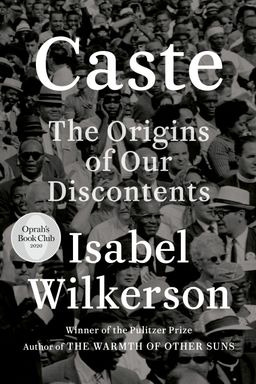
Caste cover

Caste

by Isabel Wilkerson

Caste uncovers the hidden caste system in American society, drawing parallels to those in India and Nazi Germany. Isabel Wilkerson explores the ingrained social hierarchies and offers insights into dismantling these barriers, empowering readers to foster a more equitable society.

Caste: The Hidden Architecture of Inequality

Why do hierarchies persist even when explicit laws of discrimination fall? Isabel Wilkerson’s Caste: The Origins of Our Discontents argues that America’s deepest divisions are not random or purely racial—they are manifestations of caste, a hidden infrastructure of human ranking that organizes lives, choices, and destinies. Wilkerson asks you to imagine living in an old house: beneath fresh paint and decor, studs and beams silently hold its shape. Caste works the same way—it’s the structural skeleton of society, defining who stands where and who must yield.

Caste versus Race

You are used to speaking of race, but Wilkerson distinguishes race as the skin of the system, while caste is its bones. Race is the visible coding—color, hair, name, accent. Caste is the invisible code—the expectations, rules, and psychological conditioning that give those differences meaning. When she writes that “caste is the bones, race the skin,” she means that you can repaint a wall, but the crooked frame beneath determines the angle forever unless restructured. Caste prearranges human value in ways that outlive any one generation’s prejudice.

Historical Construction of Caste

In America, this system began with a single colonial notation: “20 and odd Negroes” arriving in 1619. Over decades, those people’s descendants were legally coded into property and into the bottom rung of a new social hierarchy. By the Virginia statute of 1662, children inherited their mother’s status, ensuring perpetual inheritance of bondage. These early decisions crystallized a caste that would come to define who was “white” and who was “other.” Successive European immigrants assimilated into the dominant caste by accepting distance from those placed lowest (compare: Irish immigrants achieving “whiteness” through separation from enslaved or freed Africans).

Wilkerson shows that this logic extended globally. Nazi Germany studied U.S. race laws while crafting the Nuremberg Laws, finding moral and procedural justification in America’s segregation and anti-miscegenation statutes. That mirroring demonstrates her core claim: caste is an operating system adaptable across time and geography, from India’s jatis to America’s racial codes to Nazi hierarchies of Aryan purity.

The Eight Pillars

To explain caste’s mechanics, Wilkerson identifies eight pillars: divine will and natural law (belief that hierarchy is sacred), heritability (status by birth), endogamy (control of marriage), purity/pollution distinctions, occupational hierarchy, dehumanization, terror as enforcement, and belief in inherent superiority. Each pillar props up the illusion of permanence and moral legitimacy. Together, they form a transnational grammar of subjugation that societies repeat even when the names change.

The Lived Experience of Caste

Caste reveals itself in both era-defining and ordinary moments: a lynching postcard passed around as family souvenir; a black scholar in 1930s Mississippi forced to act subordinate to his white research assistant; a modern reporter mistaken for an impostor in an upscale shop. These scenes make visible the operating code beneath daily civility—the same code that silently guides who feels entitled to question, to command, or to belong. Even well-meaning people can uphold caste because it functions subconsciously, teaching everyone “their place.”

Moral Vision and Possibility

Wilkerson’s aim is not despair but diagnosis. Just as you cannot fix a sagging roof without examining the foundation, you cannot end inequality without exposing the caste frame beneath it. The book invites you to evolve from polite awareness into moral clarity. She draws moral courage from figures like August Landmesser, who refused the Nazi salute, and Martin Luther King Jr., who realized after visiting India that he too was considered an untouchable. Their insight: caste is global, but so is the potential for moral rebellion.

Core understanding

Wilkerson asks you not merely to condemn overt racism but to decode the system that scripts our reactions, ideals, and fears. Seeing caste clearly is the first act of repair—the act that allows you to rebuild the house before it collapses on everyone beneath the same roof.

In the chapters that follow, you explore how caste gets built, enforced, lived, and challenged—from its colonial origins and eight structural pillars through scapegoating, internal policing, backlash, and the path toward radical empathy. Wilkerson’s purpose is both analytical and moral: to make you see your society in X‑ray and to imagine the disciplined empathy required to rebuild it on a just foundation.


Building the Hierarchy

Behind America’s notion of race lies a deliberate construction of caste. Wilkerson traces how colonial elites engineered hierarchy by law and theology. The 1662 Virginia statute that bound a child to the mother’s condition did more than regulate labor—it turned the womb into a factory for supplying the lowest caste. This policy eliminated ambiguity: status and servitude would perpetuate infinitely through birthlines. Centuries later, this same idea undergirded American slavery, Jim Crow segregation, and even immigration law.

The politics of whiteness

Becoming “white” offered protection. Immigrant groups once scorned—Irish, Italians, Jews, Poles—earned provisional inclusion in the dominant caste by disavowing the subordinated. Wilkerson illustrates this with events like the New York Draft Riots of 1863, when Irish laborers, newly drafted, redirected rage into violence against Black neighbors. Whiteness, thus, was a political reward for allegiance to the caste order, not a biological fact but a constantly renegotiated membership card in dominance.

The invention of divine hierarchy

Religious stories fortified this structure. Biblical interpretations like the “curse of Ham” provided theological justification for slavery, echoing Indian myths that Brahmins came from a god’s head while others emerged from feet. By embedding rank in divine design, the system disguised coercion as order. Freedom then appeared rebellion not against people but against God.

The global model

Wilkerson records the haunting discovery that Nazi legal architects studied American segregation laws when formulating racial statutes. In 1934, Reich lawyers debated adopting U.S. definitions for racial purity. While they judged some American restrictions too extreme, they admired the legal creativity that maintained a subordinate racial class while claiming democracy. That paradox—freedom perched atop exclusion—became a tragic American export.

Insight

Caste systems do not emerge accidentally; they are built and maintained through centuries of law, myth, and economic need. Recognizing that design is the first step in redesign.

When you read these origins, you begin to see America not as merely flawed in execution but structured in hierarchy from inception. The social script was laid before independence, and every succeeding century has argued either for renovation or for keeping the roofline slanted toward inequality.


The Eight Pillars of Caste

Wilkerson condenses centuries of comparative research into eight pillars that uphold every caste system. Whether in India, Nazi Germany, or America, these principles dictate behavior and belief. Understanding them lets you name what otherwise feels like cultural instinct.

Pillars of justification and control

Divine will or natural law: Every caste claims sacred origins. The Laws of Manu define divine creation for each Indian varna; American slaveholders pointed to Providence or Ham’s curse. These myths served as divine rationalizations for inequality.

Heritability: Status is inherited, not earned. The Virginia law tying a child to the mother’s condition ensured that caste, once born, could not die with emancipation. That inheritance persists symbolically today when success fails to erase suspicion or humiliation.

Endogamy: Controlling marriage preserves boundaries. From anti-miscegenation laws in forty-one states to India’s inter-caste bans, love becomes political enforcement. Only in 1967 did the U.S. Supreme Court formally end the prohibition on interracial marriage.

Purity and pollution: Segregated bathrooms, drinking fountains, beaches, and even swimming pools carried religious undertones of contamination. The tragic story of Eugene Williams—stoned for drifting into “white” water—shows how purity rules turn ordinary geography into sites of terror.

Pillars of enforcement and belief

Occupational hierarchy: The caste system assigns labor to social rank. The American South’s “mudsill” theory demanded a permanent working base; emancipation merely swapped shackles for debt and sharecropping. In India, occupational jatis function similarly, dividing labor as destiny.

Dehumanization: Stripping individuality makes cruelty possible. American lynching postcards mirror Nazi photographs of camps: acts of terror transformed into souvenirs. The method is psychological as much as violent—minds untrain empathy to preserve rank.

Terror as enforcement: Public punishment keeps orders intact. Wilkerson names lynchings as civic theater, reminding onlookers of limits. In Natchez, Mississippi, even intellectual collaboration required white sheriffs’ supervision, proving that oversight could substitute for the gallows.

Belief in inherent superiority: This is the mental glue. Through pseudoscience, sermon, and story, people learn that inequality reflects nature. Once superiority is normalized, injustice demands no argument.

Key lesson

These pillars sustain each other: myth builds law, law authorizes cruelty, cruelty teaches belief, belief renews myth. Dismantling one without the rest leaves the house standing.

To dislodge caste, you must weaken each pillar simultaneously—revising stories, reshaping institutions, dismantling fear, and challenging superiority’s inheritance within your own mind.


Enforcement and Everyday Policing

Caste survives because it enforces itself through both spectacle and subtlety. Laws and whips are visible, but the stares, refusals, and quiet constraints carry equal weight. Wilkerson demonstrates that enforcement operates at every scale—from lynching grounds to workplace etiquette—and often co-opts the very people it oppresses.

Public violence as instruction

Lynchings were not spontaneous; they were announcements. Photographed and distributed as postcards, they taught generations where the line was. In the case of Rubin Stacy’s lynching, the mob’s leisure posture around his body communicated civic consent. Wilkerson insists these events were not aberrations but pedagogy—a form of social education in terror.

Bureaucratic and social surveillance

In Natchez, Mississippi, during a 1930s research project, black sociologist Allison Davis’s every move was tracked by sheriffs and postal clerks. Surveillance prevented interracial collaboration that might challenge hierarchy. The same logic persists when a black customer is shadowed in a store or questioned for “being out of place.” The act teaches compliance without overt violence.

Wilkerson adds that enforcers need not belong to the dominant caste. Slave drivers, guards, and even police officers of color have historically been rewarded for maintaining boundaries. That complicity illustrates caste’s psychological reach—it recruits anyone who accepts the promise of safety through distance.

Moral takeaway

Enforcement is not just violence—it is vigilance, the watchful air that keeps everyone in character. A hierarchy restrained only by terror cannot last; one reinforced by silence and habit can last centuries.

Seeing enforcement in its quiet forms—policy, posture, and protocol—teaches you where to intervene: wherever monitoring and fear are mistaken for order.


Psychology, Media, and the Body

Caste shapes both mind and body. Wilkerson widens the lens beyond economics or politics to show how the hierarchy invades perception and health. Through stereotypes, chronic vigilance, and distorted storytelling, discrimination becomes a physiological hazard—a slow violence coded in cortisol and cellular fatigue.

Media as a mirror and weapon

News outlets overrepresent people of color in images of poverty and crime. Studies by Travis Dixon and Martin Gilens show that the majority of televised “poor” faces are black, though most poor Americans are not. When the media makes one group a proxy for scarcity or threat, it primes sympathy deficits and punitive policy. Narratives then sanction the belief that inequality stems from personal failure rather than inherited rank.

The biology of stigma

Researchers like Elizabeth Page‑Gould and Arline Geronimus reveal how bias manifests in the body. Subtle prejudice triggers cortisol spikes within milliseconds, producing wear known as “weathering.”—the cellular aging from chronic vigilance. The “black tax” Wilkerson identifies is not symbolic; it is biochemical. The burden of constant self‑editing to fit majority spaces means a shorter, more strained life, even among the successful.

The COVID‑19 pandemic exposed caste’s public‑health dimension. Essential workers—bus drivers, grocery staff, sanitation crews—were disproportionately drawn from the subordinated caste, making infection not coincidence but design. Lack of healthcare amplified the old hierarchy in mortality data.

Lesson

Discrimination is not merely moral harm; it is epidemiology. To reduce health inequity, societies must treat caste as a determinant of disease.

Understanding these links compels you to see reform—fair representation, workplace equity, public health protections—not as charity but as collective survival strategy.


Scapegoating and Social Scripts

Caste relies on a psychological algorithm: preserve status by designating someone beneath you. Wilkerson calls this the scapegoat mechanism, and she demonstrates it from playground to politics. When social stress builds, anxiety seeks relief through blame, and the subordinate caste becomes both sponge and spectacle for collective fear.

Everyday policing

Microaggressions—being followed in a boutique, corrected by strangers, or presumed subservient—are not minor. They are daily confirmations of script adherence. When you internalize these cues, you perform submission unconsciously. Wilkerson’s story of Miss Hale, a woman forced to assert her title “Miss” to demand respect, shows the emotional labor required merely to exist with dignity.

The scapegoat dynamic in crises

During times of upheaval, the dominant caste instinctively finds a target. The 1989 case of Charles Stuart, who blamed a nonexistent black assailant for murdering his wife, unleashed a citywide manhunt terrorizing Black neighborhoods before the lie collapsed. Such stories reveal society’s quick reflex to protect the hierarchy’s innocence by projecting guilt downward.

Wilkerson connects this reflex to Jane Elliott’s classroom experiment: assign eye color as social marker and watch cruelty bloom instantly. Hierarchy, she shows, is frighteningly easy to initiate and internalize.

Takeaway

Scapegoating binds the dominant group together precisely by targeting the vulnerable. True solidarity begins only when no one is available for sacrifice.

Recognizing scapegoating as systemic—not accidental—helps you respond differently. When society starts hunting culprits for broad insecurities, you can ask not who is to blame, but what the system gains from assigning blame that way.


Backlash and the Politics of Restoration

Whenever someone breaks caste’s expectations, backlash often follows. Wilkerson calls this the restoration instinct—the effort to reassert the old order after a breach. Barack Obama’s presidency dramatized this dynamic. The election of a Black president, far from ending hierarchy, provoked panic among those who read it as usurpation.

Symbolic change, structural fear

After 2008, reaction coalesced into the Tea Party movement, birtherism, and deliberate political obstruction. “The most important thing is to make him a one‑term president,” declared Mitch McConnell—proof, Wilkerson argues, that political strategy can mask caste defense. Hate groups expanded, and news commentary rebranded dominance as victimhood.

From emotion to policy

Reaction hardened into law. Voter‑ID requirements, registration purges, and the Supreme Court’s gutting of the Voting Rights Act functioned as legal backstops for hierarchy. These were not isolated actions but elements of a pattern Wilkerson labels “racialized economics”—the belief that others’ progress equals one’s loss. The 2016 election then became an explicit bid to restore the old ranking, as white identity voting overtook class concerns.

The lesson of fragility

Caste resists symbolic erosion. A single victory—one monument removed, one leader elected—cannot dissolve centuries-old reflexes. Without structural change, progress invites backlash. Wilkerson compares this to removing wallpaper while ignoring termites: without treating the beams, new decor quickly peels.

Civic reminder

The struggle against caste advances only when symbolic achievements are anchored in durable policy and vigilance against counter‑mobilization.

Seeing backlash as predictable helps you prepare strategic patience. Each breach will trigger defense; knowing that protects reformers from despair and reminds society that equality is a process, not a moment.


Memory, Monuments, and Reckoning

Public memory is another battleground where caste defends itself. Monuments, Wilkerson argues, are declarations of who is worthy of remembrance. The thousands of Confederate statues across the United States, many erected during Jim Crow’s height, sustain the mythology of dominance under the guise of heritage.

Symbols as social scripts

When you see Robert E. Lee’s name on schools and streets, you are witnessing not history but ongoing indoctrination: the message that even in defeat, the values of the master class deserve honor. In New Orleans, Mayor Mitch Landrieu’s effort to remove such statues required secrecy and police protection for crane operators, proving how fiercely the public defends symbolic hierarchy.

Global comparisons

Wilkerson contrasts this with Germany’s post‑war landscape, where plaques commemorate victims, not generals. The Stolpersteine—small brass stones bearing victims’ names—force remembrance at street level. The U.S., by contrast, still venerates perpetrators; Charlottesville’s 2017 rally revealed what happens when symbols of dominance are contested: violence resurrects to preserve memory’s caste order.

Lesson

Monuments teach values as much as they recall events. To change a culture, you must curate its symbols as carefully as its laws.

Re‑imagining public space—through memorials that recognize victims or through education that names atrocities honestly—is one of the surest ways to loosen caste’s hold on collective conscience.


Breaking Silence and Practicing Radical Empathy

Wilkerson concludes by turning analysis into action. Recognizing caste is only the beginning; transformation requires courage and empathy deep enough to reprogram behavior. She applauds historical exemplars of moral courage—from August Landmesser defying the Nazi salute to Ida B. Wells documenting lynchings at risk to her life—and warns that silence itself is complicity.

The cost of silence

Drawing on Dietrich Bonhoeffer’s warning that “silence in the face of evil is itself evil,” Wilkerson shows how ordinary Germans lived beneath drifting ash from camps yet swept it away. The metaphor applies globally: polite avoidance sustains atrocity. Each unchallenged act of bias is a brick in caste’s wall.

Practicing radical empathy

Radical empathy goes beyond kindness. It blends self‑education with structural action: defending voting rights, equitable healthcare, and remembrance of victims. Wilkerson offers intimate stories—Einstein hosting Marian Anderson when hotels refused her, a Brahmin removing his sacred thread to reject purity myths—to prove that moral repair begins with daily practice.

She likens change to the butterfly effect: countless small, ordinary gestures accumulate into civic transformation. You cannot dismantle centuries alone, but you can weaken the program one empathetic act at a time.

Wilkerson’s closing charge

Caste, she writes, is a disease that infects dominators and dominated alike. Seeing and naming it is the diagnosis; radical empathy, policy reform, and truth‑telling are the cure.

Participating in this repair means accepting discomfort as necessary medicine. When you teach, vote, hire, or remember differently, you participate in rewriting the code of belonging. That is the moral labor Wilkerson leaves in your hands: to make the invisible visible and the inherited unjustifiable.

Dig Deeper

Get personalized prompts to apply these lessons to your life and deepen your understanding.

Go Deeper

Get the Full Experience

Download Insight Books for AI-powered reflections, quizzes, and more.