
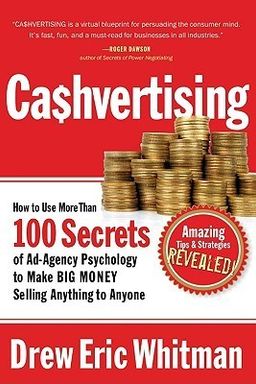
Cashvertising cover

Cashvertising

by Drew Eric Whitman

Cashvertising reveals over 100 ad-agency secrets to boost your sales without a big budget. Learn how to harness psychological insights to craft ads that captivate and convert. With practical tips and proven techniques, transform your advertising into a powerful sales engine.

The Psychology Behind Profitable Advertising

Have you ever wondered why some ads make you stop, pay attention, and even pull out your wallet, while others vanish into the background noise? In CA$HVERTISING, Drew Eric Whitman argues that the difference lies not in creativity or budget but in psychology. He insists that to sell anything effectively, you must understand how people think, feel, and act when making buying decisions. This book is not about “being clever”—it’s about getting results by learning the subconscious triggers and behavioral patterns that drive every purchase decision.

Whitman contends that every element of advertising—its message, visuals, words, and even its colors—can be scientifically designed to trigger powerful human emotions tied to survival, desire, fear, and validation. Just as agencies like Ogilvy & Mather and major consumer brands use psychological research to design their ads, so can you. Whether you sell a local service or an online product, the same principles apply, because human nature doesn’t change.

Advertising Is Persuasion, Not Entertainment

Whitman begins by dismantling one of the biggest myths of modern marketing: that advertising should be witty or artistic. Most ads fail, he says, because they try to entertain rather than persuade. In his sharp critique of “award-winning” but ineffective campaigns, he notes that great ads don’t just make people smile—they make people buy. A good ad is simply “a salesperson in print” designed to move readers to action. Like salespeople, ads should identify prospects’ core fears and desires and then present a product as the clear solution.

By contrast, most brand builders rely on being “clever,” a mistake Whitman calls fatal. He recounts the words of legendary advertiser David Ogilvy, who warned that nobody buys from ads they cannot understand. Great copy should be clear, emotional, and relentlessly benefit-driven. For Whitman, advertising is not journalism—it’s applied psychology.

The Science of Human Desire

Before you can write a single word of persuasive copy, you must understand what people really want. Whitman anchors his entire method in eight biologically programmed desires he calls the Life-Force 8: survival, enjoyment of food and drink, freedom from fear and pain, sexual companionship, comfortable living conditions, the desire to feel superior, protection of loved ones, and social approval. These drives are ancient, universal, and inescapable. When you tap into any of these instincts, you align your ad with the strongest emotional engines inside every human being. Compare this idea to Abraham Maslow’s hierarchy of needs—Whitman simplifies it, making it practical for marketers. He argues that emotional appeals based on the Life-Force 8 consistently outperform abstract features or logic.

Beyond these primary desires, Whitman identifies nine learned or secondary wants, such as curiosity, efficiency, cleanliness, and economy. These can make your appeal richer but should never replace the primal Life-Force 8. He shows, for instance, how a pizza shop can do more than advertise hot food—it can evoke safety and pleasure through comfort, indulgence, or togetherness around the table.

Advertising as Legal, Ethical Mind Control

The bold claim of CA$HVERTISING is that persuasive media is a kind of “mind control”—and that’s not necessarily a bad thing. Like skilled salespeople, advertisers guide attention through subtle cues, emotionally charged language, and perceived authority. Whitman demystifies these tools by exposing the same foundation taught in major ad agencies: principles such as scarcity, reciprocity, consistency, social proof, and authority (popularized by Robert Cialdini in Influence). By mastering these “weapons of influence,” anyone can ethically steer behavior—provided the product genuinely delivers value.

Whitman’s tone is both practical and irreverent. He admits that modern advertising is full of what he calls “trash,” not because business owners are stupid but because they’ve been taught myths. Most copywriters never study consumer psychology, he argues, so they focus on creativity over connection. To fix this, he recommends thinking more like a consumer psychologist: study what people fear losing, crave gaining, and emotionally visualize when reading an ad. In other words, make people feel first and think later.

Creating Ads That Sell, Not Just Speak

The rest of CA$HVERTISING is a toolkit for applying psychological persuasion to real-world marketing. Over the next sections, Whitman delivers dozens of proven frameworks and agency-tested tactics: the 17 foundational principles of consumer psychology, 41 ad-agency “secrets” that work across industries, and more than 100 ready-to-use techniques for boosting ad response. You’ll learn, for example, why three short words can be more powerful than a tagline rewritten a hundred times, how fear motivates action, how ego appeal turns products into identity symbols, and why clarity always outsells creativity. Each concept builds on the others, showing how structure, emotion, logic, and design work together to influence behavior.

Why This Matters to You

Whitman’s message is liberating: you don’t need a Madison Avenue budget to create world-class advertising—you just need to understand people. The same psychological levers used by global brands are available to any entrepreneur, copywriter, or small business owner willing to learn them. Whether you’re writing a sales page, an email, or a billboard, this book teaches you how to capture attention, stir desire, establish credibility, and call to action. In short, CA$HVERTISING reveals how to ethically use the psychology of persuasion to make your message irresistible—and turn ordinary words into measurable profits.


The Life-Force 8: What People Really Want

At the heart of CA$HVERTISING is the claim that all successful advertising stems from human biology. Drew Eric Whitman urges you to think of buying behavior as nature’s way of ensuring survival. He simplifies decades of consumer research into what he calls the Life-Force 8—eight primal desires that shape every choice humans make, whether we admit it or not. These aren’t marketing buzzwords but evolutionary truths baked into our DNA.

Eight Core Drives of Human Desire

  • 1. Survival and life extension: The instinct to stay alive powers markets from insurance to healthcare to alarms. Fear-based appeals work because they promise protection.
  • 2. Enjoyment of food and beverages: From Coca-Cola to Starbucks, flavor and indulgence embody comfort and reward.
  • 3. Freedom from fear, pain, and danger: Products that reduce uncertainty—from antivirus software to car airbags—reassure the primitive self.
  • 4. Sexual companionship: Whitman bluntly states that sex sells because mating drive underlies attraction, confidence, and beauty industries.
  • 5. Comfortable living conditions: Everything from furniture to air-conditioning appeals to the need for safety and stability.
  • 6. To be superior and win: This is the ego’s craving for dominance and recognition—why we buy trophies, designer logos, or high-performance gadgets.
  • 7. Care and protection of loved ones: The parental instinct fuels spending on family health, home safety, and education.
  • 8. Social approval: We want to belong and be admired; social proof, reviews, and lifestyle branding thrive here.

Whitman contends that every effective ad plugs into at least one of these eight forces. When you show how your product helps someone fulfill these urges, you bypass intellect and reach their emotional core. Just as Haldeman-Julius discovered in the 1920s when retitling books (“The Art of Kissing” outsold “A Treatise on the Science of Love”), appealing to sex or self-improvement doubles response.

Learned Wants Versus Biological Needs

Whitman contrasts these innate drives with nine “secondary wants” that society teaches us: curiosity, cleanliness, economy, convenience, and so on. While useful, they’re fragile motivators. A craving for safety will always override a desire for efficiency. He compares it to sprinting from a burning building: when instincts take over, rational preferences disappear. Thus, smart advertisers lead with primal emotion and follow with logical justification.

From Tension to Action

Desire, Whitman explains, comes from tension between what someone has and what they want. That tension fuels imagination and action. Your copy must heighten that gap while offering a relief valve—the product. “Tension → Desire → Action.” By vividly describing the outcome, you help readers experience the pleasure or freedom before they buy. It’s why he fills pages with sensory language—thick Chicago pizza sizzling in an olive-oil pan—because mental imagery sells faster than logic.

Once you learn to link your offer to a Life-Force 8 desire, you transform from a salesperson to a storyteller of survival and success. Every headline, image, and guarantee then becomes a promise to satisfy something deeply human.


The 17 Principles of Consumer Psychology

Whitman organizes the psychological mechanics of persuasion into seventeen foundational principles—models borrowed from social psychology, behavioral economics, and neuroscience. Each principle explains a mental shortcut or emotional drive you can leverage to sell more effectively. Rather than memorizing them mechanically, he urges you to use them as a diagnostic checklist for why people say yes—or no.

From Fear to Familiarity

Among the most primal is the Fear Factor: stress motivates action only when people believe they can prevent the threat. Ads must offer both the scare and the safety (think antivirus protection or home alarms). But fear is followed by identity: Ego Morphing lets customers associate with aspirational images—why luxury car ads show confident achievers instead of fuel efficiency charts. Combined with Transfer (borrowing credibility from experts or respected institutions), these principles create instant trust through association.

The Many Roads to Persuasion

The Bandwagon Effect and Social Proof capitalize on our need to belong—echoing Cialdini’s “comparison” cue. The Means-End Chain teaches sellers to emphasize the ultimate outcome, not the product itself (people want holes, not drills). The Transtheoretical Model breaks persuasion into five stages—from ignorance to habit—reminding you to meet customers where they are. And Inoculation Theory shows how exposing buyers to weak counterarguments reinforces loyalty before competitors strike (politicians use it constantly).

Attitude and Belief Systems

Consumer beliefs are stubborn. Through Belief Re-Ranking, you shift perception by reframing importance, not attacking convictions head-on. The Elaboration Likelihood Model distinguishes between reasoned central processing (used for expensive decisions) and peripheral cues (used for impulse buys). Finally, Heuristics—mental shortcuts like “length implies strength”—show that long, detailed copy often increases credibility simply because it looks thorough.

Together, these 17 principles map the entire psychological terrain of advertising—from fear to familiarity, logic to emotion, novelty to trust. Whitman’s genius lies in translating academic theory into street-smart action steps any marketer can test immediately.


How Ad Agencies Craft Irresistible Messages

When Whitman unveils his 41 Ad-Agency Secrets, he lifts the curtain on what professionals actually do to make ads sell. These are not vague guidelines but bite‑sized, high‑leverage tactics drawn from decades of agency experience. Each one connects back to the psychological principles, bridging theory with execution.

Simplicity and Benefits Rule Everything

Secret #1, the Psychology of Simplicity, lays the foundation: write so people can understand. Using the Flesch Reading Ease test, Whitman shows that clear, conversational copy always beats jargon. He proves how short words and sentences at a sixth‑grade reading level outperform corporate fluff every time. Once copy is simple, Secret #2 tells you to Bombard with Benefits. Every feature must translate into a result the reader actually wants. His favorite exercise—“Big deal! What’s in it for me?”—forces you to turn technical details into emotional payoffs.

Headlines, Scarcity, and Specifics

Secrets #3–#5 focus on attention: put your biggest benefit in the headline, add scarcity (“Sale ends Friday!”), and use proven word patterns like “Free,” “New,” “At Last,” and “How to”—a direct nod to John Caples’s tested formulas. Secret #9, Extreme Specificity, is a killer technique: back up every claim with concrete details. A generic pizzeria sells cheese and dough; a specific one sells “fresh‑baked San Marzano tomatoes and buffalo‑milk mozzarella.” The more specific you get, the more believable you sound.

Design Psychology and Visual Persuasion

Whitman dedicates major space to layout and design. The Ogilvy Layout Principle shows how placing a large photo in the upper two‑thirds of your ad dramatically increases readership. Typeface choice, color contrast, and spacing affect comprehension and mood. Serif fonts aid reading on paper, sans‑serif on screens. He warns against reversed white‑on‑black text, which tests show reduces legibility by up to 16%. Even image shape matters: circular ads grab attention because they break the rectangular routine.

From mental imagery (Directing Mental Movies) to human inertia, these secrets prove that professional advertising is less about artistry and more about orchestrated psychology. Every design decision serves one purpose: get noticed, get read, get acted upon.


The Psychology of Persuasion: Cialdini’s Weapons in Action

Whitman devotes an entire section to Cialdini’s six weapons of influence—proof that everyday compliance psychology underlies the best advertisements. These quick mental shortcuts—comparison, liking, authority, reciprocation, commitment/consistency, and scarcity—govern decision‑making under low attention. He shows not only what each means but how advertisers deploy them without crossing ethical lines.

Comparison, Liking, and Authority

Humans look sideways to decide what’s right. Showing “preferred by 9 out of 10 dentists” exploits comparison. Liking goes further: people buy from those they like, whether it’s a charming salesperson or a relatable influencer. Physical attractiveness and similarity amplify this effect; men relate to confident men in ads, women to women. Authority works even when faked—a lab coat or data chart signals trust. The trick is to borrow credible symbols, not just titles.

Reciprocation and Commitment

Give first, and the urge to give back follows. Whitman cites charities that include small gifts in mailers because receiving something triggers obligation. Likewise, once someone takes a stand—signing a petition, for example—they feel compelled to act consistently with that stance. Print ads replicate this with “four‑walls” questions: a sequence of yeses (“Do you want safety? Comfort? Reliability?”) that boxes readers into buying.

Scarcity and Urgency

Scarcity is greed’s twin. Limited editions, countdown timers, and “while supplies last” language exploit the fear of missing out. But Whitman warns: fake scarcity kills credibility. Real deadlines tied to inventory or time‑sensitive bonuses move people because they seem authentic. Fear of loss, after all, is stronger than hope of gain—a finding mirrored in behavioral economics’ “loss aversion” theory (Kahneman & Tversky).

Used ethically, these six cues can transform any offer into an irresistible psychological proposition. Combined with value and honesty, they help build campaigns that persuade without manipulation.


Words That Work: The Simplicity Rule

Everyone wants to sound smart in advertising—but Whitman proves that clarity beats cleverness every time. Advertising’s golden rule, he says, is simple: write so people can understand. Using Dr. Rudolf Flesch’s readability formulas, he demonstrates that the best‑selling ads read at a sixth‑grade level or lower. The goal is not to impress but to connect. This lesson echoes direct‑response greats from Claude Hopkins to Gary Halbert.

Short Words, Short Sentences, Short Paragraphs

Whitman dissects bloated prose and rewrites it plainly to show how comprehension and conversion soar. He advocates 70 to 80 percent one‑syllable words, one thought per sentence, and frequent paragraph breaks to maintain rhythm. Even sentence length affects accessibility; around eleven words is ideal. In a world where readers skim, simplicity acts as ethical mind control—it guides without resistance.

Personal Pronouns and Conversational Flow

Pepper copy with you and I to make it sound like dialogue, not declaration. Replace abstractions with pictures readers can visualize: instead of “financial success,” say “an extra $2,495 in your pocket each week.” This mirrors the style of modern content creators and YouTubers who speak directly to the viewer—a strategy backed by cognitive fluency research showing that the easier a message feels to process, the more truthful it seems.

“If they can’t understand what you’re saying,” Whitman warns, “you’re just talking to yourself.” Master simplicity, and you’ll out‑communicate competitors still hiding behind buzzwords.


Design Psychology: Typography, Color, and Layout

Good design is silent persuasion. Whitman devotes several chapters to how shape, typeface, size, and color structure human attention long before words are read. Drawing from classic experiments by Daniel Starch and later researchers, he explains that visual design can multiply or murder readability.

Typography That Sells

Serif typefaces—like Garamond, Times New Roman, or Cheltenham—reinforce comprehension in print, while sans‑serif fonts like Arial or Verdana work best online. All‑caps slows reading by about 18%, and reversed white‑on‑black reduces legibility by 16%. The takeaway: if your copy is hard to read, it’s hard to believe. Even small details like drop capitals at the start of paragraphs increase readership by 13% (a fact David Ogilvy loved to cite).

Color and Shape Influence Emotion

Blue evokes trust, red excites urgency, yellow captures attention but tires the eye. Men prefer orange less; with age, people lean toward cooler blues. Whitman explains the physics of color contrast and why black ink on yellow paper is most readable. Complementary color schemes attract, while clashing tones repel. Even perceived weight changes: darker packaging feels heavier and more substantial.

Layout Logic

Using David Ogilvy’s two‑thirds/one‑third rule, place a dominant image at the top and caption it—since twice as many readers view captions as body copy. He recommends “white‑wrap isolation,” surrounding ads with empty space to raise attention value up to 20%. Circular borders (“island ads”) break monotony, and faces staring directly at the viewer grab immediate focus—a principle he calls the Guillotine Effect.

In Whitman’s hands, design stops being decoration and becomes behavioral engineering. Visual elements don’t just decorate your message—they dictate whether it’s ever seen, read, or remembered.


Crafting Unstoppable Offers and Headlines

Whitman insists that every ad must sell a single idea. Two components dominate: the offer and the headline. Your headline’s job is to grab attention; your offer’s job is to make ignoring it painful. He shows how to merge psychology with structure to achieve both.

Headlines: The Ticket on the Meat

Borrowing from Caples and Ogilvy, Whitman stresses that people read five to nine words in one glance, so your headline must deliver value fast. “Attention Food Servers: Learn to Boost Tips by 512%” beats “New Waitstaff Workshop.” He catalogs 22 proven openers—Free, New, How to, At Last, Warning, Finally, Look—and reminds us: clarity sells. Long headlines can work but short ones are more read.

Offers That Destroy Inertia

Deadlines and scarcity overcome the enemy of all marketing: laziness. Tell readers exactly what to do and make it easy—“Call before Friday,” “Only 50 seats”—a practical use of loss aversion. He shows how small changes in phrasing (“Buy one, get one free” vs. “50% off”) dramatically alter perception even when mathematically equal. Testing different offers, he notes, can reveal what truly motivates your market—sometimes it’s price, sometimes exclusivity, sometimes convenience.

Guarantees and Trust

A long, confident guarantee reduces risk perception and lifts response. During the Depression, Hormel’s “double your money back” pledge triggered massive sales with only twelve returns. This echoes modern SaaS free trials: commitment feels safe when backed by trust. Whitman’s rule—if competitors guarantee 90 days, offer a year—forces them to look weak by comparison.

By stacking benefit‑rich headlines, urgent offers, and bold guarantees, you turn attention into action. As he quips, “Your ad is your salesman. If it doesn’t close, fire it.”


Persuasion by Design: Social Proof and Authority

When people don’t know whom to trust, they follow others. Whitman weaponizes this truth with principles of social proof and authority positioning. Testimonials, endorsements, and perceived expertise calm the customer’s inner skeptic and replace doubt with borrowed confidence.

Testimonials That Talk

Since 1926, when Ponds Cold Cream first published user quotes, testimonials have been psychological shortcuts to safety. Whitman encourages proactively asking for them: “We want to make you famous.” Add names, cities, and photos to increase believability. Even quantity matters—one or two imply flukes; dozens convey reliability through the “length‑implies‑strength” heuristic. Visual proof—smiling customers or before‑and‑after photos—speaks louder than adjectives.

Becoming the Authority

People respect those who educate them. Whitman suggests turning your expertise into free reports, Q&A columns, or seminars. Print your headshot and credentials everywhere to signal mastery. This “authority positioning” echoes Ogilvy’s strategy of consultants becoming teachers—the ad not only sells but informs, converting skepticism into trust. Consumers think, “If she teaches others, she must know her stuff.”

Used together, authority and social proof transform persuasion into reassurance. You’re no longer selling—you’re confirming what others already believe: buying from you is the smart, safe choice.


Testing, Feedback, and Continuous Improvement

Whitman concludes by reminding readers that the best advertisers aren’t artists—they’re experimenters. His mantra: “If you can’t measure it, you can’t improve it.” Split‑tests and surveys, not opinions, determine truth. What people respond to—not what they claim to like—is what matters.

The Power of Testing Offers

By altering small elements—price endings, word order, bonuses—you gather priceless data. Odd‑even pricing (19.99) can boost sales 8%, while prestige pricing (rounded $1000) builds luxury perception. Surveys uncover hidden motives: a pizzeria might learn that customers care more about delivery speed than topping variety. Once you know this, you redirect messaging to match reality.

Learning from Direct Response Masters

Whitman pays homage to direct marketers and to agencies that lived by testing. Claude Hopkins tested coupons a century ago; modern e‑marketers test subject lines. The medium changes, the principles don’t. He even provides a 46‑point “Killer Ad Checklist,” functioning like an advertising pre‑flight list covering headlines, copy rhythm, proof, layout, and calls to action.

For Whitman, mastery of advertising isn’t a one‑time achievement but a mindset of perpetual curiosity. In his words, “The marketplace will always be the final arbiter.” Every ad you run is research—and every result, good or bad, is tuition in the psychology of buying.

Dig Deeper

Get personalized prompts to apply these lessons to your life and deepen your understanding.

Go Deeper

Get the Full Experience

Download Insight Books for AI-powered reflections, quizzes, and more.