
Idea 1
Mastering the Case Interview
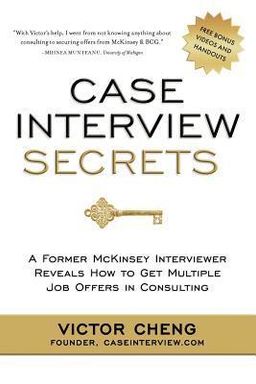
Have you ever faced a moment in your career where everything hinged on a single conversation or test—and you weren’t sure what rules you were playing by? In Case Interview Secrets, former McKinsey consultant Victor Cheng pulls back the curtain on one of the most intimidating gateways to elite consulting: the case interview. His central argument is straightforward but profound: succeeding in the consulting recruitment process depends less on innate brilliance and more on mastering a repeatable, structured problem-solving process.
Cheng contends that consulting firms use the case interview not merely to test knowledge but to simulate the real work of consulting—an arena where clarity, logic, and communication matter far more than memorizing business jargon. The book promises that if you can learn how consultants think—how they form hypotheses, build issue trees, drill down into analysis, and synthesize findings—you can not only pass any case interview but also thrive in the consulting profession itself. He argues that this process mirrors the scientific method applied to business problems: forming a hypothesis, testing it through structure, analyzing data, and synthesizing a recommendation.
Why the Case Interview Exists
Consulting firms, in Cheng’s view, aren’t merely assessing intelligence—they’re evaluating how candidates handle ambiguity. A case interview replicates what consultants do daily: walk into messy problems with too little time, too few resources, and clients looking for answers. This format reveals whether you can craft clarity out of chaos. Rather than testing “right answers,” interviewers are looking for process excellence—your ability to apply structured thinking consistently under stress. Candidates should therefore focus less on memorizing frameworks and more on showing how they can reason logically and communicate confidently when navigating uncertainty.
The Core Framework of Thinking Like a Consultant
Cheng defines four core tools used by every consultant—and by extension, every candidate during a case interview. These are your Swiss Army knife for any business problem: (1) the hypothesis, (2) the issue tree or framework, (3) drill-down analysis, and (4) synthesis. Each tool appears again and again throughout the book as he demonstrates how to apply them to profitability cases, market entry questions, mergers and acquisitions, or even qualitative creative challenges.
- Hypothesis: an educated guess about what’s driving the problem
- Issue Tree: a structure that logically tests your hypothesis
- Drill-Down Analysis: breaking problems into smaller parts and testing them through data
- Synthesis: wrapping the entire argument into a clear, actionable conclusion
For Cheng, these tools replace reliance on memorized frameworks. They reflect how consultants actually think on client projects, iterating hypotheses in real time. Each tool trains you to shift seamlessly from big-picture strategy to granular detail—a skill he claims separates future consultants from framework robots.
The Human Side of Consulting
Beyond deductive logic, Cheng reminds readers that consulting is fundamentally about people. Firms screen not only for analytical prowess but also for the ability to project confidence, communicate diplomatically, and avoid arrogance—the so-called “no-asshole rule.” Clients hire consultants because they seek reassurance, credibility, and partnership under pressure. Thus, your interpersonal skills—even in how you respond to being proven wrong or how you treat peers in a group case—mirror how you’ll manage clients later on.
Why These Ideas Matter
This book isn’t just about passing interviews—it’s a blueprint for mastering clarity in complex thinking. Cheng’s methods apply far beyond consulting: they teach you how to reason through ambiguity in any high-stakes environment, synthesize insights quickly, and communicate like an executive. He argues that a disciplined process empowers confidence, transforms analysis into action, and replaces guesswork with structure. By the time you finish, you’ll see the case interview not as a puzzle but as a performance—one that proves you can think, speak, and act like a consultant long before you’re hired.