
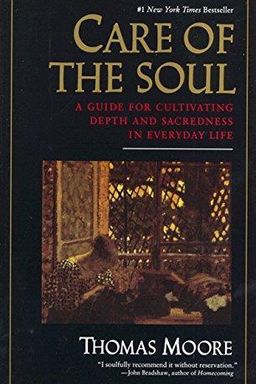
Care of the Soul cover

Care of the Soul

by Thomas Moore

Care of the Soul provides a profound guide to finding sacredness and depth in everyday life. Through a Jungian lens, Thomas Moore encourages readers to embrace their life''s narrative, redefine family dynamics, and use imagination to connect with their soul. This book offers insights into living a more meaningful and balanced life by accepting life''s imperfections.

Care of the Soul

Thomas Moore’s Care of the Soul proposes a radical cultural shift: instead of trying to cure, fix, or transcend life's pain, you learn to live with it imaginatively. The soul, for Moore, is not a part of you that can be abstracted; it is the depth dimension of your ordinary experience—the way you sense meaning through love, work, family, illness, and loss. He invites you to exchange the modern obsession with control for a reverent attention that befriends the full range of experience.

Drawing on ancient philosophy, Renaissance humanism, depth psychology, and myth, Moore crafts a contemporary theology of the ordinary. He insists that symptoms, relationships, wealth, and even depression speak a language that you can learn to read if you approach them with care and curiosity. Rather than separating religion, therapy, and art, he restores their original integration in soulful living.

From Fixing to Observing

Moore contrasts the heroic modern approach—control, mastery, treatment—with what he calls observance. Observance means cultivating patience and imagination in the face of pain, treating symptoms as symbolic communications rather than malfunctions. When someone is depressed, compulsive, or jealous, Moore asks not "How can I get rid of it?" but "What does it want to say?" This shift transforms pathology into dialogue. The symptom itself becomes a living messenger of unacknowledged needs and repressed vitality.

The Soul’s Landscape

For Moore, the soul reveals itself through images—dreams, stories, physical symptoms, creative expressions, and desires. The family becomes a mythic arena, love a rite of passage, work a sacred opus, and even jealousy or depression a visit from the gods. The book’s method is mythopoetic: he draws on Greek myths (Hera’s jealousy, Narcissus’s reflection, Demeter’s grief) and medieval alchemy to help you see the imagination within daily life. Where modern psychology tends to diagnose, Moore mythologizes. He encourages retelling your life stories as personal myths that hold paradox and depth.

The Practice of Soulfulness

Practicing soul care is as much art as therapy. You pay attention to places, rituals, and objects that hold feeling; you create sacred space in ordinary life; you observe dreams without forcing interpretation. Soul care might mean keeping a family heirloom alive, listening to music that draws out feeling, or creating time for solitude. These small gestures are not self-help techniques but forms of worship to life’s complexity. In this worldview, the divine appears not in transcendence but in particularity—your body, your home, and your relationships.

Why This Matters Today

Modern society, Moore argues, has desacralized the world: we hurry through experience, discard objects, and seek anesthetic escape from emotion. The result is spiritual numbness and alienation. Care of the Soul invites you to slow down, restore connection to symbols, and dwell in mystery. You do not solve the soul as a problem; you live with it as a presence. The reward is not constant happiness but depth—an integrity that arises when you integrate shadow and light, joy and melancholy, love and loss.

Core Insight

Soul care is the art of imaginative attention. It transforms the ordinary—family quarrels, depression, money worries—into the alchemical material of self-knowledge and reverence.


Listening to Symptoms

Moore begins practical soul work where modern medicine and psychology often end—with the symptom. Rather than suppressing depression, anxiety, addiction, or compulsion, he teaches you to listen to what each symptom may be trying to say about your deeper needs. The symptom becomes the soul’s speech, a metaphorical revelation rather than mechanical failure.

From Cure to Conversation

Modern therapy tends to impose a moral or functional narrative—"fix this habit," "overcome dependency," "resume normal functioning." Moore reverses this logic. He shows examples where healing begins only when the therapist and client adopt a receptive stance. A dependent woman, rather than being urged to become self-reliant, is encouraged to see what her dependency asks for: intimacy and trust. A disenchanted worker learns to reenter his despised factory job not as a prison but as a site for recovering craftsmanship and integrity.

Observance as Ritual

Moore borrows from Taoist wuwei—nonaction—to describe observance: a poised watchfulness that allows meaning to unfold. He recommends recording dreams, noticing recurring symbols, and performing small rituals around the problem. A bulimic woman’s dream of old women cooking becomes a rite of initiation into feminine appetite. As you witness your suffering symbolically, it gradually transforms.

Observance also extends to relationships: the therapist (or friend) becomes not a fixer but a midwife of the soul. Through patient conversation, symptoms slowly release their wisdom. In Moore’s model, your path to wholeness emerges not by eradicating affliction but by deepening your conversation with it.


Family and Ancestral Myths

Family, Moore writes, is not merely a social institution but a living mythology. Every family carries gods, archetypes, and unfinished stories that shape who you are. Healing family wounds doesn't mean eliminating dysfunction—it means finding the mythic pattern within it and allowing that story to mature consciously.

The Family as Crucible

When you view family solely through the lens of psychology or sociology, you see it as cause and effect, sin and blame. Moore asks you to look imaginally: family is the soul’s theater, where archetypal figures—father, mother, child, wanderer—interact. A man estranged from his father reconnects only when he tells his father’s story as myth, seeing the 'wandering father' as an inherited fate. Family becomes alchemical matter, transforming suffering into understanding.

Objects as Soul Vessels

Heirlooms, houses, and even furniture hold emotional memory. When you tend to these objects—repairing a wardrobe, preserving a wedding ring—you care for the ancestral soul itself. Discarding relics without ritual severs continuity. Reverence for these seemingly material items restores community between past and present generations.

This mythic vision doesn't excuse cruelty or pain, but it allows compassion. When you transform family history into story rather than pathology, you regain imaginative freedom. Your roots become sources of meaning rather than chains of causality.


Love as Initiation

Moore reframes love as a sacred initiation through which you encounter both joy and heartbreak. Inspired by Plato, Novalis, and the legend of Tristan and Isolde, he sees love not as a problem to be solved but as a gateway into your own depths. To love is to enter a mystery where opposites—union and loss, fullness and hunger—teach the soul its lessons.

The Alchemy of Eros

In the myth of Tristan and Isolde, passion is both blessing and curse. Their fated love potion entwines them in joy, exile, and tragedy. Moore interprets this as the soul’s initiation: when you fall in love, something archetypal claims you. The task is not to manage the relationship efficiently but to discover what myth you are living. Love inevitably involves separation, loss, and transformation; its suffering prunes away illusions about control.

Ritualizing Love’s Changes

Clinical examples show how paying attention to love’s dream-life reveals what the relationship demands. A bride’s dream of her brother intruding on her wedding points to love’s entanglement with family archetypes. When clients accept separation as an alchemical separatio, they grow rather than collapse. The practical truth: love will undo you—and that undoing is its value.

By treating love as a rite rather than a performance, you release the pressure for perfection and invite initiation. Through Eros, the soul learns surrender, humility, and compassion.


The Gift of Saturn

Moore devotes two chapters to Saturn, the melancholic planet that rules depression, endings, and wisdom. Against a culture obsessed with positivity, he argues that melancholy carries dignity and depth. Depression, when not pathological, can function as Saturn’s classroom—where life slows, memories condense, and meaning thickens.

Saturn’s Pedagogy

Moore presents Saturn as the slow teacher of introspection. In sadness you may feel old, heavy, or withdrawn, yet these moods invite reflection and self-knowledge. He references Ficino’s Renaissance writings and modern texts like Oscar Wilde’s De Profundis to show that depression often accompanies creative ripening.

A Case Example

Bill, an aging priest, collapses into despair after losing his position. Instead of being forced into cheer, he’s guided to inhabit the darkness. Through dreams and art, he perceives his depression as initiation into elderhood. The descent births a more authentic sense of vocation. Moore calls this learning from Saturn’s season.

Practically, Saturn may be honored through quiet rituals—solitary walks, reflective journaling, or art. Distinguish between disabling illness and fruitful reflection, but avoid erasing every dark mood. When accepted, Saturn gives gravity, artistry, and humility—a slow beauty at life’s core.


Narcissus and Self-Regard

Modern culture condemns narcissism, yet Moore reinterprets the myth of Narcissus as a call to develop tender self-regard. The myth’s cure lies in reflection: learning to see yourself as a beloved image rather than an object of judgment or inflation. Narcissus’s 'hardness' softens when wonder enters his gaze.

The Mirror as Teacher

Echo loses her voice by repeating others, while Narcissus cannot love anyone but the image. Together they mirror modern wounds—self-erasure and self-absorption. Moore suggests cultivating a reflective relationship to your self-image: keep photographs, create altars, and work with mirrors as sacred companions. Self-love ripens when tempered by poetic imagination and contact with others who reflect you without flattery.

Transforming narcissism means converting inflated fantasy into creative work. Grandiosity can mature into vocation when it engages reality—Moore’s student who fancied himself Jesus learns to channel that fervor into service. You are called to cherish your image, not worship it.


Jealousy and the Many Gods

Moore’s polytheistic psychology rejects the idea that every emotion must yield to one moral law. Jealousy and envy, he shows through Greek myths like Euripides’ Hippolytus, are divine conflicts within the soul. When you feel jealousy, rather than suppression, you should ask which neglected inner god—Hera, Aphrodite, Artemis—is demanding recognition.

Polytheistic Care

In therapy, Moore helps clients discover that jealousy signals imbalance among competing deities: purity versus sensuality, autonomy versus connection. The task is not cure but inclusion. Myths, rituals, and journaling can let each aspect speak, reducing explosive rivalry within the psyche.

A polytheistic life tolerates contradiction. By honoring jealousy as an archetypal voice, you move toward psychic plurality and empathy. Emotional complexity becomes a form of spiritual intelligence.


Work and Money as Soul Material

Work and money—often treated as profane necessities—become sacred instruments of soul when viewed imaginatively. Moore defines work as opus, the alchemical process that transforms raw life into meaningful form. Money, likewise, is not a neutral medium but a symbolic currency of relationship and value.

Work as Opus

Every task can be liturgy if done with care. Moore recounts reading a client’s home like a living text: each room mirrored psychic life. Craftsmanship, whether in gardening, teaching, or artistry, aligns your external labor with inner vocation. Ritualizing work—using good tools, caring for spaces—binds the sacred to the everyday.

Money’s Soul

By tracing money to oikos (home), Moore unites ecology and economy. Money’s flow mirrors breath—profit as inhalation, spending as exhalation. When hoarded, it stagnates. Saturn presides over counting and stewardship; handling money ritually restores proportion and gratitude. Moore’s own money dream warns against clever self-sabotage and urges ethical balance between giving and keeping.

Honoring work and money as soul processes brings satisfaction beyond success: you craft a life resonant with creativity, integrity, and community.


Body and the World Soul

Moore extends soul care to the physical world—the body, nature, and objects. He invites you to recover the ancient sense of anima mundi, the world soul that animates matter itself. Illness, physical pain, and home surroundings are not separate from spirit but expressions of it.

The Body Speaks Poetically

The body, Moore says, is the soul’s fullest expression. Symptoms and ailments can be imaginal: chest tightness may speak of grief, digestive trouble of unassimilated experience. His own dream of colorful tigers during massage taught him courage and playfulness. Healing combines medical treatment and symbolic listening—one treats the body while also attending to the image it presents.

Things Have Soul

Extending this logic outward, Moore describes the psychopathology of things: neglected neighborhoods and disposable culture mirror spiritual wasteland. Tending a tree, repairing a chair, or cherishing a worn object restores bond with the world soul. Artists like Sōetsu Yanagi and J.B. Jackson, who honor craftsmanship and ruins, show how beauty revives matter’s dignity.

When you treat the world’s body poetically—listening to its voices, caring for its materials—you heal personal alienation and restore ecological imagination.


Ritual, Art, and Dream

In his final chapters, Moore reunites art, ritual, and dream as the soul’s essential languages. Ritual grounds spirit in matter; art arrests perception; dreams deliver images from the underworld of the psyche. You don’t need grand ceremonies or masterpieces—simple, repeated gestures keep the divine alive in daily life.

Everyday Ritual

Moore contrasts hollow productivity with sacred pause. Jung’s Bollingen Tower exemplifies retreat as spiritual technology: a crafted space for solitude, silence, and imagination. Your version may be a small writing nook, a candlelit bath, or five minutes with dreams. Rituals—lighting incense, keeping family shrines, telling stories aloud—help digest modern life’s speed, restoring connection between inner and outer worlds.

Art and Dreamwork

For Moore, art is not self-expression but soul expression. Hanging laundry carefully or painting a small panel can evoke the sacred. Dreams, likewise, are living art pieces that interpret you. Rather than analyzing them instantly, re-tell and replay them; let each figure speak. Through this process you meet your daimon, the guiding presence shaping your life story.

By honoring art and dream, you rediscover imagination as holy ground. The soul’s nourishment lies not in abstraction but in contact—with beauty, silence, and the images that guide your unfolding life.

Dig Deeper

Get personalized prompts to apply these lessons to your life and deepen your understanding.

Go Deeper

Get the Full Experience

Download Insight Books for AI-powered reflections, quizzes, and more.