
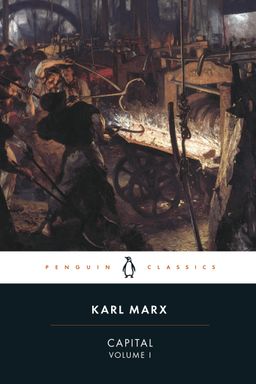
Capital cover

Capital

by Karl Marx

Karl Marx''s ''Capital'' is a profound critique of capitalism, exploring the exploitation of labor and the resulting social inequalities. It dissects the capitalist system''s complexities, offering invaluable insights into economic and social dynamics that continue to resonate today.

Capital, Labour, and the Social Logic of Value

Why do ordinary things—a coat, a piece of linen, a loaf of bread—rule our lives like social powers? In Capital, Karl Marx answers that question by revealing how human labour, when organized through exchange, turns into an abstract social force called value. He argues that capitalism is not merely an economy but a social system in which wealth appears as an immense collection of commodities and relationships between people adopt the mystified form of relationships between things.

If you follow Marx’s argument closely, you move from the smallest cell, the commodity, to the complex organism of capitalist production and accumulation. You first see how commodities have a double character—use-value and exchange-value—then how the value-form develops into money, how labour-power becomes a commodity, how surplus-value arises, and finally how capital accumulates through exploitation, crisis, and concentration. Each step uncovers an essential law of motion hidden inside everyday exchange.

From Use-Value to Exchange-Value

Every commodity, Marx insists, is a paradox: it must be useful (a use-value) but it also serves as an exchange-value—an embodiment of abstract, socially necessary labour-time. When you buy linen or coffee you are not paying for beauty or fulfillment, but for the average labour-time society requires to produce those items. Value arises not from personal skill but from socially necessary work under prevailing conditions of productivity.

Because the market abstracts away individual differences, labour becomes “abstract labour.” The equality of commodities in exchange is, in truth, the equality of human labour reduced to a common denominator. This abstraction is what allows calculation, prices, and profit to appear rational even though they conceal complex social relationships of labour.

Money and the Mystification of Exchange

Once society regularly expresses all commodities in terms of a single equivalent—gold or another standard—money emerges. Money, Marx shows, is not a random invention: it crystallizes the general form of value. But in doing so it produces illusion. Money appears as a natural substance of value when it is actually the social form that value takes. Hence the “fetishism of commodities”: relations among people—producers, labourers, buyers—now seem like relations among objects, their prices, and the money that mediates them.

For example, a Bible, an iron bar, and ten yards of linen share nothing but the fact that each can be exchanged for a certain quantity of gold. The gold seems to make them equal, hiding the human labour that connects them. This is why Marx compares commodity worship to religion: both involve mistaking human creations for autonomous powers.

From Circulation to Production

To understand profit you must move from the sphere of exchange (C–M–C) to the sphere of production (M–C–M'). In simple circulation, people sell commodities to buy others that satisfy their needs. In capitalist circulation, money becomes the starting and ending point: you buy to sell and end with more money. The increment—ΔM—is surplus-value. But circulation alone cannot explain that increment, because exchanges of equivalents cannot create new value. Surplus-value arises only in production, where a peculiar commodity—labour-power—produces more value than it costs.

Labour-Power and Surplus Labour

Labour-power itself has a value: the labour-time needed to produce and reproduce the worker’s life—food, housing, education. Yet when used in production, labour-power creates new value beyond that. The workday splits into necessary labour (reproducing wages) and surplus labour (creating unpaid value). Profit, interest, and rent all derive from that unpaid portion. Historical struggles over the length and intensity of the working day, from the Factory Acts to union battles, revolve around how that surplus is extracted and limited.

Capital as a Social Relation

Capital is not primarily a machine or money pile; it is a social relation in which the owners of means of production appropriate surplus labour of workers separated from those means. Primitive accumulation—enclosures, colonization, and slave trade—historically created the “free” worker who must sell labour-power to live. Once established, competition compels every capitalist to reinvest surplus-value to survive, producing endless accumulation, technological change, and recurrent crises.

The Dynamics of Accumulation and Crisis

Accumulation enlarges capital quantitatively and transforms it qualitatively. As productivity rises, the organic composition of capital shifts: more machinery (constant capital) per worker (variable capital). This reduces relative demand for labour, creating an industrial reserve army that disciplines wages and expands exploitation. The very success of capital, therefore, breeds unemployment and crisis: it generates wealth and poverty together. Eventually, capital centralizes—small capitals are expropriated by larger ones—until production becomes profoundly social while ownership remains private.

Marx ends Volume I showing that these contradictions—social production, private appropriation—contain an implicit historical tendency: as productive forces mature and labour becomes fully socialized, private capital becomes a fetter on further development. The same process that gave birth to capitalism plants the seeds for its transcendence. (Note: this is not prophecy but a structural analysis—the “expropriation of the expropriators” as an immanent possibility within capitalism’s own logic.)


The Dual World of Commodities

Marx begins his analysis with the commodity because it contains in miniature all the contradictions of capitalist society. A commodity is both a use-value, satisfying some need, and a value, representing embodied labour-time. These two aspects align materially and socially: usefulness connects people through consumption, while value connects them through exchange. You have to hold both sides to see capitalism as a system where personal labour becomes an impersonal social relation.

Use-Value: Material Utility

Use-values arise from the qualitative side of labour—concrete work that makes bread, steel, or books. They exist in every society. In Marx’s terms, the “tangible” side of the commodity is physical and practical: a coat keeps you warm whether produced under feudalism or capitalism. Yet only when produced for exchange does it become a commodity. The networks of producers making things for strangers is already a social transformation of work.

Value: Abstract Labour and Exchange

Exchange abstracts away concrete differences between jobs. In the equation 20 yards of linen = 1 coat, what matters is not linen or tailoring but the common quantity of human labour-time crystallized in them. This abstraction—the reduction of work to “socially necessary labour-time”—creates a world where value seems autonomous. Productivity changes alter value: if a new loom halves weaving time, the value of linen falls even if useful output doubles.

Fetishism and the Social Illusion

Once products appear as commodities, the social character of labour hides behind things. Goods look as if value were inscribed in them by nature. This “commodity fetishism” means that people treat social powers as object powers—like believing coins or market forces possess independent will. Marx uses examples from theology and daily life—the wooden table that dances as a commodity—to show how capitalism turns human activity into an alien power over humans. When you forget that prices are social relations between people, you accept economic structures as natural laws.

Marx’s discovery here is methodological: by analyzing the commodity’s dual character, you can decode all later economic forms. Currencies, capital, interest, even state policy inherit this dual nature. Understanding value as a social relation demystifies the workings of capitalism and exposes how human cooperation is masked by apparently autonomous markets.


Money, Circulation, and the Birth of Capital

To follow Marx, you have to watch how simple exchange evolves into the circulation of capital. Money is not an assumption but a necessary outcome of exchange among multiple commodities. Initially, products are swapped directly—barter—but soon a universal equivalent arises to measure all others. That evolution from 20 yards of linen = 1 coat to 20 yards of linen = 2 ounces of gold captures a profound shift: value now has a fixed physical form in money.

Stages of the Value-Form

You can trace four stages: (1) the simple form (commodity A = commodity B), (2) the expanded form (commodity A = many other commodities), (3) the general form (all commodities express value in one commodity), and (4) the money form (that commodity becomes money, usually a precious metal). Once society continuously expresses values in one material, the general equivalent solidifies historically as gold or silver. People then start believing gold has value by nature, not by social convention—a misconception Marx calls the money fetish.

Circulation Forms: C–M–C and M–C–M′

Ordinary trade follows the pattern C–M–C: you sell a commodity for money to buy another commodity—use-value remains central. Capitalist circulation reverses it: M–C–M′. Here money buys commodities only to sell them again for more money. The increment M′–M = ΔM is surplus-value, and this shift transforms the meaning of trade itself. What was once a means to satisfy needs becomes a means to expand value without limit. That inversion—money pursuing its own expansion—marks the birth of capital.

The Limits of Circulation and the Turn to Production

Marx examines why merchants’ profits or usury cannot explain surplus-value. In circulation, all exchanges are of equivalents; buying cheap and selling dear merely redistributes value. The total remains the same. To find creation of new value, we must move to production, where a commodity exists that generates value when consumed—labour-power. Only in production can M–C–M′ be realized as genuine valorization rather than mere transfer.

When you see traders and financiers apparently producing money from money (M–M′), Marx reminds you that such profits ultimately rest on surplus created in production. This insight shifts analysis from the stock exchange to the workshop, from market appearance to material process—the first great breakthrough of his theory of capital.


Labour-Power, Value Creation, and Surplus Extraction

Once you understand that circulation cannot create surplus-value, you can see why Marx calls labour-power the special commodity of capitalism. The worker sells not labour itself but the capacity to labour for a period. The capitalist buys that capacity, uses it in production, and extracts value greater than the wage he pays. That difference—surplus-value—is the basis of profit, rent, and interest.

The Labour Process and the Valorization Process

Marx splits every act of production into two simultaneous layers. The labour process transforms raw materials into useful products using tools and machines. The valorization process transforms the same activity into value and surplus-value measured in labour-time. For instance, spinning yarn uses cotton (object of labour) and the spindle (instrument). The worker’s living labour adds new value to the cotton. Part of that value covers wages; the rest becomes unpaid surplus for capital.

Constant and Variable Capital

Here Marx introduces the distinction between constant capital (c) and variable capital (v). Constant capital—machinery, materials—transfers its existing value to new products but adds none. Variable capital—wages—creates new value through living labour. The secret of accumulation lies in this variable part: v becomes v + s (where s is surplus). Changes in technology or productivity shift how much of total capital counts as constant versus variable, shaping profit rates and employment levels.

Absolute and Relative Surplus-Value

Capitalists raise surplus-value in two ways. Absolute surplus-value extends the working day beyond necessary labour-time—longer hours, night shifts, or unpaid overtime. Relative surplus-value increases productivity so that necessary labour-time falls while total hours stay fixed, expanding the surplus portion. Machinery, scientific management, and education are tools of relative surplus extraction.

Rate and Mass of Surplus-Value

The rate of exploitation (s/v) measures how much unpaid labour is extracted relative to paid labour; the mass (S = V × s/v) measures total surplus generated. Marx’s factory examples—thousands of spindles driven by a few workers—show how both measures can rise even if each worker earns more in absolute terms. Productivity improvements intensify exploitation by reducing the labour required for reproduction (wages) faster than they reduce total labour inputs.

Once you view capitalism through this lens, you see profit not as thrift or luck but as the systemic appropriation of unpaid labour-time organized through production and hidden behind the wage contract.


Machinery, Division of Labour, and Social Control

Industrial capitalism does more than employ machines; it reorganizes workers and knowledge around them. Marx traces a historical sequence: simple cooperation → manufacture → machinery. Each stage increases productivity and transforms the worker’s role from autonomous craftsman to collective appendage.

Co-operation and Manufacture

When many workers labour side by side under one capitalist, new powers emerge: tasks synchronize, large projects become possible, and a single plan coordinates labour. This cooperation is the embryo of the factory. Manufacture, arising in the sixteenth and seventeenth centuries, divides work into specialized operations—one person makes screws, another shapes cases, another polishes—like William Petty’s watchmakers. The result is higher productivity and a new hierarchy of skills.

From Tool to Machine

The leap to machinery changes the motive power itself. Human muscle gives way to steam and water; the worker now watches over self-acting devices. The machine system joins three components: motor, transmission, and working tool. With Watt’s engine and later slide-rests, factories achieve continuous production. Machines replicate one-sided human movements mechanically—spinning, weaving, cutting—and replace complex skill with mechanical precision.

Social and Human Consequences

Machines multiply output but deskill labour, turning adults, women, and children into interchangeable attendants. They enable longer hours, tighter discipline, and pervasive supervision—"despotic bell" discipline, as Engels calls it. Factory fines, overseers, and penal codes replace patriarchal authority with industrial bureaucracy. Women and children enter the labour market en masse, cheapening labour-power and eroding family life. Inspectors’ reports in the 1860s document widespread exhaustion, ill health, and mortality.

Conflict, Resistance, and Crisis

Workers often fight machines initially (the Luddites), then confront the social system that uses machines against them. As mechanization spreads, cycles of boom and bust appear: overproduction gluts markets, crises create mass unemployment. Machines that promised liberation become instruments of competition between capitals and coercion over labour. Yet in this process, labour also becomes increasingly social and collective—preparing conditions for larger social change.

You can see factories and railways as the physical architecture of capital’s power, but also as stages where human cooperation achieves technical feats never possible before. Marx’s irony is that capitalism’s triumphs of production already contain the seeds of its transformation: the socialization of labour under private control generates both immense wealth and mounting contradiction.


Accumulation, Crisis, and Primitive Origins

Capital accumulation perpetuates itself by turning surplus-value into new capital. This self-reinforcing loop—M–C–M′ repeated endlessly—reshapes society’s structure. But to keep expanding, capital must continuously find labour, markets, and resources, which drives both domestic inequality and global conquest. Marx’s later chapters explain how accumulation reproduces class relations inside countries and how violence abroad feeds the same system.

Accumulation and the Reserve Army

As capitals grow and technology advances, constant capital rises faster than variable capital; fewer workers are needed relative to machines. This generates a surplus population—the industrial reserve army—that oscillates between employment and unemployment. Booms absorb it; crises expel it. Wages remain bounded because labour’s oversupply disciplines those still employed. Marx distinguishes floating (urban), latent (rural), and stagnant (irregular) reserves, all vital to capital’s flexibility.

Reproduction and Simple Repetition

Even if no expansion occurs, capital reproduces itself. Wages advanced to workers are merely forms of the labourer’s own past product returned via the capitalist. The so-called “labour fund” belongs conceptually to the worker but appears as an advance from the capitalist—a social mirage that hides exploitation within routine reproduction.

Primitive Accumulation and Historical Violence

Behind the silent compulsion of the market lies a violent history. Primitive accumulation—the precondition of capitalism—separated producers from their means of production through enclosures, colonial plunder, and slavery. English landholders fenced commons and expelled peasants; Highland landlords cleared clans for sheep; colonial powers looted gold, silver, and human lives. Marx cites the Sutherland clearances and the slave-driven wealth of Liverpool as stark evidence that capital’s first accumulations dripped with blood and dirt.

At the global scale, colonial expropriation and the slave trade supplied Europe with both capital and raw materials. Banks, public debts, and the stock exchange turned plunder into finance. Colonial administrators like Wakefield even designed schemes to artificially create wage-labour by restricting access to land—proof that capitalism must continually re-enact primitive accumulation wherever free producers exist.

The Historical Tendency

Accumulation centralizes ownership, socializes production, and polarizes classes. The same forces that impoverish workers concentrate power in fewer hands and simultaneously create the organizational and technical capacity for collective control. Marx captures this dialectically: “The expropriators are expropriated.” History thus points toward a form of social production freed from private appropriation—though Marx leaves its realization to human struggle rather than inevitability.

Understanding accumulation, therefore, is to see capitalism not as a closed circuit of money and goods, but as a historical system sustained by inequality, coercion, and global integration. That vision links daily wage-work to centuries of dispossession.

Dig Deeper

Get personalized prompts to apply these lessons to your life and deepen your understanding.

Go Deeper

Get the Full Experience

Download Insight Books for AI-powered reflections, quizzes, and more.