
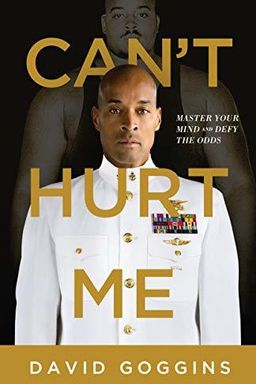
Can’t Hurt Me cover

Can’t Hurt Me

by David Goggins

Can’t Hurt Me by David Goggins is an extraordinary account of resilience and self-discipline. From a traumatic upbringing to becoming a Navy SEAL and ultramarathon runner, Goggins shares his journey of transformation, demonstrating that with determination and mental toughness, anyone can overcome adversity and achieve the impossible.

Turning Pain Into Power

What happens when suffering becomes strategy? In Can't Hurt Me, David Goggins argues that every human has vast reserves of untapped potential, hidden by comfort, fear, and trauma. His life—spanning child abuse, racism, obesity, military failure, and elite endurance sports—is an illustration of how deliberate suffering, radical honesty, and disciplined repetition can transform weakness into superhuman endurance. The book is less a memoir than a manual: it teaches you how to engineer resilience by choice.

The Hidden Power of Trauma

Goggins’ childhood in Williamsville, New York looked like prosperity—a home on Paradise Road, his father’s business Skateland, and luxury cars—but behind that facade existed daily violence. His father, Trunnis, beat and humiliated the family. That duplicity taught Goggins the first lesson: appearances deceive. When he and his mother escaped to Brazil, Indiana, racism added new scars. From that mixture of abuse and isolation, he learned early survival habits—hiding, cheating, and performing for acceptance—that later became fuel for discipline.

Learning Radical Accountability

Recovery began with truth. The Accountability Mirror, covered in blunt Post-It notes, forced him to confront the lies that kept him stuck. The act of telling himself “You’re fat” or “You’re not studying” wasn’t cruelty—it was clarity. This active honesty replaced victimhood with measurable micro-goals: lose two pounds this week, study ninety minutes, make the bed every morning. Repetition and recorded progress rewired his self-perception. (Note: This mirrors cognitive-behavioral therapy’s approach of replacing vague self-talk with structured, empirical feedback loops.)

Engineering Discipline

Goggins treats change like an engineering problem. When he decided to lose over 100 pounds to qualify for Navy SEAL training, he built a strict schedule: 4:30 a.m. cardio on the stationary bike, hours of swimming, high-rep strength circuits, and calorie restriction. He didn’t rely on motivation; he relied on systems. Failures became diagnostic data: missed goals earned extra suffering, forcing consistency. This blueprint-based discipline shows that transformation requires architecture, not emotion.

Expanding Capacity Through Exposure

Repeated exposure to discomfort builds psychological callouses. In the Air Force Pararescue program, his near-drowning episodes and the fear of 'water confidence' exercises revealed that fear dominates by domain—you might be fearless in one setting but paralyzed in another. Facing these domains intentionally through graduated exposure drills rewrites mental limits. Goggins converts failure into training data: quitting once only redefines the route.

Mind Over Body, Body Over Ego

Hell Week at BUD/S demonstrates his idea of 'taking souls': using mental dominance to reverse the power dynamic. By outperforming expectations under extreme duress, you unsettle opponents and reclaim control. Goggins applies it universally—to exams, meetings, and races—anywhere mental advantage precedes physical victory. Pain, properly understood, is a currency. You earn strength by paying it forward.

The Mature Transformation: Purpose Beyond Pain

In later years, Goggins redirects pain into service. The deaths of SEAL comrades during Operation Red Wings lead him to run ultra-endurance events to fundraise for their families. Suffering gains moral weight. Instead of punishment or validation, pain becomes contribution. Purpose multiplies endurance by connecting self-transcendence to impact.

The Core Argument

Throughout Can't Hurt Me, the message stabilizes: humans stop at 40% of their true capacity. By callousing your mind through controlled suffering, mastering constructive failure analysis, and maintaining radical self-accountability, you unlock the remaining 60%. The book’s evolution—from survival to self-discipline to service—illustrates how pain, properly interpreted, can become a renewable resource for courage and mastery.


Radical Accountability

Goggins teaches that the first transformation arises through honesty. The Accountability Mirror symbolizes self-audit—the act of seeing yourself unfiltered. You write your truths on sticky notes so the mirror tells no lies. These notes become measurable tasks, making change actionable rather than aspirational.

Building a System of Truth

You start with small goals: lose two pounds, complete flash cards, clean the room. Each task feeds momentum. Brutal honesty recalibrates motivation—you stop confusing effort feelings for real results. Paired with rituals like shaving, running, and bed-making, these daily acts rebuild integrity.

From Cheating to Mastery

Earlier, cheating was Goggins’ survival strategy. The mirror helped him replace shortcuts with study and incremental mastery. Transcription, repetition, and flash cards transformed him from a failing student to one who could pass military exams. By quantifying every step, he built reproducible accountability. (Note: This parallels James Clear’s atomic habits—both focus on measurable input as the foundation of sustainable change.)

Key Lesson

Self-improvement starts with honest diagnosis. Sugarcoating kills progress; data saves it.

Use your mirror daily. State the problem plainly. Then measure whether your action solved it. Radical accountability isn’t punishment—it’s the language of growth.


Design the Impossible

Transforming your life demands blueprinted discipline, not wishful thinking. For Goggins, losing over 100 pounds in three months was his 'impossible task'—not achieved by magic but by engineering. He built a plan like a machine, attacking body and mind simultaneously.

Blueprint Thinking

He treated change as modular design: wake at 4:30, bike while studying, swim laps, lift weights, eat sparingly, track metrics, repeat. Every hour had purpose. When a goal failed, he doubled the cost—extra miles or reps. Suffering became a feedback loop reinforcing discipline, not punishment.

Physical and Mental Co-Engineered Systems

His workouts rebuilt physiology while cognitive drills—flash cards, transcription, repetition—rebuilt confidence. Micro-failures were logged like laboratory data. Honesty and system repetition converted chaos into structure. He also tracked heart rate, sleep, food, and study duration, showing that mastery emerges from structured inputs.

Insight

If you want impossible results, design impossible systems. Emotion burns out, architecture endures.

By the end, he proved radical transformation hinges on daily calibration—precise routines turning suffering into construct. Your impossible task must be engineered, not imagined.


Callous the Mind

The '40% Rule' frames human capacity. When you think you’re done, you’ve used only 40%. Fatigue is psychological signaling, not total depletion. Repeated controlled stress hardens your mental governor and expands usable energy.

How Callousing Works

Just as skin toughens through repeated friction, the mind toughens through repeated discomfort. Add 5–10% more effort weekly in workouts or tasks. That incremental stress teaches endurance. Goggins learned this during ultras like Hurt 100 and Badwater, where enduring boredom and agony unlocked hidden stamina reserves.

The Governor Metaphor

Your brain’s 'governor' limits effort to avoid suffering. Exposure retrains that mechanism: when the alarm triggers, recognize it as signal, not stop. Elite performers override the governor calmly, expanding performance range.

Practice

Keep a log of discomfort duration, then extend it weekly. You grow when the governor hesitates and you move anyway.

Callousing is not masochism. It’s progressive adaptation—learning to function inside pain without panic. Eventually, your mind stops seeing pain as threat; it sees it as training data.


Fear and the Domain of Quitting

Everyone has a domain where fear rules. For Goggins, it was water. His Pararescue training exposed suffocating panic underwater. He quit once, rationalizing through medical diagnosis. That moment taught him that fear is domain-specific—it lives where competence is low.

Confronting the Domain

To dismantle fear, identify the specific setting—public speaking, rejection, depth—and design exposure drills that incrementally reduce panic. For Goggins, this meant knot tying underwater with a fractured knee, repeated until blackout fear normalized. Each repetition reprogrammed his stress response.

Lessons from Quitting

Quitting, if analyzed, is data. Goggins returned stronger through SEAL training, converting that earlier retreat into insight. Fear doesn’t vanish—it gets compartmentalized and re-trained through repetition under stress. (In psychology, this reflects exposure therapy: consistent controlled engagement with triggers.)

Takeaway

Quitting once doesn’t define you—your response afterward does. Fear marks the next training location.

You conquer domains of quitting by systematic, uncomfortable participation. Avoidance feeds fear; engagement rewires it.


Taking Souls

In Hell Week, Goggins developed 'taking souls'—a mental warfare tactic that uses performance to unsettle others. Instead of reacting to pressure, you turn effort into offense: dominate expectations so opponents lose control of their narrative.

Tactical Mindset

Boat Crew Two used stolen schedules and ritual chants to create psychological control. They sang in surf torture, outperformed others, and became admired even by instructors. The tactic converted exhaustion into belonging.

Transferable Strategy

Taking souls applies anywhere: outperform negative bosses, surprise examiners, or outprepare rivals. You don’t attack people—you attack their assumptions. Preparation becomes your psychological weapon. (Note: This concept echoes stoic control through response rather than reaction.)

Core Message

When you control the mental tempo, you control the outcome. The body follows the mind’s pace.

Every hardship contains chance to take souls. When others expect surrender, overdeliver. The shockwave creates moral advantage.


The Cookie Jar Method

Willpower depletes without emotional recall. The 'Cookie Jar' is Goggins' mental technique for drawing energy from past victories during pain. You inventory wins and replay them until pride and gratitude override fatigue.

Reaching Into the Jar

Each stored memory—passing the ASVAB, losing weight, surviving abuse—contains emotion. When racing 100 miles, he remembered early wins to summon adrenaline at mile 70. Emotional recall triggers physiological endurance boosts.

Practical Setup

List twenty victories, big and small. Practice recalling sensations, not just facts. Use this before fatigue peaks. When trained, it becomes an automatic resilience switch.

Remember

The Cookie Jar is not nostalgia—it’s tactical emotion management. Past pride fuels current grit.

Practice gratitude under duress. Stored pride transforms current pain into continuation.


Prepare Like a Scientist

Preparation protects willpower. Goggins treats extreme events as experimental design. He studies conditions, runs simulations, and eliminates unknowns before they sabotage performance. Research replaces guesswork.

Reconnaissance and Visualization

For Badwater, he mapped weather, elevation, and cooling stations. He visualized breakdown scenarios—heat, cramps, equipment failure—and pre-rehearsed responses. This method allowed focused execution under stress. (Note: Similar to NASA’s simulation principle—pre-program responses to minimize failure impact.)

Learning from Failure

In earlier races, poor gear and hydration caused collapses. Analysis produced redundancy systems: backup lights, salt tabs, layered heat suits. Every fix born of failure became the foundation for future durability.

Principle

Preparation is mental armor. When conditions break, your pre-planned responses sustain you.

Study, simulate, adapt. Scientific preparedness converts anxiety into competence—a portable advantage in any domain.


Failure and the Feedback Loop

For Goggins, failure is laboratory data. His After Action Reports (AARs) analyze mistakes so each setback becomes instruction. The world-record pull-up saga exemplifies this: he failed twice, each time refining technique and recovery until success.

Writing the AAR

Immediately document what went right and wrong. List errors precisely: equipment, pacing, food. Propose experimental fixes, schedule retry. This transforms failure from identity to iteration.

Iterative Mastery

His first Today Show attempt failed—unstable bar, bad nutrition. Second improved but created hand injuries. Third succeeded through foam padding, pacing, and preparation. Each AAR elevated competence. (Comparable to agile development—rapid, small-cycle improvement.)

Lesson

Failure isn't verdict, it's version control. Analyze, iterate, and update until mastery compiles.

Use AARs in your own life: turn embarrassment into blueprint. Performance evolves by curiosity, not pride.


Purpose and Legacy

Beyond endurance, Goggins finds meaning in service. After losing SEAL teammates in Operation Red Wings, he turns races into fundraising platforms for military families. Pain gains transcendent purpose.

From Suffering to Service

At the San Diego One Day race, he channels exhaustion into fundraising commitment. Every mile becomes symbolic debt payment to fallen peers. When hardship benefits others, motivation becomes inexhaustible.

Living Beyond Self

Comfort pursuit fades; contribution endures. Pain with intent builds legacy. The equation changes: suffering becomes resource, not deficit. Service transforms grit into reverence.

Essential Insight

Purpose is multiplier. When your struggle lifts others, endurance becomes infinite.

Make suffering useful—tie it to cause, family, or community. That form of transcendence stabilizes willpower through meaning.

Dig Deeper

Get personalized prompts to apply these lessons to your life and deepen your understanding.

Go Deeper

Get the Full Experience

Download Insight Books for AI-powered reflections, quizzes, and more.