
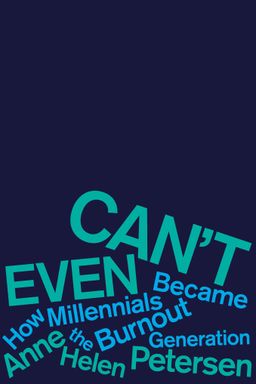
Can''t Even cover

Can''t Even

by Anne Helen Petersen

Can''t Even reveals the systemic challenges millennials face, from overbearing childhoods and educational burdens to exploitative work cultures. Anne Helen Petersen dissects the roots of millennial burnout, offering a compassionate critique of societal norms and expectations.

The Anatomy of Burnout

Why do so many of us feel hollow and exhausted even when we’re doing everything “right”? In Can’t Even: How Millennials Became the Burnout Generation, Anne Helen Petersen argues that burnout is not just tiredness—it’s the defining condition of a generation. She describes it as “what happens when you hit the wall but keep going,” a phenomenon shaped by economic insecurity, cultural expectations of relentless productivity, and institutions that treat exhaustion as proof of worth.

Petersen redefines burnout as a structural condition, not a moral failure. You were taught to overwork by systems—schools, jobs, and social networks—that made busyness synonymous with virtue. Yet beneath this performance lies a pervasive sense of futility: no amount of work produces stability or satisfaction. This book traces how economic precarity, cultural myths like “do what you love,” and technology together create endless striving without rest or reward.

From Personal Exhaustion to Structural Crisis

Burnout feels personal—you can’t finish your errands, answer emails, or detach from work—but Petersen insists it’s social in origin. She ties the modern burnout epidemic to the erosion of job security, rising student debt, and gig-economy expectations. The World Health Organization recognizes it as an occupational phenomenon, confirming that what you feel isn’t laziness—it’s survival under conditions of constant production pressure.

Throughout the book, you meet people whose coping strategies mirror your own: the BuzzFeed employee who can’t log off Slack, the adjunct chasing stability through “hope labor,” the parent drowning in childcare logistics. These aren’t isolated failures but symptoms of systems designed to extract as much energy as possible from individuals who can’t afford to stop.

How We Got Here: The Millennial Condition

If you’re a millennial, your burnout began early. Raised on the promise that education and hard work guaranteed success, you entered an economy that broke that bargain. The Great Recession, the collapse of unions, and ballooning student debt reshaped work into a high-risk competition. You learned to optimize yourself—through extracurriculars, perfect résumés, unpaid internships—because stability was no longer guaranteed.

Sociologists call your upbringing “concerted cultivation,” a form of parenting that micromanaged play and turned free time into résumé fodder. As an adult, that training manifests as inability to rest—you equate worth with busyness. The result: a cohort of competent, anxious adults skilled at performing productivity but unfamiliar with restoration.

Technology, Surveillance, and the Erosion of Boundaries

Digital tools promised liberation but instead created 24/7 workplaces. Slack pings mimic urgency; algorithms schedule shifts without regard for human rhythm; gig apps convert independence into isolation. Surveillance software tracks keystrokes and “engagement,” reducing trust to data points. As Petersen shows through stories of Bri, Sabrina, and millions of gig workers, technology has intensified both control and insecurity.

The attention economy compounds the problem. Your leisure is colonized by apps that monetize distraction and fuel comparison. Even rest—Netflix binges, Instagram scrolls—reinforces the same metrics of visibility and validation that drive your labor. Eventually, you can’t tell where work ends and you begin.

Why Burnout Persists—and How It Might Break

Burnout endures because it benefits someone. Corporations externalize risk, governments underfund labor protections, and cultural myths glorify suffering as character. Petersen argues that by diagnosing burnout collectively—not as personal weakness but as policy failure—we reclaim the ability to demand better systems: universal childcare, predictable scheduling, strong labor laws, and the right to genuine leisure.

Core insight

You are not lazy or broken. You are responding rationally to conditions designed to keep you running. The cure for burnout isn’t better self-care—it’s structural care.

By the end of the book, the message is clear: rest is political. When you understand burnout as systemic, your exhaustion becomes not shameful but revelatory—a sign that the system needs to change, not you.


Millennial Precarity and the Broken Promise

Millennial burnout begins with economic betrayal. Between 1981 and 1996, a generation grew up told that education and hustle would deliver stability. Instead, millennials entered adulthood amid collapsing wages, vanishing pensions, and mass debt. Petersen uses data and personal stories to show how structural insecurity made overwork a rational strategy.

Debt, Risk, and the Education Gospel

From high school onward, you were promised salvation through education. Anne Lareau’s concept of “concerted cultivation” describes how middle-class families raised children to build résumés—the premise being that optimization led to safety. But as tuition soared, that safety morphed into a trap: degrees were necessary but insufficient, leaving graduates burdened with $30,000–$50,000 in loans and unstable work. The “education gospel,” as sociologists call it, became a moral command to keep upgrading yourself indefinitely.

Unequal Precarity

The burnout crisis is racialized and classed. Black borrowers default on student loans at more than twice the rate of whites; working-class millennials face limited safety nets compared to peers with generational wealth. Petersen reminds readers that insecurity is unevenly distributed but universally felt—it organizes how you plan children, housing, and even rest.

The Compulsion to Keep Working

In an environment where stability is never guaranteed, work becomes emotional armor. You reason that if you never stop, catastrophe can’t catch you. This survival logic feeds a society where rest looks like failure. Burnout, then, is not just exhaustion—it’s the psychic cost of meritocracy in decline.

Millennials didn’t invent overwork; they perfected it under duress. Burnout is their logical adaptation to living without institutional guarantees.


Work as Identity and Exploitation

Petersen calls the mantra “Do what you love” one of modern capitalism’s most seductive lies. Popularized by Steve Jobs and echoed in countless commencement speeches, it frames labor as passion. But as scholars like Miya Tokumitsu note, it’s a perfect recipe for exploitation: workers who love their jobs will do them endlessly, for little pay, and call it meaning.

Hope Labor and the Dream of Calling

“Hope labor” describes unpaid or underpaid work done in the belief it will lead to future reward—internships, fellowships, or side hustles “for exposure.” Petersen’s examples—Sofia’s museum internships, Hiba’s magazine work on a friend’s couch—reveal how passion rhetoric obscures privilege. Those who can afford to work for free gain access; others are shut out.

Even jobs that truly align with personal calling, like zookeeping or academia, rely on devotion to justify low pay. Passion becomes a disciplinary tool: if you suffer, it’s proof you care enough. That inversion transforms purpose into self-exploitation.

From Calling to Commodity

The new economy converts vocation into brand. On social media, freelancers and creators market themselves as personal products. The promise of autonomy hides dependence on algorithms, clients, or employers who dictate terms. What was framed as self-expression degenerates into constant self-marketing—another form of labor without downtime.

“Do what you love” sounds like liberation; in practice, it replaces fair compensation with devotion as the metric of value.


How Work Became Precarious

Understanding burnout requires tracing how work itself changed. The postwar era’s stable jobs—pensions, unions, and clear roles—gave way to deregulation, outsourcing, and gig labor. Petersen shows how the “fissured workplace” transformed collective responsibility into individual precarity, producing a generation of workers always one cutaway from disaster.

From Security to Flexibility

Starting in the 1970s, corporations dismantled the institutions that buffered risk. Temporary workers and independent contractors replaced full-time staff. Private equity firms prioritized short-term profits over long-term welfare, hollowing out once-solid companies like Toys “R” Us. The result: stronger profits, weaker people.

The Gig Economy’s False Freedom

Gig platforms like Uber reframed control as flexibility: no boss, no schedule—just you and your app. But algorithms dictate who gets work and at what rate, turning independence into shadow employment. Nick, a freelance data analyst, sums up the feeling: “You’re working eternally.” What looks like empowerment is actually exploitation disguised as autonomy.

Surveillance Capitalism at Work

Tech-driven management amplifies pressure. Employees like Bri and Sabrina, tracked by keystrokes or time logs, describe constant anxiety about appearing productive. Data replaces trust, producing paranoia rather than performance. As Amy Wrzesniewski notes, surveillance crushes meaning-making—the essence of human work.

The new labor contract is unspoken: full responsibility without full autonomy, infinite accountability without security.


Digital Life and the Collapse of Leisure

The modern attention economy ensures you’re never truly off. Digital tools designed to connect you instead consume every pause. Petersen’s day—a blur of Slack, Twitter, emails, and alerts—mirrors yours: even leisure is mediated by screens. Every ping pulls you back into performance.

Attention as Commodity

Apps are built on behavioral economics: variable rewards, red badges, infinite scrolls. Dopamine ensures that missing a notification feels like missing the world. Even digital wellness tools slot into the same logic—another dashboard to optimize your existence. Over time, attention itself becomes labor, managed across platforms that profit from your anxiety.

The Performance of Productivity

Slack and similar tools make work theatrical. You “LARP” your job—posting comments, reacting with emojis—to prove worth through visibility. When output is intangible, presence replaces results. Petersen notes that she wrote more in six days offline than weeks online—a quantitative proof of how distraction dilutes creativity.

The Vanishing Weekend

Historically, workers fought for weekends as collective rest. Now, online hustle culture erases boundaries between work and play. Juliet Schor documented the paradox decades ago: higher productivity without more leisure. Today’s “wellness weekends” are just optimized downtime, not restoration. Yet experiments with shorter workweeks, like Microsoft Japan’s four-day trial, show how real rest strengthens output.

Rest is not indulgence; it’s infrastructure. Protecting time off is a form of resistance against a system that profits from your constant attention.


Care, Gender, and Hidden Labor

Burnout doesn’t stop at the workplace—it extends into homes. Petersen integrates feminist scholarship to show how caregiving, especially for mothers, multiplies exhaustion. Society still runs on the friction of invisible labor: meal planning, emotional caretaking, scheduling, remembering. Parenting under capitalism is not just physically tiring—it’s mentally unsustainable.

The Mental Load

Arlie Hochschild’s “second shift” remains the rule: women perform paid work, then unpaid domestic work. Even egalitarian couples reproduce imbalance—fathers increase hours while mothers carry logistics. Stories like Lisa’s meltdown over toddler shoes or Lauren’s morning dread testify to exhaustion not solved by better planning but by rebalanced systems.

Systemic and Racial Inequities

For parents of color, the burnout risk is magnified by judgment and surveillance. Black mothers face criminalization for choices white parents call independence. Childcare costs consume a third of income for single parents. The moral rhetoric of “good parenting” punishes everyone by privatizing what should be public infrastructure: support, community, time.

Real Relief Requires Policy

Paid leave, universal childcare, and cultural norms that value caregiving rank among Petersen’s non-negotiables. Self-help cannot redistribute labor; policy can. Recognizing the mental load as real work is the first step toward a fairer division of time and dignity.

Parenting burnout isn’t personal weakness—it’s collective neglect. When society refuses to support caregivers, everyone burns out eventually.


From Individual Fatigue to Collective Action

The book closes with a political challenge: burnout is not a personal defect but evidence of systemic malfunction. You cannot self-care your way out of structures that depend on overwork. Petersen moves from diagnosis to prescription—demanding solidarity, regulation, and reimagined public life that values rest.

Collective Naming as Power

Naming burnout as political defuses shame. You stop asking “What’s wrong with me?” and start asking “Who benefits from my exhaustion?” That question transforms isolation into collective possibility. Across cultures—from Japan’s “karoshi” deaths to American gig workers—the same pattern emerges: systems designed for extraction replicate suffering globally.

Systemic Solutions

Real relief lies in a social contract that redistributes time and security: universal healthcare, parental leave, scheduling laws, and a four-day workweek. Even small policy shifts—predictability mandates or childcare credits—reduce the psychological tax that drives burnout. The goal isn’t just to rest more but to live differently.

“Refuse the narrative that more effort will save you.” Petersen’s closing line reframes agency: collective action is the only scalable cure for collective exhaustion.

In the end, Can’t Even is both diagnosis and manifesto. It invites you to see your fatigue as political evidence—a signal to organize, not optimize. The path to healing is not doing more but demanding better.

Dig Deeper

Get personalized prompts to apply these lessons to your life and deepen your understanding.

Go Deeper

Get the Full Experience

Download Insight Books for AI-powered reflections, quizzes, and more.