
Idea 1
How Luck Really Works
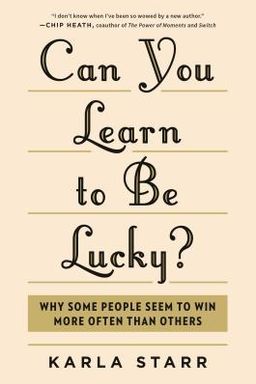
Why do some people seem perpetually lucky while equally capable others struggle? In Can You Learn to Be Lucky?, Karla Starr argues that luck isn’t mystical—it’s predictable. We call it luck when timing, perception, and opportunity align, but those alignments follow identifiable psychological and social patterns. Starr blends behavioral science, neuroscience, and real-world stories to reveal how traits like confidence, self-control, social skill, and readiness transform randomness into advantage.
Her unifying claim is disarmingly practical: luck favors preparation that others can perceive. You can’t control random events, but you can control your visibility, fluency, timing, and how easily others imagine you succeeding. Across stories of athletes, entrepreneurs, politicians, and musicians, Starr shows that our brains—wired for shortcuts—assign luck unevenly. Those who understand these shortcuts win more opportunities.
The Psychology of Chance
Human decisions rely on accessible cues. Judges, investors, and interviewers lean on whatever is easiest to process—faces, stories, order, timing. That’s why Michelle Kwan’s early skating position disadvantaged her in Nagano, or why parole judges were lenient after lunch but harsh before breaks. These cognitive biases mean performance and merit only partly determine results. Understanding them lets you choreograph how and when you’re seen.
Social Networks and Familiarity
Luck often arrives through people. Familiarity, fluency, and proximity—a principle Starr calls the Charlie Brewer effect—shape whom others favor. You gain marbles of positive evidence with every exposure or shared link. Festinger’s MIT housing study proved friendship probability increased by architectural proximity, while Zajonc showed that mere exposure builds liking even without conscious recall. Familiarity compresses uncertainty; that compression is often mistaken for merit.
Status, Confidence, and Preparation
Confidence—anchored in status cues, habitus, and biological activation systems—triggers opportunities because it signals readiness. When your behavioral activation system (the BAS) outruns inhibition (BIS), you act boldly. That action itself changes how others treat you. Bourdieu’s concept of habitus explains why children from high-status backgrounds internalize authority; they feel entitled to try, so they get more tries. The same applies emotionally: higher dopamine and testosterone reinforce approach behavior, creating a feedback loop between confidence and luck.
Skill, Genes, and Environments
Talent interacts with environment. Donald Thomas’s meteoric rise in high jump came from genetic predisposition (long Achilles tendons) combined with fortuitous exposure, coaching, and persistence. Genes create ceilings, but exposure and effort fill the space beneath them. Starr’s synthesis echoes Chambliss’s and Ericsson’s findings: deliberate practice matters, yet only alongside structural advantages like quality feedback, supportive neighborhoods, and timely mentors. You change your odds by choosing environments that reward iteration.
Luck as Designed System
Self-control and habit turn fleeting opportunities into progress. Sivers’s CD Baby story and Mischel’s marshmallow experiments illustrate that delay of gratification, embedded in reliable contexts and scaffolding habits, allows you to compound small wins. Similarly, visible self-investment—that Kickstarter trailer or prototype—shows gatekeepers you’re ready. Luck becomes cumulative when effort produces visible signals others trust.
Core Thesis
Luck isn’t random generosity; it’s patterned opportunity you can strategically magnify. You gain more chances when you are visible, fluent, confident, prepared, and positioned where judgment works in your favor.
Across all chapters, Starr’s message is consistent: you can learn luck by learning psychology. Manage impressions, timing, and self-control, and you shape how randomness lands. When you perform late, appear familiar, look fluent, act confidently, and invest visibly, you turn happenstance into predictable success.