
Idea 1
Why We Buy: Uncovering Our Hidden Buyology
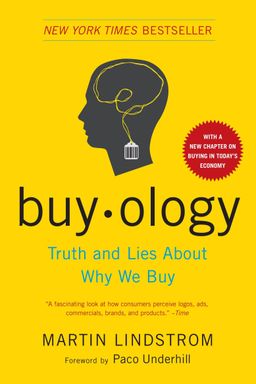
Why do you buy what you buy—and why do you choose one brand over another even when you don’t mean to? In Buyology, marketing expert Martin Lindstrom takes you inside the human brain to reveal that our purchasing decisions are governed far less by logic than by invisible, unconscious forces. Despite what we tell ourselves, we buy not because of rational features or prices, but because our brains are hypnotized by brands that tap emotions, rituals, and sensory experiences.
Drawing from a three-year, $7 million neuromarketing study—the largest of its kind—Lindstrom combines science and storytelling to show how advertising influences us at levels deeper than awareness. Using tools such as fMRI and SST brain scans, he decodes the subconscious responses people have to logos, slogans, colors, smells, and even warning labels. He argues that traditional market research—surveys, focus groups, questionnaires—is largely worthless because people can’t explain their preferences. Instead, our real motivations light up inside the brain like electrical storms.
The Birth of Neuromarketing
Neuromarketing, the fusion of neuroscience and marketing, is the field Lindstrom helped pioneer. Its goal is not to manipulate consumers but to understand what triggers desire, loyalty, and emotion. Through experiments with smokers and TV viewers, he discovered fascinating contradictions between what participants said and what their brains revealed. Smokers, for example, claimed warning labels deterred them—but their fMRI scans showed those same labels activated the nucleus accumbens, the brain’s craving spot. Rather than discouraging smoking, the labels made people want a cigarette even more. This paradox exemplifies his central point: our conscious minds lie to us; our brains tell the truth.
The Mystery of Branding and Behavior
At its core, Buyology is about how brands become embedded in the brain’s emotional systems. Lindstrom explores mirror neurons, subliminal triggers, rituals, religion, and even sex to explain what he calls our Buyology—the hidden mental blueprint of buying. Each advertisement, sound, or scent interacts with our brain chemistry. Coke’s red color, Harley-Davidson’s engine growl, Apple’s sleek design, and the ritual of pouring Guinness all bypass logic and reach the limbic center, where feelings, memories, and addictions converge. In that moment, buying becomes a form of faith, rooted in deeply personal neurological associations.
Why Our Brains Are Brand Addicts
Lindstrom’s thesis challenges the myth that we are rational shoppers. In truth, 85 percent of our decisions are made below awareness. From the color of a Tiffany box to the smell of a bakery, sensations evoke emotions that drive action. Brands succeed when they fuse themselves into our identity and reassure us at times of stress or uncertainty—just as religion uses ritual and symbolism to comfort its followers. His work demonstrates that brands activate the same regions of the brain as spiritual experiences, suggesting that brand devotion and religious faith may share neurological roots.
Previewing the Buyology Roadmap
Across twelve chapters, Lindstrom explores how subliminal advertising still thrives, why product placement often fails, how superstitions and rituals strengthen brand loyalty, and how sensations like smell and sound shape perception. You’ll encounter studies of mirror neurons that make us mimic others’ choices (“I’ll have what she’s having”), discover why logos are dying while sensory cues rise, and see how warning messages can spark cravings instead of caution. He’ll also reveal how religion and branding overlap, why attention is a scarce resource, and how future marketing may become more ethical once we fully understand the brain’s mysteries.
Why This Matters
Lindstrom’s message is both cautionary and empowering. The more we understand our Buyology—the emotional, cellular-level impulses that drive every purchase—the more conscious we can become as consumers. Recognizing that sound, scent, and ritual influence us helps us resist manipulation and choose meaning over marketing hype. At the same time, ethical companies can use these discoveries to build products that genuinely connect and serve human emotion rather than exploit it. In the end, Buyology reveals that capitalism’s future may depend not on selling harder, but on understanding who we are when we buy.