
Idea 1
Financial Freedom on Your Terms
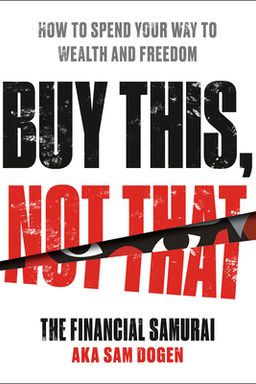
How can you design a life that is both financially secure and personally fulfilling? In Buy This, Not That, Sam Dogen (known as the Financial Samurai) argues that true financial freedom means being able to live life on your terms—not just accumulating wealth for its own sake. He presents a practical, math-driven philosophy that combines the psychology of freedom, the mechanics of wealth-building, and the humility of probabilistic thinking.
Dogen’s framework begins with a simple premise: money is a tool, not the finish line. He estimates that money accounts for roughly 40% of happiness—the rest comes from purpose, relationships, and growth. Progress, not possessions, forms his definition of happiness. But progress requires strategy. Across the book, he offers numerical benchmarks, tested rules, and mental models for reaching financial independence faster.
The twin engines: defense and offense
Financial freedom operates on two fronts. Defensively, it shields you when life throws shocks—like layoffs or market plunges. Offensively, it gives you permission to pursue your own projects, take risks, or step away from the hamster wheel. Dogen retired from banking at thirty-four after securing passive income streams and negotiating a severance package. That severance bought him time to raise his family, build Financial Samurai, and live life without fear of money’s grip.
You can replicate this strategy—not by relying on luck, but by mapping numbers and actions to your desired lifestyle. Define what freedom looks like for you, price that vision, and reverse-engineer how much passive income you must build to support it.
Translate dreams into mathematics
The book anchors your goals in formulas: target a net worth equal to about 20× your average annual gross income or 25× your yearly expenses. If you earn $150,000, you’d aim for $3 million. If you spend $60,000, then $1.5 million may be enough. These targets bridge idealism and arithmetic—ambitious but precise.
To help you calibrate time horizons, he provides age-based milestones (from 2× at 30 to 20× at 60). You measure progress by the years of living expenses you’ve bought through investments. He interweaves math with emotion—reminding you that the end goal is not spreadsheets but psychological freedom.
The 70/30 rule for life, work, and risk
A recurring theme in the book is probabilistic decision-making. Instead of waiting for perfect certainty, act when you have at least a 70% chance your choice is right. Accept that 30% of the time, you’ll be wrong—and adapt. This applies to career moves, investments, and even relationships. People who act on imperfect but favorable odds create opportunities others miss. (Note: This echoes Annie Duke’s concept of “thinking in bets,” another high-level probabilistic guide.)
Sam trains you to forecast decisions deliberately: write down predictions, compare them to outcomes, and adjust. Over time, your internal probability radar sharpens—helping you make faster, higher-quality choices in money and life.
The Financial Samurai blueprint
Dogen’s playbook unfolds in four phases: (1) save aggressively using tax-advantaged and taxable accounts, (2) invest in real estate and equities for passive income, (3) master debt through the FS DAIR formula (allocating cash between debt payoff and investment), and (4) diversify through careers and side hustles to multiply cash flow. Each phase centers on one principle—move decisively and measure results.
He also develops subtle lifestyle frameworks: Stealth Wealth (keep a low financial profile to preserve freedom), BURL (Buy Utility, Rent Luxury for housing), and income tethering (link investments to small joys like your favorite pastry or vacation). Small wins build psychological momentum and sustain long-term goals.
Freedom through responsibility
At its core, Dogen’s philosophy rejects entitlement. Financial freedom comes from self-knowledge and math-based responsibility—not from luck or shortcuts. It’s about designing your personal game plan, making probabilistic moves, and compounding those choices through disciplined saving and investing. You aren’t chasing maximal wealth; you’re optimizing life for autonomy.
Financial freedom sooner than later
Don’t wait for retirement to begin living freely. Use the Financial Samurai approach—define, price, save, invest, iterate—and shorten your runway to independence. Freedom isn’t a future date; it’s a disciplined path you build now.
By integrating psychology, arithmetic, and adaptive decision-making, Dogen’s book becomes less about money itself and more about mastering agency: the ability to act with confidence and design the life you actually want.