
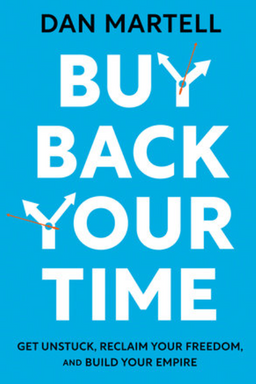
Buy Back Your Time cover

Buy Back Your Time

by Dan Martell

Buy Back Your Time by Dan Martell offers entrepreneurs a roadmap to escape the grind of daily tasks and focus on building their empire. Through actionable advice and real-life success stories, learn to delegate effectively, enhance productivity, and achieve a fulfilling work-life balance.

Reclaiming Time to Reclaim Freedom

Have you ever felt trapped by your own success, constantly working but barely living? In Buy Back Your Time, serial entrepreneur Dan Martell offers a powerful answer: stop working harder, and start buying back the time that gives you life. Martell argues that true entrepreneurial freedom doesn't come from grinding longer hours—it comes from systematically trading money for time so you can focus on what lights you up and makes you money. His book shows you how to do exactly that, blending frameworks, real-life stories, and step-by-step strategies borrowed from over a decade of mentoring founders.

Martell’s message is rooted in personal experience. After transforming his life from a troubled youth and near tragedy to a successful founder, he built businesses that nearly destroyed his health and relationships. When everything fell apart, he vowed to design a business—and a life—that would grow his time, not eat away at it. This insight became the Buyback Principle: “Don’t hire to grow your business. Hire to buy back your time.” Instead of building companies that enslave you, Martell teaches you to structure your time, systems, and hires so success increases your freedom instead of your pain.

The Entrepreneur’s Trap

Martell identifies the modern entrepreneur’s paradox: the harder you work, the more trapped you become. Founders start businesses dreaming of flexibility and purpose, but as workloads pile up, they end up chained to their calendar, drowning in emails, meetings, and tasks they despise. He calls this the “Pain Line”—the point where success creates more suffering than joy. When you reach it, you unconsciously stall, sabotage, or sell your company just to stop the pain. The Buyback Principle is your exit route.

From Time to Energy to Growth

At the heart of Martell’s system is the Buyback Loop: audit, transfer, fill. First, audit where your time goes. Then transfer low-value or energy-draining tasks to someone else. Finally, fill freed hours with activities that give you energy and increase revenue. Each cycle upgrades your time and expands your freedom. When you focus on work you excel at and enjoy—your “Production Quadrant”—your business grows faster and your life gets better. This idea echoes Stephen Covey’s famous principle of investing time rather than spending it, but Martell modernizes it for founders juggling leadership, technology, and balance.

The Frameworks of Freedom

Throughout the book, Martell introduces practical tools to turn philosophy into daily action. The DRIP Matrix helps you categorize tasks not just by money but by energy—Delegation, Replacement, Investment, and Production—so you can see where your life gets drained or charged. The Replacement Ladder breaks hiring into strategic rungs, showing which roles to off-load first—from admin work to leadership—so your time scales along with your business. The Buyback Rate formula helps you calculate what your time is worth and determine what tasks to delegate, hire, or automate. It’s a financial mindset shift: time, not money, is the ultimate currency of growth.

Living the Buyback Life

In the end, Buy Back Your Time isn’t just about productivity—it’s about transforming your lifestyle. Martell’s clients learn that buying back time is the secret to reclaiming health, creativity, and relationships. Through case studies—from panicked founders to thriving entrepreneurs—he shows that building systems, empowering teams, and designing energy-based weeks can make work joyful again. As he puts it, “You don’t own a business if it depends on you. You have a job.” Buying back time lets you become not just a business owner, but an empire-builder.

This book matters because time management alone isn’t enough. Martell’s message is revolutionary for anyone who’s succeeded by hustle but yearns for peace. It’s a playbook for reclaiming freedom, scaling joy, and designing a business you don’t grow to hate. If you’ve ever said, “I wish I had more time,” Martell argues it’s not a dream—it’s a strategy you can execute starting today.


The Buyback Principle

Martell’s cornerstone idea is simple yet profound: Don’t hire to grow your business. Hire to buy back your time. Entrepreneurs often add staff reactively—to fix problems or increase capacity—but Martell flips this logic. Every hire should free you from tasks that drain energy and steal focus so you can reinvest your attention into high-value work that expands profit and joy.

Breaking the Get Sh*t Done Mentality

Martell once lived by the mantra “Get Sh*t Done.” It drove early success but eventually led to burnout. He recounts his coaching client Stuart, a software founder who built his company through nonstop work until stress triggered panic attacks. Stuart was trapped doing everything himself—coding, accounting, customer service. Once he applied the Buyback Principle, hiring two assistants and off-loading low-value tasks through Martell’s Camcorder Method (recording himself performing tasks and training others with those videos), Stuart freed up 30 hours weekly. Within months, his anxiety disappeared and revenue tripled. This transformation captures how buying time changes lives, not just businesses.

The Pain Line and Growth Ceiling

Martell introduces the Pain Line—a psychological and operational threshold every founder hits when growth becomes unbearable. At that point, entrepreneurs unconsciously stall, sabotage, or sell their business to escape discomfort. The solution isn’t quitting—it’s upgrading systems and mindset. By letting go of tasks below your pay grade (determined by your Buyback Rate), you prevent burnout and avoid self-sabotage.

Systems Over Goals

Martell echoes James Clear’s insight from Atomic Habits: “You don’t rise to the level of your goals; you fall to the level of your systems.” Buying back time is a system—repeatable, measurable, sustainable. Growth stops being a product of willpower and becomes a result of structure. Martell’s formula—Audit, Transfer, Fill—offers entrepreneurs an infinite loop where every gain in revenue buys more freedom, creating exponential improvement.

Key takeaway:

Your business isn’t meant to grow through your sacrifice. Buy back your time first, and growth will follow naturally.


The DRIP Matrix: Energy Is Money

The DRIP Matrix is Martell’s visual tool for deciding where to focus your effort. Every task you perform lies somewhere between two dimensions: how much money it makes and how much energy it gives or drains. The goal? Spend most of your time in the Production Quadrant, where work lights you up and drives revenue, rather than drowning in low-value chaos.

The Four Quadrants

  • Delegation: Tasks that make little money and drain energy (emails, billing). Remove them immediately.
  • Replacement: High-value but draining tasks (sales, marketing). Outsource carefully using the Replacement Ladder.
  • Investment: Energizing work that might not pay now—hobbies, learning, networking. These restore creativity.
  • Production: Activities that pay the most and energize you most—innovating, leading, visioning. Spend most of your life here.

From Oprah to Warhol

Martell illustrates how timeless this principle is. Oprah discovered her genius zone when she shifted from news reporting to talk shows—work that lit her up and made her billions. Andy Warhol


The Replacement Ladder: Scaling in Sequence

Martell’s Replacement Ladder turns delegation into a science. Instead of dumping tasks randomly, you climb systematically through five rungs, each freeing new bandwidth. The ladder ensures that growth is sustainable and sequential so you never lose control of quality or energy.

The Five Rungs

  • Rung 1: Administration. Hire an assistant to manage your inbox and calendar—the gateway to freedom.
  • Rung 2: Delivery. Transfer client fulfillment and customer support using the 10-80-10 rule: do the first 10%, let staff handle 80%, finish the last 10% yourself.
  • Rung 3: Marketing. Appoint a marketing head to maintain consistent campaigns, eliminating friction cycles.
  • Rung 4: Sales. Pass sales calls and follow-up to trained reps. Remember: 80% done by someone else is 100% awesome.
  • Rung 5: Leadership. Build a senior team that runs the business collaboratively, letting you focus on vision and innovation.

Learning from Andy Warhol

Warhol, whom Martell cites as a model, built his legendary “Factory” to replicate his art with assistants, turning creativity into an assembly line without losing essence. The artist wanted to “be a machine,” mastering the art of replacement to expand impact. Entrepreneurs, Martell says, must adopt the same mindset: replace yourself step by step, build systems that produce excellence, and you’ll become an empire-builder rather than an exhausted technician.

Key takeaway:

Scale systematically. Each hire should climb you up the ladder—from stuck to flow—until your company runs without you.


Clone Yourself with Systems

Martell’s motto for founders is bold: Clone yourself through systems, not effort. The first step is hiring an administrative assistant—the ultimate buyback investment. Many entrepreneurs resist this, claiming they’re not “busy enough” or “can’t afford it.” Martell dismantles these fears with data and examples, showing that even billionaires like Richard Branson entrust their time to trained assistants.

The Two Core Responsibilities

Your assistant should own two things: your calendar and your inbox. These are the front doors of your life. By giving them full authority to schedule meetings and handle email, you eliminate 70% of daily distraction. Martell’s “Email GPS” offers folders and rules to route correspondence automatically, so your inbox becomes a controlled system—not a public to-do list. Once founders surrender these tasks, their productivity and energy surge.

The Emotional Barrier

Entrepreneurs often hesitate because they equate delegation with loss of control. Martell reframes it: “You’re not losing power—you’re gaining time.” He shares how his brother Pierre struggled with administrative overload until he let his assistant manage email and scheduling. Within weeks, Pierre reclaimed hours for sales, his unique genius, doubling revenue. Martell calls this the “Free Yourself Jump Start.”

The 9-Figure Assistant

Even elite founders keep lifelong assistants. A friend selling his company for nine figures refused to lose his trusted admin after the deal. Martell calls them “associates and lifelines,” quoting Keith Ferrazzi’s Never Eat Alone: relationships define productivity. Ultimately, cloning yourself isn’t about duplication—it’s about elevation. Your assistant handles the noise; you handle the magic.


Building Playbooks for Predictability

To scale without chaos, Martell introduces Playbooks—repeatable systems that capture excellence so results are predictable. Just as McDonald’s replicated its Speedee Service System worldwide, entrepreneurs can codify how marketing, selling, or onboarding work. Unlimited predictability beats intermittent excellence.

The Four Cs

  • Camcorder Method: Record yourself performing a task three times while narrating actions. These videos become automatic training tools.
  • Course: Write high-level steps—not micromanagement. Think “open café” not “turn knob left for steam.”
  • Cadence: Define how often the task occurs—daily, weekly, monthly.
  • Checklist: List nonnegotiable items to guarantee consistency.

Real Examples

Peter, a plumber, created a billing Playbook to stop forgetting invoices. He filmed himself doing billing once; now new hires follow that system flawlessly. Mark, a software founder, made one for hiring, recording his process and freeing himself for leadership. Martell himself documents everything—from coaching calls to YouTube videos—so his team can replicate perfection.

Playbooks democratize knowledge and reduce questions. Employees learn autonomy under clear checkpoints. Martell’s motto: an 80% complete Playbook is 100% awesome, because it saves you hours every week and keeps your results predictable.


The Perfect Week and Preloaded Year

Time freedom isn’t just about delegating tasks—it’s about designing your schedule to protect energy. Martell’s Perfect Week and Preloaded Year frameworks teach proactive planning so you control your calendar instead of reacting to demands.

The Perfect Week

Instead of squeezing tasks into random gaps, plan your week around energy. Identify when you’re most creative or social and schedule accordingly. Martell’s client Marcell, a founder and CrossFit coach, used this structure to balance fitness, business, and relationships. Batching similar tasks—calls with calls, meetings with meetings—reduces context-switching and boosts flow (shown in studies by Cornell University). Make every hour intentional; remove “buffer time” where nothing meaningful happens.

The Preloaded Year

Zooming out, Martell suggests planning an entire year around “big rocks,” inspired by Stephen Covey. Insert life’s major events—family milestones, vacations, strategic business projects—first. Then batch smaller pebbles like meetings and travel. This ensures what matters most always fits before minor tasks crowd your time. Martell himself preloads birthdays, retreats, and conferences so life happens by design, not accident.

Stress Testing for Energy

After mapping your year, stress test it: check spacing, balance, and recovery. Add maintenance breaks after big events to recharge. Ask, “Would this year feel amazing if it unfolded exactly as planned?” If yes, you’ve architected freedom. If not, adjust. A planned calendar, Martell says, doesn’t kill creativity—it multiplies it.


Transformational Leadership and Feedback

Buying back time ultimately requires empowering others. Martell’s chapters on Transformational Leadership and Feedback reveal how founders evolve from micromanagers to multipliers of talent.

From Transaction to Transformation

Most leaders operate transactionally—telling, checking, repeating—in perpetual control loops. Martell calls it the “tell-check-next” ceiling; you max out at twelve direct reports before collapsing. Replace that cycle with “Tell outcome, check measure, coach to success.” Instead of dictating tasks, define outcomes (“We must be GDPR compliant”) and let team members design the “how.” They grow, you gain freedom.

Coaching through CO-A-CH

Martell’s CO-A-CH framework guides one-on-one conversations: identify the Core issue, share an Actual story, invite Change. By framing lessons through stories, leaders inspire autonomy. Just as John Wooden transformed UCLA athletes with teaching insight instead of commands, founders can replicate brilliance through mentorship, not micromanagement.

The Power of Feedback

Martell’s chapter “This F-Word Will Save Your Business” reframes feedback as the pulse of productivity. He recounts embarrassing moments when he exploded from suppressed frustration with employees like Jacob or Alexis—proof that neglected feedback kills performance. Using coach Matt Mochary’s CLEAR Framework (Create, Lead, Emphasize, Ask, Reject/Accept), he teaches leaders to invite critique safely, listen deeply, and model vulnerability. Cultures that exchange honest feedback retain ‘A players’ and prevent burnout.

True leadership, Martell concludes, is transformational: you build people, they build the business. Once your team thrives autonomously, you’re free to lead creatively and buy back not just hours—but impact.


Dream Big, Live Bigger

Freedom without a dream is idle time. Martell’s final lesson is to use your bought-back hours to build your empire through visionary planning. His concept of the 10X Vision merges ambition with clarity: dream audaciously first, then map tangibly. Lane Merrifield’s story—turning a children’s game into Disney’s $350-million Club Penguin—illustrates boundless belief paired with precision.

Two Phases: Dream, Then Define

Phase 1 is limitless imagination. Ask what you’d do without constraints—eradicate hunger, change industries, redefine joy. Phase 2 adds clarity: describe your future with the same detail you describe your present. Entrepreneurs outline four dimensions—Team, One Business, Empire, Lifestyle—so visions become plans. When Joseph Schooling visualized beating Michael Phelps, he made his abstract dream concrete—and achieved it. Martell teaches founders to visualize, document, and execute similarly.

Living the Buyback Life

Martell’s conclusion blends ambition with peace. In his “Buyback Life,” he works few hours, trains for Ironman events, mentors youth, and dines nightly with family. Success without exhaustion is possible when time funds purpose. He urges readers to visualize stepping into their future like a movie—feel the sights, sounds, and emotions—then silence doubt with “Thank you, not necessary.” Dreaming big isn’t arrogance; it’s service. (As Marianne Williamson writes, “Playing small does not serve the world.”)

Martell’s legacy is a blueprint for entrepreneurs to scale both business and happiness. Buy back your minutes, invest them in meaning, and play the infinite game of life. The goal isn’t retirement—it’s designing work you’ll never want to retire from.

Dig Deeper

Get personalized prompts to apply these lessons to your life and deepen your understanding.

Go Deeper

Get the Full Experience

Download Insight Books for AI-powered reflections, quizzes, and more.