
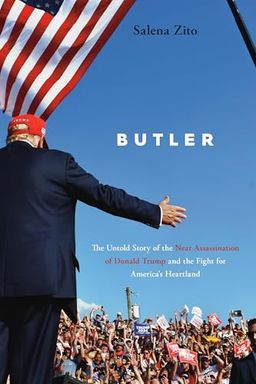
Butler cover

Butler

by Salena Zito

A firsthand account of the attempted assassination of Donald Trump during an open-air campaign rally in Pennsylvania on July 13, 2024.

An Inch That Redefined a Movement

Have you ever felt that a single inch—one tiny turn of the head, a missed step, an unexpected phone call—changed everything? In Butler, Salena Zito argues that America came one inch from a different history when a bullet grazed Donald Trump’s ear at a July 13, 2024 rally in Butler, Pennsylvania. She contends the near-assassination didn’t just test a candidate or a crowd; it exposed a deeper story about rooted American communities (“the placed”), a media that often can’t see them (“the placeless”), and a political realignment that has been building from the bottom up for nearly a decade.

What Zito asks you to see is simple and unsettling: the inch between life and death in Butler mirrored the inch between two Americas—those anchored to place, tradition, and daily interdependence, and those organized around mobility, abstraction, and ideology. She weaves the split-second drama of the shooting with on-the-ground reporting across farm towns, union halls, parking lots, and rope lines to argue that “place” is the missing variable in how campaigns are run, how news is reported, and how millions vote.

What really happened in Butler

Zito opens from the buffer zone just feet from Trump when the first four shots cracked across a treeless farm field that, for 75 years, has hosted the Butler Farm Show. She records agent commands (“Spare, get ready”) and the blood along Trump’s cheek, captures the moment he stands to pump his fist—“Fight, fight, fight”—and the eerie steadiness of a crowd that doesn’t stampede. She watches first responders carry a limp figure from the stands: Corey Comperatore, a volunteer fire captain and father, later pronounced dead after shielding his family with his body. Two others, David Dutch and James Copenhaver, are critically injured.

The day after, Trump calls Zito: “God… the hand of God.” He reworks his Republican National Convention speech from a “vicious” attack into a unity frame, literally ripping up the draft. Weeks later, he returns to Butler, opens with, “As I was saying…,” and pauses for “Ave Maria” to honor Comperatore. Zito then places the event inside hard facts: a bipartisan House task force concludes the Secret Service failed to secure an obvious risk—the American Glass Research roof just 400 feet from the stage—creating “coverage gaps” and communication breakdowns that allowed the shooter to fire eight rounds.

Why Butler matters beyond a rally

To understand why this moment reverberated, you have to understand Butler County itself: a place where Washington was once nearly killed by a musket ball, where Jeeps were born, railcar wheels forged, and families measure time by the July farm show. It’s a region where, as Zito documents, eight out of ten people live within eight miles of where they grew up. That rootedness—what Youngstown State’s Tom Maraffa contrasts as “placed” versus “placeless”—shapes how people see energy policy, crime, the price of eggs, and candidates who “show up.” (Compare to Robert Putnam’s Bowling Alone on social capital, or Arlie Hochschild’s Strangers in Their Own Land on cultural empathy.)

For Zito, Butler is a prism. It explains why Trump’s muddy-boot trip to East Palestine, Ohio, after a train derailment was his 2024 “inflection point,” why a packed New Holland Arena at the Pennsylvania Farm Show wasn’t just another arena but sacred ground for 4-H kids and cattle shows, and why tight, invite-only events in airport hangars or a stop at a politically performative spice franchise in Pittsburgh can miss the moment entirely.

What you’ll discover in this summary

You’ll track the minute-by-minute realities of July 13 and the official investigation’s conclusions. You’ll meet the “everyman” who stands at the center of Zito’s reporting—people like Comperatore, Vietnam veteran and farmer Harry Norman, and Pittsburgh organizer Erin Koper—who show you how a coalition forms along church basements, factory floors, and youth soccer sidelines. You’ll watch the RNC pivot to “regular people” on its main stage and see how J. D. Vance, “the son of Appalachia,” translates personal biography into movement coherence (a theme that echoes his own Hillbilly Elegy).

Then you’ll step into Pennsylvania as national stage: Butler, Harrisburg, Erie, and the Pittsburgh Strip become tests of who honors place and who orchestrates optics. Finally, you’ll examine Zito’s indictment of big media’s blind spots—FBI crime-data fact-checking errors, coastal newsroom geography, and a post-Butler “reckoning” accelerated by decentralized voices (Meta’s policy pivot, Joe Rogan’s reach, RealClearPolitics’ clash with the New York Times). The throughline is clear: the heartland isn’t a backdrop; it’s a protagonist.

Why this matters to you

If you’ve wondered why polls miss late shifts, why your neighbors sniff at national narratives, or why certain visuals (a fist in the air, a firefighter’s jacket) seem to carry more political force than policy white papers, this book hands you a field manual. Zito shows you how to read place—what it prizes, who it trusts, how it remembers—and why candidates who grasp that grammar often win the last mile. Butler, she argues, wasn’t an isolated trauma. It was a reveal: about courage and competence, grief and gratitude, and the stubborn staying power of communities that measure politics not in slogans but in Sunday dinners, hay bales, and who actually shows up when the water rises or a train derails.

Core claim

“Place explains politics.” Butler was the near-miss that made that visible to anyone willing to stand in the dirt and listen.


The Power of Place vs. Placelessness

Zito’s central interpretive lens is deceptively simple: if you don’t understand how people are attached to where they live, you’ll misread why they vote, what they fear, and who they trust. She calls it the difference between the “placed” and the “placeless,” borrowing from geographer Tom Maraffa’s framework. You’ve probably felt this tension in your own life—between staying and seeking, between Sunday dinners and airport lounges.

What “place” really means

Place isn’t a zip code. It’s a network of obligations—church fish fries, volunteer fire companies, high school gyms, and the aunt who watches the kids so you can make the shift. In Butler County, that rootedness is multigenerational. Zito’s own family settled nearby in the 1790s; her great-great-great-great-grandfather David McJunkin built tanneries and mills, served in the War of 1812, and seeded crafts passed down over two centuries. These aren’t museum plaques; they’re live wires in how people weigh tradeoffs (like a cheap import versus a neighbor’s job).

Butler as a case study

Butler has been a lot of America in miniature. Oil booms (Petrolia), a military innovation (the original Jeep was sketched here), railcar work (Pullman Standard), and a modern steel remnant (Cleveland-Cliffs’ transformer plant) that nearly died under a new DOE rule—until Gov. Josh Shapiro intervened. Cranberry Township’s suburban surge brought change, but the county’s civic grammar stayed: volunteerism, fairs, 4-H, and employers embedded in the local bloodstream. When Zito says eight in ten people live within eight miles of where they grew up, it’s not nostalgia; it’s a predictor of values.

Why elites often miss it

In Zito’s telling, successful national reporters, political operatives, and cultural curators are rewarded by mobility. They form identities around ideas and networks, not street corners and softball teams. That “placelessness” isn’t immoral—but it’s blinding. If your peer group confirms that LNG export bans sound forward-looking, you may not see the Pennsylvania farmer whose gas royalties keep a fifth-generation farm solvent. If your daily life has private security and ride-hailing, “defund police” might scan as reform, not a 3 a.m. station with no desk sergeant (as Pittsburgh briefly instituted).

(Context: The critique rhymes with Robert Putnam’s Bowling Alone on the collapse of civic ties and Christopher Lasch’s Revolt of the Elites on class detachment.)

How place shapes votes

Place reframes policy: climate rules = the substation transformer you build; border chaos = the fentanyl funeral you attend; inflation = the family grocery bill that spikes while wages don’t. It also reframes campaign strategy. Trump’s team, Zito argues, “gets” place: Butler in 2020 and 2024, an East Palestine visit in sleet, a Harrisburg rally at the New Holland Arena where rodeo dust and 4-H blue ribbons matter. By contrast, she highlights Harris/Walz’s invite-only airport hangar event mis-sold as “Pittsburgh,” an orchestrated Primanti Bros. stop that displaced regulars, and a choreographed visit to Penzeys Spices—a franchise whose owner emails “Republicans are racist.” It’s not that photo-ops don’t work; it’s that place-savvy voters can smell production versus presence.

Why this matters to you

If you lead a team, run a campaign, report a story, or simply want to persuade your neighbor, Zito’s advice is blunt: show up where people live, and speak in their grammar. Ask: What does this policy do to Friday night football, to the feed store, to the EMT corps, to the diner that sponsors Little League? If your answer is abstract and theirs is a layoff, you’ve lost them before a single ad airs.

Key reminder

“The placed think neighborhood-first; the placeless think abstraction-first.” When choices collide, the former wins in the voting booth.


Inside July 13: Courage, Chaos, Aftermath

Zito puts you in the gravel. She’s crouched just feet from the stage at the Butler Farm Show grounds when four shots rip the air. Trump flinches, grabs his ear, and vanishes behind the podium. Then a second volley. She records commands in real-time—“Spare, get ready… Hawkeye’s here… Shooter’s down?”—and the odd calm of a crowd that somehow never stampedes. A Secret Service agent with an AR points past her as the protective ring surges by. Then, a fist: “Fight, fight, fight.”

The field and the failure

The Butler site was a flat, sunbaked field with bleachers behind the stage and a clear line-of-sight to an industrial roof just 400 feet away—the American Glass Research (AGR) complex. Hours later, law enforcement shoots the assailant dead on that roof. The bipartisan House task force would later find that the Secret Service failed to secure this “recognized high-risk area,” allowed an unscreened crowd to collect at the fence line, and left gaps in monitoring and command. Technology outages and unclear responsibility (Were local snipers watching the roof? Were they even tasked to?) compounded the risk. The shooter fired eight rounds.

A crowd that didn’t run

Zito fixates on what didn’t happen: no crush, no scream-wave, no exits jammed with panic. Instead, people point toward the roofline. A single scream pierces the drone. First responders, including off-duty firefighters, surge. In the stands sits Corey Comperatore, a 50-year-old volunteer fire captain from Sarver. When the bullets start, he covers his family with his own body. He dies protecting them. Two others—Marine veteran David Dutch and Pittsburgher James Copenhaver—are gravely injured.

The ten minutes that changed a speech

That night and the next day, Trump calls Zito repeatedly. “It felt like a giant mosquito… or a bullet.” He circles one idea—“Why did I turn then?”—and eventually lands on a phrase: “The hand of God.” On the flight to the RNC, he tells Sen. Lindsey Graham he’s scrapping his prepared “vicious” speech and will ask to “bring the country together.” In Milwaukee, he narrates the shot sequence, thanks the agents, and pauses over Comperatore’s jacket and helmet: “There is no greater love than to lay down one’s life for others.”

Return and ritual

On October 5, Trump returns to Butler. There’s Plexiglas at the podium and hay bales backstage. He opens, “As I was saying…,” a stubborn continuity the crowd understands. Zito watches the widow, Helen Comperatore, in the front row. As “Ave Maria” swells, the ritual feels less like a rally and more like a wake fused with a revival—grief, gratitude, and grit. Elon Musk joins Trump onstage and later tells Zito, “This is the most important election in our lifetime.”

What this sequence reveals

First, competence matters. The task force’s report is a sober map of what must change—perimeter clarity, over-watch doctrine, comms redundancy. Second, symbols matter. A raised fist, a jacket on a chair, an aria in the wind—those aren’t optics; they are collective memory-making. Finally, crowd character matters. The absence of panic, the presence of responders, the network of strangers handing out water in a jammed parking field—this is what Zito means by “place” under stress: who you are when the microphone cuts out.

Two indelible lines

“Fight, fight, fight” (onstage) and “As I was saying…” (on return). One defiance, one continuity—together, a narrative spine for the months that followed.


From Bullet To Ballot: The Pivot

The shot that missed by an inch ricocheted through the campaign. Zito outlines the pivot in three beats: Trump’s personal framing, the convention’s recalibration, and the contrast with Democratic turbulence as the race morphed from Biden vs. Trump to Harris vs. Trump.

A new story Trump wanted to tell

On July 14, Trump calls Zito eight times. The refrain becomes a theology of survival—“the hand of God.” He tells her he’s ripping up his RNC speech: “It went from the world’s most vicious speech to ‘Let’s bring the country together.’ May not be as exciting, but there it is.” That tone shapes Milwaukee. He recounts Butler but refuses to wallow in it: once, then never again. He centers the crowd’s steadiness, lauds the agents, and memorializes Comperatore by name. The gesture plays in places where heroism is a vocation, not a hashtag.

A convention built on “regular people”

Campaign managers Chris LaCivita and Susie Wiles choose a simple device: hand the mic to the public. Not just senators, but store owners, Gold Star families, and a Pittsburgh organizer named Erin Koper, who tells a prime-time audience how her hometown spiraled under “defund” impulses, how police desks went dark 3–7 a.m., and how she began registering voters at folding tables. The theme night—“Make America Safe Once Again”—isn’t theoretical; it’s a 911 call log. (Compare to the 2016 RNC “forgotten man” throughline; here it’s the “still-here neighbor.”)

Democratic disarray and the Harris handoff

While Republicans wrap, Democrats detonate. Donors like George Clooney balk. Governors whisper. Within days, Biden steps aside and endorses Kamala Harris; the media canonizes her as a fresh start. LaCivita is unfazed: “If it’s Harris, she’s the border czar.” The campaign has already war-gamed a Biden exit and cues a contrast: Trump is defined; Harris is a “blank canvas,” and MAGA holds the “bucket of paint.” Ads pull her words on fracking, crime, and the border into one line: “This is the Biden-Harris record.”

The message lanes that opened

Butler reframed “safety” across levels—physical (security failure), civic (crowd calm), economic (inflation), and cultural (who honors the hero next door). The RNC locked those lanes by featuring lived experiences, not think tanks. Then the ticket choice—Trump tapping a young senator from the Rust Belt hollers—tightened the loop from story to structure: the movement had a multi-decade bench now, not just a single star. Harris, in turn, faced a paradox: to keep a fragile coalition, she needed carefully managed, invite-only scenes, but that looked like choreography—the very thing Zito says place-savvy voters reject.

What it means if you organize, lead, or sell

Crisis clarifies proposition. Trump’s pivot offered a usable story in three moves any leader can practice: name the wound once (credibility), honor the helpers (reciprocity), broaden the circle (mission). The RNC then packaged proof via first-person testimonies instead of bullet points. If you want durable connection, don’t just state values—stage them through neighbors who live the cost.

Aftershock

The near-assassination didn’t freeze the race; it focused it. Safety, dignity of work, and respect for place became the triad that organized the months ahead.


Building The Heartland Coalition

Zito insists the movement predates Trump. He didn’t create the coalition; he recognized it—and then showed up where it lived. You meet that coalition through names and addresses, not crosstabs.

Erin Koper’s Pittsburgh

Erin’s father left poverty in Armagh, Northern Ireland; she grew up in the steel shadow of Weirton, WV. A lifelong Democrat, she flipped after crime, homelessness, and “performative rhetoric” left her downtown shaken—and after watching a young intern, Sofia Mancing from Butler, get dragged into traffic and beaten in broad daylight. When no officials spoke up, Erin got off the couch, failed at her first voter-registration drive, showed up again, and by Milwaukee was telling a national audience: “The Democrats have given Pittsburgh defund-the-police on steroids.” If you’ve wondered what “agency” looks like in politics, it looks like Erin at a folding table with a paper form.

East Palestine’s inflection point

Forty-two miles from Butler, a derailment poisons soil and air. Biden doesn’t go for a year. Trump arrives in sleet wearing galoshes, hauls McDonald’s and bottled water, and says simply, “You are not forgotten.” Zito marks this as the moment he won back skeptical Republicans who wanted a “winner” after 2022. (The choice echoes Bill Clinton’s 1992 “I feel your pain,” but Zito argues Trump’s version is tactile: I showed up.)

The son of Appalachia

J. D. Vance enters as biography made political. He drinks a Big Gulp in a square pizza shop; gets his blood drawn by a nervous student; brings Oram’s donuts to a church hall in East Palestine; tells a Room of 100 in Steubenville, “My mom struggled with opioids… my grandparents raised me.” He says in Erie, “I don’t need a Teleprompter—I’ve got thoughts in my head.” He crosses a tarmac to greet Harris’s press pool when she won’t take questions. He’s not just a messenger; he’s movement infrastructure: proof the coalition is generational, cross-racial, and rooted in shop floors as much as seminar rooms.

Work, safety, dignity—across race

Zito’s most underlined claim: working-class whites, Blacks, and Hispanics increasingly vote together when organized around place. She finds Black union workers in Detroit waving Trump flags after UAW brass backs Harris; she meets Puerto Rican families in Allentown lining up for a Trump rally while a predicted backlash fizzles into a small protest a block away. The “placed” don’t agree on everything, but they agree on this: does anyone with power see us?

How to build like this yourself

The pattern is replicable. Show up. Share burdens. Feature neighbors, not surrogates. Don’t sneer at “small” stories—be there when the substation blows, the river crests, or the 3rd shift loses benefits. If you lead a team or a company, this is culture-building 101: shared adversity + reliable presence = trust.

Coalition math

From “forgotten” to “together,” the heartland formula runs on dignity of work, safety your kids can feel, and leaders who know the way to your street without GPS.


Pennsylvania: Stage, Signal, Stress Test

Zito treats Pennsylvania not as a battleground cliché, but as a living syllabus for the campaign. If you want to predict where the country’s going, she says, watch Butler, Harrisburg, Erie, and the Pittsburgh Strip—not just on election day, but in the Tuesdays in between.

Farm shows and sacred dirt

Trump’s first post-Butler rally in the state lands at Harrisburg’s New Holland Arena, a venue where 4-H competitions, high school rodeos, and tractor square-dancing aren’t “quirky”; they’re identity. Agriculture pumps $132.5 billion into the state economy; farmers felt 300% fertilizer spikes, pipeline stoppages, and an LNG export “pause” that dried up gas royalties. When Zito writes that “the dirt floor is sacred,” she isn’t being cute. Speaking there, to those facts, signals fluency in the local grammar.

Butler to Kittanning: the long way

Days after another alleged threat at a golf course, Trump rides back roads through Allegheny, Armstrong, Indiana, and Westmoreland counties—honks from tractor-trailers on the overpass, families waving from tractors, crowds outside Sprankle’s Neighborhood Market where he buys Utz pretzels and peels off $100 for a family’s cart. Cynics call it theater; Zito calls it “showing up,” the stuff that fills memory and phones in places campaigns often fly over at 30,000 feet.

Erie as the hinge

Win Erie County, win Pennsylvania; win Pennsylvania, win the race. Vance packs a logistics company lot; on the way to Gordon’s Butcher Shop, Zito notices national reporters hunched over phones instead of looking out the window as people line streets with flags. Erie once ran on GE Rail; today, far fewer clock in. If your message speaks to that quiet, you’ve learned the state’s dialect.

Harris, Walz, and optics

By contrast, Zito catalogs unforced errors: an invite-only “Pittsburgh” kickoff 17 miles away in an airport hangar (mostly SEIU members), a “bus tour” that loops 34 miles to a Sheetz after the administration sues the chain for background checks, a Pittsburgh Strip visit to Penzeys Spices (a chain with political screeds) instead of Pennsylvania Macaroni (a multi-generation local anchor). Gov. Shapiro, who saved a Butler steel plant from a DOE rule, wasn’t tapped as VP; Tim Walz, who leaned into calling Vance “weird,” was. Zito suggests the label backfired in places where “weird” often just means “you don’t know us.”

Shapiro’s counterexample

Zito notes that Shapiro—no Trump ally—understands place. He walked Butler the morning after, called Corey Comperatore’s family, and framed the moment as a grief his constituents owned. In 2022 he outperformed Biden in Butler County (43% vs. 35%) because he showed up. It’s a principle more than a party.

When you evaluate leaders, ask her question: do they prefer optics or dirt?

Pennsylvania rule of thumb

If a campaign understands farm shows, substation transformers, and Friday night lights, it understands the state. If it substitutes VIP lists and franchise photo-ops, it doesn’t.


Media Blind Spots And A Reckoning

Zito doesn’t just report the campaign; she diagnoses the information ecosystem that covers it. Her bottom line is blunt: the “big media era is over” (as Axios put it), not because people hate facts but because they can’t trust filters that miss, mangle, or mock the places where elections are decided.

Geography is destiny in newsrooms

When most national reporters live within a few zip codes around Manhattan and Washington, DC, they will naturally default to narratives that resonate in those worlds. Zito calls this the “placeless press.” The result: missing why East Palestine mattered; missing the cultural significance of the Farm Show dirt floor; missing how an LNG pause lands on a landlord with a gas lease that kept the farm afloat.

When “fact-checks” fail

During the ABC debate, moderator David Muir “corrected” Trump by citing FBI data that violent crime was down nationally. Within days, the Bureau updated reporting that had omitted major cities (including Pittsburgh), because many departments hadn’t submitted data to the new NIBRS system. The underlying point—people experience crime locally, not nationally—made the correction land as out-of-touch. (Note: This mirrors broader academic caution about national aggregates obscuring local variation.)

RCP vs. NYT, Meta vs. fact-checkers

Zito highlights RealClearPolitics’ Carl Cannon rebutting a New York Times piece claiming RCP “turned right,” demonstrating with a front-page audit that it was still aggregating across the spectrum. Meanwhile, Meta scaled back fact-checking partnerships, with Mark Zuckerberg arguing they’d “destroyed more trust than they created,” and introduced community notes-style guardrails. Pair that with Joe Rogan’s 3-hour interviews drawing tens of millions (including a late-cycle Vance episode), and you see a fragmented but democratized information space.

Local news: where trust still lives

Zito is a throwback: she drives back roads, talks to firefighters, and helps pass out water at her own press pen when crowds overheat. She quotes longtime editor Matt Paxton: small-town reporters meet their sources in the cereal aisle the next morning—so accuracy isn’t a brand strategy; it’s survival. The crisis: 3,200 local papers have closed since 2005. The opportunity: readers like you can reward outlets that know your streets.

How you can read smarter

Diversify beyond one “side.” Seek reporters who log miles, not just likes. When a national claim conflicts with your lived reality, triangulate: local police logs, county budgets, school board minutes, on-the-ground stringers. And when you find reliable locals, subscribe. That $10 might be the highest civic ROI you have.

The reckoning

Trust didn’t collapse in one scandal; it bled out through a thousand small slights against place. Healing it starts where those slights began—on your block.


How To Show Up: Practical Civic Playbook

Zito’s book doubles as a field guide for citizens who want to move beyond doomscrolling. If you’ve ever wondered, “What can I actually do where I live?” the stories in Butler give you a list to start tomorrow.

Be physically present

Presence beats posts. Erin Koper failed at her first voter-registration shift; she went back and succeeded. Zito didn’t just cover a heat-struck crowd; she helped haul water. Trump’s “showing up” in East Palestine mattered because it was wet, cold, and smelled like vinyl chloride. Your analog presence—at a council meeting, a school forum, a shelter drive—builds the muscle that online arguments atrophy.

Honor the everyman

Center the firefighter, the EMT, the line cook, the teacher. Build rituals that remember them—like the RNC placing Corey Comperatore’s jacket on stage, or the Butler return’s “Ave Maria.” In your world, this could be as simple as opening a meeting with a volunteer roll call or celebrating the shift supervisor who saved the quarter.

Read the room (and the dirt)

Replace “messaging” with “listening sessions” in the actual places people live—fire halls, farm show arenas, union gyms, laundromats. Ask: what changed here in five years? What do you miss? What could come back with a different policy or partner? If your answers require jargon, you haven’t translated yet.

Build cross-racial, working-class ties

Follow the coalition logic Zito spotlights: welders and cosmetologists, Puerto Rican small business owners and Black union stewards, young moms and retired millwrights—organized around safety, price stability, and local control. Host a mixed-room roundtable on two questions only: “What’s making our lives harder?” and “What can we fix locally by Christmas?”

Audit your information diet

Pair a national daily with two local sources; reward shoe-leather reporting with your attention; keep one long-form pod (left or right) that books people you disagree with—then listen generously. When a “fact-check” contradicts your block, look for the data feed (police submissions, budget ledgers) and the hole (what’s not in there?).

Respect security and competence

Whether you organize festivals, rallies, or PTA nights, learn from Butler’s failures: map your perimeters, assign over-watch, rehearse comms backups, designate plainclothes medics, and practice your “all clear.” Competence is a civic love language.

Create continuities

In trauma, people crave the line that ties “before” to “after.” That’s why “As I was saying…” mattered. In your community, it could be re-opening a storm-cancelled concert with the same first song, or starting the next meeting with the agenda item cut short by a power outage. Small continuities whisper, “We’re still us.”

The playbook in one line

Show up, lift up, follow up. And do it on the ground where your neighbors live.

Dig Deeper

Get personalized prompts to apply these lessons to your life and deepen your understanding.

Go Deeper

Get the Full Experience

Download Insight Books for AI-powered reflections, quizzes, and more.