
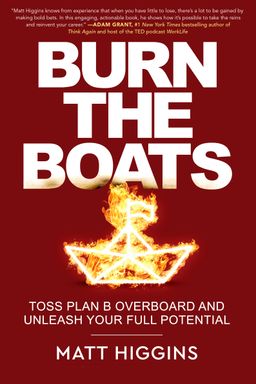
Burn the Boats cover

Burn the Boats

by Matt Higgins

Burn the Boats reveals the transformative power of committing fully to your ambitions. Matt Higgins shares his journey from poverty to success by eliminating Plan B and embracing risk. Filled with inspirational stories and practical strategies, this book encourages readers to trust their instincts, embrace fear, and continually reinvent themselves to achieve their dreams.

Burn the Boats: Eliminating Plan B to Achieve Extraordinary Success

What would happen if you took away every safety net in your life and made success your only option? In Burn the Boats, entrepreneur and Shark Tank investor Matt Higgins argues that greatness is never born from caution. His central philosophy—drawn from history, psychology, and his own rags-to-riches story—is that the most successful people don't leave themselves a way out. Like ancient generals who burned their ships to ensure their armies fought with full commitment, Higgins believes that you must destroy your Plan B. The absence of retreat forces you to perform at your highest potential.

Through vivid storytelling and practical insight, Higgins weaves together historical examples—from Julius Caesar to Sun Tzu to Volodymyr Zelensky—with lessons from modern entrepreneurship. He invites you to reprogram your relationship with risk, failure, and fear. He demonstrates that the courage to commit completely—without fallback plans—is the most reliable catalyst for growth, innovation, and meaning.

From Poverty to Prosperity: A Personal Testament

Higgins’s authority on risk isn’t hypothetical—it’s personal. Raised in crushing poverty in Queens, New York, he watched his single mother sacrifice everything to keep her family afloat. By sixteen, he dropped out of high school—not from apathy but from vision. He devised a plan: pass the GED, go to college early, and escape poverty faster. Everyone told him he’d ruined his life, but his bet on himself paid off. The GED led to college, then law school, then a career as New York City’s youngest press secretary during the trauma of 9/11. His journey from near-homelessness to millionaire entrepreneur is a living case study in burning boats.

Higgins insists that this approach isn’t unique to him. From David Chang’s Impossible Burger launch to Christina Tosi’s Milk Bar pivot during the pandemic, the “no-turning-back” mindset separates those who dream from those who execute. As Higgins puts it, “You don’t win when you give yourself the option to lose.”

The Anatomy of the Burn-the-Boats Mindset

Higgins structures his philosophy around three sweeping phases that form the book’s architecture: Get in the Water, No Turning Back, and Build More Boats. Each section reinforces a different layer of commitment.

  • Get in the Water is about confronting your fears and trusting your instincts. It teaches you to silence critics, overcome inner demons, and make decisive leaps.
  • No Turning Back explores how to convert fear and anxiety into fuel. It’s about optimizing discomfort, embracing crises as catalysts, and breaking the mental patterns that sabotage success.
  • Build More Boats reveals how to scale beyond survival—how to consolidate wins, empower others, and manifest dreams that multiply impact.

Each phase demands a radical reorientation of how you think about safety, failure, and preparation. Higgins draws on psychology—like the Yerkes-Dodson law, which shows that moderate stress enhances performance—to prove that anxiety, when channeled, leads to breakthrough results. The secret is not eliminating fear but making it functional.

History, Science, and Heart

What makes Higgins’s approach powerful is its blend of rational evidence and emotional truth. The story of Hernán Cortés burning his ships in 1519, or Sun Tzu’s strategy of cornering his troops to ensure total commitment, provides the metaphorical backbone. But scientific studies back it up: planning backups reduces effort and motivation, while overchoice—having too many options—often paralyzes us. Modern neuroscience agrees: we thrive under meaningful pressure, not under safety.

Higgins threads these proofs through stories of founders, athletes, and creators he’s mentored or invested in—Brian Chesky of Airbnb, LOLA’s Alex and Jordana, and RSE’s own portfolio companies like Bluestone Lane and Milk Bar. The book doubles as a collection of entrepreneurial case studies and as a psychological playbook for high-stakes living. Each story circles back to the same conclusion: without commitment, opportunity withers.

Why It Matters: The Modern Case for Burning Boats

In an age that glorifies optionality—side hustles, safety nets, and backup plans—Higgins makes a countercultural argument. He calls out our obsession with Plan B as disguised self-sabotage. Planning exits dulls our drive; it pre-emptively invites failure. Burn the Boats isn’t about reckless leaps—it’s about strategic conviction. It’s recognizing that odds shift dramatically when your brain knows there’s no fallback. Commitment maximizes courage.

Ultimately, Higgins’s message is simple but profound: you have one life. The cavalry isn’t coming, and no one owes you rescue. If you want to change your life—or the world—the only way forward is through. When you stop giving yourself a way back, what remains is possibility, power, and purpose. The path to greatness, as Higgins proves through every chapter, begins with a single act of defiance: light the match.


Trust Your Instincts as Your Greatest Asset

Matt Higgins begins his playbook with the principle of trusting your instincts. Your instincts, he writes, are not random guesses— they’re the product of encoded experience and deeply personal pattern recognition. When you ignore them, you silence the greatest expert on your life: you. From dropping out of high school to taking a chance on unproven founders, Higgins demonstrates that instinct often precedes proof.

Defining Destiny through Vision

Every success story begins with a clear vision. For Higgins, it was freedom from poverty; for Brian Chesky, it was affordable belonging through Airbnb. For Freddie Harrel, founder of RadSwan, it was redefining Black beauty through joy rather than shame. These examples underscore his first principle: “Destiny starts with a vision.” You can’t achieve what you can’t imagine—and your inner voice is the compass that guides you before the world validates you.

Higgins also points out how his partner Stephen Ross defied a generation of skeptics to build Hudson Yards—a $20 billion development once considered a wasteland. Ross’s intuition for potential, like Higgins’s own, shows that boldness often manifests long before consensus catches up.

The Gut Sandwich: Blending Data and Intuition

Higgins introduces what he calls the “Gut Sandwich” principle—decisions that layer data between two slices of instinct. Data refines judgment; it shouldn’t replace it. He cites Stuart Landesberg of Grove Collaborative, who endured 175 investor rejections before finally finding support for his eco-conscious household goods company. Data told him to quit. Instinct told him to persist. The result? A billion-dollar company built on conviction.

Here, Higgins echoes Steve Jobs’s approach: start with human intuition and work backward to the technology. Like Katrina Lake of Stitch Fix or Jeff Bezos transforming an online bookstore into Amazon’s empire, visionaries lead through what they feel before it’s visible on spreadsheets.

Building Confidence through Action

Trust isn’t static—it’s a muscle that strengthens with use. Higgins shows how rapid, repeated acts of faith create momentum. He recounts leaving the New York mayor’s office when denied a promotion; quitting seemed reckless, but it led to his eventual role as press secretary—the youngest in city history. Momentum compounds like interest, he argues: fast decisions accelerate learning, while hesitation compounds regret.

Higgins likens this to the careers of Shark Tank peers Kevin O’Leary and Lori Greiner, who continually reinvented themselves across industries. Trusting instincts doesn’t mean stubbornness; it means continuously leaping, learning, and adapting, expanding what you believe possible with every success.

Instincts in Crisis: From Grief to Growth

The ultimate test of instinct came when Higgins lost his mother on the first day of his dream job. The shock reinforced his deepest belief: when everything collapses, the only certainty left is yourself. “If you act on your doubts,” he writes, “you’re sabotaging yourself.” His story mirrors that of Kaley Young, who channeled grief into action after her firefighter father’s death, transforming his cutting-board invention into a top-selling Williams-Sonoma product after appearing on Shark Tank. Loss became her ignition source.

In the end, Higgins insists that trusting your instincts is the great equalizer: it requires no privilege or pedigree, only courage. Data may forecast probabilities, but gut conviction mobilizes destiny. As Emerson wrote in Self-Reliance, which Higgins quotes, “Trust thyself: every heart vibrates to that iron string.” Your instincts, Higgins reminds you, are not whispers to dismiss—they’re the voice of your future calling from ahead.


Overcome Demons and Enemies to Unleash Confidence

Once you commit, the biggest obstacles aren’t external—they’re the inner fears, insecurities, and critics that undermine confidence. Higgins devotes this section to confronting both internal and external enemies that stand between you and decisive action. Through stories of entrepreneurs, athletes, and his own humiliations and hardships, he dismantles the myths of perfection and teaches readers to transform pain into propulsion.

Silence the Haters, Cradle Your Ideas

Higgins’s partnership with chef David Chang illustrates how defying skeptics can yield staggering success. When Chang served the world’s first Impossible Burger at Momofuku in 2016, critics mocked him; even Higgins was unconvinced. Four years later, Impossible Foods was valued at $4 billion. Likewise, his investment in the Drone Racing League—dismissed as “toys”—proved prescient as drone technology evolved into both a sporting and tactical revolution. The lesson: critics lack your context. Don’t let their limited vision dictate your future.

Higgins distinguishes types of detractors: those missing information, those motivated by envy, those fearing change, and those threatened by your boldness. Recognizing these categories helps you separate useful feedback from noise. Haters, he warns, are data points, not destiny.

Rewrite the Story of Shame

Many of us carry “shame narratives” that limit potential. Higgins admits his own—concealing cancer surgery out of fear it would signal weakness. His recovery taught him empathy: “You can’t love others if you don’t extend kindness to yourself.” He recounts how Jets coach Rex Ryan overcame media humiliation about leaked personal videos by reframing shame as devotion to his wife—turning scandal into authenticity. Similarly, chef David Chang’s openness about bipolar disorder transformed stigma into strength, creating connection with his audience instead of distance.

Photographer Isaac “Drift” Wright offers another extreme: jailed for trespassing while taking high-rise photos, he transmuted his confinement into creativity, later selling an NFT of his work for $6.8 million. Across these tales, the alchemy is consistent—own your flaws before the world weaponizes them. Transparency disarms judgment.

Absorb Wins, Reflect Losses

Higgins claims the highest achievers “absorb wins and reflect losses.” Instead of ruminating on failure, they extract the lesson, then bury it. Entrepreneur Michael Rubin, now worth billions, went bankrupt as a teen but used each setback as scaffolding for later victories. Likewise, Dave Chang views failure as tuition—the price of progress. This mindset flips loss aversion (the psychological bias to fear losing more than we enjoy winning) into strategic indifference: accept losses as data, not identity.

The emotional cornerstone of this chapter is empathy. Empathy for yourself fuels resilience; empathy for others builds loyalty. Leaders who extend it foster trust and innovation. By facing shame, absorbing critics, and turning adversity into authenticity, Higgins shows you that courage doesn’t mean invulnerability—it means exposure without apology.


Take the Leap: Risk Is the Only Way Forward

Courage begins at the edge of your comfort. In Take the Leap, Higgins dismantles the myths that keep people tethered to safety— beliefs such as “It’s too risky,” “I’ve already invested too much,” or “I need others to agree first.” Through stories of entrepreneurs and musicians, he proves that waiting for permission or perfect timing is the surest way to miss opportunity.

Redefining Risk and Safety

When Higgins convinced PR prodigy Jesse Derris to quit his secure partnership and start his own firm, Derris feared failure. Higgins flipped the logic: depending on others’ approval was the real risk. With initial backing from RSE Ventures, Derris & Company became a top direct-to-consumer agency representing numerous billion-dollar brands. The point wasn’t the safety of capital—it was the safety of autonomy.

Similarly, Emmett Shine’s decision to dissolve his successful marketing empire, Gin Lane, to build new lifestyle brands under Pattern seemed reckless. Yet by burning what worked, Shine found renewal. They initially struggled but adapted by acquiring rather than inventing new brands. Courage without flexibility is recklessness; courage with adaptation is reinvention.

The Psychology of Sunk Costs

One of Higgins’s sharpest insights revolves around the sunk cost fallacy—the irrational urge to continue a path because of past effort. He recalls turning down a lucrative law-firm job after earning his JD, realizing it no longer aligned with his goals. Entrepreneurs at Magic Spoon made the same move, abandoning years of work on cricket-protein snacks to pivot into high-protein cereal. Their rejection of sunk costs birthed a nine-figure company. “Let the sunk costs sink,” Higgins advises. Clinging to old dreams wastes energy that could feed new ones.

Proprietary Insights: Acting Before the Herd

Higgins urges readers to seize proprietary insights—the glimpses of opportunity visible only from your vantage point. Michelle Cordeiro Grant left Victoria’s Secret to create Lively, lingerie designed for empowerment, not provocation. Joe Bayen saw poverty as both a problem and possibility, creating Grow Credit to help underserved borrowers build credit through subscriptions. Both pushed forward despite expert doubt. Opportunity, Higgins argues, is like lightning: “If you wait for thunder, you’re already too late.”

No Plan B

Wharton researchers confirm what Higgins intuited: backup plans kill motivation. He cites Arnold Schwarzenegger’s mantra, “I hate Plan B.” When you imagine a safety net, you subconsciously prepare to fall. Going all in doesn’t mean irresponsibility—it means emotional exclusivity. Keep your day job if you must, but orient every ounce of energy toward Plan A. Higgins’s own leap from the New York Jets to cofound RSE embodied that philosophy. Leaving security opened the door to entrepreneurship, television, and teaching at Harvard.

In short, burning boats isn’t about thrill-seeking—it’s about trusting your convictions more than your contingencies. You’ll never feel ready; readiness emerges from action. Every leap begins midair.


Optimize Your Anxiety for Peak Performance

Higgins’s counterintuitive claim: anxiety isn’t your enemy—it’s your edge. Drawing on neuroscience and sports psychology, he reframes fear as energy to harness rather than extinguish. Optimal anxiety, he explains, propels you forward; excessive anxiety, unmanaged, derails you. The goal is not calm, but calibrated tension.

Finding the Productive Edge

Higgins borrows from the Yerkes-Dodson law, a 1908 psychological model showing that performance peaks under moderate stress. He saw this firsthand working with Jets coach Eric Mangini, who deliberately disoriented players with noise and pressure to build resilience. Likewise, Higgins’s own anxiety drove him to overprepare for teaching at Harvard Business School, transforming fear into excellence.

Auditing your comfort, he says, is crucial: if you’re too calm, you’re underperforming. Discomfort signals growth. He asks, “Are you comfortable? If yes, something’s wrong.”

Turning Fear into Focus

To optimize anxiety, Higgins prescribes action. When he prepped for his Harvard class, he obsessively studied, rehearsed, and even practiced handwriting to control the uncontrollable. Anxiety, redirected into preparation, sharpens execution. He contrasts this with comedian Gary Gulman and pitcher Zack Greinke, who both nearly lost their careers to unmanaged anxiety until they reframed their struggles as creative fuel.

Fear, Higgins says, forces mastery. When you have no Plan B, your senses heighten, and focus intensifies. This is why athletes, entrepreneurs, and soldiers perform miracles under fire—they don’t have the luxury of hesitation.

Tools for Sustainable Courage

Higgins offers practical strategies to stay at the productive edge of fear:

  • Find reassurance in research—data grounds emotion.
  • Create rituals—like meditation or breathwork—to rebalance your nervous system.
  • Choose the right partners—people who amplify your courage, not your panic.
  • Expose vulnerabilities—ask for help before burnout, as Jets GM Mike Tannenbaum did through therapy.

The paradox of high performance is that anxiety never disappears—it just becomes data. Master it, and you transform nerves into momentum. Deny it, and it controls you. Higgins’s lesson echoes Marcus Aurelius: the obstacle isn’t in the way; it is the way.


Embrace Crisis as a Catalyst for Reinvention

Higgins’s firsthand experience with catastrophe—the 9/11 attacks, corporate failures, COVID-19 illness—convinced him that crisis isn’t an interruption to success; it’s the crucible that forges it. His philosophy: when crisis constrains your options, creativity expands. The question isn’t “Will crisis strike?” but “How will I use it?”

Face the Fire, Then Redefine It

During 9/11, Higgins saw leadership distilled to one principle: show up. As press secretary coordinating communications amid chaos, he learned that persistence equals survival. In business, he applies the same rule—stay visible, stay active. Whether rebuilding after loss or recovering from failure (like his failed Omnichannel Acquisition Corp deal), he treats setbacks as feedback loops, not verdicts.

He cites food entrepreneur Michael Lastoria, whose &pizza chain thrived by doubling down on people—raising wages and funding activism during COVID, turning crisis into culture. Likewise, Milk Bar’s Christina Tosi responded to lockdown by reinventing her business, livestreaming baking classes and expanding retail distribution. Crisis exposed new opportunity because she wasn’t wedded to what once worked.

The Philosophy of Reinvention

Higgins urges you to ask: “If I were starting today, what would I do?” That simple reframing sparks innovation. For Bluestone Lane founder Nick Stone, COVID was a chance to restructure leases and digitize operations, positioning the company for post-pandemic growth. Relevent Sports Group did the same, pivoting from live soccer events to selling global broadcast rights, ultimately brokering a $1.5 billion deal with UEFA.

Crises eliminate illusions of control. Use them to make bold pivots before circumstances force your hand. As Higgins writes, “We can iterate before we’re forced to.”

Good, Bad—Who’s to Say?

A Taoist parable anchors this chapter: when misfortunes occur, the wise say, “Good, bad—who’s to say?” Higgins recounts how Taylor Lindsay-Noel’s gymnastics accident left her quadriplegic yet led to a thriving tea business. Martha Stewart and financier Michael Milken turned disgrace and prison into renewed purpose. Senator Lauren Book turned childhood trauma into legislation protecting abuse survivors. Crisis isn’t curse—it’s conversion.

Higgins’s mantra: chase the threat. Don’t wait for catastrophe to force reinvention—seek tension, change, and challenge proactively. Each crisis, real or self-created, is a furnace for potential. If you emerge burned but unbroken, you’ve found your next beginning.


Break the Patterns That Hold You Back

Most failure, Higgins argues, isn’t caused by ignorance but by repetition—by reenacting flawed patterns without noticing. This chapter examines external and internal traps: wrong partners, scarce resources, early exits, ego, and misalignment. He teaches how to identify patterns, acknowledge what truly fits, and steer before destruction.

Choosing the Right People

Partnerships can accelerate or anchor. Many founders seek cofounders out of insecurity, not necessity. Studies show solo founders often outperform teams, yet billion-dollar “unicorns” emerge from aligned partnerships. Michelle Grant of Lively avoided this trap by building a flexible “bench” of advisors instead of equal partners—retaining control while gaining expertise. The same rule applies personally: choose partners who multiply courage, not conflict.

Recognize External Obstacles Early

Higgins shares cautionary tales: Juicero’s investors ousted its visionary founder, dooming the company. His time at Kozmo.com taught him that great ideas fail without financial runway. Even in success stories like Kin Insurance or RESY, he notes that timing and patience determine survival. The lesson: success requires both persistence and awareness of market readiness. You can’t control timing, but you can extend your runway until others catch up.

Inner Patterns of Sabotage

Internally, leaders fail when they overcontrol or under-evolve. “You can’t do it all,” Higgins warns. Delegation is maturity, not weakness—wisdom NFL coaches often resist. Playing small, chasing hype, or fearing replacement limits growth. True leaders hire those better than themselves, celebrate their strength, and pivot quickly when wrong.

His most potent lesson comes from psychological truth: self-awareness beats brilliance. To surface blind spots, Higgins employs psychologist Dr. Laura Finfer to assess CEOs. She identifies derailers—ego, deference, politics, selfish credit—and retrains them toward transparency. As Higgins says, “Great leaders are intellectually curious about their weaknesses.”

Breaking patterns means breaking pride. By replacing insecurity with reflection and perfectionism with iteration, you create not just success—but sustainability.


Consolidate Your Gains and Keep Building

After burning the boats and winning new ground, Higgins urges you not to rest but to consolidate your gains. Progress compounds only when you reinvest victories into a larger mission. This chapter focuses on leveraging advantages, bypassing incrementalism, and maintaining perpetual growth.

Leverage What You Have Now

Using one’s current platform as a launchpad is crucial. NFL player Byron Jones, for instance, used his league visibility early to lay the foundation for post-football entrepreneurship, investing and networking while “relevant.” Higgins compares this foresight to his investment strategy at RSE—using his wins in food brands to acquire Magnolia Bakery and scale nationally. Everyone, he notes, has leverage: access, skill, or story. The key is to deploy it now, before the spotlight fades.

Skip Incremental Progress

Higgins encourages what he calls the step change mindset—jumping directly to your next peak rather than climbing traditional ladders. Intelligence officer Alexander Harstrick exemplified this by skipping corporate apprenticeship and founding a defense investment fund straight out of Harvard, securing $10 million and later $50 million. “No one will take me seriously fresh out of school,” he thought. Until someone did.

Incrementalism feels safe but wastes time. The world rewards speed and clarity, not patience misapplied. Higgins argues that “waiting your turn” is a trap taught by insecure bosses who fear being surpassed. You don’t need permission—only proof of potential.

Train for Perpetual Growth

Success brings danger: habituation. Higgins warns against becoming numb to your own excellence. Each new challenge demands new discomfort. He cites Stephen Ross’s mantra—“Don’t be a grasshopper”—as a call to finish what you started before jumping ahead. Growth requires alternating cycles of expansion and consolidation—reaping, then reinvesting.

In essence, every victory is just new fuel. Consolidating gains means transforming success into platforms for others, new ventures, and deeper mastery. If you stop building, you begin sinking.


Submit to and Unleash the Greatness of Others

In his most human chapter, Higgins dismantles the myth of the lone genius. Success at scale, he insists, requires you to “submit to the greatness of others.” This is both humility and strategy—surrounding yourself with people who are better than you in distinct ways and giving them freedom to shine.

Finding the Pillars of Greatness

Higgins identifies four archetypes every team needs: the Visionary (who sees the future), the Catalyst (who mobilizes it), the Executor (who delivers it), and the Communicator (who tells its story). He illustrates these through real partners—Gary Vaynerchuk as Visionary, Sean Harper of Kin as Catalyst, Rachel O’Connell as Executor, and advertising veteran Tom Carroll as Communicator. Each person extends Higgins’s reach far beyond his own capabilities.

Avoiding Toxic Archetypes

Just as you seek greatness, you must guard against its opposites: the Withholder (who hoards praise), the Hijacker (who exploits others), the Victim (who wallows in injustice), the Martyr (who overworks for validation), and the Gaslighter (who distorts truth). Higgins’s experience coaching executives shows that these behaviors infect cultures and strangle growth. Spot them early—especially in yourself—and opt instead for empathy, transparency, and generosity.

Unlocking Collective Potential

No story illustrates this better than Aidan Kehoe’s transformation at SKOUT CyberSecurity. When Kehoe faced burnout and investor pressure, Higgins and psychologist Laura Finfer guided him through radical transparency—sharing his flaws openly with his team. The vulnerability sparked loyalty, alignment, and performance, leading to a nine-figure acquisition. “Whatever you think you’re hiding,” Higgins told him, “everyone already knows.”

Empowering others isn’t selfless—it’s exponential. As studies show, helping elevates the helper as much as the helped. Leaders who foster greatness multiply it. Higgins concludes that true legacy isn’t what you build alone—it’s what you enable in others long after you’ve moved on.


Manifest Your Boldest Dreams

Higgins closes with a call to eternal motion: never stop dreaming, building, and burning new boats. Manifestation, for him, is not passive visualization—it’s continuous courage compounded. Life doesn’t reward those who wait; it honors those who persist through the unknown.

Redefining Fulfillment

He opens with the surprising story of baseball legend Andre Dawson, who left fame to run a funeral home, and artist Micah Johnson, who traded professional sports for NFT artistry. Both embody fulfillment beyond status. Likewise, journalist Laurie Segall left CNN to start a tech-humanity media company. Each story reveals that success has no fixed form—only alignment between values and action.

Living in Perpetual Pursuit

Higgins warns of “post-success depression.” Studies show that after major achievements, satisfaction dips; joy lies in pursuit, not arrival. He likens progress to marathon running—the high fades once you cross the finish line. Figures like Jon Stewart or Marc Lore find renewal by always starting anew. Hard isn’t punishment—it’s purpose.

He also celebrates those who dare to multitask meaningfully, like Pro Football Hall of Famer Curtis Martin translating pain into philanthropy, or dancer Julianne Hough using movement to heal others through her company KINRGY. Dreams shouldn’t be sequential; they’re concurrent streams of expression and impact.

Making Impact, Leaving Legacy

The pinnacle of burning boats is using success to serve others. Higgins funds scholarships for single mothers at Queens College—the same institution that once saved him and his late mother—transforming her memory into empowerment for others. Like Pope Francis, whom Higgins later meets, he believes courage is both action and compassion: to “go to the periphery of the soul,” serving those who need light most.

His closing metaphor seals the lesson. A boatbuilder once saved his prized vessel from fire by sinking it—destroying to preserve. So too, you may need to submerge your comfort to save your calling. Higgins’s final charge echoes in three words from the pope himself: “Be courageous.” Courage, he writes, is the truest form of faith—in yourself, and in the future you have yet to build.

Dig Deeper

Get personalized prompts to apply these lessons to your life and deepen your understanding.

Go Deeper

Get the Full Experience

Download Insight Books for AI-powered reflections, quizzes, and more.