
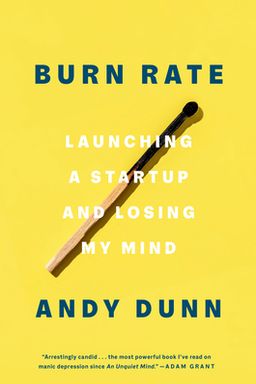
Burn Rate cover

Burn Rate

by Andy Dunn

Burn Rate unveils the gripping story of Andy Dunn''s dual journey as the cofounder of Bonobos and his struggle with bipolar disorder. This honest narrative explores the intersection of mental health and entrepreneurship, offering a compelling call for openness, understanding, and resilience.

The Hidden Cost of Entrepreneurial Success

Have you ever wondered what drives an entrepreneur to risk everything—money, sanity, relationships—for a dream? And what the psychological toll of that drive might be? In Burn Rate, Andy Dunn tears down the glossy myths of startup life to reveal the personal cost that ambition exacts. Dunn argues that behind Silicon Valley's cult of success hides a darker truth: many founders are propelled not just by vision and grit, but by untreated mental illness. His memoir reads less like a startup guide and more like a survival manual for those caught between brilliance and breakdown.

At its heart, Burn Rate is an exploration of bipolar disorder—the "Ghost" that haunted Dunn throughout his life. The title doesn’t only refer to the speed at which startups spend their capital; it also symbolizes the pace at which mental illness can consume human potential. Dunn moves beyond the stereotypical narrative of tech triumphs to ask a more haunting question: what happens when the same manic energy that fuels entrepreneurial genius pushes a person toward collapse?

Success and Sanity: The Startup Illusion

From the outside, Bonobos—the men’s apparel company Dunn co-founded—seemed like an American success story. But as Dunn reveals, his journey was riddled with secrecy, denial, and mania. He masks the early signs of his disorder under the plucky optimism expected of startup founders. Mental instability is the unspoken enemy of business leadership, especially in a world that glorifies risk-taking and boundless energy. Dunn demonstrates how the very traits that investors reward—boldness, charisma, relentless drive—mirror the symptoms of hypomania.

He contends that entrepreneurship’s manic culture, with its slogans of “move fast and break things,” functions as a mirror of mental illness itself. Startup founders soar and crash at terrifying speeds, living in cycles of elation and depression that echo his own bipolar swings. Thus, the book asks readers to reconsider how society conflates hyper-productivity with mental wellness. Dunn’s experience shows that while hypomania can enable creativity and resilience, unchecked it can overpower the capacity for rational decision-making—a theme echoed by psychologist Kay Redfield Jamison in An Unquiet Mind.

The Ghost Within: Making Mental Illness Visible

Dunn’s “Ghost” is his name for bipolar disorder, an invisible companion that oscillates between empowerment and destruction. It gives him brilliance, intensity, and charm, yet it also leaves him sleepless, delusional, and suicidal. For years, he hides it from colleagues and loved ones, fearing stigma more than instability. His later breakdown—culminating in hospitalization and an arrest for assault—forces him to confront that denial. In laying bare his illness, Dunn transforms his Ghost from adversary into truth-teller.

At the book’s opening, Dunn describes writing the memoir as his final act of confession, a way to “bring the Ghost out of the closet.” The author argues that secrecy is the engine of suffering. By refusing to talk about mental illness, especially in the business world, we perpetuate silence that kills. Referencing epidemiological studies, he cites that entrepreneurs are disproportionately affected by mental health challenges—sometimes up to seven times more likely to have bipolar disorder than non-entrepreneurs. Through these sobering statistics, Dunn reframes his story as communal rather than individual. Many of us, he suggests, live with ghosts we refuse to name.

Family, Identity, and the Seeds of Delusion

Dunn’s storytelling is richly personal, charting his upbringing in a bicultural Chicago family—an Indian immigrant mother and a Midwestern father—and revealing early traces of both ambition and fragility. His mother’s ceaseless self-sacrifice and his father’s stoic intellect create competing models of strength. The fusion of empathy and perfectionism becomes his blueprint for both love and leadership. The early validation of intelligence (“the gifted kid syndrome”) plants the seed of hubris, an emotional accelerant for mania later in life.

The family’s generational silence around mental illness—his grandmother’s institutionalizations, his father’s quiet denial—becomes the emotional inheritance Dunn must eventually unmask. Like a startup idea passed down through generations, dysfunction is both legacy and catalyst. The Ghost, he learns, is not an aberration but a mirror of his family’s buried wounds. This duality—mental illness as both curse and creativity—anchors Dunn’s argument: to conquer the beast, you must first make it beautiful.

Why It Matters

By merging the language of entrepreneurship with the language of psychology, Dunn reframes success as survival. Burn Rate is not merely about recovering from one founder’s psychosis; it’s about redefining what it means to build a company—and a life—around vulnerability rather than denial. He invites readers, whether business leaders or not, to confront how our own ambitions can blur into addictions. The memoir makes a case for normalizing open dialogue on mental health in professional spaces. Ultimately, Dunn’s lesson is painfully universal: Behind every burn rate—whether financial or emotional—lurks a reckoning with what it costs to stay aflame.


The Entrepreneurial Mania

Andy Dunn’s journey exposes how the entrepreneurial psyche often mirrors the rhythm of bipolar disorder. The manic climb to success feels intoxicating—the rush of ideas, confidence, sleeplessness, and the ability to move mountains. Yet those same surges can ignite catastrophic crashes. For Dunn, the intensity of building Bonobos wasn’t just business; it was biochemical.

Hypomania as Jet Fuel

During Bonobos’s growth, Dunn operated at the edge of hypomania—sparkling creativity, infectious optimism, and relentless drive. Investors saw that energy as leadership; friends saw brilliance. Clinical science might call it hypomania, but Silicon Valley calls it hustle. Dunn describes his intense productivity phases: endless meetings, 16-hour workdays, sleepless nights—each resembling manic acceleration. The same neurotransmitters fueling vision also blur judgment. He spent impulsively, hired excessively, and mistook exhaustion for inspiration. This pattern echoes the psychological profiles of other founders like Elon Musk and Steve Jobs (both are discussed by biographers as having manic creative tendencies).

The Crash Beneath the Glory

Mania flips quickly. For Dunn, depressive troughs hit like gravity after orbit. He slept endlessly, withdrew socially, and fantasized about surrendering. He calls depression “the long night,” a season where every movement hurts. What stands out, however, is how he continued functioning publicly—pitching investors by day while falling apart privately. This duality between outer triumph and inner torment defines the book’s tension. Dunn’s metaphor for mental illness as the startup’s burn rate reflects capitalism’s hidden cruelty: when your fuel is your psyche, there’s nothing left to spend when it runs dry.

Mania in the Mirror of Capitalism

Dunn parallels his manic energy with the culture of venture-backed business itself. Startups reward acceleration, not sustainability. Founders are encouraged to “burn” capital aggressively to achieve growth. The fetishization of speed, optimism, and fearlessness becomes both economic and psychological pathology. When Dunn describes his impulse to expand Bonobos into multiple brands before profitability, it’s clear that mania has infiltrated strategy. Even funding meetings mirror emotional cycles—euphoric belief in success followed by crushing anxiety about failure. Dunn’s psychiatrist, Dr. Z, later helps him see that entrepreneurship offered a socially acceptable stage for madness. It provided purpose but also camouflage.

Survival through Structure

The turning point comes when Dunn realizes that structure can substitute for chemistry. His healing relies on daily rhythms: medication, therapy, consistent sleep. He compares the startup routine—metrics, meetings, sprints—to his mental recovery regimen. The irony is powerful: the same systems that scale companies can stabilize minds. From burnout he learns that hypomania may build empires but discipline saves lives. Entrepreneurship, Dunn concludes, isn’t inherently pathological—what’s dangerous is a system that rewards illness more than introspection.

In modeling transparency about his bipolar disorder, Dunn points toward a healthier paradigm: a founder who doesn’t need to grind himself into dust for glory. He reframes success not as conquering competitors but as striking equilibrium—a radical idea in a culture that worships overdrive.


When Mental Illness Meets Leadership

The hardest question Dunn invites us to face isn’t how to succeed—it’s how to lead while broken. In business, stability is currency; mania is taboo. Through his story, Dunn challenges how corporations and investors treat mental illness, arguing that leadership and vulnerability can coexist—but only through honesty and support.

The Silence of the Boardroom

For most of his career, Dunn felt forced to hide the Ghost. Bipolar disorder is a final taboo in business; discussing it could end funding rounds, jobs, or reputation. He notes the stark contrast: athletes and artists, like Simone Biles or Kanye West, may speak openly about mental health, but CEOs stay silent. The silence, Dunn says, creates two realities—the public persona of fearless leadership and a private battle that feels shameful. This gap, he observes, fuels stigma and perpetuates misunderstanding within the corporate world.

The Breakdown and Public Reckoning

In 2016, just as Bonobos approached sale to Walmart, Dunn suffered his most severe manic episode, culminating in hospitalization and an arrest for assault. He calls it his “psychic death.” The fallout forced a confrontation with the industry’s silence. Yet instead of ruin, Dunn encountered compassion. His investors and family didn’t abandon him; they supported treatment, understanding it as illness, not moral failure. This episode becomes the memoir’s moral fulcrum—a moment that tests whether society can separate sickness from character. Dunn’s openness after recovery reframes leadership: authority gained through transparency rather than dominance.

New Models of Leadership

As Dunn stabilizes under treatment, his approach to leading Bonobos changes. He begins incorporating empathy, therapy structures, and self-awareness into company culture. He praises mentors like Joel Peterson and Marc Lore for teaching that honesty—not bravado—wins loyalty. His reinvention mirrors a broader cultural shift: from command-and-control models toward emotionally intelligent leadership. Dunn demonstrates that the courage to admit weakness can galvanize teams more than charisma ever could.

The Future of Work and Wellness

In concluding chapters, Dunn argues for systemic reform: companies should treat mental health as infrastructure. Therapy should be as normalized as executive coaching; psychiatric regimens as ordinary as budgets. By narrating his own recovery—combining medication with ritual, sleep tracking, and transparency—he offers a template for others. Mental wellness, he insists, isn’t peripheral to leadership; it’s prerequisite. The book’s closing image is powerful: Dunn holding his newborn son, vowing that he will never hide his illness again. Leadership, therefore, begins not with control but with confession.


The Power of Vulnerability in Healing

Throughout Burn Rate, Dunn learns that healing begins where shame ends. The core act of recovery is vulnerability—admitting secrets, accepting help, and letting others truly see you. His journey through therapy, family reconciliation, and marriage demonstrates how emotional exposure transforms trauma into growth.

Breaking the Silence

After decades of denial, Dunn’s decision to write about his bipolar disorder is radical. In therapy with Dr. Z, he learns that suppression magnifies suffering. He describes the process of disclosure: first telling his board, then his employees, then his readers. Each revelation is an act of liberation but also of fear. Dunn compares this uncovering to the entrepreneurial risk of launching a product—you expose something uncertain to public scrutiny, and by doing so, you own it. Vulnerability becomes his new form of innovation.

The Role of Relationships

Dunn’s transformation hinges on relationships that don’t abandon him. His wife, Manuela, remains after his psychosis, offering forgiveness coupled with boundaries. His mother, sister, and mentors stay steadfast. Rather than redemption through isolation, Dunn finds healing through connection—mirroring contemporary therapy approaches like Attachment Theory (Dr. Sue Johnson’s work demonstrates the same). The most striking moment comes when Dunn’s mother admits her guilt over decades of silence. This mutual vulnerability between parent and child finally dissolves their shared shame.

Vulnerability as Leadership

On returning to Bonobos after his episode, Dunn changes his entire management philosophy. He incorporates openness into company practices, encouraging team-wide honesty and balancing compassion with accountability. His executive coach, Vivian, guides him to express real-time emotion and feedback during leadership retreats. By modeling imperfection publicly, Dunn transforms vulnerability from weakness into cultural capital. This shift echoes Brené Brown’s argument in Daring Greatly: vulnerability is courage in disguise.

Integration and Acceptance

Recovery, Dunn concludes, isn’t about removing the Ghost but integrating it. His medications—Lamictal, Abilify, and Wellbutrin—help narrow the mood swings but don’t erase his emotions. Therapy teaches him equilibrium, not immunity. By embracing both brilliance and fragility, Dunn finally becomes whole. The memoir ends on this paradox: healing didn’t come from conquering mania; it came from befriending it. Vulnerability, in other words, isn't defeat—it's the doorway to authenticity.

By turning his private pain into public truth, Dunn converts mental illness into a platform for empathy. His vulnerability not only saves his life—it also redefines what strong leadership looks like in the modern world.


Reframing Mental Illness as Creativity

One of Dunn’s most provocative arguments is that mental illness and creativity can coexist—even collaborate. The highs of bipolar disorder, he notes, are not just symptoms but sources of imagination and innovation. To reject them entirely is to risk flattening the creative spirit that builds ideas worth following.

The Creative Paradox

Dunn acknowledges the paradox of his condition: mania sparked his best ideas but nearly destroyed him. Hypomania gave him vision, persuasive charisma, and resilience during Bonobos’s founding. Depression instilled empathy and introspection. “My illness,” he writes, “is both jet fuel and fire.” Drawing on Jamison’s theory that manic-depressive illness embodies both beauty and danger, Dunn frames bipolar tendencies as a double-edged gift. Instead of seeking to erase those forces, he learns to channel them.

Artistry of Entrepreneurship

Entrepreneurship is presented as modern artistry. Dunn’s creative periods echo the psychological intensity of artists—frantic drafting, sleepless passion, grand visions. Each startup decision becomes an act of creation. But he warns that romanticizing suffering is perilous; creativity thrives on structure, not chaos. What saved his imagination wasn’t mania—it was treatment that allowed his ideas to mature. Through medication, therapy, and mindfulness, Dunn learns that disciplined creativity surpasses explosive genius.

Mindfulness and Medication

Dunn’s regimen—daily mood stabilizers, therapy, sleep monitoring—becomes a form of creative discipline. He discovers joy in consistency: art through steadiness rather than frenzy. This lesson parallels Elizabeth Gilbert’s Big Magic, which portrays creativity as partnership with fear, not escape from it. Dunn finds magic in moderation. His psychiatrist’s mantra—“Everything is overdetermined”—teaches that genius doesn’t erase biology; it harmonizes with it.

Ultimately, Dunn invites us to reconsider how we treat “madness” in creative industries. He urges readers to stop glorifying breakdowns as price tags for brilliance and instead champion treatment as part of the creative process. For him, medication isn’t dampening art; it’s enabling it.


Breaking the Stigma in Business

Dunn’s most urgent mission in Burn Rate is to dismantle the stigma surrounding mental illness in professional environments. Despite progress in public discourse, he argues that corporate spaces still treat mental health as unspeakable—especially at the leadership level. His story becomes both confession and campaign for transparency.

Unspoken Rules of Stability

In the entrepreneurial world, competence equals calm. Investors entrust millions to founders who project unwavering control. Dunn confesses that even after Bonobos’s success, he feared that revealing bipolar disorder would end his career. Business deals hinge on perception, and the myth of the “sane CEO” keeps executives silent. Dunn exposes how this silence breeds vulnerability—the less people talk about mental illness, the more dangerous it becomes. “To deny the Ghost,” he writes, “is to deny myself.”

Ending the Culture of Denial

When Dunn begins publicly discussing his illness, he notices the wave of human responses it evokes: empathy, curiosity, and solidarity. Fellow executives confide their own struggles. The taboo cracks. He discovers that transparency doesn’t diminish authority—it expands it. His example normalizes therapy as leadership training and medication as productivity enhancement. Dunn’s openness ripples across industries, much like leaders following Naomi Osaka’s and Simone Biles’s advocacy for mental health in sports.

Toward Organizational Compassion

Dunn envisions corporations adopting mental health infrastructure: regular therapy coverage, candid check-ins, and destigmatized disclosure. He calls out burnout cultures that mistake endurance for excellence. The “burn rate” of human minds, he warns, is more perilous than financial losses. His story advocates for slow growth, sustainable ambition, and compassion as economic strategy. The ultimate message: companies that protect emotional sanity are more innovative than those that exploit it.

By blending memoir and manifesto, Dunn provides a blueprint for dismantling stigma through storytelling. His vulnerability is revolutionary not because it’s rare, but because it’s needed. Healing begins when leaders stop pretending health and ambition are opposites.

Dig Deeper

Get personalized prompts to apply these lessons to your life and deepen your understanding.

Go Deeper

Get the Full Experience

Download Insight Books for AI-powered reflections, quizzes, and more.