
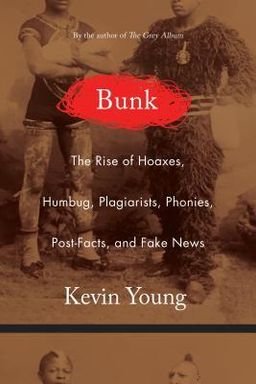
Bunk cover

Bunk

by Kevin Young

Bunk delves into the fascinating yet troubling history of hoaxes in America, unraveling their deep connections to racial stereotypes and cultural narratives. Kevin Young''s insightful exploration reveals how these deceitful tales have evolved, impacting society''s perception of truth and reality in the digital age.

The American Art of Deception

What makes a lie entertaining? In this sweeping study of American culture, the author traces how deception evolves from carnival trick to cultural system—from P. T. Barnum’s nineteenth-century humbug to contemporary media’s crafted realities. The book argues that hoaxes are not isolated scandals but structural performances. Each era invents new ways to blur truth and spectacle, inviting audiences to suspect, believe, and still participate. The result is a national tradition of conscious gullibility—what Barnum recognized as the pleasure of being fooled.

From Barnum’s Humbug to Mass Media

Barnum recasts deceit as entertainment. His distinction between humbug and swindle—between exaggeration that still gives value and fraud that gives none—becomes a moral defense of spectacle. Audiences are invited to be 'both judge and mark': aware of the trick yet complicit in the fun. This interactive skepticism shapes American consumer psychology, mirrored later in reality TV and viral marketing (note how producers now phrase stories: 'you decide'). Barnum’s American Museum teaches a public to enjoy ambiguity and to read deception as proof of cultural sophistication.

Media, Race, and the Theater of Belief

From the Moon Hoax of 1835, which staged fake lunar discoveries in scientific language, to the exhibition of Joice Heth and the 'What Is It?' performer, the nineteenth century blends mass media, racialized spectacle, and pseudoscience. Each hoax exploits authority—scientific jargon, anatomical displays, or ethnographic fantasy—to legitimize falsehoods. These spectacles teach audiences to associate curiosity with colonial gaze and to translate wonder into hierarchy. Race and deception intertwine: the freak show becomes a mirror that projects white anxieties, sexual panic, and imperial control.

Science, Spiritualism, and the Search for Proof

The book connects scientific spectacle with the emotional economies of belief. Spirit photography (William Mumler’s conjured ghosts, Mary Todd Lincoln’s image) and the séances of the Fox sisters illustrate how grief meets technology. Audiences crave comfort and evidence at once; hoaxers respond with engineered miracles. This fusion of science and consolation anticipates today’s misinformation about health and spirituality—claims that blend emotional need with visual proof.

Identity Performance and Modern Authenticity

Across centuries, performers and writers fabricate selves—bearded ladies negotiating gender; girl wonders marketing innocence; literary impostors like JT LeRoy or Rachel Dolezal constructing alternative races or histories. Each uses disguise as strategy to gain visibility or legitimacy in markets that fetishize trauma and marginality. The book positions impersonation as technology: a repeatable method for converting personal myth into commercial capital. The emotional contract between audience and performer—'I reveal myself, you believe'—becomes exploitable currency.

Forgery, Journalism, and Institutional Collusion

Forgeries and fabricated reportage show deception not as outsider art but as institutional failure. From van Meegeren’s fake Vermeers traded with Nazi officials to the Hitler Diaries and Jayson Blair’s fraudulent Times stories, the book demonstrates that belief systems collapse fastest under pressure for profit or speed. Institutions often enable lies because trust feels efficient: editors prefer drama; collectors love provenance; readers crave catharsis. Hoaxes flourish when verification slows or euphemism softens responsibility.

The Age of Euphemism

The closing argument situates modern media in what the author calls 'The Age of Euphemism'—an era where language itself is engineered to obscure wrong. From political 'alternative facts' to advertising spin, spectacle replaces verification. Barnum’s legacy persists: the humbug becomes a governing principle. In a post-factual world, the best defense is vigilance—understanding how narratives, identities, and institutions manufacture belief. The reader is left with an ethical call: resist euphemism, demand evidence, and remember that entertainment and fraud share the same stage lights.

In sum, the American art of deception is both mirror and teacher: it reveals what a culture values, fears, and buys into when truth becomes negotiable.


Barnum’s Blueprint for Modern Spectacle

Barnum’s life reads as a master class in turning deception into entertainment. His idea of humbug—a playful exaggeration that delights rather than defrauds—legitimizes the showman’s manipulations. When Barnum presents Joice Heth as George Washington’s 161-year-old nurse or the Feejee Mermaid as an exotic creature, he knows the audience suspects fakery. That suspicion is the value: you pay for the pleasure of being deceived and instantly knowing it. (Scholars have compared this to the modern 'reality effect' in television and viral stunts.)

Audience as Co-Conspirator

Barnum redefines spectatorship. His museum teaches visitors to evaluate marvels critically, to perform skepticism as social intelligence. The audience becomes part of the trick—a self-aware participant who enjoys complicity. That pedagogy of doubt spreads into journalism and advertising. When later marketers promise impossible wonders ('the greatest show on earth'), they inherit Barnum’s moral loophole: a fantasy that doesn’t conceal its falsity but celebrates it.

Ethnicity, Exoticism, and the Market

Barnum’s branding relies on cultural stereotypes. He uses ethnic labels and imperial curiosity to sell spectacle. The 'Circassian Beauty' act promotes whiteness as endangered exoticism; 'What Is It?' displays Blackness as evolutionary proof. He frames both as educational curiosities, merging racism and wonder. The result is a racial theater that trains audiences to read bodies as entertainment and science simultaneously. (In this, Barnum’s exhibits parallel later film tropes of the exotic 'other.')

Barnum institutionalizes suspicion, teaching Americans that spectacle justifies exaggeration. That worldview underlies modern media—where outrage and curiosity keep you watching even after truth collapses.


The Moon Hoax and the Birth of Fake News

Richard Adams Locke’s 1835 'Moon Hoax' stands as journalism’s founding fraud. It describes lunar civilizations and fantastical 'man-bats' as telescopic discoveries by scientist John Herschel. Locke mimics scientific rhetoric, cites defunct journals, and maps authority through triangulated sources. Readers consume the absurd as plausible science; even rival newspapers amplify it through debate. The penny press’s cheap format turns incredulity into circulation—a viral loop long before the internet.

Formulas of Believability

Locke’s method defines how misinformation works: combine credible names, mimic expert tone, exploit cultural timing. (Halley’s Comet had recently heightened astronomical interest.) Edgar Allan Poe’s essays on 'diddling' extend this taxonomy, describing the hoaxer as artist—audacious, ingenious, and grinning privately at night. The grin marks aesthetic delight in deception; truth becomes an aesthetic problem rather than an ethical one. That irony persists: readers enjoy detecting fakes as much as believing them.

Media Ecosystem and Modern Echoes

The Moon Hoax reveals early mass-media economics: low cost, shareability, emotional intrigue. It parallels today’s clickbait environment—where competition among outlets amplifies sensationalism. Cultural anxieties (race, evolution, empire) shape what the public finds believable. Locke’s lunar hierarchies mirror phrenological ideas and racial pseudoscience, projecting earthly prejudice onto cosmic narrative. In effect, the hoax invents science fiction as colonial allegory; every later viral falsehood follows its pattern.

When a headline or image feels too plausible to doubt, remember Locke’s template: authority language, triangulation, and timing—the mechanics that make fake news endure.


Bodies, Race, and the Grotesque

Spectacle in America has always been racial. Barnum’s freak shows, ethnographic displays, and pseudo-scientific exhibits transformed living people into case studies of difference. Joice Heth’s autopsy, William Henry Johnson’s 'What Is It?', and the fetishized Circassian Beauties each translate race into theater. The grotesque doesn’t just dehumanize—it reassures the audience of its own normalcy and superiority.

Display as Power

Bodies under display function as social texts. In Peale’s museum, Agassiz’s photography, and Baartman’s dissected anatomy, science merges with voyeurism. The audience learns to read race visually and morally—the open body signifies openness to exploitation. These acts don’t simply reflect racism; they perpetuate it through normalization of public inspection.

The Hoax as Racial Mirror

Later chapters expand this pattern to political pamphlets like the 1864 Miscegenation hoax and to lost-race fiction. Hoaxes serve as mirrors: they reveal what the hoaxer fears about race more than what they fabricate. The panic about mixture or invasion (Martians, Panther Women) recodes colonial and sexual anxieties. The exotic other becomes a projection screen for national guilt and curiosity.

Every racial hoax doubles back: its lie about others is a confession about the liar’s society.


Spiritualism and the Technology of Belief

The nineteenth century’s faith in photography and séance culture turns mourning into marketplace. The Fox sisters, William Mumler’s spirit photos, and Mary Todd Lincoln’s image demonstrate how grief and technology fuse. Audiences, craving evidence of spirits, accept photographic artifacts as truth. Barnum plays both sides—debunker and advertiser—revealing the profitable ambiguity between faith and fraud.

Spectacle of Consolation

Spirit photography operates like religion’s counterfeit proof: it offers empathy where science seems indifferent. When wartime bereavement floods households, these images give families visible hope. Courts struggle to prosecute deception because belief itself becomes the defense. The same emotional leverage surfaces in later cases—from the Cottingley fairies endorsed by Arthur Conan Doyle to modern digital afterlife imagery.

Belief versus Verification

The book contrasts believers like Conan Doyle with skeptics like Houdini, illustrating culture’s split between comfort and truth. Both are showmen; both depend on spectacle. The conflict dramatizes a lesson: audiences reward hope over evidence. Spiritualism thus exemplifies how media technologies create faith by visual persuasion—a pattern that continues in doctored photography and viral deepfakes.

When uncertainty feels unbearable, illusion offers emotional logic—and that logic fuels many hoaxes disguised as healing.


Confession and the Market of Truth

The modern hoax migrates into autobiography. Memoir, once moral reflection, becomes commodity. James Frey’s A Million Little Pieces and Laura Albert’s JT LeRoy persona show how confession markets suffering. Readers crave redemption from chaos; publishers monetize that appetite; authors learn exaggeration sells. The hoaxer’s contrition afterward often functions as sequel, not apology.

The Long Con Structure

The book identifies a ritual pattern: denial, partial admission, confession, aftermath. Each phase sustains attention. After exposure, scandal transforms into spectacle; authenticity becomes performance. Oprah’s 'truthiness' defense of Frey—valuing felt truth over factual truth—illustrates cultural complicity. Emotional credibility outranks verification.

Therapeutic Market and Identity Performance

Memoir hoaxes exploit institutional incentives. Trauma sells; belief in recovery comforts the audience. When authenticity becomes a genre, fabrication is structural. Gender and youth amplify this economy—'girl wonders' like Opal Whiteley or Joan Lowell stage precocity as miracle. Their later exposure matters less than their myth, proving that confession pays twice: first as revelation, then as retraction.

Memoir culture teaches you this paradox: the more we demand lived truth, the more the market rewards its imitation.


Forgery, Imposture, and the Desire to Belong

Forgery in this book isn’t only counterfeiting—it’s identity alchemy. From van Meegeren’s falsified Vermeers to Christian Gerhartsreiter’s 'Clark Rockefeller' persona, forgers and impostors manipulate provenance and pedigree to enter closed systems of power. They perform legitimacy until institutions confirm it. Belief, not skill, sustains the illusion.

Social Engineering of Trust

Institutions fail when provenance becomes narrative, not evidence. Museums love romantic backstories; social elites love accents. Forgers exploit that hunger. Gerhartsreiter’s polite manner and pseudo-Ivy pedigree disarm scrutiny. Han van Meegeren’s wartime sales deliver moral camouflage ('mocking Nazis') that later proves false. Each case demonstrates how deception survives by flattering the audience’s vanity and class assumptions.

Reinvention versus Theft

The author distinguishes creative reinvention from cannibalism—the taking of other people’s work or history to inhabit their fame. America venerates self-making, which leaves gray zones for imposture. The ethical line lies in consent and transparency. Forgers don’t just alter objects; they rewrite history’s ownership. Their crimes expose how deeply we equate status with story.

Belonging by theft is the quiet theme beneath every imposture: the yearning to be believed outweighs the duty to be true.


Journalism, Institutions, and the Collapse of Trust

The press once claimed moral authority; this book shows how its shortcuts enable deceit. Cases like Janet Cooke’s "Jimmy’s World," Stephen Glass’s fabrications, and Jayson Blair’s New York Times scandals reveal structural vulnerabilities: haste, hierarchy, and sentimental bias. Emotional stories bypass verification because editors trust narrative impact over factual rigor.

Why Institutions Fail

Editors love talent and urgency; those loves override skepticism. Blair’s fraudulent reports on grief exploited newsroom speed; Cooke’s Pulitzer-winning story exploited compassion. The book frames these as systemic—not individual—failures. Lack of checks, missing ombudsmen, and cultural prestige allow small falsehoods to accumulate until exposure forces reckoning.

Aftermath and Reform

After investigations, institutions respond with corrections and resignations. 'Correcting the Record' at the Times becomes a symbolic ritual of restoration. Yet damage lingers: victims misquoted, policies distorted, public trust eroded. The lesson extends beyond journalism—verification systems everywhere require slow, boring diligence. The cure for spectacle is transparency.

Truth is procedural. When institutions skip procedure, the hoax walks in through the open door of trust.


Plagiarism and Cultural Theft

Plagiarism here is framed not as laziness but as social predation. The term’s origin—plagiarius, kidnapper—defines the act as stealing people as much as words. Modern examples like Kaavya Viswanathan and Adam Wheeler show ambition masquerading as achievement. Each copied language and credentials to seize the privileges attached to cultural or academic capital.

Prestige and Power

Plagiarists aim upward: they appropriate the voices of those whose legitimacy they covet. Wheeler fakes Harvard transcripts; Viswanathan borrows sentences from established novelists. These aren't stylistic borrowings—they're acts of hierarchical mimicry. The plagiarist performs excellence before actually earning it. Such theft exposes how institutions reward product over process.

Ethics of Voice

When you steal writing, you steal the author's social labor—the voice honed through experience and reputation. Mallon’s idea that plagiarism is a 'fraternal crime' captures its intimacy; it violates creative kinship. In a culture obsessed with output, plagiarism becomes survival tactic. The book argues for restoring authorship as moral relation, not mere ownership.

Every stolen sentence is a miniature imposture: the taking of authority without the burden of honesty.


The Age of Euphemism and Resistance

The book concludes by diagnosing a cultural stage where language sanitizes deceit. 'Euphemism,' once a polite veil, becomes ideological tool. Political spin, press releases, and 'alternative facts' all echo Barnum’s humbug: truth rebranded as performance. You live amid constant spectacle; the only safeguard is literate skepticism.

How Euphemism Works

Euphemism dilutes accountability ('collateral damage' for civilian death, 'enhanced interrogation' for torture). It makes falsehood palatable, teaching citizens to prefer comfort over clarity. The invented dictionary word 'esquivalience'—meaning the willful avoidance of one’s duties—becomes emblematic of society’s moral drift toward evasion.

Spectacle and Politics

The author draws the line from Barnum’s showmanship to Trump-era media, where personality eclipses policy and spectacle substitutes fact. Institutions weakened by prior hoaxes now amplify euphemism unchallenged. The real danger isn’t the lie itself but the shrinking of outrage. Once deception feels normal, democracy loses its reflex to verify.

Practicing Resistance

You can’t stop euphemism globally, but you can cultivate precision locally. Ask for sources, demand corrections, reward transparency. Restore the habit of evidence. The book ends on a practical ethic: reclaim the right to slow truth amid fast spectacle. Verification, even when tedious, is cultural rebellion.

To resist euphemism is to resist forgetting—it is the act that keeps reality visible through the glare of showmanship.

Dig Deeper

Get personalized prompts to apply these lessons to your life and deepen your understanding.

Go Deeper

Get the Full Experience

Download Insight Books for AI-powered reflections, quizzes, and more.