
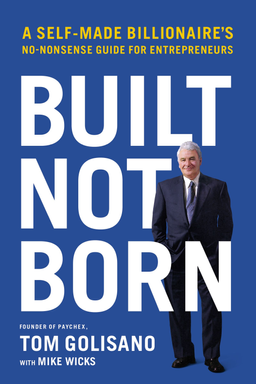
Built, Not Born cover

Built, Not Born

by Tom Golisano

Built, Not Born is a no-nonsense guide by self-made billionaire Tom Golisano, revealing the steps to turn any promising business idea into a thriving enterprise. From planning to exits, it provides concrete strategies to navigate the entrepreneurial journey, dismantling myths and offering practical wisdom for building lasting success.

Entrepreneurship as a No-Nonsense Path to Freedom

What if starting your own business isn’t the risky gamble everyone says it is? In Built, Not Born, billionaire entrepreneur Tom Golisano—founder of Paychex—argues that entrepreneurship is both a practical and achievable path to personal freedom, financial independence, and societal contribution. Through five decades of firsthand experience, Golisano insists success doesn’t require genius or luck. It’s about mastering fundamentals—understanding your business, managing money wisely, leading with integrity, and continuously questioning how things are done.

Golisano’s primary contention is simple but powerful: entrepreneurs are built, not born. Great business leaders are made through relentless curiosity, disciplined learning, and an unsentimental grasp of cash flow, people, and markets. Drawing from his journey building Paychex—from a $3,000 startup in 1971 to a $28 billion corporation—he offers readers a masterclass in how to build organizations that thrive long after their founders have stepped away.

From Small Beginnings to Billion-Dollar Principles

When Golisano launched Paychex, his only goal was to support his family and provide security for his developmentally disabled son. But he also questioned why the payroll industry ignored small businesses. While others saw a low-profit niche, he saw an underserved market—95% of American firms had fifty employees or fewer. This single act of questioning conventional wisdom became his lifelong entrepreneurial philosophy: never accept an assumption without testing it.

From this mindset came principles that shaped every decision he made—understanding how money really moves inside a business, believing sales cures almost everything, and building teams around attitude rather than résumé. His story reflects an anti-MBA approach to leadership: decision-making rooted in practical sense rather than academic theory. He tells his readers bluntly—skip the jargon and fancy plans. Focus on selling value, delivering consistency, and protecting integrity.

A Playbook for Real-World Entrepreneurs

Built, Not Born acts as a field manual for people considering, buying, or growing a business. Each chapter presents a step in the entrepreneurial lifecycle—from assessing whether you’re cut out for the lifestyle to building strong management, mastering sales, and eventually making an exit. You learn why it’s safer to own the company than to work for one, why business ideas fail without a one-page viability test, and why understanding a balance sheet is non-negotiable. Throughout, Golisano shares anecdotes of hard lessons: software crashes, sleepless nights, and near disaster that proved perseverance always trumps panic.

He punctuates advice with humor and stoic realism—“If you don’t have capital, don’t start,” he warns. “If you can’t stand the heat, get out of the kitchen.” Yet he also insists on fairness: “Make it a good deal for everyone,” a mantra that guided his negotiations from small franchises to multimillion-dollar acquisitions. Integrity, not ruthlessness, built his empire.

Leadership Beyond Business

Golisano extends his principles beyond the boardroom—to politics, sports, and philanthropy. He cofounded New York’s Independence Party, revived the bankrupt Buffalo Sabres hockey team, and donated over $250 million to medical and educational causes. His story demonstrates that entrepreneurial skills—curiosity, persistence, and the drive to improve—are transferable to any endeavor. His philosophy is clear: the best business success allows you to reinvest in the world that made that success possible.

Ultimately, Built, Not Born stands as both a pragmatic guide and a personal manifesto. It celebrates entrepreneurs not as capitalist outliers but as builders of opportunity and progress. By confronting risk, understanding money, hiring wisely, and leading with vision, you can create a legacy that outlasts you—and maybe, as Golisano did, build something that employs tens of thousands while changing lives far beyond business.


Entrepreneurship: A Calculated Risk Worth Taking

Golisano opens his book by dismantling one of the biggest myths out there—that starting your own business is too risky. He argues the opposite: relying solely on a job is actually the greater gamble. Employment, he notes, can vanish overnight due to technological change, corporate restructuring, or poor leadership. In contrast, a successful business offers control, legacy, and a transferable asset. He draws from Kodak’s downfall in his hometown of Rochester, New York, as proof that no employer is forever.

Managing Risk Through Knowledge

According to Golisano, the perceived risk of entrepreneurship reduces dramatically when you truly understand how business functions. He insists on grasping basics like pricing, sales, and market math before you start. “You don’t eliminate risk—you manage it,” he reminds readers. His own leap—leaving a stable payroll job to start Paychex with $3,000—wasn’t reckless; it was calculated, founded on months of research into small-business needs.

He uses relatable vignettes—such as his early ventures collecting newspapers or reselling bowling-lane tickets—to show that entrepreneurial instincts often stem from curiosity, not innate genius. Entrepreneurs, he says, constantly “question every business they see”—counting customers at food trucks, estimating profit margins in real time, and asking, “Could I do that better?”

Knowing If You’re Cut Out for It

Not everyone is meant to build a business, Golisano admits, but nearly anyone can become a better entrepreneur. The key traits are courage, realism, and perseverance. He warns against romanticizing passion without preparation: loving tacos isn’t a business plan for a taco truck. Real entrepreneurship, he says, means understanding the numbers before you fall in love with the idea. If you’re not willing to work through crises and “sleep on your office floor,” you may need to reconsider.

He shares how an early software failure nearly ended Paychex before it started, forcing a week-long all-nighter to deliver paychecks manually. His wife’s advice—“put one foot in front of the other”—became a life motto for pushing through chaos. Perseverance, not brilliance, saved the company.

The Rewards of Independent Success

Beyond the financial upside, Golisano stresses that entrepreneurship offers the rare gift of autonomy. You choose whom to work with, how to treat employees, and what principles to stand for. By contrast, he warns, the employed worker “can’t sell a job or pass it along to heirs.” A profitable company, however, can support your family indefinitely and even outlive you—a far better retirement plan than any salary.

He also highlights “entrepreneurial employees,” those who act like owners even within someone else’s company. Such people innovate, question, and take responsibility. They are the inner engine of sustainable enterprises—and often future founders themselves.


Understand Your Business on One Page

For Golisano, most entrepreneurs fail because they overlook simple arithmetic. He insists you can determine the viability of any business on a single sheet of paper. His “one-page business plan” is deceptively simple: list your overhead, price, margin, and volume needed to break even. If the numbers don’t work there, no lengthy plan will fix it. “Passion,” he warns, “can’t substitute for math.”

Cut the Fluff: Planning That Matters

Golisano ridicules 30,000-word business plans as doorstops. “Who’s going to read that?” Instead, he prioritizes three essentials for any investor or lender: a clear executive summary, an accurate profit-and-loss projection, and proof that you and your team know your industry. He advises realism over hype: claiming “10% of the market” without proof raises more red flags than capital.

He recounts rejecting a proposed partnership when an eager entrepreneur miscalculated Paychex’s addressable market by misreading W-2 data—illustrating how inflated assumptions destroy credibility. Golisano’s message echoes Peter Drucker’s pragmatism: if you can’t prove viability in a page, you don’t understand your business.

Key Areas to Master

Golisano walks entrepreneurs through core areas—product, market research, competition, pricing, sales channels, production, and distribution—urging them to “know everything about your industry.” He also demystifies legal structures: sole proprietorships, LLCs, S corporations, and C corporations, warning that your choice affects liability, taxes, and flexibility. He confesses he should have incorporated Paychex far earlier to save legal costs later; a decision made without anticipating growth can haunt you.

He details buying existing firms, valuing inventory, and spotting red flags in due diligence. Always ask, “Why is the owner selling?” Many hide declining sales or accounts receivable inflated with products “out on consignment.” His rule of thumb: demand a 15–20% return on investment and never confuse buying a job for buying a business.

“A first-rate business plan can often tell you not to start the business at all. Run away—and run fast.”


Money Matters: The Discipline of Capital

“If you don’t have enough capital, don’t start,” Golisano advises bluntly. Undercapitalization, he warns, is the number one killer of small businesses. Having gone four years without a paycheck, he understands the realities of early-stage survival. He outlines how entrepreneurs can fund growth creatively but responsibly—while maintaining skin in the game.

Smart Funding Before Flashy Spending

He categorizes funding sources—self-financing, family loans, bank credit, angel capital, and venture funding—cautioning that each comes with trade-offs. Borrow from “the Bank of Mom and Pop” if you must, but put everything in writing to protect relationships. Above all, show investors you’re willing to sacrifice personally; no one else will risk money you refuse to risk yourself.

Paychex itself leaned heavily on unglamorous, practical financing: second mortgages, small consumer loans, and community banks. When he finally took the company public in 1983, raising $7.7 million, he did so only after achieving real profitability. He criticizes the modern obsession with “funding rounds,” asserting that disciplined cash management is the true lifeblood of sustainable companies.

Understand the Numbers or Go Home

Golisano insists entrepreneurs must personally understand financial statements—balance sheet, profit and loss, and cash flow—not delegate them blindly. “If you can’t read them, you’re running your business blindfolded,” he warns. His magnifying-ruler routine—literally scanning every line of a spreadsheet—symbolizes obsessive fiscal control. He famously reviewed President Clinton’s nonprofit budgets “line by line” when co-founding the Clinton Global Initiative.

He illustrates profitability through Paychex’s counterintuitive model: ten small payroll clients generate 2.5 times more profit than one large client because smaller accounts pay higher per-check rates. The message: big isn’t always better; margins matter more than magnitude. His final word in this section—get a prenuptial or postnuptial agreement—extends financial prudence into personal life: protect the business from domestic misfortune.


Sell or Starve: Why Cash Flow Is a Sales Problem

Many founders, Golisano notes, panic over cash shortages when the real issue is sluggish sales. “If you say you have a cash flow problem,” he quips, “you have a sales problem.” His philosophy reframes revenue generation as the foundation of financial health. Administrative efficiencies don’t matter if nobody’s selling.

Sales Over Everything

He begins by differentiating marketing and sales: marketing creates awareness, but sales closes deals. Entrepreneurs must immerse themselves in selling firsthand, not outsource it. By doing so, they learn their customers’ objections and needs. “Nothing happens in a business until someone sells something.” Early at Paychex, Golisano himself sold door-to-door, and those conversations shaped his long-term value proposition.

He reminds leaders to beware “sleeping with elephants”—large clients whose volume tempts but whose dominance endangers you. When one client accounts for 30% of revenue, you’ve placed your survival in their hands. Paychex avoided this entirely: no single customer contributes more than one-thousandth of its income—a model of stability.

The Psychology of Selling

Golisano teaches practical selling psychology—master objections, recognize buying signals, and use the “trial close.” In one anecdote, franchisee Chuck Wollmer failed to close a restaurant owner who’d already said, “What do I do to get started?” because he didn’t ask for the sale. “He delivered the worst presentation ever,” Golisano told him—not for lack of knowledge but for missing the signal. He trains readers to listen more than they speak and embrace strategic silence—the “pregnant pause”—to let prospects talk themselves into buying.

Good salesmanship, he adds, also means ethical competition. Never disparage rivals. He refused to poach ADP’s salespeople and forbade anyone at Paychex from trashing competitors. “Only losers do that,” he said. Instead, competitors exist to sharpen you. When ADP created Taxpay, Golisano studied and improved it, soon capturing 95% client adoption. Sales, for him, is daily learning, not daily combat.


Hire for Attitude, Train for Skill

If entrepreneurship is about people, leadership is about culture. Golisano’s hiring rule—“hire for attitude, train for skill, fire when necessary”—encapsulates his philosophy on building lasting organizations. He learned empathy early watching his father humiliated by an abusive boss, vowing never to treat employees that way. His HR philosophy became the moral backbone of Paychex’s success.

Creating a Respectful Culture

Respect, Golisano stresses, must flow both ways. Leaders set the tone. He demanded clean desks and professionalism, believing order signaled reliability. Even small habits—saying thank you, tidying after meals, wearing a tie—were signs of pride, not control. He saw corporate culture as contagious; if leaders act sloppy, service deteriorates, reputation follows.

He also practiced compassion in policies—never forcing donations or tolerating nepotism. His youthful experience being coerced to contribute to the United Way convinced him employees should never be pressured into charity “for optics.” His generosity—later donating over $250 million personally—was entirely voluntary. “If you hold power,” he writes, “use it with integrity and fairness.”

Finding and Keeping the Right People

Great employees, he argues, share two traits: coachability and positivity. Skills can be taught; attitude can’t. His interview tests were subtle: watch if candidates say thank you, push in their chair, or show courtesy. He also relied on silence—the “pregnant pause”—as a probing tool. Those who fidgeted or spoke impulsively under silence rarely thrived in high-pressure roles.

Training, at Paychex, became sacred. Golisano’s new headquarters literally built classrooms around the lobby to signal its importance. Over a million training hours a year kept morale and skill high. Humor reinforced discipline; pranks, jokes, and lessons coexisted. “Have fun, but be serious about training,” he urged. When employees learn and laugh, culture sticks.

But mercy had limits. He fired chronic harassers and energy drainers—the “negative forces” who infect teams. Growth, he emphasizes, eliminates most toxicity naturally: busy, expanding companies breed optimism. Stagnation breeds politics.


Lead, Follow, or Get Out of the Way

One of Golisano’s famous desk signs read: “Lead, Follow, or Get Out of the Way.” It sums up his philosophy of decisive management. The best businesses, he says, have leaders who create vision, communicate relentlessly, and never lose sight of details—the “chocolate wrapper on the floor.” Leadership means balancing strategic altitude with street-level awareness.

Integrity and Respect

He measures leaders by integrity and manners. Whether someone thanks an assistant or cleans up their coffee cup reveals far more than degrees or resumes. Respect, he insists, is earned through small actions done consistently. At Paychex, neat desks symbolized accuracy; messy ones hinted at sloppy service. Culture mirrors leadership.

Working on the Business, Not Just in It

CEOs, he says, should be the least busy people organizationally—free to think, question, and observe. A haggard executive means poor delegation. “Good managers discover weaknesses and plug holes,” he advises, recounting uncovering triple rug-billing in a branch simply by reviewing invoices. His diligence prevented thousands in hidden waste and modeled accountability to his team.

He encourages founders to build informal advisory boards—lawyers, accountants, local experts—and meet quarterly with a simple agenda. It’s a low-cost stand-in for corporate boards and a reminder that leadership thrives on outside perspective.

Vision, Execution, and Persistence

A leader’s role, Golisano explains, follows four steps: create vision, sell it, execute it, and monitor results. Communication is the connective tissue holding this cycle together. He also emphasizes patience—knowing when to stick with an idea and when to walk. His $20 million investment in Ultra-Scan, a fingerprint scanner, eventually sold for $65 million because he waited and believed.

Leadership, for Golisano, is a moral art: fairness, humility, and persistence build trust. Titles don’t make leaders. Consistent results do.


A Good Deal for Everyone

If there’s one phrase Golisano lives by, it’s this: “Make it a good deal for everyone.” Whether with partners, employees, vendors, or spouses, fairness creates enduring success. He despises “win-at-all-costs” mentalities that breed resentment and short-term gains.

Win–Win by Design, Not Accident

He recounts how Paychex grew nationally through partnerships and franchises built on trust and mutual profit. Consolidating all seventeen partners into one corporation required sound judgment and firmness—no negotiation once terms were fair. He told them, “This is the deal—take it or leave it,” and every partner joined. Decades later, even the smallest shareholder became a multimillionaire. That clarity and equity—everyone gaining together—is what Golisano calls “ethical capitalism.”

Negotiating Without Enemies

His negotiation style hinges on preparation, patience, and silence. Borrowing from his own rule, “Never negotiate from an ultimatum,” he still knows when to stand firm. During Paychex’s $240 million acquisition of Advantage Payroll Services, he made his offer after just forty-five minutes because he’d already done his homework. “The best deals,” he says, “are ones both sides can sleep on.”

He warns entrepreneurs to rein in billable-hour vendors—lawyers, accountants, agencies—whose incentives differ from yours. His solution: clear deliverables, monthly billing, and cutting unnecessary legal squabbles. “Never let lawyers get in the way of a good deal; bring them in only afterward.” His use of the “pregnant pause” even worked in hockey: silent discipline once stunned his Buffalo Sabres executives into confronting a $250,000 mistake—a leadership moment built on respect, not rage.

Humor, Humanity, and Accountability

Finally, he reminds leaders to enjoy business. Humor diffuses tension and reinforces lessons. His playful pranks—like suspending a colleague’s car five stories up with a crane—carried messages about teamwork and humility. “Business should be fun,” he concludes, “but responsibility always comes first.”


Building a Positive Public Image

Golisano argues your company’s reputation begins long before the public hears about you. Employees, vendors, and customers all co-create your brand. “If you don’t craft your image, one will be thrust upon you,” he warns. Image, therefore, is not vanity—it’s economic survival.

Professionalism as Daily Marketing

A tidy office, courteous staff, and fair treatment are the cheapest advertising you’ll ever buy. He recalls enforcing clean desks and professional phone greetings at Paychex because each customer touchpoint broadcasts competence. He encouraged an “underpromise and overdeliver” philosophy, knowing reliability is the ultimate PR.

Every relationship matter—from paying vendors promptly to producing well-designed business cards—builds trust. For small firms without big ad budgets, he suggests milestone press releases, testimonials, and networking to keep your name visible. “The best marketing,” he writes, “is a satisfied customer who tells two more.”

Be Credible, Not Controversial

He cautions against entanglement in politics: “Support democracy, not parties.” CEOs shouldn’t become partisan figures. Instead, he promotes community philanthropy that aligns with business capability—building credibility through action. When crises occur, own them publicly, present a plan, and fix them quickly. Transparency, not defensiveness, sustains a positive image.

In the digital age, he acknowledges, social media amplifies every voice. Monitoring online feedback and engaging authentically is now part of leadership. A company that “delivers a good deal for everyone,” he concludes, will project integrity both inside and out.


Leaving on Your Terms

No empire lasts forever. “Only diamonds are forever,” Golisano wryly notes, emphasizing the need for an exit strategy. Planning your departure early safeguards both wealth and legacy. Unlike many founders who cling too long, he prepared decades ahead—consolidating Paychex specifically to enable a future public offering.

Plan Before You Need To

Exiting well starts with asking, “How will I walk away from what I built?” Golisano lays out three options: sell the company, pass it on, or step back while retaining ownership. Each requires clean books, minimal long-term liabilities, and successor-ready leadership. He recounts rejecting a lowball $14 million offer for his Safe Site company that later sold for $63 million—proof that patience pays.

He warns against overindulgence when times are good—big houses, fast cars, spoiled kids—because success can reverse overnight. “Never bet the farm on your next idea,” he cautions those tempted to gamble post-sale. Instead, be patient, live modestly, and reinvest wisely.

Retire with Purpose

Stepping away doesn’t mean disappearing. As Paychex’s chairman, Golisano chose to forgo stock options and golden parachutes, taking home only his desk and credenza as retirement souvenirs. His pride came from seeing Paychex employees thrive without him—proof of strong systems, not dependency. He found new fulfillment investing in startups and philanthropy, channeling decades of wisdom into mentoring others.

His closing message transcends business: success is measured not just by money made but by people empowered and causes advanced. Exit with integrity, and your influence becomes timeless—even if your tenure doesn’t.


What America Must Do Better

In his final chapter, Golisano widens his lens to critique how American institutions treat entrepreneurs. Despite employing nearly 60 million people, small businesses remain undervalued by education, government, and media. “Entrepreneurs built this country,” he says, “and they’ll rebuild it—if we let them.”

Education: Teach Capitalism Early

He argues business literacy should be taught alongside algebra—students should learn to read financial statements and understand markets before leaving school. Most will work for small firms, not corporations, so entrepreneurial thinking benefits everyone. “Why teach Van Gogh’s ear before a balance sheet?” he asks provocatively. (Economist Milton Friedman once voiced similar concerns about civic illiteracy around economics.)

Government: Cut the Red Tape

Golisano calls government the entrepreneur’s “silent partner who shares no risk but takes a large cut.” Overregulation, inconsistent taxes, and slow permitting suffocate growth. He critiques targeted subsidies as wasteful—“rifle shots” helping a few instead of systemic tax relief helping all. Instead of subsidizing corporations like Amazon or sports arenas, he urges broad-based, simple policies that unleash job creation organically.

Media and Associations: Celebrate Builders

Too often, he says, journalism demonizes success. “We celebrate athletes and actors, but not the people who sign their paychecks.” He calls on media to honor entrepreneurs who generate employment and innovation. He champions business networks like local Chambers of Commerce and the NFIB as critical communities for learning, lobbying, and mutual support. His final exhortation—“Don’t forget to have fun!”—is both playful and profound: joy sustains the long game of enterprise.

Dig Deeper

Get personalized prompts to apply these lessons to your life and deepen your understanding.

Go Deeper

Get the Full Experience

Download Insight Books for AI-powered reflections, quizzes, and more.