
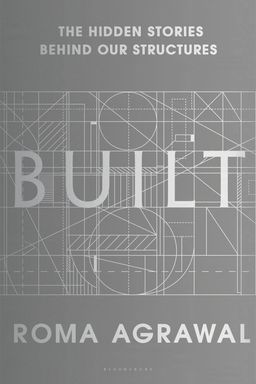
Built cover

Built

by Roma Agrawal

Built by Roma Agrawal explores the captivating tales of structural engineering, revealing the creativity and innovation behind the structures that define our world. From ancient marvels to modern skyscrapers, discover the artistry and science of building resilience against nature''s forces.

Building Humanity: The Story of Engineering and Design

Have you ever looked up at a skyscraper or crossed a bridge and wondered, “How on earth did humans imagine and create this?” In Built, structural engineer Roma Agrawal takes you on that journey—from the first mud huts of ancient civilizations to the gleaming glass towers that define our modern skylines. Through captivating storytelling and vivid examples, she shows how the structures we live, work, and move within are much more than static objects—they are expressions of creativity, science, and resilience.

Agrawal argues that engineering is not about cold equations or brute construction; it’s about imagination grounded in physics and a deep curiosity about how the world works. It’s about solving problems of gravity, wind, and stability while balancing beauty, practicality, and human comfort. Her central claim is that humanity’s progress—and even our understanding of ourselves—can be traced through our structures. Every tunnel, dome, bridge, or skyscraper tells a story of how we’ve learned to work with nature, not just against it.

From Curiosity to Creation

Agrawal’s own experience as a structural engineer is woven throughout the book. From her first project, the Northumbria Footbridge in Newcastle, to her work on London’s Shard—Western Europe’s tallest tower—she shows how engineering begins with an idea, a conversation, and a sketch before it becomes concrete reality. She introduces readers to the unseen forces that every engineer must consider: gravity, compression, tension, wind, and vibration. These make buildings stand—or fall—with breathtaking precision.

But this is not only a modern story. The book traces a lineage stretching back thousands of years—from Archimedes’ pulleys to Brunelleschi’s dome, from Otis’s safety elevator to Fazlur Khan’s tubular towers. These innovators didn’t just build—they transformed how humanity inhabits space. You see how Roman aqueducts gave us water systems, how Brunelleschi’s herringbone brick pattern made impossible domes possible, and how Khan’s exoskeleton design revolutionized skyscrapers. Engineering becomes a tapestry of human persistence and imagination.

Why This Matters Today

Agrawal’s message is that the built environment shapes not only our daily experience but also our identity. The structures around us reflect our cultures, technologies, and values. Just as Florence’s cathedral spoke to Renaissance humanism, today’s Shard in London or Burj Khalifa in Dubai symbolize global ambition and connection. Yet she cautions that progress demands responsibility: the question now is not whether we can build higher, but whether we should. Environmental impact, social well-being, and human touch must guide the future of engineering.

Her exploration expands into surprising corners—Mexico City’s sinking cathedral, self-healing concrete that mimics biological systems, ancient Persian water tunnels, and Japan’s sanitation innovations. Each episode reveals the same truth: engineering has always been about clever adaptation. Whether solving how to carry water through deserts, how to cure rust, or how to stabilize towers in earthquakes, humans continually blend science with artistry.

The Emotional Core

Perhaps most moving is Agrawal’s emphasis on the people behind the progress—especially the often-overlooked women. She celebrates Emily Warren Roebling, who guided the completion of the Brooklyn Bridge when her husband fell ill, as well as those who continue breaking barriers today. Her own story—being often “the only woman in the room”—gives the book a personal resonance. Engineering, she insists, thrives when diverse minds collaborate and when creativity is not confined by stereotype or geography.

In short, Built contends that engineering is one of humanity’s most creative acts. It asks you to look around at the walls, bridges, and towers shaping your world, and to see them not only as construction but as conversation—with physics, with history, and with the collective imagination of everyone who ever dreamed the impossible and made it real.


The Invisible Forces That Shape Every Structure

Agrawal begins where all engineering begins: with forces. Everything built by humans must obey the same physical constraints that govern mountains and trees. These forces—gravity, tension, compression, and wind—become the language of structural design. Ignoring any of them leads to failure, as seen in the catastrophic collapse of Quebec Bridge in 1907, a tragedy caused by negligence and hubris.

Gravity: The Constant Companion

Gravity, consistent and relentless, determines every structural choice. It drives the form and material of buildings and bridges. Agrawal shows how engineers channel gravity through columns, beams, arches, and domes, ensuring the weight moves predictably to the ground rather than sideways. From the symmetry of the Parthenon’s columns to the arching bridges of Rome, gravity becomes not an adversary but a design partner.

Compression and Tension: The Yin and Yang

Compression squeezes, tension pulls apart. Every beam and cable lives in their dance. A column resists compression like your leg supporting your body, while a suspension bridge transforms tension into art. Agrawal’s example of the Northumbria Footbridge shows how cables remain in tension while steel towers compress—an elegant balance mirroring the forces holding nature itself together.

Wind and Earth: Moving Against Stillness

Wind adds unpredictability. Ancient engineers feared it as divine punishment; modern ones measure it with sensors and wind tunnels. At Athens’s “Tower of the Winds,” Roman sculptors carved deities representing each direction, a poetic hint that our understanding of airflow and stability is ancient. Agrawal’s visit to wind-tunnel labs unveils how skyscrapers like London’s Gherkin and Taipei 101 are tested against gusts and vibration. Sway, she explains, isn’t weakness—it’s controlled movement designed to avoid resonance that could make occupants seasick or worse.

This invisible world of forces reveals the artistry behind engineering. You learn to see buildings not as static objects but as living organisms adapting to pressure, gravity, and rhythm. As physicist J.E. Gordon once wrote (in Structures: Or Why Things Don’t Fall Down), strength resides not in rigidity, but in balance—a truth Agrawal echoes across every chapter.


From Mud to Metal: The Evolution of Materials

To understand human progress, Agrawal invites you to trace our journey through materials—from mud and stone to iron and steel. Each new substance transformed what was possible to build, marking milestones in civilization’s embrace of science.

Clay and Brick: The First Building Blocks

Early humans shaped earth into homes, learning that sun-dried clay could shield them from weather. In Jericho and the Indus Valley, hand-moulded bricks followed precise ratios of 4:2:1—a design still used today. Romans perfected this craft, mass-producing bricks that formed arches and aqueducts. Vitruvius, Rome’s philosopher-engineer, even offered a recipe for ideal bricks, emphasizing patience and proportionality, much like Agrawal’s careful baking analogy.

Rock and Concrete: The Magic of Transformation

Concrete was Rome’s miracle invention: mixing lime, volcanic ash (pozzolana), and stones to create opus caementicium—so strong it built the Pantheon dome, still standing after 2,000 years. Agrawal describes the chemistry of hydration as a transformation from liquid to stone, a literal rebirth. Later, Joseph Monier’s discovery of reinforcing concrete with iron wires in the 19th century created “reinforced concrete,” marrying tension strength with compression resilience. This marriage defines nearly every modern structure around us.

Metal: From Iron to Steel

The leap from iron to steel changed everything. Ancient iron pillars—like the rust-proof column in Delhi—show early mastery of chemistry. But real revolutions arrived with Henry Bessemer’s furnace process in 1856, enabling mass production of strong, cheap steel. Railways expanded, bridges stretched, and skyscrapers rose. Steel’s ductility and tensile strength made designs lighter yet larger, culminating in masterpieces like the Eiffel Tower, the Empire State Building, and The Shard.

(Fun comparison: Just as silicon revolutionized computing, steel revolutionized construction—the backbone of modern civilization.)

Agrawal ends this chapter with an environmental call: materials aren’t static relics—they change with us. From fungi-based bricks to graphene towers, the next frontier mirrors our ancient curiosity to mold nature into enduring shapes.


Reaching for the Sky: The Art of Building Tall

Where earlier civilizations built big, modern humans built tall. In exploring skyscrapers, Agrawal reveals how centuries of incremental inventions—from pulleys to elevators and exoskeletons—merged to create cities of vertical wonder. Each era’s quest for height reflected its ambitions and technological confidence.

The Lineage of Height

The Great Pyramid of Giza held the record for millennia. Then cathedrals like Lincoln and Strasbourg pushed higher, symbolizing spiritual aspiration. The industrial age shifted ambition from divine to practical. In Chicago (1884), the ten-storey Home Insurance Building became the first true skyscraper, supported by a steel frame. Soon, Eiffel’s iron tower broke the 300m mark, and the race skyward began.

The Minds Behind the Modern Skyline

Agrawal highlights engineers whose genius changed our skylines. Elisha Otis invented the safety elevator—tested dramatically at the 1853 World’s Fair—removing humanity’s vertical limit. Without it, skyscrapers like The Shard or Burj Khalifa couldn’t exist. Centuries later, Fazlur Khan introduced the “tubular design,” moving stability to the building’s exterior. His John Hancock Center and the bundled tubes of the Burj Khalifa turned skyscrapers inside out, enabling strength with elegance.

Innovation Meets Humanity

Agrawal draws parallels between Brunelleschi’s dome and her own top-down construction method at The Shard—both defied convention to solve real-world problems. Today, she notes, technology can make towers a kilometer high, but ethics ask us to pause: “It’s not about what we can build, but what we want to build.” In this moment, skyscrapers become a philosophical mirror—symbols of ambition, yet reminders of our desire for sunlight, air, and connection to the earth.

Through these stories, Agrawal celebrates tall buildings not just as engineering triumphs but as testaments to endurance, creativity, and our unending curiosity to touch the sky.


Water, Waste, and the Hidden Infrastructure Beneath

While we marvel at skyscrapers above, Agrawal asks us to look below—to the pipes, tunnels, and sewers sustaining life. Beneath every city lies an unseen world of engineering that is just as vital and ingenious as what stands overhead.

The Quest for Clean Water

Agrawal’s journey through ancient Persia’s kariz systems and Roman aqueducts reveals an astonishing continuity of ideas. The kariz—hand-carved tunnels channeling groundwater through deserts—still provides irrigation today. Roman aqueducts like Pont du Gard showed how gravity could distribute clean water across nations. These innovations combined physics with civic responsibility, shaping civilizations around accessibility.

Engineering for Sanitation

Fast-forward to nineteenth-century London, when Joseph Bazalgette transformed the city’s health with his vast sewer network after the Great Stink of 1858. His brick-lined tunnels not only conquered cholera but set the foundation for modern urban hygiene. Agrawal recounts his foresight—designing sewers twice as large as needed—that still serve London today.

Modern Challenges and Futures

Singapore’s “Four National Taps” initiative—collecting rainwater, recycling wastewater, desalinating seawater, and importing reserves—epitomizes cutting-edge sustainability. Agrawal contrasts these systems with Tokyo’s historical “night soil” trade, reminding us how civilization’s advancement often begins in uncomfortable places. Her exploration of projects like London’s Thames Tideway Tunnel shows that even in today’s megacities, the battle for clean water and sanitation continues beneath our feet.

By looking underground, Agrawal transforms the narrative of infrastructure into one of heroism. Our interaction with water and waste isn’t merely technical—it’s moral, ecological, and deeply human.


The Genius of Builders and Thinkers

Not all engineering breakthroughs came from laboratories. Agrawal celebrates the mavericks—the dreamers and rebels—whose intuition and courage reshaped construction. She revisits figures like Archimedes, Brunelleschi, Otis, Khan, and Emily Roebling, tracing how imagination converted impossible ideas into lasting reality.

Archimedes and the Lifting of Limits

Archimedes’ compound pulley, first used to single-handedly move ships, began humanity’s conquest of height. His principle, “Give me a place to stand and I will move the earth,” becomes an archetype for all inventors who transform simple observations into paradigm shifts. His mathematics still inform cranes today.

Brunelleschi: The Madman with a Vision

In Renaissance Florence, Filippo Brunelleschi built the Duomo’s dome without scaffolding—a feat thought impossible. His secret? A double-shell structure and an ingenious “herringbone” pattern of bricks to counter tension. Agrawal likens Brunelleschi’s obstinate creativity to modern innovation—how “thinking beyond orthodoxy” leads to breakthroughs like top-down construction or self-healing materials.

Modern Visionaries

Elisha Otis’s elevator securement system and Fazlur Khan’s exoskeleton skyscrapers epitomize practical genius. Emily Warren Roebling’s story stands as emotional proof that brilliance knows no gender. Acting as de facto chief engineer for the Brooklyn Bridge, she managed the world’s first pneumatic caissons and negotiated with politicians while her husband lay ill—an achievement both technical and profoundly human.

Agrawal’s portraits show that progress depends on defiance. Every major advance—from Roman cranes to modern skyscrapers—was once dismissed as madness until someone built it. These stories remind you that innovation begins with daring to think differently.


Engineering the Future: Nature, Technology, and Imagination

Towards the end of Built, Agrawal turns toward the future, merging biology, robotics, and design into one vision. She asks: if humans have always shaped the earth, how can we now shape it responsibly?

Nature as Teacher

Using examples from biomimicry, Agrawal envisions structures that reflect living systems. The termite-inspired ventilation of Zimbabwe’s Eastgate Centre, bird-skull-inspired truss patterns in Stuttgart, and sea-urchin-like wooden shells all show a move toward efficiency and harmony. Nature’s “less is more” design philosophy may become modern architecture’s most sustainable doctrine.

Technology as Partner

3D printing and robotics redefine construction. Agrawal recounts printing modules made from unexpected materials—grape skins, salt, recycled rubber—that fuse creativity with ecology. Drones capable of self-repairing roads and fiber-optic “nervous systems” embedded in tunnels suggest that buildings may soon possess senses and self-healing abilities.

Imagination as Foundation

The future, Agrawal writes, belongs to those who dream responsibly. Engineers will craft not just mega-towers but livable environments—light-filled, community-focused, and connected to nature. Against the allure of ego-driven “tallest-in-the-world” projects, she argues for equilibrium: “We might gaze upwards, but we must remain grounded.”

In the end, Agrawal’s vision of engineering’s future is not mechanical, but humanistic. The next renaissance of construction, she predicts, will arise from empathy—where beauty, sustainability, and imagination fuse to build a better world.

Dig Deeper

Get personalized prompts to apply these lessons to your life and deepen your understanding.

Go Deeper

Get the Full Experience

Download Insight Books for AI-powered reflections, quizzes, and more.