
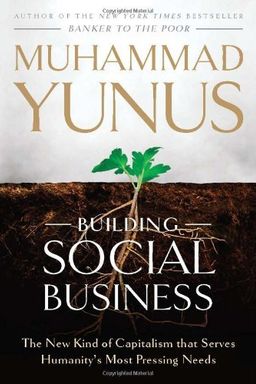
Building Social Business cover

Building Social Business

by Muhammad Yunus

Building Social Business by Muhammad Yunus reveals how companies can serve humanity''s needs without sacrificing profitability. Discover practical insights into starting your own social business, combining economic sustainability with social impact to create a better world.

Redefining Capitalism through Social Business

What if businesses existed not to make profits for shareholders, but to solve humanity’s most stubborn problems—poverty, disease, hunger, and environmental decay—while sustaining themselves financially? In Building Social Business, Nobel laureate Muhammad Yunus invites you to imagine exactly that. He proposes a new kind of capitalism that restores balance to our economic system by acknowledging that human nature is not purely selfish, but also profoundly selfless.

After decades of experience with Grameen Bank in Bangladesh—the pioneering microcredit institution that empowered millions of poor women to become entrepreneurs—Yunus concluded that traditional capitalism misrepresents human potential. It assumes that people act only to maximize their own profits, leading to an economy that celebrates greed, rewards exploitation, and excludes billions from meaningful participation. The result? A planet of wealth for the few and relentless poverty for the many.

From Profit to Purpose: A New Form of Capitalism

Yunus challenges this assumption head-on. Humans are not one-dimensional profit seekers; we’re driven by compassion, curiosity, family, and community. That’s why we also need a new kind of organization—a social business—which exists purely to solve social problems using business methods. A social business is self-sustaining like a traditional corporation, but its investors take no dividends beyond recouping their original funding. All profits are reinvested into expanding its impact. In this system, social entrepreneurs and corporations alike can harness their ingenuity to eliminate poverty, improve education, fight disease, protect the planet, and empower women.

The Two Types of Social Business

Yunus delineates two kinds of social businesses. Type I is a non-loss, non-dividend company that reinvests surplus into achieving its social goal—like Grameen Danone Foods, which combats child malnutrition by selling fortified yogurt at an affordable price. Type II is a profit-making business owned by the poor or managed through a trust acting on their behalf—like Grameen Bank, where borrowers are also shareholders, earning income and dignity in one stroke. Both types operate sustainably without reliance on charity or endless donor support.

Why Social Business Matters

Yunus argues that social business can address capitalism’s failures while preserving its strengths. Capitalism encourages innovation, efficiency, and competition—qualities we should keep—but it fails to direct those qualities toward universal well-being. By introducing the logic of selflessness into the marketplace, Yunus believes we can mobilize the same creative energy that drives Silicon Valley or Wall Street to solve global problems rather than perpetuate them. Social business gives everyone—not just governments or philanthropists—a role in creating a world without poverty.

The Stories that Prove It Works

To prove his idea is more than theory, Yunus weaves in compelling case studies: Grameen Danone’s success in delivering affordable nutrition to Bangladeshi children; Grameen Veolia Water, which provides arsenic-free water to rural families; and Grameen Intel, which uses technology to improve maternal health. He describes joint ventures with BASF to fight malaria through treated mosquito nets and Adidas to create a one-euro shoe for the poor. These enterprises illustrate social business as a living, evolving form of “social R&D” (research and development) for the planet.

A Blueprint for Global Transformation

The book is not just a manifesto—it’s a manual. Yunus outlines practical frameworks: how to design, fund, and launch social businesses; the legal reforms needed to support them; and the creation of institutions like the Yunus Centre and Grameen Creative Lab to nurture social business ecosystems. He also calls for the creation of social investment funds and eventually a social stock market, where investors measure success not by return on equity but by impact on human lives.

In a world reeling from financial, ecological, and moral crises, Yunus’s vision feels both urgent and hopeful. Social business, he insists, can turn frustration into action. It gives you, as a citizen and consumer, the tools to make capitalism compassionate—to align entrepreneurship with empathy. As Yunus puts it, we don’t need to abandon capitalism; we need to complete it. The future, he assures us, belongs to those who can blend profit with purpose, competition with compassion, and business with benevolence.


The Two Faces of Human Nature

Yunus begins with a philosophical observation about human nature: we are not one-dimensional beings driven solely by greed. Yet traditional capitalism has constructed its global system on precisely that false premise. In the process, it has generated vast wealth inequality and institutionalized poverty. His challenge is simple but radical: build an economic theory that fits the real human condition, which includes empathy, creativity, and a desire to help others.

Self-Interest Meets Selflessness

Yunus argues that every person is part entrepreneur and part altruist. We create, innovate, and hustle not only to earn but also to contribute. In the current economic model, the altruist has been erased from the equation, leaving society dangerously unbalanced. By reintroducing selflessness into business through the concept of social enterprise, he envisions a world where helping others isn’t confined to philanthropy—it’s baked into how we work, produce, and invest.

The Moral and Pragmatic Shift

Unlike charity, which can breed dependency, social business preserves dignity by empowering people to solve their own problems sustainably. It avoids the bureaucracy of government welfare while moving beyond the narrow self-interest of for-profit companies. Yunus contends that this model aligns as much with moral instincts as with practical economics—it transforms compassion into a self-sustaining force.

“Poverty is not created by poor people,” Yunus writes. “It is created by the systems we built, the institutions we designed, and the concepts we formulated.”

By acknowledging both the selfish and selfless sides of capitalism, Yunus hopes to restore the soul of the marketplace. The success of ventures like Grameen Bank shows that unlocking empathy is not only noble—it’s economically viable.


Building a Business to Solve, Not to Profit

Launching a social business follows the same practical steps as launching any other company—but with a defining difference: the end goal is social impact, not personal gain. Yunus provides a detailed blueprint for transforming compassion into a self-sustaining enterprise that solves specific community problems.

Starting with a Problem, Not a Market

Traditional entrepreneurs begin by identifying a market gap that promises profitability. Social entrepreneurs, Yunus insists, begin by finding a social pain point—a community’s unmet need—and designing a financially viable way to eliminate it. For instance, Grameen Danone arose from the need to fight child malnutrition in Bangladesh through affordable, nutrient-rich yogurt. Similarly, Grameen Veolia Water began with the crisis of arsenic poisoning in rural water supplies.

Learning by Doing

Social business thrives on experimentation. Yunus’s mantra: start small and learn fast. His experience with joint ventures like Grameen Veolia shows that most early plans collapse when confronted with cultural realities. Villagers initially refused to buy water even at nominal prices, not because it was unaffordable but because they were unused to paying for water they believed was free. Solutions emerged only through adaptability—cross-subsidization, new promotion strategies, and eventually, alternate revenue models. Flexibility is a form of pragmatism, Yunus stresses, not failure.

Sustainability as the Core Metric

A social business must cover its costs through sales, just like any competitor. Charity depends on inflow; social business circulates its own lifeblood. This principle ensures long-term independence and scalability. Meanwhile, success is measured not by return on equity but by improvements in health, education, or environment—an inversion of conventional capitalism’s scoreboard.

By replacing profit motives with purpose, Yunus redefines entrepreneurship as a moral and intellectual pursuit—the art of solving human pain sustainably.


Lessons from Grameen Danone and Veolia

Real-world experiments anchor Yunus’s theory. His partnerships with major corporations like Danone and Veolia reveal both the promise and difficulties of merging business acumen with social purpose. These projects highlight how wealth-driven institutions can reinvent themselves as engines of empathy and innovation.

Grameen Danone: Nutrition at a Price the Poor Can Pay

Founded in 2006, Grameen Danone was designed to eliminate child malnutrition in Bangladesh through affordable yogurt fortified with micronutrients. But even with Danone’s resources, the project faced setbacks. Costs spiked during global inflation, distribution faltered, and consumer habits stalled growth. Instead of shutting down, the company adapted—introducing smaller servings, rural women vendors, and cross-subsidized urban sales. By 2010, it was nearing financial viability and serving thousands of children. The key lesson? Start small, stay flexible, and let purpose steer persistence.

Grameen Veolia Water: A Social R&D Laboratory

Grameen Veolia Water tackled Bangladesh’s arsenic crisis by supplying safe, affordable drinking water. Despite high enthusiasm, only 10–15% of the target population initially paid for water. Yunus’s team discovered deep-rooted obstacles: cultural skepticism, long-term risk denial, and ingrained habits. They reframed the project as social R&D—a space for experimentation rather than immediate success. Gradually, alternative models like bottled institutional sales, tiered pricing, and community education increased adoption. The collaboration also transformed Veolia’s own identity, turning a multinational into a socially conscious innovator.

Through both ventures, Yunus demonstrates that social business is not charity with marketing—it’s capitalism reborn as care. Failure becomes insight, and impact replaces dividends.


Social Business in Healthcare: Curing to Learn

One of Yunus’s most compelling stories comes from the realm of healthcare: the partnership between Grameen Healthcare Trust and Italy’s Cure2Children Foundation. This joint venture shows how medical innovation and compassion can merge into a financially sustainable healthcare model addressing complex diseases like thalassemia.

From Tragedy to Innovation

When Dr. Lawrence Faulkner and entrepreneur Eugenio La Mesa lost two young cancer patients in Italy, they redirected their grief into creation. They launched Cure2Children to treat children with blood disorders in low-income countries. Partnering with Grameen turned this mission into a self-supporting social business: two paying patients fund treatment for one impoverished child, creating cross-subsidized healthcare. The model achieves Western-level care at a fraction of the cost—around $20,000 per bone marrow transplant versus $200,000 in the West.

Healthcare with Dignity

Unlike charity hospitals that depend on donors, Cure2Children’s model retains patients’ dignity while ensuring high quality through training, local ownership, and telemedicine. Using open-source technology—Skype, Yugma, and online databases—Italian physicians mentor Bangladeshi and Pakistani doctors remotely. The result: a replicable learning ecosystem that saves lives and builds local competence.

By proving that world-class healthcare is both affordable and teachable, Yunus redefines medicine as a social enterprise rather than a privilege. Each patient cured becomes both outcome and teacher—proof that even the most advanced science can serve humanity instead of the market.


Creating a Global Infrastructure for Good

To sustain the social business revolution, Yunus emphasizes building a strong global infrastructure. Institutions like the Yunus Centre in Dhaka and the Grameen Creative Lab (GCL) in Wiesbaden, Germany, act as incubators bridging academia, corporations, and social entrepreneurs.

Labs, Universities, and Think Tanks

The Yunus Centre serves as a one-stop hub connecting Grameen-driven ventures and aspiring social businesses worldwide, while GCL—led by creative entrepreneur Hans Reitz—functions as an “action tank” translating ideas into practice. Globally, universities like Glasgow Caledonian (Scotland), California State University Channel Islands, Kyushu University (Japan), and HEC Paris have created social business chairs and labs. They integrate economics, business, and ethics to craft a new generation of “Social MBAs.”

Financing the Movement

New financial vehicles such as the Danone Communities Fund, Grameen Crédit Agricole Microfinance Foundation, and the IDB Grameen Social Business Initiative are pioneering social investment funds, measuring returns in societal value rather than profit. Yunus envisions a future social stock market—a global exchange where “social shares” are traded based on impact metrics instead of dividends, revolutionizing how we value success.

This network of labs, funds, and universities transforms social business from an ideal into a global discipline—making solving poverty as teachable, measurable, and scalable as engineering or medicine.


Partnerships that Change Companies

A surprising impact of social business, Yunus observes, lies in how it transforms the corporations that join it. An enterprise like Danone or Veolia doesn’t lose money by collaborating with Grameen—it gains moral momentum, innovation, and pride among its employees. Social business becomes a laboratory not just for solutions but for corporate renewal.

How Doing Good Reinspires Workers

Employees in profit-driven companies often feel trapped by purpose-less work. When Veolia Water joined Grameen to deliver clean water, Yunus recalls, “engineers who once repaired pipes discovered they were saving lives.” Workers volunteered for overseas assignments, rediscovering meaning beyond paychecks. This emotional dividend revitalizes corporate culture—a performance indicator rarely measured by Wall Street but profoundly valuable.

Corporate Compatibility

Yunus notes that social business works best when aligned with a corporation’s core mission. Veolia focused on water, Danone on food, and BASF on health technologies. This alignment ensures relevance and commitment. Even traditional managers, skeptical of “philanthropic experiments,” find themselves energized when they see social impact strengthening brand reputation and employee engagement simultaneously.

In effect, social business acts as capitalism’s conscience—reminding corporations of their humanity while teaching them new ways to serve customers at the base of the economic pyramid sustainably.


Completing Capitalism and Ending Poverty

Yunus ends his book with an audacious promise: poverty can be eliminated within our lifetimes. Capitalism, he declares, is flawed not because it rewards initiative, but because it erases compassion. By embedding selfless business alongside profit-making ones, we can complete capitalism’s architecture and make it humane.

From Crisis to Correction

The 2008 financial crisis, environmental degradation, and food insecurity all reveal how greed-driven systems collapse under their own weight. Social business offers a systemic correction—a way to align innovation with inclusion. Yunus argues that when we direct technology, capital, and creativity toward the poor, the entire global economy benefits. A world where six billion consumers are also producers is not only moral—it’s more sustainable.

A Paradigm Shift in Human Aspiration

Ultimately, Yunus invites us to dream of a future where “poverty museums” are the only reminders of inequality. He envisions capitalism enriched by purpose, where future generations design companies that measure joy and justice alongside profit. He reminds us: change doesn’t require permission—only imagination. Social business, he concludes, is the human economy we’ve been waiting for—a capitalism that serves, not subjugates, humanity.

Dig Deeper

Get personalized prompts to apply these lessons to your life and deepen your understanding.

Go Deeper

Get the Full Experience

Download Insight Books for AI-powered reflections, quizzes, and more.