
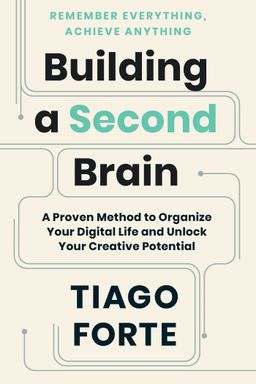
Building a Second Brain cover

Building a Second Brain

by Tiago Forte

In ''Building a Second Brain,'' Tiago Forte presents a revolutionary method to conquer information overload and unlock your creative potential. Learn to effectively capture, organize, and utilize digital knowledge, transforming your productivity and enabling innovative thinking. This book is your guide to mastering the digital world and enhancing your life''s creative pursuits.

Building a Second Brain: Extending Your Mind Beyond Memory

How often have you felt overwhelmed by the sheer amount of information you need to retain—ideas slipping away mid-conversation, valuable insights lost in the flood of daily data, or creative sparks that vanish before you can act on them? In Building a Second Brain, productivity expert Tiago Forte proposes a bold and practical answer: stop relying on your biological memory alone. Instead, create a trusted digital extension of your mind—a 'Second Brain'—that stores your ideas, refines them, and helps you turn them into creative output.

Forte’s core argument is that modern life bombards us with more information than our Paleolithic brains can comfortably handle. Rather than fighting to remember everything, we should outsource memory to technology. By doing so, we free mental space for insight, imagination, and creation. This idea draws from the movement known as personal knowledge management (PKM)—the art of structuring the information you encounter to serve your goals and creativity.

The Problem: From Information Overload to Information Exhaustion

We now consume an average of thirty-four gigabytes of data per day—the equivalent of 174 newspapers’ worth of content. Yet much of this intake doesn’t translate into applied knowledge or creativity. As Forte notes, we spend hours collecting advice from podcasts, articles, and courses, yet struggle to recall one actionable idea when it matters most. The digital deluge leaves us anxious, distracted, and uncertain about what to prioritize.

The antidote, Forte argues, lies in treating technology not as the enemy of focus but as a tool for thinking. Just as a personal computer revolutionized productivity, so too can a “personal knowledge system” revolutionize how we manage ideas. Your devices become less a source of distraction and more a trusted assistant—a “bicycle for the mind,” borrowing Steve Jobs’s phrase.

The Vision: A Digital Commonplace to Capture and Create

Forte builds on historical precedents. During the Enlightenment, writers from John Locke to Leonardo da Vinci kept commonplace books—personal collections of ideas, excerpts, and reflections. These notebooks helped thinkers digest complex information and combine old ideas into new insights. In the digital age, a Second Brain serves the same function, updated with searchability, tagging, and synchronization across devices.

Your Second Brain becomes an evolving repository for everything meaningful you learn—articles, images, reflections, quotes, and notes from daily life. Rather than letting these fragments scatter across apps and folders, this system helps you capture them intentionally, organize them around your goals, distill their essence, and express them effectively. Those four steps form the core of Forte’s simple yet powerful methodology: CODE— Capture, Organize, Distill, Express.

The CODE Method: Turning Information into Action

Capture means keeping what resonates—selectively saving the ideas, phrases, or questions that spark curiosity. Organize involves storing those captured pieces for actionability—using Forte’s popular PARA framework: Projects, Areas, Resources, and Archives. Distill teaches you to extract key insights through a process he calls Progressive Summarization, highlighting only what matters most. Finally, Express is where it all pays off: turning notes into creative output—presentations, articles, plans, or innovations—using structured methods that lower the barrier to action.

Through these four simple habits, Forte redefines productivity from mere information consumption to purposeful creation. The Second Brain doesn’t just store knowledge—it incubates and evolves it, helping you move from collecting ideas to connecting and expressing them.

Why It Matters: The Shift from Memory to Meaning

The book’s deeper promise is more philosophical: when you externalize your thoughts, you become less reactive and more creative. Tiago Forte’s personal journey—from struggling with chronic pain and memory loss to developing this system—embodies that transformation. His method isn’t about perfect organization but about creating a reliable relationship with your ideas. Once you trust your Second Brain to remember for you, you can focus your attention on higher-level thinking—pattern recognition, intuition, and synthesis.

Ultimately, Building a Second Brain invites you to transcend information overwhelm by transforming technology into an ally for reflection and creativity. It calls us to treat knowledge not as something to be hoarded but as a living ecosystem to cultivate. Forte promises—and demonstrates—that when you build a Second Brain, you build a smarter, calmer, and more creative self.


The Birth of the Second Brain Concept

Every transformative method begins with a personal struggle. For Tiago Forte, the idea of a 'Second Brain' emerged not from theory but from necessity. As a college student, he developed a chronic throat pain that left him unable to speak comfortably and, due to medication side effects, struggling with memory loss. This forced him to rethink how to manage his thoughts, knowledge, and even identity.

From Suffering to System

Unable to rely on his mind alone, Forte turned to writing and digitizing his medical records. Scanning hundreds of pages, he discovered how putting information into a searchable digital format made sense of chaos. By tracking symptoms, treatments, and outcomes, he began to identify patterns no doctor had seen. This experience became a revelation: writing things down creates thinking space.

Over time, Forte’s notes became a lifeline not just for his health but for his learning. In college and later as a Peace Corps teacher in Ukraine, he found that digital note-taking let him capture lessons, refine teaching methods, and develop creative resources for his students. Years later, while working in consulting at a frenetic Silicon Valley firm, his growing repository of notes became a competitive advantage—allowing him to retrieve facts, projects, and insights faster than his colleagues.

From Personal Tool to Global Movement

Forte’s system evolved from a personal coping strategy into a reproducible framework. His colleagues, curious about his efficiency, asked him to teach them. Those lunchtime sessions became workshops, then a blog, then the online course 'Building a Second Brain,' which grew into a global program studied by thousands in over 100 countries. That same practical framework now underpins the book itself.

What began as a way to survive chronic pain became a worldview: technology isn’t just for storage—it can become an active partner in thinking. The 'Second Brain' exists outside you but works alongside you, remembering when you cannot, offering perspective when you’re lost, and connecting patterns your conscious mind overlooks.

Beyond Self-Improvement

Forte insists his method isn’t about perfect self-optimization. It’s about relieving your mind of the exhausting need to hold everything at once so you’re free to explore, reflect, and live fully. Your Second Brain acts as a trusted partner in thought, one that mirrors your ideas back to you and extends your memory across time.

“Your mind is for having ideas, not holding them.” —David Allen, Getting Things Done

That single insight encapsulates Forte’s journey. Building a Second Brain is not a luxury for obsessive note-takers—it’s a necessity in a knowledge-driven world where forgetting is inevitable but meaning is optional. Forte’s message: organize your knowledge, and you organize your life.


Inside the CODE Method

At the heart of Forte’s philosophy is the CODE Method—a four-step framework that turns loose fragments of information into creative output. Each step—Capture, Organize, Distill, and Express—mirrors how we naturally learn, reflect, and share.

Capture: Keep What Resonates

Capture is about noticing what sparks curiosity and saving it without overthinking. Forte borrows from songwriter Taylor Swift, who constantly jots lyric ideas into her phone. The key isn’t to capture everything—it’s to “keep what resonates.” Using criteria such as inspiration, usefulness, personal meaning, and surprise, you save only the 10% of content that genuinely moves you. Capture tools (like Kindle highlights, read‑later apps, screenshots, and voice memos) act as nets for valuable insights before they slip away.

Organize: Save for Actionability

Captured notes become powerful only when organized for action. Forte’s PARA framework divides information into Projects you’re working on now, Areas of ongoing responsibility (like health or finances), Resources for topics of interest, and Archives for completed or inactive items. This simple hierarchy turns chaos into clarity. Crucially, PARA organizes by actionability, not by topic—so instead of storing everything about 'psychology' in one giant folder, you link each note directly to a goal or project where it might be useful.

Distill: Find the Essence

Once organized, your notes are ready for Distillation—extracting the key ideas that truly matter. Forte teaches a process called Progressive Summarization: highlight the best parts, then bold the best of those highlights, then create short summaries. Each layer of refinement turns long notes into quick‑reference insights. Like duplicating Picasso’s simplification of a bull into elegant lines, distillation keeps essence and discards clutter. The result: insights that are instantly usable, even months later.

Express: Show Your Work

Finally, knowledge becomes real only when expressed. In this step, you assemble your distilled notes into tangible outputs—proposals, presentations, podcasts, or posts. Forte encourages working with Intermediate Packets—smaller, reusable components of previous work. Think of slides, templates, or research summaries as LEGO blocks that you can rearrange to build something new. This iterative approach lowers perfectionist pressure and transforms learning into creation.

Together, the CODE steps transform productivity from an exhausting chase for input into a steady rhythm of discovery, synthesis, and output. You no longer scramble to recall or reinvent—your Second Brain holds the raw material of your best ideas, ready to use when inspiration strikes.


The PARA Framework: Organizing for Action

In most workplaces and lives, information is scattered—across inboxes, desktops, notebooks, cloud files, and apps. Forte’s PARA framework offers an elegant, flexible system for taming this chaos. Rather than organizing information by topic (which changes constantly), PARA structures it by actionability—how soon and how often you’ll use it. This shifts organization from theory to utility.

Projects: Active Endeavors

Projects are short-term efforts with a clear outcome. “Plan a trip,” “Launch a website,” or “Submit a research paper” all fit here. By confining active work to a small set of project folders—typically five to fifteen—you always know what matters now. When a project ends, move its folder to Archives and celebrate closure. Forte emphasizes that frequent small completions are what keep momentum and motivation alive.

Areas: Ongoing Responsibilities

Areas cover long-term commitments—your health, finances, relationships, or work duties. There’s no end point, just standards to maintain. Keeping a folder for each area lets you monitor progress and store key info (like routines, budgets, or guidelines). These folders act as dashboards for your life, preventing slow declines in important domains.

Resources: Reference Material

Resources hold everything you might use someday—articles, research, or inspiration. They’re your personal library, organized by curiosity rather than obligation. When inspiration strikes or a project demands ideas, you can dip into this rich archive. As Forte notes, “Resources are for future possibilities, not current pressure.”

Archives: The Offstage Library

Finally, Archives preserve completed or dormant work. They stay out of sight but never out of reach. Digital storage makes hoarding risk-free, but the key is to keep the 'stage'—your active workspace—clear. With PARA across all your platforms (notes, computer files, cloud folders), everything is findable and connected. This cross‑system coherence is what makes PARA so powerful: you don’t just store information, you build a living ecosystem that mirrors your goals.


Progressive Summarization: The Art of Forgetting Well

We live in an age that worships remembering. Yet Forte argues that forgetting strategically is the real superpower. Progressive Summarization—the heart of the Distill step—ensures that your future self can resurface key ideas in seconds. It’s a simple but transformative process: highlight, then bold, then summarize. Each pass compresses the information, sharpening clarity and saving time later.

The Layers of Memory

Imagine your notes as archaeological strata. The first layer captures raw excerpts—a passage from a book, a paragraph from an article, or your own reflection. The second layer adds bold highlights—phrases that capture meaning. The third layer adds bright highlights—the essence of the essence. A final optional layer is the 'executive summary'—your own short synthesis at the top.

This technique honors the way our brains naturally forget: by erasing detail while preserving meaning. When you return to old notes, you see a hierarchy of significance—the best lines stand out, while the rest fades gracefully away. Over time, your archive becomes more distilled, less cluttered, and more powerful.

“Progressive Summarization is not about remembering as much as possible—it’s about forgetting well, so you can focus on what truly matters.”

Like sculptor Pablo Picasso refining his sketch of a bull from detail to simplicity, each pass removes noise to reveal form. Similarly, documentary filmmaker Ken Burns distills fifty hours of footage into one hour of narrative. Both exemplify how creative power grows through elegant reduction. Progressive Summarization turns that craft into an everyday habit for your intellectual life.


Intermediate Packets: Think Small to Create Big

Forte’s secret to stress-free creativity lies in what he calls Intermediate Packets—small, reusable building blocks of work. Instead of tackling massive projects as single monoliths, you break them into manageable, modular pieces: a paragraph, a slide, or a research summary. Each packet represents knowledge you can reuse and repurpose, creating leverage across time.

Five Kinds of Intermediate Packets

  • Distilled notes: refined summaries from books or lectures you can deploy instantly.
  • Outtakes: deleted paragraphs or unused designs that might suit future work.
  • Work-in-process: drafts, agendas, or prototypes in development.
  • Final deliverables: finished pieces like presentations or reports you can reference later.
  • Documents by others: useful materials created by teammates or clients.

Why Thinking Small Works

Breaking big projects into Intermediate Packets has four benefits: you become interruption-proof (you can stop anytime and resume easily), progress-ready (you can work in short bursts), feedback-focused (others can review small pieces), and infinitely reusable (past packets become assets for future projects). Like LEGO pieces, these packets click together into larger creations without starting from zero.

Viewed this way, creativity stops being a mysterious lightning bolt and becomes an ongoing flow of assembly and reassembly. Your Second Brain holds every packet you’ve ever created—each one ready to serve new goals.


Habits for a Sustainable Second Brain

A Second Brain only works if used consistently. To sustain it, Forte teaches three essential habits drawn from the culinary world’s mise en place—the discipline professional chefs use to keep kitchens organized amid chaos. As James Clear notes in Atomic Habits, small routines reduce cognitive load. Similarly, these micro‑habits ensure your system stays frictionless and alive.

1. Project Checklists

Use a Project Kickoff Checklist to start projects intentionally—capture existing notes, review similar folders, and outline next steps in twenty minutes. Use a Project Completion Checklist to close loops—move materials to Archives, mark tasks complete, and distill lessons learned. This rhythm turns your projects into learning cycles where insight compounds over time.

2. Weekly and Monthly Reviews

Once a week, clear inboxes (email, desktop, notes) and set your priorities. Once a month, reflect on your goals, areas of life, and 'someday/maybe' dreams. Regular reviews keep your Second Brain fresh, relevant, and trusted. They transform organization from a chore into mindful reflection.

3. Noticing Habits

Finally, develop the art of noticing—micro‑adjustments in real time. Rename a note for clarity. Move an idea closer to where it’s actionable. Merge duplicates. Share a useful note with a colleague. These tiny touches accumulate into what Forte calls “engineering serendipity”—you create your own good luck by making ideas easier to connect and apply.

Forte’s insight: organization isn’t a monumental event. It’s a continuous conversation with your work. Done lightly and often, these habits keep your Second Brain not just organized—but alive.


From Scarcity to Abundance: The Mindset Shift

The final chapters of Forte’s book zoom out from tools to transformation. Once the system is in place, the real change is internal: shifting your mindset from information scarcity to abundance, from obligation to service, and from consumption to creation.

Information Abundance

In school, we were rewarded for memorizing scarce facts. Today, information is infinite and instantly accessible. The new skill is not recall but curation—deciding what deserves your limited attention. Your Second Brain becomes a filter that amplifies meaning while silencing noise. You stop hoarding and start trusting that the right ideas will reappear when you need them.

Service over Obligation

Forte observes that once people accumulate knowledge in their Second Brains, they often feel a natural pull toward contribution. Knowledge, he says, “wants to be shared.” Seeing your accumulated wisdom laid out makes it clear how much you have to offer. The shift from self-centered productivity to service‑oriented creativity marks maturity in this practice. You create less out of duty, more out of genuine desire to help.

Creation as Self-Expression

Most profoundly, the book argues that self-expression is a fundamental human need. In his darkest moments battling illness, Forte found writing and digital organization to be acts of healing—turning pain into insight. Similarly, your notes become a mirror for who you are and what you believe. Creating is no longer a performance for others—it’s a way of discovering yourself.

Forte closes with a challenge: build your Second Brain not merely to “get things done,” but to think, live, and contribute more fully. Because once technology remembers for you, your mind is finally free to imagine.

Dig Deeper

Get personalized prompts to apply these lessons to your life and deepen your understanding.

Go Deeper

Get the Full Experience

Download Insight Books for AI-powered reflections, quizzes, and more.