
Idea 1
Awakening to Reality and Freedom of Mind
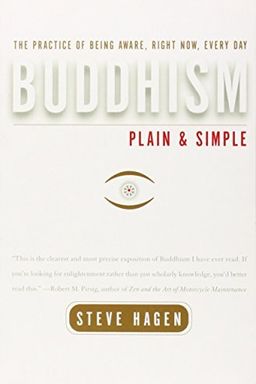
Have you ever felt like something essential is missing—even when life seems full? In Buddhism Plain and Simple, Zen teacher Steve Hagen challenges our assumption that lasting peace lies in possessions, success, or belief systems. He argues that our unease comes not from what we lack, but from the way we see—or fail to see—the world as it really is.
Hagen contends that human suffering—what the Buddha called duhkha—arises because we grasp at illusions of permanence and self. We think happiness depends on control and meaning, yet reality itself is flux. The Buddha’s teaching, Hagen explains, isn’t about faith or ritual but about awareness: seeing existence directly, before thoughts and labels distort it. Enlightenment isn’t supernatural; it’s simply being awake to the truth of thusness—the seamless wholeness of reality in the present moment.
Modern Confusion and the Need for Clarity
Hagen opens with humanity’s existential crisis: in an age of science and skepticism, many feel the world is vast, impersonal, and meaningless. Deprived of comforting myths, we seek refuge in pleasure, success, or spirituality—but these paths only deepen our discontent. We live, as ancient philosopher Yang Chu described, “chained by ignorance,” passing by the joys of life without tasting freedom.
This confusion isn’t new. Twenty-five hundred years ago, a man named Gautama faced it and awakened. His insight—that suffering ends through direct awareness—spread as Buddhism. Yet as Hagen notes, centuries of cultural accretions have obscured the Buddha’s clear simplicity beneath robes, rituals, and metaphysics. Hagen’s goal is to strip Buddhism back to its heart: a practical, moment-to-moment seeing of reality.
Seeing Rather Than Believing
Instead of belief, the Buddha proposed observation. Seeing is believing—but belief is not seeing. Hagen illustrates this with a striking exercise: imagine a blurred picture that at first looks meaningless. Only when you truly see the hidden image does confusion vanish. Awakening, he says, is like recognizing what was always there. In that moment, doubt disappears. This experiential understanding, not abstract thought, is what Buddhism means by wisdom.
Truth is immediate and self-evident.
You don’t need scriptures, spirits, or special robes to find it—you only need to pay attention to what’s actually happening in this moment.
The Journey Into Now
Hagen retells the Buddha’s own awakening story as a journey that leads nowhere but here. Gautama, born into privilege, saw that all worldly attainments end in sorrow. Neither pleasure nor asceticism could free him. Sitting under a tree, he observed his experience so deeply that illusion fell away. He became “awake”—not divine or mystical, simply clear-eyed. This moment of awakening revealed that reality has no beginning or end; it only comes to be—right now.
In our own lives, Hagen suggests, we too can awaken by letting go of interpretations and seeing directly. This requires courage, because clarity means meeting impermanence head-on. Everything changes: weather, emotions, relationships, bodies, even thoughts. Yet impermanence, he insists, isn’t a curse—it’s what makes life precious. The rose you love has beauty because it fades. Trying to make it eternal only creates plastic imitations that never truly live.
A Religion of Middles, Not Extremes
Unlike religions that promise salvation in a future world, Buddhism centers on the present. It is what the Buddha called the middle way—a path between denial and indulgence, belief and nihilism. The awakened don’t speculate about origins or afterlife. Such questions, Hagen writes, are distractions like asking about the bow and arrow that wounded you instead of removing the arrow itself. What matters is healing—the immediate realization that suffering ends when we stop resisting reality.
Through this book, Hagen challenges you to turn inward—not in isolation, but in awareness. You already have the authority, he says. The Buddha’s final words were, “Be a light unto yourself.” That light is attention. It dissolves ignorance and reveals the natural wholeness underlying all chaos. Freedom of mind isn’t acquired; it’s uncovered. And it’s available right now, in the simple act of seeing what is.