
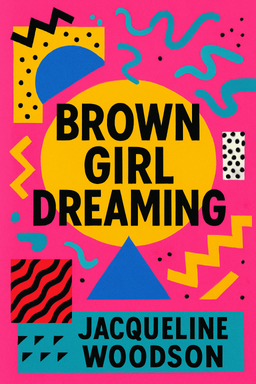
Brown Girl Dreaming cover

Brown Girl Dreaming

by Jacqueline Woodson

Brown Girl Dreaming by Jacqueline Woodson is an evocative memoir that captures the essence of growing up as an African American in the 1960s and 1970s. It beautifully intertwines personal narratives with historical events, offering profound insights into family, identity, and resilience during a time of significant social change.

Finding Voice and Freedom Through Memory and Story

How do you find your voice when the world around you keeps trying to silence it? In Brown Girl Dreaming, Jacqueline Woodson answers this question through a poetic memoir that charts her journey from a child born into segregation-era America to a young writer learning to claim her own power through words. Rather than simply telling her story, Woodson uses verse to show how identity, family, faith, and history intertwine to shape a person’s dreams. Her core argument is that storytelling—whether whispered across kitchen tables or scribbled in notebooks—is both resistance and rebirth. Writing gives us the power to make sense of who we are, where we come from, and the worlds that once tried to define us.

Set across the 1960s and 1970s, the book moves between Ohio, South Carolina, and Brooklyn—each a landscape of discovery, loss, and belonging. It threads the personal with the political, showing how one brown girl’s awakening mirrors the broader Black experience during the Civil Rights era. As Woodson grows, she absorbs her mother’s defiance, her grandparents' deep Southern faith, and her brother’s quiet resilience, learning that identity is both inherited and invented. Through these experiences, she learns to listen—to voices of protest, storytellers, preachers, and her own inner rhythms—and eventually begins to speak back to the world in verse.

Roots and Rivers: Where the Story Begins

Woodson opens with her 1963 birth in Ohio—the same year Martin Luther King Jr. is preparing for the March on Washington and only a few years after Ruby Bridges braved an all-white school. Her birth into a family divided between North and South symbolizes a nation itself pulled between freedom and racism. The Woodsons of Ohio trace their lineage back to Thomas Jefferson and Sally Hemings’s supposed first son, while her mother’s South Carolina roots overflow with the rhythms of Black survival and pride. “The stories of South Carolina run like rivers through my veins,” she writes, highlighting how ancestry and geography anchor identity.

When her family moves between these two places—segregated South Carolina and Northern Ohio—Woodson encounters the fractures of America’s racial contradictions. Her mother’s longing for freedom (“We’re as good as anybody”) meets her father’s conviction that he’s escaped the indignities of the South. Yet Ohio offers its own quiet oppressions: isolation, grief, and the pull of a home left behind. This constant movement mirrors the larger African-American migration northward—seeking safety, yet never quite escaping the past.

Becoming a Witness

A central turning point comes when Woodson’s mother leaves her father and returns with her three children to live in Greenville, South Carolina. There, Jacqueline finds warmth in the steady rituals of her grandparents—their garden, their songs, their front porch stories. Her grandmother becomes her spiritual guide, immersing her in the faith of Jehovah’s Witnesses. Saturdays are for knocking on doors; Sundays are for Bible study. Yet, beneath this structure, Woodson begins to question dogma and difference, sensing that her imagination doesn’t always fit neatly into sermons or rules. “I want the world where my daddy is,” she confesses, caught between two gods, two worlds.

This duality—between the sacred and the secular, the North and South, silence and speech—becomes the foundation of her eventual artistic voice. Her grandmother teaches her to listen, to hold silence as power, while her environment teaches her what must finally be said aloud. Like Langston Hughes and Maya Angelou before her, Woodson transforms the ordinary—Sunday hair pressing, Bible stories, the hum of crickets—into sacred text. Her poems become a kind of scripture of memory itself.

Brooklyn and the Awakening of the Writer

When the family relocates to Brooklyn, everything shifts. In Bushwick, a melting pot of Black, Puerto Rican, and Caribbean cultures, Jacqueline befriends Maria—her “Forever Friend”—and begins to explore the boundaries of identity through language. The city is not the paradise her Southern kin imagined (“diamonds speckle the sidewalk”), but it becomes the place where her written voice finally emerges. A composition notebook opens a door to infinite worlds. With each story, she reconstructs herself: not merely the other Woodson behind brilliant Odella, not just a Witness, not merely a Southern girl up North—but a creator. “On paper, things can live forever,” she writes. “On paper, a butterfly never dies.”

Woodson’s love for words evolves out of struggle: dyslexia makes reading slow, teachers doubt her intelligence, and comparisons to her gifted sister are constant. But her persistence, shaped by oral traditions and music, becomes her hidden rebellion. Poems and stories let her imagine better worlds and reconcile contradictions—between Black and white, belief and doubt, girlhood and womanhood. Like other writers of witness (James Baldwin, Toni Morrison, Nikki Giovanni), she turns language into liberation.

Memory as Resistance

By the end, Woodson’s voice is free. Storytelling becomes her act of survival and devotion—a way to keep her grandfather alive, to connect North and South, and to rewrite the narratives history often erased. Her memoir closes not simply with achievement but with belief: belief in God, love, people, and the power of writing to unify worlds. “Each day a new world opens itself up to you,” she declares. Through memory, she claims them all.

In reading Brown Girl Dreaming, you’re invited to do the same—to see how your own story is shaped by the ones who came before, and how words, carefully chosen, can bridge the worlds inside and around you.


Family, Heritage, and the Weight of the South

For Jacqueline Woodson, family is both a tether and a teacher. Her connection to the South—its soil, its voices, its ghosts—is inseparable from her sense of self. The early chapters reveal how her ancestry shapes not only who she is but what she dreams to become. From her great-great-grandfather, born free in 1832 and listed on a Civil War memorial, to her grandfather Gunnar tending a Greenville garden, each generation passes down resilience wrapped in story. “Think of William Woodson,” her mother warns, “and you’ll be alright.”

An Inherited Story

Woodson’s father’s family carries pride in education and achievement—the Woodsons of Ohio claim descent from Thomas Jefferson and Sally Hemings. The myth itself is telling: it reflects how Black families, denied written histories, preserve identity through oral legend. Her mother’s side, rooted in Greenville, South Carolina, embodies a quieter endurance. Grandmother Georgiana and grandfather Gunnar live humbly but with spiritual wealth: he sings through the evenings after the printing press, she reads her Bible and fills their home with faith and care.

The South is both home and battleground. Through her grandparents’ eyes, young Jacqueline learns about segregation, but also about resistance. The Civil Rights Movement hums around them: teenagers march downtown, Freedom Singers raise protest songs, and neighbors like Miss Bell turn ordinary dinners into safe harbors for activists. Gunnar tells her, “This is the way brown people have to fight—you have to insist on something gently.” That philosophy of gentle insistence stays with Woodson all her life: hope anchored by dignity.

Planting and Persevering

The image of Gunnar’s garden becomes one of the book’s grounding metaphors. Each seed planted stands for work, legacy, and faith in what can’t yet be seen. For a man who “missed slavery by one generation,” the act of gardening is both remembrance and reclamation. Jehovah’s Witness teachings preach endurance, but the garden preaches patience and renewal. Through these moments, Woodson portrays survival as a quiet daily ritual, rooted in land and faith, rather than grand gestures. You can feel the aching respect she has for those who found beauty amid oppression, those who turned fields of toil into sanctuaries of sustenance.

In contrast, her father’s rejection of the South—his insistence that “no Woodson will ever sit in the back of the bus”—reflects a different kind of defiance: the desire to escape rather than endure. The tension between release and return haunts the family, mirroring the contradictions of African-American history. Woodson’s writing continually circles back to this truth: You can leave a place, but you never quite leave its story behind.

Love as Survival

Woodson’s grandparents embody love as a moral act—firm, consistent, and sacrificial. Her grandmother’s long days doing “daywork”—cleaning white homes after teaching part-time—end with swollen ankles, but also lessons: “I’m doing it now so you don’t have to.” That pride in endurance gives Jacqueline her first language of gratitude, a recognition that ordinary heroism often goes unnamed. Her grandfather’s song, laughter, and the rhythmic life of Nicholtown become memory’s lullaby—a soundscape of belonging strong enough to survive time and death. When Gunnar later dies, Woodson inherits both his softness and his strength, writing, “I got my grandfather’s easy way.”

Family, then, is not simply ancestry for Woodson; it’s instruction. It teaches her how to hold pain without bitterness, how to create beauty from restriction, and how to root herself in something larger than circumstance. Through family, she discovers that “home” can be both a place you return to and a story you carry forward.


The Power of Silence and Faith

Faith, for Woodson, is both a refuge and a restraint. In Greenville, her grandmother pulls the children deeper into the beliefs of Jehovah’s Witnesses—faithful door-knocking, Kingdom Hall lessons, the constant reminder that the world is wicked and soon to end. “In my house,” her grandmother insists, “you will do as I do.” What begins as structure gradually becomes a conflict between external obedience and internal wonder. Woodson learns to balance reverence and rebellion, finding quiet defiance within the rituals of belief.

Learning Through Listening

Her recurring series “How to Listen” captures her belief that silence can hold as much truth as speech. Each moment—whether her grandfather’s cough, her mother’s sigh, or the sound of frogs after dark—teaches her to attend to life with reverent attention. Listening becomes spiritual practice. It’s within this listening that she experiences connection to something divine beyond doctrine. Like faith writers Thomas Merton or bell hooks, Woodson depicts silence not as passivity but as wisdom in motion—the space where creativity incubates.

Faith and Freedom

Jehovah’s Witness rules demand separation—no birthdays, no pledging to the flag, no Christmas, no fighting. That separation isolates the young Woodson but also forces her to define belief on her own terms. At school, she envies the children celebrating with cupcakes and flags, yet at home she feels the warmth of purpose that faith can give. When her grandfather coughs himself toward death, her theological questions become visceral: Why would any God make her choose between heaven and the here-and-now world she loves? In questioning, she begins to individuate her spiritual life, seeking a God large enough for contradictions.

Spiritual Syncretism

By the book’s end, Woodson’s faith becomes a patchwork—part Witness discipline, part Southern mysticism, part humanist awe. She recites scriptures but also kneels beside her uncle Robert as he prays toward Mecca, captivated by the calm holiness of his ritual. “Look with your heart and your head,” he tells her, “You’ll know when you get there.” In that line, faith becomes what art later becomes for her: an act of vision. Belief isn’t about belonging to one side but about finding wholeness in multiplicity. Her final affirmation—“I believe in God and evolution... in Brooklyn, and the four of you”—perfectly captures a spirituality rooted in love rather than fear.

Through faith, Woodson learns patience and empathy; through questioning faith, she learns self-trust. Her silence becomes her canvas, her prayer a blank page. When belief broadens into creativity, her soul opens. Through that widening, she becomes the writer she was destined to be.


The Transition to the North: Brooklyn and Becoming

When Woodson moves to Brooklyn, she enters a world as quick and combustible as her imagination. Brownsville and later Bushwick become the backdrop for urban innocence and social change. “Maybe it’s another New York City they talk about,” she writes wryly after seeing the gray streets and concrete in place of Southern pines. This is not a world of front porches and azaleas but one of fire hydrants turned into fountains and neighborhoods filled with immigrants from Puerto Rico and the Dominican Republic. Yet amid the noise, isolation, and graffiti, Brooklyn shapes her voice in new ways.

City Lessons

In Bushwick, Jacqueline learns how cultures collide—and how friendship can bridge the divide. Her friendship with Maria, a Puerto Rican girl whose family feeds her warm arroz con habichuelas, reveals a new form of community. They trade dinners and languages, swapping corn bread and pasteles, West Indian rhythms and salsa beats. Through Maria, Woodson begins to see identity not as either/or but as both/and—a theme echoed in her vision of America as a plural, complicated home. Their bond teaches Woodson what activist Grace Lee Boggs called “revolutionary love”—connection across difference as transformation.

Encountering Difference

In this new world, she also meets discrimination of another sort. Bushwick’s invisible racial lines—roads like Wyckoff Avenue that separate Black and white—remind her that segregation morphs rather than disappears. But she begins to notice everyday acts of rebellion around her: neighbors raising fists Angela Davis–style, children shouting “I’m Black and I’m proud.” The Civil Rights soundscape becomes part of her childhood rhythm, and she must decide what it means to exist between faith’s silence and the street’s clamor for justice.

A Place for Words

Urban life also awakens her as a reader and emerging writer. School becomes a crucible of self-worth, where she struggles against comparisons to her gifted sister Odella. Through kind teachers like Ms. Feidler and Ms. Vivo, who tells her, “You’re a writer,” she experiences the radical affirmation that her story matters. She writes poems about butterflies, monuments, and mountains; she dreams of revolutions; she learns that stories can carry beauty where silence once held pain. Brooklyn’s public library becomes her church, and her composition notebook—“bright white pages with pale blue lines”—becomes sacred scripture.

By the end of her Brooklyn years, Woodson sees that a dream—much like a city—is not just arrived at; it’s built. The city, with all its noise and grayness, gives her the materials to construct new vision. On the streets of Bushwick, amid music, marches, and murals, she becomes what she always was: a storyteller carving out freedom in ink.


Language, Listening, and the Birth of a Writer

From childhood, Jacqueline Woodson senses that language is magic—an act of creation that transforms the listener into the speaker. Her early poems, scattered between Greenville’s porches and Brooklyn’s stoops, trace the birth of this awareness. But becoming a writer requires both defiance and devotion: defiance against those who tell her she is not gifted, and devotion to the slow craft of listening, memory, and rewriting what history forgot.

The Gift of Listening

Repeatedly throughout the book, Woodson writes short reflective poems titled “How to Listen,” turning listening into a creative calling. She learns that stories often live in the pauses—between “grown folks’ talk,” in the sound of crickets, in her sister’s soft voice reading “Hans Brinker.” From these sensory fragments, she builds her first stories. Like Zora Neale Hurston in her Eatonville porch tales, Woodson’s artistry emerges from overheard voices. In a world trying to label her, listening becomes her rebellion.

Finding Stories in Small Things

Early in school, she struggles with reading, her eyes unable to catch the turning letters. Yet memory becomes her salvation: she memorizes poems and songs line by line until rhythm and meaning merge. The poem “Stevie and Me” marks another awakening—the first time she sees a brown boy on a book cover. Representation becomes revelation. She learns that a story with “someone who looked like me” can validate existence itself. Every reader who has ever longed to see themselves reflected in pages can feel the jolt of that recognition.

Writing as Liberation

By the book’s final sections, Woodson embraces writing as her true country. A teacher’s declaration—“You’re a writer”—anchors her identity more surely than any geography or religion. She begins stapling poems into homemade books, learning to “write what I know” and then daring to write beyond it. “Every dandelion blown,” she says, “Every wish is the same: to be a writer.” Writing becomes her version of prayer, her own act of witnessing. Whether describing butterfly wings, Brooklyn rooftops, or her grandfather’s dying breath, she finds holiness in remembering.

By weaving her verse together like strands of memory, Woodson proves that joy and justice both begin in expression. Her voice—lyrical, persistent, endlessly human—is a reminder to every reader: The dream begins the moment you put pen to paper.

Dig Deeper

Get personalized prompts to apply these lessons to your life and deepen your understanding.

Go Deeper

Get the Full Experience

Download Insight Books for AI-powered reflections, quizzes, and more.