
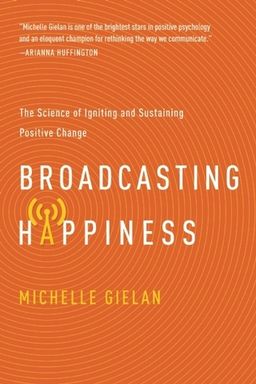
Broadcasting Happiness cover

Broadcasting Happiness

by Michelle Gielan

Broadcasting Happiness by Michelle Gielan transforms how you view positivity''s role in everyday life. Discover strategies to communicate optimism, uplift your workplace, and nurture relationships, all while fostering personal growth and emotional resilience.

Broadcasting Happiness: The Science of Positive Influence

What would happen if every story you told—at home, at work, or online—had the power to lift someone’s mood and spark real change? Broadcasting Happiness by former CBS News anchor and positive psychology researcher Michelle Gielan argues that the stories we share and the way we communicate are contagious. She contends that our words don’t just describe reality—they create it, shaping how others think, feel, and act.

Gielan’s insight began in a newsroom filled with stories of tragedy and despair. When she saw how relentlessly negative coverage left both reporters and viewers powerless, she realized journalism—and leadership, parenting, and even casual conversation—could work differently. Instead of highlighting what’s broken, focusing on what’s possible and already working can transform communities. This shift—from problems to progress—is what she calls broadcasting happiness: intentionally sharing stories that ignite hope, action, and connection.

The Core Idea: Communication Shapes Reality

We are all broadcasters. Every text, meeting, or conversation is a micro-broadcast that affects others’ thinking. Neuroscience confirms that hearing positive, solutions-focused stories can activate the brain’s reward centers, boosting creativity, engagement, and performance. Conversely, hearing negative, fear-based narratives triggers defensiveness, shutting down problem-solving. The way we frame events—whether as opportunities or threats—changes how people perceive their power to act.

This isn’t Pollyanna optimism. Broadcasting happiness doesn’t mean ignoring reality but reframing it around possibility and agency. In fact, Gielan lays out an evidence-based case from psychology and business research showing that optimism, social capital, and support-giving—not cynicism—drive measurable results like productivity, resilience, and sales. As she puts it, the stories we tell predict success.

The Three Predictors of Success

Central to Gielan’s framework are three interconnected factors drawn from her research: work optimism (believing good things can happen and our behavior matters), positive engagement (facing challenges as opportunities instead of threats), and support provision (investing in others’ success). Together, these three predictors explain roughly 75% of job success, she found. They influence health, intelligence, creativity, and profit. Optimists outsell pessimists by 37%; physicians with positive affect diagnose 19% faster; managers who frame stress constructively see 23% drops in stress symptoms. In short, happiness is not a side effect of achievement—it fuels it (a concept also explored by Gielan’s husband Shawn Achor in The Happiness Advantage).

From Journalism to Leadership

Gielan’s book isn’t just research—it’s a roadmap for transforming everyday communication. Drawing on her experience in broadcast media, she reimagines journalism as “Transformative Journalism,” an emerging model that tells engaging, solutions-focused stories instead of “if it bleeds, it leads” ones. In business and education, the same principles apply: leaders and teachers become broadcasters by focusing meetings, feedback, and classroom discussion on progress and discoveries instead of problems.

Throughout the book, Gielan introduces practical tools for positive broadcasting, each built from behavioral science and tested in major organizations. These include the Power Lead (starting every interaction with optimism), Flash Memories (linking success stories to neural patterns that fuel motivation), Leading Questions (asking questions that direct attention to possibility), Fact-Checking (reframing stressful thoughts with energizing facts), Strategic Retreats (temporarily disengaging from toxic negativity), and The Four Cs of Bad News (delivering negative information with compassion, context, and commitment).

Why This Matters

In a hyperconnected world, what we share spreads faster than ever. Social research, including studies with Facebook and Cornell University, shows emotional contagion on massive scales: when people’s newsfeeds tilt positive, their own posts become more positive. Similarly, leaders set the emotional tone for teams, parents for families, and educators for classrooms. As Gielan reminds us, positivity multiplies—but so does negativity.

By the end of Broadcasting Happiness, you realize that influencing others begins not with authority but story selection. You don’t have to wait for media or management to change—you can broadcast happiness in your own life. Whether you’re motivating a team, calming a child, mentoring an employee, or posting online, your message creates ripples that improve health, success, and human connection. The book calls for moving beyond cynicism toward an activated optimism—one broadcast, one conversation at a time.


Power Leads: Starting Conversations for Success

Every interaction begins somewhere—and Gielan argues that those first few seconds determine everything that follows. In media, the first story is the “lead.” In life, it’s the opening line of a conversation, meeting, or email. The problem is that most leads are negative: complaints about traffic, stress, or bad news. These “downers” hijack the brain’s limited attention, priming it for threat rather than opportunity. Gielan’s solution is the Power Lead—a positive, optimistic, and growth-oriented opening that instantly elevates communication and primes everyone’s brains for high performance.

Priming the Brain for Positivity

Humans process about 11 million bits of information each second but can consciously handle only 40–50. Because attention is scarce, the emotional tone at the start of an interaction determines which bits we focus on. In psychology, this is called priming. Experiments show that people who read polite words act politely; those primed with rude words interrupt more. Children primed with positive memories solve puzzles 66% more efficiently. Likewise, simply starting a meeting with optimism instead of anxiety can transform creativity and engagement. Positive priming, Gielan explains, sets the stage for “the happiness advantage”—the brain’s high-performance zone identified by Shawn Achor’s research.

Turning Interactions Around

Gielan tells stories that illustrate how small openings spark big changes. A software manager named Ellen began asking her team, “What’s one awesome thing you did—no matter how small—this week?” At first, employees froze. Soon, they started tracking daily wins so they’d have answers ready. Productivity and morale soared. At Walmart, a woman named Sharon—who had lost her mother and husband—became known as “the happiest woman in the world” because she chose to start every interaction with a cheerful greeting. Her resilience warmed coworkers and served as proof that positivity is contagious. Even Gielan herself used a power lead to reinvent her newsroom relationships when she stopped saying “I’m tired” and started talking about something simple and pleasant—like her morning coffee.

Practical Ways to Use Power Leads

  • Conversations: Replace neutral or negative responses like “I’m fine” with something positive—“I had breakfast with my son, and he was hilarious.”
  • Meetings: Start by sharing gratitudes or wins, as managers at Hugo Boss did. A five-minute round of positivity, they reported, made “an eight-hour difference.”
  • Emails: Begin with warmth—“Hope your week’s been great!”—or even with a simply personal subject line like “Our next GREAT collaboration,” priming connection.
  • Parenting: Ask kids, “What was the best thing that happened at school today?” to train their brains to scan for the good.

Why It Works

Studies cited in the book—from Bless and Schwarz (1990) to Lerner and Keltner (2000)—show that positive moods increase persuasiveness and openness while fear breeds risk aversion. The power lead activates trust and makes communication smoother. Over time, this practice builds habit loops in the brain and relationships: employees feel respected, families share gratitude, and teams become primed for success. Even emails and reports benefit—you can set a constructive frame by starting with purpose and achievement.

“Science proves,” Gielan writes, “that the best way to get to a good end is to have a good beginning.” Like any muscle, positivity strengthens with repetition. Her challenge: use one power lead a day for three weeks and watch how your world changes. When you start positively, you don’t just improve a conversation—you build the foundation of a more successful and happier culture.


Flash Memories: Rewriting the Story of Success

Do your first thoughts about work, success, or people help or hinder you? Gielan introduces the concept of flash memories—instant mental associations that shape our behavior. When the brain’s first reaction to “work” is “stress,” motivation suffers; when it’s “progress,” energy rises. The goal, she says, is to rewrite these flash memories by repeating success stories until positivity becomes automatic.

How the Brain Stores Stories

Drawing from neuroscience, Gielan explains that memory recall reactivates old neural patterns. When we update memories with new facts or stories, we literally change their emotional tone. Every retelling reshapes beliefs about ourselves and others. This “creative reimagination” allows communities and teams to build new narratives of resilience and capability. It’s how Sunnyside High School in Washington State turned a 41% graduation rate into 89% in seven years—by constantly celebrating victories, highlighting students who overcame setbacks, and reminding everyone what excellence looked like.

Spotlighting Wins

Research shows that emphasizing progress fuels motivation better than focusing on gaps. At REMAX, leaders charted their company’s rise year-over-year and posted visual reminders like graphs of “32 Years of Unstoppable Growth.” Teachers and parents can apply the same technique: call out specific wins instead of shortcomings. In competitive swimming, coaches who paired encouragement with instruction saw higher effort and more persistence. In schools, newsletters that repeat “success” messages help students internalize achievement.

Packaging and Repeating Positive Stories

To make success memorable, stories must evoke emotion and be retold frequently. Psychologist Adam Grant proved this when fundraisers met scholarship students instead of reading letters; donations rose 171%. Personal, emotional encounters spark engagement more than abstract praise. Yet repetition cements it. Advertisers know it takes at least three exposures for a message to stick. Gielan urges leaders to repeat success stories often—like mantras—until they become new flash memories. The goal isn’t self-congratulation; it’s neural reinforcement of hope and competence.

Practical Application

  • Share “win-of-the-day” stories at team meetings or dinners to train the brain toward positive recall.
  • Transform feedback discussions from performance deficits to progress dialogues.
  • Embed success visuals—photos, graphs, messages—in organizational spaces.

“You can’t build greatness on failure alone,” Gielan writes. Repetition embeds accomplishment into identity. With enough positive flash memories, success becomes not a surprise—but a habit.


Leading Questions: Redirecting Thought Toward Growth

If statements tell, questions lead. Gielan shows how asking the right questions can shift focus from problems to possibilities. The book highlights how journalists, leaders, and parents can use four kinds of leading questions—Digging for Gold, Shifting the Focus, Next Best, and What Else—to flip negative scripts and uncover insight.

Digging for Gold

These are the “why” questions that uncover the meaning behind success. Instead of “What are sales numbers?” ask “Why are they rising?” At a pharmaceutical company, a VP learned that top sales came not from product advantages but from compassionate follow-ups—like a rep visiting a chemo patient in the hospital. Sharing these kinds of stories motivates teams far more than metrics, because it connects work to purpose.

Shifting the Focus

These lead the mind toward positive action. At Burt’s Bees, CEO John Replogle asked frazzled global managers, “When was the last time you discussed company values with your team?” The question instantly reframed their anxiety around deadlines into a conversation about meaning and collaboration. Psychologist David Cooperrider calls this technique Appreciative Inquiry: systematically asking questions that uncover a system’s best qualities and build on them. Gielan points out that this method—similar to solution-focused therapy—transforms not only answers but organizational culture.

Next Best and What Else?

When no ideal solution exists, “Next Best” questions open alternatives. A pediatrician asks terminally ill families, “Given what we’re up against, what are you hoping for?” instead of “What do you want?” That subtle shift turns despair into agency. “What else?” questions ensure completeness—like Gielan asking her skydiving instructor what step she’d missed right before jumping (“Don’t straighten your legs on landing!”). These probes reveal what’s hidden and help people feel heard.

Creating a Culture of Questions

When teams or families routinely ask positive, forward-looking questions, collective intelligence rises. In Sweden, citizen “study circles” use inquiry to solve social problems. In business, executives use questions to replace grumbling with innovation: “What can we do to create positive change here?” Questions beget solutions, empathy, and movement. They transform conversations from complaint-driven to growth-oriented.

Every question Gielan recommends achieves one purpose—to bring light to where minds are stuck in the dark. You can’t force people to see differently, but you can ask them questions that make it impossible not to.


Fact-Check: Moving From Paralysis to Activation

When faced with stress, what facts are you focusing on? Gielan borrows the journalistic idea of “fact-checking” and applies it to thoughts. Instead of assuming worst-case scenarios, she teaches readers to test which facts fuel paralysis versus activation. By reorienting attention toward energizing truths, you can transform fear into forward motion.

The Principle of Fueling Facts

Humans are wired for negativity bias—our brains scan for threats. Fact-checking interrupts that loop. Whether it’s a quadriplegic Ironman like Joe Stone succeeding against all odds or a woman rethinking the “age 35 fertility crisis,” Gielan shows that new, accurate facts change emotional and behavioral outcomes. Stone reframed his prognosis from permanent paralysis to potential strength training. Researcher Jean Twenge fact-checked fertility data and found modern women far more capable of conception than feared. The truth, properly framed, empowers action.

Applying the GPS of Positivity

When helping someone fact-check a stressor, follow the GPS mnemonic: Get an accurate time frame (How long will this situation last?), Pinpoint the smallest domain (Where exactly does the problem occur?), and Scan for resources and past achievements (What strengths can you draw on?). This process transforms vague anxiety into opportunity. Managers at UBS used a similar mindset training, learning to see stress as enhancing—boosting attention and performance—rather than debilitating. Their participants reported 23% fewer stress-related symptoms even during tax season.

The Quick Tune-Up

Not all stress needs deep analysis. Sometimes you just add, subtract, or reverse a single fact. If a colleague thinks “my boss hates me,” adding one fact—he’s caring for a sick spouse—changes everything. Removing a false assumption, like “we’ll be broke unless we never move,” restores hope. Reversing a fact—viewing a missed 3% goal as “97% achieved”—turns defeat into drive. Each reframing adjusts the truth without distortion.

In short, fact-checking thoughts is like investigative journalism for the mind. By gathering more complete evidence, you move from catastrophic storytelling to empowered realism. “We write headlines in our own brains every day,” Gielan notes. “It’s time to make them accurate.”


Strategic Retreats: Managing Toxic Negativity

What if positivity doesn’t work because someone else’s negativity keeps derailing you? In this chapter, Gielan teaches how to deal with toxic people through Strategic Retreats. The idea isn’t escape—it’s smart withdrawal followed by regrouping and planned reentry. As Sun Tzu wrote, “Victorious warriors win first then go to war.” Gielan adapts this wisdom for office politics and family drama alike.

Recognizing When to Retreat

  • Your defenses are down: You’re hungry, angry, lonely, or tired (“HALT”). Engaging then invites disaster.
  • They’re deeply entrenched: When emotional arousal is high, reason fails.
  • You’re surrounded: Timing or audience makes confrontation counterproductive.

A manager worked with her husband’s post-work irritability by waiting an hour before talking through issues, sparing both stress. Retreat buys perspective.

Regrouping With Positive Habits

Retreat isn’t avoidance; it’s preparation. Gielan prescribes three quick habits to buffer against negativity: send one positive email a day, list three specific gratitudes, and take a positive photo daily. Over 21 days, each rewires attention and mood. Studies from Eastern Washington University and Duke show gratitude practices raise well-being and resilience weeks after the activity ends.

Planning a Reentry

When you’re ready, pick favorable timing, bring reinforcements, and run a “two-minute drill.” Know your conversational playbook—your opener, core message, and exit line—so you avoid emotional spirals. One accountant rehearsed his interaction with a hostile coworker: start with praise, ask a simple question, end with gratitude. It worked perfectly. You can even substitute silent compassion—as when a bank teller softened an angry customer simply by mentally repeating “I love you.” Two years later, they were married.

Strategic retreats redefine strength not as confrontation but composure. When you control your exposure, refill your positivity, and reengage intentionally, you turn toxic encounters into opportunities. As Gielan reminds us: “The supreme art of war is to subdue the enemy without fighting.”


Delivering Bad News the Right Way

Most people stumble when giving bad news. Gielan offers a formula called the Four Cs—Create social capital, Give context, Express compassion, and Stay committed—to transform tough conversations into trust-building moments. Her examples range from a zero-complaint traffic cop to a CEO who turned a company’s snowstorm disaster into customer loyalty.

1. Create Social Capital

Social capital—trust built through positive interactions—is your safety net when trouble strikes. Managers who nurture relationships before crises can deliver bad news without backlash. A Google director who bought beer for her team during rough times gained goodwill that later helped her weather layoffs smoothly. “Deposits before withdrawals,” Gielan advises.

2. Give Context

Context turns judgment into understanding. Instead of bluntly saying “We’re behind schedule,” frame it empathetically: acknowledge effort, explain causes, and show shared stakes. Research by Angela Legg and Kate Sweeny shows recipients prefer hearing bad news first—but if action is needed, start with good news to spur engagement. Smart framing prevents despair and promotes problem-solving.

3. Express Compassion

Compassion disarms defensiveness. JetBlue’s CEO, David Neeleman, wrote after the infamous 2007 snowstorm: “We are sorry and embarrassed—but most of all, we are deeply sorry.” His empathy, followed by corrective action, preserved trust. Hospitals with “I’m sorry” policies cut malpractice payouts by 627%. People forgive when they feel cared for.

4. Stay Committed

Finally, follow through. Whether it’s a doctor helping a patient recover or a professor guiding a struggling student to graduate, commitment rebuilds credibility. Actions speak louder than apologies. Gielan’s examples—like the Kentucky nurse who personally ensured families received support after child neglect reports—show that post-crisis involvement turns bad news into progress.

Delivering bad news well isn’t just damage control; it’s leadership. When you combine social connection, context, compassion, and commitment, setbacks become opportunities for deeper trust. As Gielan sums up, “Bad news doesn’t have to break us—it can bond us.”


Go Viral: Spreading Contagious Optimism

One positive story can ripple across an entire organization. The final chapter, Go Viral, explains how to multiply your positive influence so that optimism spreads like wildfire. Drawing on examples from Nationwide Insurance, Facebook research, and the Ochsner Health System, Gielan outlines six elements that make positivity contagious.

1. Activate the Hidden 31

Around 31% of people are positive but silent. These “hidden broadcasters” can become your most powerful allies once engaged. Managers should ask what excites them and invite them to share publicly. In political campaigns (like Obama’s 2008 run), microtargeted calls to action mobilized such people into active supporters. Activate them, and culture tips toward optimism.

2. Raise the Broadcaster’s Status

People share stories that make them look informed and altruistic. Give others content that enhances their reputation as experts. The ALS Ice Bucket Challenge exemplified this perfectly—participants joined a global movement that was fun, visible, and ethical. Status-fueled sharing amplifies reach.

3. Communicate High Emotion

According to research by Jonah Berger and Katherine Milkman at Wharton, people are more likely to share high-arousal positive stories—those inspiring awe, joy, or admiration—than negative ones. Emotional tone matters. When Ochsner Hospital trained 11,000 employees to smile and greet patients (“the 10/5 Way”), both satisfaction and profits rose. Positive emotion creates replication.

4. Make It Practical

Share stories that are useful. “News you can use” spreads faster because people want actionable insight. Narrowcast—targeting specific audiences—boosts adoption. A teacher who posted firsthand classroom stories for parents online saw engagement surge because parents could act on the information.

5. Lower Activation Energy

Make sharing easy—short headlines, infographics, or templates. Shawn Achor’s “20-second rule” applies here: small decreases in effort massively increase action. The more accessible your message, the farther it travels.

6. Operationalize the Message

Turn inspiration into routine. Gratitude boards, team challenges, or mobile apps can embed positivity into practice. At a conference, organizers used an app to gamify gratitude—participants who used it reported higher overall ratings for the event. When repeated, positive behaviors become culture.

Together, these six factors turn isolated optimism into systemic change. “Contagious optimism,” Gielan concludes, “means smiles become expectations, not exceptions.” The broadcast isn’t just a message—it’s a movement.

Dig Deeper

Get personalized prompts to apply these lessons to your life and deepen your understanding.

Go Deeper

Get the Full Experience

Download Insight Books for AI-powered reflections, quizzes, and more.