
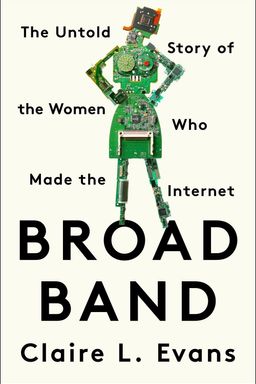
Broad Band cover

Broad Band

by Claire L Evans

Broad Band by Claire L Evans reveals the hidden history of women who pioneered the internet and computing. From Ada Lovelace''s first programming steps to early social networks, these trailblazers shaped our digital world despite being marginalized. Their stories inspire and illuminate the crucial roles women played in technology''s evolution.

Weaving the Digital World

Computing doesn’t begin with silicon—it begins with weaving. This book tells how patterns on looms led to patterns in logic, and how the act of separating instruction from mechanism reshaped human work and imagination. Across centuries, women have been central to this evolution—from Jacquard’s loom and Ada Lovelace’s algebraic patterns to the ENIAC Six, Grace Hopper’s compilers, and the builders of civic networks and online communities.

The story follows a lineage: first, the idea that machine processes can follow stored instructions; then, the shift from human computers to electronic ones; and finally, a democratization of computing through accessibility, community, and cultural participation. When you trace this history, you see programming not as isolated genius but as a social practice shaped by collaboration, labor, and values.

From Looms to Logic

Joseph-Marie Jacquard’s punched cards allowed patterns to be woven systematically. That small insight—portable memory controlling mechanism—became foundational to computation. Charles Babbage borrowed this metaphor when designing his Analytical Engine, and Ada Lovelace extended it conceptually to symbol manipulation itself. She predicted what software could become: a system of abstractions that could symbolize anything—music, logic, or mathematics.

(Note: Lovelace’s phrasing that the Engine “weaves algebraical patterns” created an enduring metaphor connecting textile art to algorithmic design.)

Labor Behind Machines

Before computers were electronic, they were human. For nearly two centuries, teams of women called “computers” manually executed astronomical or ballistics calculations. Their collective labor mirrored the distributed systems to come: tasks divided, checked, recombined. Women like Katherine Johnson or Annie Jump Cannon advanced science within hierarchical institutions, yet their work often disappeared from historical recognition.

From Hidden Work to Visible Code

The ENIAC Six—Kay McNulty, Betty Holberton, Frances Bilas, and others—stepped from hand computation into programming’s physical form: wiring circuits and debugging vacuum tubes. Their invisible labor enabled machine performance but was edited out of media narratives. Grace Hopper continued their legacy, demanding that programming become understandable and reusable. Her compilers turned human intent into machine language and seeded an industry built on accessibility and abstraction.

(In doing so, Hopper argued that programming should be a civic literacy, not an esoteric art—a position echoed later by open-source advocates.)

Communities and the Human Turn

As computers became networked, new social forms proliferated. From communal mainframes like Resource One and civic bulletin boards to feminist networks and artistic experiments, women helped reimagine technology as a communal tool. Cyberfeminism and early BBS cultures insisted that design encoded power: who controlled servers, who moderated, and who preserved archives determined whether online spaces nurtured dialogue or commodified attention.

The book’s arc thus moves from punched-card machines to social platforms, showing how programming languages, standards, and online systems always reflect human structures—sometimes hierarchical, sometimes radically egalitarian. Each era redefines participation: from loom operators to digital activists, the constant thread is human ingenuity aligning pattern and purpose.

Central insight

Technology is woven out of human imagination and collective labor. Understanding who coded, wired, and curated the digital world reveals how intentional design—shaped by values and visibility—determines the systems you live in today.

When you interact with any digital interface, you’re engaging centuries of accumulated practice—from Jacquard’s pattern logic to Lovelace’s abstract code, Hopper’s human-language compilers, and community-driven computing. The book asks you to remember that every program and platform carries the imprint of people who built it, often invisibly, and that recognizing their labor helps ensure future technology serves human need rather than erase it.


From Looms to Algorithms

The transformation from textile weaving to algorithmic logic begins with the Jacquard loom. Its punched cards encoded repeatable motions, allowing pattern separation from process. The loom became the first machine with instructions externalized—a precursor to programmable computation. Charles Babbage admired this design and conceived machines that could 'weave numbers.' Ada Lovelace recognized that symbolic manipulation meant software could represent any structured thought.

Ada Lovelace's Theoretical Leap

Lovelace’s Notes proposed general-purpose manipulation of symbols, laying the groundwork for algorithmic abstraction. When she wrote steps for Bernoulli number computation, she introduced structured operations resembling subroutines. Her insight—that machines could handle melody or logic as easily as numbers—connects directly to modern notions of programmable creativity.

Pattern, Process, and Symbol

By divorcing pattern from mechanism, these early inventors made ideas portable. This portability allowed future programming languages to flourish, transforming mechanical devices into universes of logic. When you write a script today, you inherit Lovelace's structural vision. Recognizing this lineage reframes computation not as cold arithmetic but as human artistry—the translation of thought into repeatable pattern.

Key insight

Programming began with an artistic act: expressing idea as repeatable pattern. This separation between pattern and execution defines modern computing.


Human Computers and the Gendered Machine

Before machines took over computation, women performed it by hand. In observatories, war offices, and universities, female 'computers' broke vast calculations into parts. Their discipline of precision foreshadowed digital systems. The 'kilogirl' unit—hundreds of hours of female computation—turns gender into measure, exposing how deeply social structures shaped technology's birth.

Collective Calculation and Knowledge Production

Offices of human computers acted like synchronized processors. Each woman computed fragments, verified others’ work, and assembled complete tables. Figures like Maria Mitchell, Williamina Fleming, and Annie Jump Cannon transformed astronomy but rarely gained public credit. Their collaborations mirrored modern distributed computation long before the term existed.

Transition to Machines

As tabulators and early electronic machines emerged, these women shifted roles—from pencil work to switch-setting and card-punching. The job title 'computer' migrated to hardware, yet the expertise remained human. This continuity reveals that automation doesn’t erase skill; it simply changes its medium.

Key insight

The human computer era shows that technical progress is inseparable from social context. Labor division and gender bias shaped early computational organization as much as algorithms themselves.


Grace Hopper and Making Code Human

Grace Hopper transformed programming from opaque machinery into understandable expression. Working on the Mark I during WWII, she documented code meticulously and built reusable routines. Her conviction: you should talk to computers in near‑human language. She expected machines to translate meaning into mechanics—a philosophy that revolutionized access to software creation.

Inventing the Compiler

Hopper’s team at Remington Rand created A‑0, A‑1, and A‑2 compilers that automated translation of higher-level language into machine executables. These paved the path for business languages like FLOW‑MATIC and COBOL. Hopper’s advocacy pushed military and corporate systems towards standardized, machine-independent programming—a step crucial for scalability and long-term maintenance.

Humanizing Technology

Her approach democratized coding. Documentation, readability, and accessibility made programming inclusive. Today’s software engineering principles—code reuse, annotated libraries, and clear syntax—descend from Hopper’s insistence that people of diverse backgrounds should write code. Without that vision, computing might have remained a narrow technical priesthood.

Key insight

Grace Hopper's compilers turned programming into language: a shift from cryptic calculation to expressive collaboration that opened software to humanity.


Invisible Labor and the ENIAC Era

The ENIAC debut in 1946 symbolized electronic triumph, but the human labor behind it was hidden. Six women—Kay McNulty, Betty Jennings, Betty Snyder, Marlyn Wescoff, Frances Bilas, and Ruth Lichterman—unwired mathematics into circuitry, debugging manually. Their physical programming bridged human computation and digital automation.

Erasure and Recognition

Though the ENIAC Six’s work defined programming technique, publicity omitted them. This erasure reveals enduring tension: machines attract fame, operators vanish. Restoring their story restores the discipline’s collaborative origins.

Legacy Beyond ENIAC

Some of these women joined subsequent projects like UNIVAC and created self‑generating programs—code that writes code. Yet industrial mergers marginalized their role, replacing creative environments with masculinized corporate hierarchies. The ENIAC Six remind you that innovation often thrives in cooperative culture more than institutional status.

Key insight

Recognizing invisible labor restores the human dimension of technological progress. Machines do not invent themselves—people, often erased, make them work.


Standards and the Gendered Shift

When compilers matured into standards, programming evolved from flexible craft to formal engineering. Hopper’s vision continued through CODASYL and COBOL—languages designed for business readability. But as standardization attracted credentialed engineering, women’s representation declined even though they had defined early practices.

Professionalization Paradox

Automation made programming accessible, yet professional identity narrowed it. Committees and formal training replaced open experimentation. While figures like Jean Sammet shaped language design, institutional biases favored those with engineering degrees, re‑masculinizing the field.

Consequences for Diversity

This shift influenced decades of hiring and perception: coding became engineering rather than creative problem‑solving. Understanding this structural turn clarifies why inclusion policies still matter—the criteria we use to define expertise determine whose ideas shape technology.

Key insight

Standardization strengthened software but constrained participation. Professional norms redefined who belonged in the digital revolution.


Computers for the Community

In the 1970s, not all computing served corporations. Resource One in San Francisco reimagined technology as public utility. Pam Hardt‑English and her team turned an SDS‑940 mainframe into community infrastructure. Their system supported social service directories and Community Memory kiosks—precursors to civic digital networks.

Access and Ethics

Resource One embraced 'access to tools' philosophy, linking technology with equitable access. Its Social Services Directory applied data management to social aid—an early intersection of computing and public service. Women administrators curated inclusive data long before UX or civic tech became disciplines.

Community Memory

Community Memory terminals showed how localized digital spaces encourage mutual aid and creativity. Jude Milhon’s grassroots moderation exemplified online ethics grounded in place and empathy. These projects modeled civic responsibility in digital design—values often lost in commercial expansion.

Key insight

Technology becomes transformative when aligned with communal care. Design for access outlasts design for profit.


Networks and Early Online Culture

As ARPANET grew, women shaped its infrastructure and civility. Jake Feinler’s Network Information Center organized early host tables, turning chaos into navigable order. Her WHOIS and host‑naming conventions underlie modern domain systems. Radia Perlman stabilized networks through her spanning‑tree protocol, creating reliable communication paths.

Social Networks Before Social Media

From text adventures like Colossal Cave to bulletin boards and Echo, online life blended work and culture. Stacy Horn’s Echo community intentionally mixed genders and real‑world interaction, proving that face‑to‑face relationships strengthen digital conversation. Echo’s conferences and accountability predicted healthier community models than today’s algorithmic feeds.

Infrastructure and Culture

These network builders balanced technical invention with social architecture—linking protocols to people. Their curation of norms and indexes shows that communication technology succeeds only when organization and empathy intersect.

Key insight

Every network depends on invisible custodians. Mapping, moderating, and maintaining are as vital as inventing.


From Hypertext to the Web

Before the Web’s simplicity triumphed, hypertext research explored richer linking structures. Systems like Microcosm, NoteCards, and Intermedia allowed context‑aware metadata and non‑linear navigation. Wendy Hall’s Microcosm decoupled links from documents, storing them in a separate linkbase—a sophisticated method enabling dynamic association across archives.

Trade-Offs of Simplicity

Tim Berners‑Lee’s Web offered simplicity and scale at the cost of durability. Embedded, one‑way links create fragility (404 errors) while sacrificing semantic depth. The network effect made the Web ubiquitous but also thin in meaning. The rich hypertext tradition’s insights reemerge today in semantic web and AI metadata research.

Richer Futures

Constructive hypertext’s idea—that linking is creative thinking—remains vital for research and machine understanding. When you organize digital knowledge, you revive these early experiments. The Web may have won the moment, but its evolution depends on rediscovering the complexity it lost.

Key insight

Scale often sacrifices nuance. Revisiting hypertext reminds us that meaning, context, and connection are design choices, not inevitable simplifications.


Digital Creativity and Cultural Memory

In mid‑1990s New York, Silicon Alley embodied digital optimism. Jaime Levy and Marisa Bowe merged zine culture with interactive media—floppy‑disk magazines and experimental web journals. Their artistry bridged DIY independence and corporate interest, suggesting that creativity could define digital entrepreneurship.

Community and Collisions

These creators cultivated social hubs, parties, and media convergence. Yet commercialization eroded artistic autonomy. When venture capital arrived, platforms prioritized scale over craft, echoing earlier gendered shifts in programming—it’s a cycle where structure overtakes spontaneity.

Preservation and Legacy

Echo’s archival donation and surviving floppies remind you that digital culture is fragile. Without deliberate preservation, early creativity disappears. Silicon Alley’s rise and collapse show that technology cultures require memory stewardship as much as innovation.

Key insight

Artistic computing built culture before commerce did. Remembering its works preserves diversity of imagination essential for future technology.


Cyberfeminism and Inclusive Futures

Cyberfeminism reframed the digital revolution as a site for gender resistance and creativity. Artists and theorists like VNS Matrix and Sadie Plant imagined networks as wombs of new expression—spaces where women could recode power structures. Their provocations turned technology into political art.

Rebellion and Assimilation

Early cyberfeminism thrived on radical optimism: anonymity, identity fluidity, and self‑expression online. But commercialization absorbed that energy, turning utopian networks into ad‑driven ecosystems. Still, its legacy persists in design ethics, inclusion movements, and digital activism.

Continuing the Work

Cyberfeminism’s message endures: technologies are social artifacts. Building equitable futures requires embedding diversity at every layer—from hardware and software to governance. You participate in that evolution whenever you challenge norms or design with empathy.

Key insight

Design choices shape society. Cyberfeminism teaches that inclusion isn’t a feature—it’s a foundation for how digital worlds are made.

Dig Deeper

Get personalized prompts to apply these lessons to your life and deepen your understanding.

Go Deeper

Get the Full Experience

Download Insight Books for AI-powered reflections, quizzes, and more.