
Idea 1
Live Brighter by Facing Death
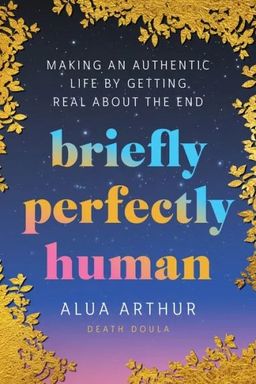
How do you become more fully alive without waiting for a crisis? In Briefly Perfectly Human, Alua Arthur argues that you learn to live by turning toward death, not away from it. She shows how honest encounters with mortality—your own and others’—cut through numbness, surface your deepest values, and reshape the way you love, work, and plan. Death is not the great equalizer, she insists; your identities and histories track all the way to the bedside. But death is a great clarifier: it focuses attention, strips pretense, and invites you to design a life—and a death—that look like you.
The book weaves memoir, bedside stories, and practical tools into a single thesis: mortality awareness is not morbid; it is a compass. That compass points you toward presence (show up), humility (shut up), and alignment (live like you, not like a role). It also points you toward advocacy—especially for marginalized identities at the end of life—because dignity in death is not guaranteed by default.
The spark: shocks that wake you up
Arthur begins with two ruptures on the road: nearly getting hit by a taxi in Trinidad and a conversation on a Viazul bus with Jessica, a stranger casually explaining her uterine cancer. Those moments unsettle the author’s autopilot and turn her inward: Who am I now? Who do I want to have been when I die? She lets the questions bite. The near-miss strips vanity; the bus talk offers permission. The result is movement—she starts a blog, then the vocation that follows. You see that clarity doesn’t always arrive as a plan; it often appears as a jolt that rearranges what matters.
The body: source, storyteller, sovereign
In bedside rooms, bodies read like biographies. Jonathan’s furrows, Elizabeth’s smile lines, Ernst’s jowls, Edward’s tattoos—each tells a story you can respect in how you show up. But bodies are also sovereign. Arthur learns sprinting has a hard stop her will can’t bend. As a doula, she refuses futile battles against biology and instead shepherds surrender with dignity. (Note: This posture counters the cultural fiction that discipline alone conquers mortality; see also Atul Gawande’s Being Mortal for a physician’s version of this shift.)
The work: show up, then shut up
Her bedside ethic is disarmingly simple: be there, then stop taking over. Compassion is not empathy “gone wild.” It is presence without possession. With Akua, who dreams of dancing even as her body fails, Arthur chooses to dream alongside her—finding a wheelchair, plotting ramps, arranging purple roses and music—without insisting on a “realistic” narrative. With Natasha, she learns the cost of empathic overreach and the necessity of boundaries that protect both parties.
The inequity: death is not equal
Nancy’s blunt question—“Are you Black?”—exposes how race, history, and power enter the room. Arthur refuses a colorblind softness; she notes how earlier deaths, system distrust, and microaggressions distort end-of-life care for Black Americans. Identity specificity—not universality—produces safety. A “good death” is not one-size-fits-all; it’s one that sees and honors the person’s whole self.
The practice: meet fear slowly
Jordan’s guided death meditation (Atisha’s Nine Contemplations, taught by Joan Halifax and Larry Rosenberg) shows a way to rehearse dying without panic. With lights low, a quilt, and a weighted blanket, Arthur pairs breath phrases with facts—limited lifespan, uncertain timing, many causes, the body’s fragility—then leads a gentle anatomy of shutdown. Jordan exits at peace about being gone; his real fear is pain in the process, not annihilation. That reframe opens life back up.
The turn: vocation, advocacy, and design
Peter Saint John’s long dying shoves Arthur into seeing the gaps between medicine and humanity—the sticky-note avalanche of tasks, the need for ritual, the relief of a hand on a foot. She trains (Sacred Crossings, hospice volunteering) and founds Going with Grace. Her cases—Ken’s glitter nails, Summer’s home funeral, Janet’s newly discovered siblings—reveal that small wishes often carry the largest meaning. Advocacy translates values into reality when families or institutions would erase them.
The reckoning: collapse and the help you accept
Authenticity requires honesty about your own breaking points. Arthur’s misfit in law (the “hexagon peg”) slides into depression: the Dungeon transfer, gray suits, tears at alarms, hash and wine, and medical leave. Burning Man shakes her awake; psilocybin in Colorado cracks denial. Receiving help from Kristin becomes a practice in dying to ego—the same skill she later teaches clients who can’t name a proxy (see Claudia). (Note: Her account echoes modern research on social support as a protective factor in major depression.)
The payoff: purpose as many small goods
Purpose, Arthur argues, is plural. Dora’s relief at choosing career over kids, Summer’s orange roses and hats, the author’s own “glitter wave” death vision—these are not one grand Why but a weave of small, precise yesses. Imagine your last senses—music, flowers, light—and let that image guide today’s choices. (Compare Ernest Becker’s claim that death anxiety fuels symbolic projects; Arthur grounds it in playlists, quilts, and paperwork.)
Key Idea
Mortality, met honestly, is a design tool. It reorients how you spend attention, how you care, and how you’re cared for when your body finally wins.
By the end, you don’t get a universal formula. You get practices: imagine your death; name your proxy; ask better questions; accept help; defend small wishes; and show up, then shut up. Do these, and your life—briefly, perfectly human—will read as yours when it’s time to go.