
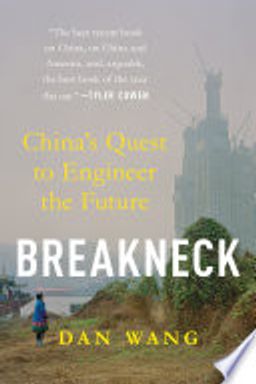
Breakneck cover

Breakneck

by Dan Wang

In "Breakneck," technology analyst Dan Wang offers a gripping firsthand exploration of China’s rapid progress and its human costs, contrasting it with America’s stagnation. Drawing from his nearly decade-long experience in the country, Wang investigates how China’s ambitious mega-projects drive economic success but also foster political repression and social traumas. Blending immersive storytelling with sharp analysis, he reveals profound lessons that each nation can learn from the other, challenging readers to rethink the paths toward a brighter future.

Engineers, Lawyers, and the Capacity to Build

How can you deliver big improvements to everyday life without sacrificing the dignity and rights of the people you serve? In this book, Dan Wang argues that the answer starts with who sits in power and how institutions understand problems. He contrasts China’s engineering state—led by technocrats who frame challenges as design variables to be optimized—with America’s lawyerly society—organized around rights, process, and adjudication. This is not a simple East–West comparison; it is a lens for seeing why some societies build rapidly while others stall, and why speed can sometimes morph into coercion.

The core claim is straightforward: engineers build; lawyers stop things. Wang shows you what this looks like on the ground. China erects high-speed rail and suspension bridges across mountains in Guizhou, while the U.S. struggles to break ground on a single California high-speed rail segment. The same administrative machinery that gets things done can also be turned to social engineering, as with the one-child policy or the prolonged zero-Covid campaign. Meanwhile, American proceduralism shields you from the worst state excesses—even as it makes it agonizingly hard to add housing, subways, and clean energy at scale.

What the engineering state means in practice

Wang tracks the implications of an elite stacked with engineers. Deng-era promotions favored technical expertise; by 2002 all nine members of the Politburo Standing Committee had engineering backgrounds, and Xi Jinping himself trained in chemical engineering at Tsinghua. The result is a policymaking style that treats society like a system to stabilize: build more rail to move people; erect dams to generate power; impose targets to control population growth or viral spread. You see this in Guizhou’s museum of bridges, Shenzhen’s industrial ecosystems, and the speed of emergency hospital construction in Wuhan.

But Wang also catalogs the recurring harms when this logic goes unreviewed. Local leaders in Liupanshui and Tianjin chase monuments, rack up debt near sovereign levels, and leave white-elephant airports and empty financial districts. Technocratic overconfidence enabled the one-child policy, where cybernetic models from missile scientist Song Jian convinced party leaders to treat fertility like a knob to twist. Enforcement under Qian Xinzhong meant forced sterilizations, late-term abortions, and a scarred generation. Zero-Covid begins as a triumph of control and ends as a humanitarian crisis in Shanghai when logistics fail and citizens lose patience.

What the lawyerly society gets right—and wrong

America excels at protecting rights and allowing contestation. Lawyers, courts, and administrative procedures slow decisions so citizens can be heard. Legal scholars like Tong Zhiwei can challenge the legitimacy of sweeping lockdowns, even if their essays are censored in China. This legal culture prevents catastrophic overreach, but it also encourages a “procedure fetish” in public works. You feel the cost in ballooning budgets for New York subways, delayed broadband rollouts, and EV charging stations trickling out years after funds are approved. The U.S. knows how to litigate; it has forgotten how to build.

Manufacturing as power—not just products

The book’s most strategic idea is that manufacturing capacity is national power. Shenzhen shows you why: process knowledge—how to tune a line, source a screw, or retool a mold at 2 a.m.—cannot be captured in a PDF. Apple, Foxconn (Terry Gou), BYD, DJI, and Huawei thrive because dense supplier networks and tacit expertise transform prototypes into global products. China’s dominance in solar, batteries, and shipbuilding stems from its willingness to run at low margins to learn by doing. The U.S., by offshoring factories, allowed its process knowledge to atrophy, leaving it flat-footed when crises demand scaling PPE, munitions, or semiconductors.

The policy turn: discipline capital, favor industry

Under Xi, regulators curbed the “disorderly expansion of capital” across venture-backed platforms and private education, stalling Ant Group’s IPO and probing Didi. Wang shows how this chilled digital entrepreneurship while channeling resources toward “hard tech,” clean energy, and chipmaking. You can dislike the chill without dismissing the aim: redirect talent to strategic manufacturing. The tradeoff is stark—animal spirits fade in consumer tech as state planners double down on factories and energy security.

Your takeaway: borrow strengths, guard against pathologies

Wang’s prescription is pragmatic. Democracies must relearn the art of building—streamline permitting with accountability, elevate project managers, and rebuild communities of engineering practice—while preserving pluralism. China’s engineering state should allow more legal contestation and civic oversight to catch errors early and limit coercion. If you care about affordable housing, climate tech, transit, or resilience, the lesson is to fuse engineering ambition with legal protections. Build faster—without forgetting why rights matter. (Note: this echoes “supply-side progressivism” in U.S. debates, while warning against romanticizing authoritarian speed.)

Key Idea

“Engineers build; lawyers stop things” is a heuristic, not a verdict. The book asks you to design institutions that let engineers build while lawyers keep them honest.

In the pages ahead, you’ll travel from Guizhou’s bridges to Shenzhen’s bazaars, through Shanghai’s lockdown, past the one-child policy, and into boardrooms reshaped by crackdowns. The throughline is simple: capacity to build changes lives, but without legitimate constraints it can also crush them.


The Engineering State in Action

Wang shows you how an engineering elite reshapes a country’s agenda. China’s top leadership—Xi Jinping (chemical engineering, Tsinghua) and cohorts like Yuan Jiajun and Li Ganjie—signals a system that values technical problem-solving over legal process. Policies emerge as control problems with targets, feedback loops, and visible hardware. You experience this as high-speed trains that arrive on time, clean stations in second-tier cities, and bridges that turn days of travel into minutes.

Design mindsets and metrics

Engineers love metrics. The engineering state favors numeric goals—kilometers of rail, tons of steel, gigawatts of capacity, infection counts to zero—and then mobilizes to hit them. The upside is legibility and speed: once a metric is set, funding, land, and labor can be assembled in months. The high-speed rail network that now exceeds the rest of the world combined is the canonical example. You can see similar ambition in nuclear approvals (dozens of reactors under construction) and in clean-tech scale-ups for solar and wind.

Delivery institutions

Local governments, state-owned enterprises, and private champions form a project-delivery machine. Cities compete to land factories, offering cheap land, tax holidays, and worker pipelines. Foxconn’s mega-campuses operated like small cities with dorms, cafeterias, and clinics; municipal officials promised they could “borrow” workers from mines or mobilize students as “interns” to staff lines. This political economy rewards the visible: ribbon cuttings, kilometers built, capacity added.

Benefits you can touch

The gains are real. In Guizhou, one of China’s poorest provinces, expressways, airports, and a lattice of record-high bridges open markets for farmers and factory owners alike. Zheng’an County’s Guitar Culture Industrial Park turned out an astonishing share of the world’s guitars by leveraging new logistics. Ordinary people feel pride because their lives materially improve: shorter commutes, cheaper tickets, and reliable power. Wang argues that this materialism generates consent that abstract freedoms sometimes cannot match.

The pathologies inside the machine

Targets can become blinders. When promotions depend on construction and GDP, officials pursue vanity projects that look impressive but don’t cash-flow: Liupanshui’s fake European squares and ski resorts, Tianjin’s half-empty Binhai skyline, and airports with single-digit weekly flights. The debt piles up, Moody’s rings alarms, and the public ultimately pays. Environmental damages compound the fiscal risk: dams resettle over a million people (Three Gorges), coal plants swell emissions even as renewables soar, and urban relocations push rural families into high-rises ill-suited to their livelihoods.

When social engineering enters

The same tools that build bridges can police bodies. Song Jian’s cybernetic models helped justify the one-child policy; Qian Xinzhong’s enforcement arm operationalized it with “shock brigades,” fines, and mass sterilizations. During zero-Covid, infection counts became the single design variable, driving citywide lockdowns, mass PCR regimes, and quarantine centers. When metrics crowd out judgment, people become inputs to be managed, and abuses follow.

The lesson for you

Embrace the engineering virtues—clarity, delivery, iteration—but insist on independent oversight and plural feedback. Wang doesn’t call for abandoning targets; he calls for better ones, reviewed in public, with channels that register failure quickly. You can apply this in your city by pushing for transparent scorecards on transit or housing alongside rights-preserving guardrails. (Note: think of Hyman Rickover’s rigid quality culture in the U.S. Navy’s nuclear program—engineering excellence tethered to unforgiving oversight.)

Key Idea

Targets drive action; institutions decide whether they drive wisdom or harm. Put engineers in the room—but also the people affected by their designs.


Building Big, Pride, and Peril

Wang’s travelogue through Guizhou and Chongqing turns abstract claims into concrete landscapes. You ride a train through mountains where engineers have punched tunnels and hung spidery bridges over valleys; you count airports in a poor province and watch delivery trucks stream to new industrial parks. This is modern China’s showpiece: a society that builds big and fast, often spectacularly well, sometimes disastrously.

What big looks like on the ground

Guizhou boasts forty-five of the world’s 100 highest bridges, around a thousand miles of high-speed rail, and a mesh of expressways that were unthinkable a generation ago. Local manufacturing clusters appear in unlikely places—Zheng’an’s guitar hub becomes a global supplier. Nationally, China pours more cement in a few years than the U.S. did in a century. It builds a high-speed rail network longer than the rest of the world combined and approves new nuclear plants at a clip few democracies can match.

Public pride and everyday gains

For many, this is liberation. A farmer can reach a city market in hours instead of days; families visit grandparents by train instead of bus. Infrastructure slashes coordination costs and anchors supply chains. Wang underscores how visible change shapes consent. When you can board a cheap, clean, frequent train, you forgive a lot—at least for a while. This helps explain why authoritarian states can sustain legitimacy: they deliver.

Perverse incentives and debt

But the incentives that push officials to build also warp decisions. Without a property tax, local budgets lean on land sales; leaders win promotion with big projects, not careful maintenance. Li Zaiyong’s Liupanshui piled up $21 billion in debt with fake European squares and a dud ski resort; Tianjin’s Binhai boasts empty towers and a photogenic library with shelves of fake books behind glass. Airports open to a handful of weekly flights. Moody’s points to regions with debt-to-GDP ratios approaching Italy’s.

Environmental and social costs

The environmental ledger is mixed. China deploys solar and wind at staggering scale and extends nuclear, even as it burns more coal than the rest of the world combined. Dams deliver power but uproot communities—Three Gorges resettled up to 1.5 million people. Rural residents undergo “thought work” to accept relocation, then struggle in high-rise apartments far from fields and social networks. These are not side effects; they are the price of speed without robust consent.

Better building, not just more

Wang doesn’t reject building; he asks for better selection and governance. That means rigorous cost-benefit analysis not captured by photo ops, accountability that punishes white elephants, and willingness to fund less glamorous but vital services like public health and education. In pandemic times, for example, raw hospital capacity mattered as much as rail lines. The same ambition that lays track should sustain clinics.

Implications for you

If you live in a city that can’t add housing or transit, China’s scale may tempt you. Learn from the speed and from the procurement muscle, but guard against the debt spiral and the urge to build for prestige. Push your representatives to measure success by service quality—frequency, reliability, safety—not just ribbon cuttings. (Note: scholars of “state capacity” like Francis Fukuyama focus on how institutions deliver; Wang adds the crucial distinction of what professions dominate those institutions.)

Key Idea

Build what compounds human welfare, not what flatters a skyline. The problem isn’t speed; it’s selection and accountability.


Shenzhen’s Factory Intelligence

To understand modern tech power, Wang takes you to Shenzhen—oyster shores turned world workshop. Its genius is not a single policy but a living ecosystem of suppliers, tinkerers, assemblers, and logistics pros who turn designs into devices at scale. If Silicon Valley is imagination, Shenzhen is execution. This is where “process knowledge,” not just patents, decides who wins.

How the ecosystem works

Walk Huaqiangbei’s electronics bazaars and you’ll see why proximity matters. Components line bins; you can buy one sensor to test or ten thousand for a production run. Need to change a screw or adhesive? A supplier is a short drive away. This collapses the iteration cycle from months to days. Apple relies on Foxconn to orchestrate city-scale assembly lines; at peak, Foxconn housed hundreds of thousands of workers on campuses with dorms, cafeterias, even a “university.” The goal isn’t just assembling iPhones—it’s compressing design-to-mass-production timelines.

Process knowledge as strategic capital

Wang emphasizes tacit know-how—the routines that never appear in a blueprint. How hot should the solder be on a humid day? When a mold warps, who can regrind it overnight? Which warehouse can pre-clear customs for a Saturday ship? This muscle memory compounds over time. BYD, DJI, and Huawei didn’t just copy; they learned through relentless iteration, supported by local governments willing to offer land, tax breaks, and labor pipelines.

Labor, scale, and politics

The ecosystem’s speed rides on grueling schedules and political bargains. Dormitories pack workers; canteens serve tons of rice daily; schools “intern” students on lines. After Foxconn’s 2010 suicides, reforms followed, but the fundamental cadence—three shifts, razor-thin margins, constant line balancing—remained. Municipal officials pledged to solve bottlenecks for factory bosses because jobs and tax receipts justify it. The political logic is explicit: deliver manufacturing and the party earns legitimacy.

Why moving out is hard

When the U.S. offshored manufacturing, it exported more than jobs—it exported the community of practice. Rebuilding a fab, a battery plant, or even a simple assembly network means reconstituting hundreds of supplier relationships and the human knowledge that glues them. Western leaders often ask how to “build a Shenzhen.” Wang’s answer: you don’t copy a district; you cultivate a dense, locally embedded network of skills, suppliers, and logistics that learn together for years. (Note: Silvia Lindtner’s work aligns with this, highlighting maker cultures and grassroots innovation in Shenzhen.)

Your takeaway

If you design products or craft policy, treat manufacturing not as an afterthought but as core R&D. Fund apprenticeship-like programs, co-locate suppliers, and build public institutions that solve coordination failures—industrial parks, shared tooling labs, and fast customs channels. The art of building at scale is a national capability, not just a firm-level decision. And because it’s embodied in people, delays or policy whiplash scatter hard-won skills. Stability matters.

Key Idea

Innovation without manufacturing is a demo; manufacturing without innovation is a commodity. Power lies in pairing both through dense, iterative ecosystems.


Tech Power Through Making

Wang separates invention from industrialization. Breakthroughs may start in labs, but advantage accrues on factory floors that grind down costs through learning-by-doing. China masters this in solar, batteries, and EVs, while the U.S. struggles to translate breakthroughs into volume. The policy question for you is not whether to subsidize, but how to build and retain communities of practice that compound over time.

Solar: from lab insight to price collapse

Early photovoltaic advances came from the West (think Bell Labs), but Chinese firms bought production equipment, copied lines, and sprinted down the cost curve. By the mid-2010s, they were making the tools themselves and exporting modules at prices others couldn’t match. The secret wasn’t a single patent—it was many small improvements across thousands of runs, underwritten by cheap capital and a willingness to tolerate low margins to win scale.

EVs and batteries: BYD to Tesla’s “catfish”

BYD rose from batteries to become the world’s largest EV maker, while CATL became a battery giant. Local and national subsidies ignited demand and supply; later, Tesla’s Shanghai Gigafactory intensified competition, the so-called “catfish effect” that spurred domestic rivals to improve. The result is a full supply chain—from materials to packs to cars—that gives China leverage in future energy systems.

America’s process-knowledge gap

Offshoring hollowed out not only plants but also the tacit skills to scale. When shocks hit—masks, tests, vaccines, munitions—the U.S. discovered that it could design but not manufacture fast. Investors favored capital-light software with high returns, while asset-heavy factories looked unattractive. Intel wrestled with execution; Boeing’s production culture faltered; shipyards atrophied. Rebuilding is possible, but it requires patience, procurement certainty, and a talent pipeline that valorizes technicians as much as coders.

Industrial policy, calibrated

Wang argues for pragmatic industrial policy: invest in training, de-risk scale-up with public purchasing, and coordinate clusters without micromanaging firms. He’s wary of blunt protectionism that breeds stagnation and of naive free trade that assumes displaced communities retool on their own. Export controls and tariffs can slow opponents but also accelerate import substitution—China often doubles down when cut off. The trick is to preserve your own capacities while avoiding the “own goal” of catalyzing the rival’s domestic surge.

Manufacturing as strategic power

Capacity isn’t just commercial; it’s geopolitical. Munitions, drones, ships, and rails are built, not brainstormed. China’s shipbuilding numbers and battery dominance translate into deterrence and resilience. Energy security—more coal capacity plus huge renewables—makes the system robust. Wang’s warning: if you prize liberal order but can’t make what you need, your values will sit on shaky supply chains.

What you should do

Support policies that rebuild process knowledge: apprenticeship programs, technical colleges, and career ladders for machinists and line engineers; fast-track permits for factories with strong environmental controls; long-term procurement for clean tech that rewards domestic learning. Innovation policy should end at the loading dock, not on a whiteboard. (Note: this aligns with “supply-side progressivism” and echoes Dani Rodrik’s calls for productivist policy.)

Key Idea

Learning-by-doing compounds like interest. Nations that keep factories keep the future.


Social Engineering’s Human Cost

Wang treats the one-child policy as the most chilling expression of engineering logic turned on people. A missile scientist, Song Jian, imported cybernetic thinking into demography, convincing leaders like Deng Xiaoping that only strict population caps could avert catastrophe. With the prestige of natural science and the authority of charts, the state set a numeric goal—one child per family—and built enforcement machinery to hit it.

From model to mandate

Song Jian’s projections posited billions of future Chinese without intervention, swaying debates away from social scientists who urged caution. In 1980, the party launched the one-child policy. Qian Xinzhong led the State Family Planning Commission, fielding “shock brigades” of cadres and medical teams. The playbook mixed propaganda, fines, and coercion at immense scale. In 1983 alone, authorities recorded 16 million sterilizations and 14 million abortions—numbers that dwarf prior years.

Enforcement on the ground

The state’s reach penetrated paperwork and bodies: marriage permits, pregnancy checks, IUD insertions, and quotas pushed down to village cadres. At its ugliest, coercion meant forced late-term abortions and sterilizations without meaningful consent. Guan County’s “childless hundred days” in 1991 symbolizes the brutality—an infamous sweep of forced abortions to meet targets. Rural families bore the brunt, and female infanticide and abandonment skewed sex ratios to peaks near 120 boys per 100 girls.

Long-term consequences

Demographically, China now faces rapid aging and a fertility rate near 1.0. Labor shortages loom; pensions strain; schools close maternity wards as adult-diaper sales rise. Politically, leaders reversed course—allowing two children in 2016 and three in 2021—while launching pro-natalist campaigns that encourage marriage and births. But decades of urbanization, workplace pressures, housing costs, and lingering mistrust of state intrusion make recovery hard. Restrictions on reproductive services for unmarried women (e.g., IVF and egg freezing) compound the challenge.

What this reveals about the engineering state

When society is treated as a control system, people become variables to adjust. Targets focus effort, but they tempt policymakers to shave away consent. Wang doesn’t deny that fertility fell; he underlines the price: trauma and a demographic trap. This episode should inoculate you against the seduction of overly tidy models. Forecasts can be wrong; even right forecasts may not justify coercion. (Note: scholars like Susan Greenhalgh and Kay Ann Johnson provide archival corroboration of coercive practices.)

Your guardrails

Demand that big social goals be pursued through supportive systems—childcare, housing, workplace reforms—before coercive mandates. Embed legal checks that allow citizens and courts to challenge state overreach. Numbers should trigger questions, not dictate punishments. The underlying design principle applies widely: prefer empowerment mechanisms that respect agency over enforcement that weaponizes metrics.

Key Idea

When a policy turns bodies into targets, cruelty scales. Build institutions that make coercion hard, not tempting.


Zero-Covid’s Arc and Shanghai’s Ordeal

Zero-Covid is engineering logic under stress. In 2020, China’s rapid lockdowns, contact tracing, and hospital construction suppressed spread while many Western systems stumbled. But a policy built around a single number—cases to zero—proved brittle over time. Shanghai’s 2022 lockdown reveals what happens when logistics, law, and human dignity are treated as externalities.

Phase one: early success via command

The state deployed mass PCR testing, color-coded health apps, travel bans, and quarantine centers. “Big whites” (dabai) in protective suits became the face of the campaign, sealing neighborhoods and escorting close contacts. Pop-up hospitals rose in days. For a period, many cities functioned near normally inside closed borders. The engineering state delivered a public-health victory—at high but tolerated cost.

Phase two: frictions and fatigue

As months stretched into years, measures compounded. In Shanghai, officials announced an eight-day “partial pause,” splitting the city east–west, then escalated to citywide lockdowns. Logistics broke. Truckers faced quarantine crossing provinces; trucking throughput fell to roughly 15% of normal. Grocery apps crashed; elderly neighborhood committees lacked supply-chain skills. Residents like Owen improvised WeChat groups to bulk order food. Government food drops stuttered; one resident, Emma, received a freshly slaughtered chicken with no way to cook it.

Human costs and governance failures

Medical care for non-Covid patients faltered; a nurse reportedly died after being denied care. Parents were separated from infants in quarantine centers; viral clips showed a dabai striking a corgi, stoking fear. Daily testing lines themselves may have seeded infections. Censorship amplified trauma: the montage “Voices of April”—a collage of lockdown cries—spread virally before deletions chased it across platforms and even onto blockchains. Legal scholar Tong Zhiwei’s critique of the lockdown’s shaky legal basis was censored, underlining how engineering logic sidelined rule-of-law checks.

Collapse and course change

By late 2022, economic damage, mental-health strain, and scattered protests eroded compliance. The state pivoted abruptly, dropping most controls and triggering a large wave. Zero-Covid’s end underscored the danger of policies that can mobilize hard but struggle to recalibrate gently. The issue wasn’t only policy content; it was institutional design that prioritized a single metric above system resilience.

What you should learn

Emergency powers require legal scaffolding, transparent thresholds, and logistics competence. Treat supply chains and healthcare continuity as core variables, not afterthoughts. Ask: what’s the exit ramp? What triggers a shift from suppression to mitigation? Who can say “stop” without career suicide? (Note: Giorgio Agamben’s critique of states of exception frames the risk; Wang supplies the operational anatomy of failure.)

Key Idea

A single-number policy can win the sprint and lose the marathon. Build in feedback loops, legal review, and logistics muscle from day one.


Discipline Capital, Redirect Talent

The regulatory storm after 2018 shows the party’s willingness to reshape markets. Beijing moved from permissive growth to discipline: stalling Ant Group’s IPO, probing Didi over data security, fining platforms, and banning profits in after-school tutoring. Wang blends the technocratic and the political: this was about antitrust and data—but also about curbing alternative power centers, aligning culture with “socialist core values,” and steering talent toward manufacturing.

The timeline and signals

Post-2018, officials sent clear signals: avoid platform excess, align with national goals. In 2020–21, the clampdown peaked. ByteDance’s Zhang Yiming issued contrite letters; founders learned to perform deference. Lu Wei’s earlier fall served as a warning to would-be mavericks. Venture investment chilled; trillions in market value vanished from Chinese tech giants; some entrepreneurs left or moved wealth abroad. The cultural message was blunt: the party leads, capital follows.

Technocratic logic and strategic redirection

Platforms looked like rent-seeking to policy planners—absorbing top engineers into ad targeting and food delivery, generating social frictions, and amassing data beyond state reach. Xi’s agenda channeled capital into “hard tech”: semiconductors, batteries, EVs, machine tools. The Central Science and Technology Commission and initiatives like “Made in China 2025” concentrated funding and political attention on industrial chains across hundreds of UN categories—Xi’s completionist ambition.

The costs and who pays

The short-run price was real. Emigration ticked up; a creative diaspora bloomed in places like Chiang Mai, Thailand, where Nowhere Books hosts readings and crypto tinkerers meet. In New York and other cities, Mandarin open-mic nights and uncensored bookstores became new salons for cultural life. Those who “rùn” (run) are often young, educated, and urban—exactly the cohort that animated China’s internet boom. The state simultaneously enticed scientists and skilled manufacturing workers back with funding and labs, prioritizing industrial goals over consumer internet glamour.

Net assessment

Did the crackdown sap innovation? Yes, especially in consumer tech. Did it strengthen strategic industries? Also yes. Wang refuses simple judgments. He asks you to see a trade: a colder climate for platforms and creatives in exchange for an even stronger push in factories, energy, and defense-adjacent sectors. Whether this bet pays off depends on whether redirected talent truly migrates, whether governance can tolerate enough experimentation, and whether foreign markets remain open.

How to read the signals

If you’re an investor or founder, build a political thesis alongside your product thesis. Ask where the party wants capacity, not just where the market wants clicks. If you’re a policymaker abroad, expect periods when China’s consumer internet underperforms while its industrial machine outcompetes. Design alliances and domestic incentives accordingly—friend-shore key inputs, invest in your own industrial base, and welcome diaspora creatives who can enrich your cultural and entrepreneurial scenes.

Key Idea

States can reprice entire sectors overnight. In China, tech power now means factories and energy as much as feeds and apps.


A Democratic Way to Build Again

Wang closes with a challenge to democracies, especially the United States: reclaim the capacity to build without abandoning pluralism. The “lawyerly society” protects you from bulldozers at your door—but it can also trap you in process purgatory. Housing remains scarce, transit crawls, broadband funds languish, and EV chargers dribble out after years. The goal is not to copy China; it’s to combine engineering ambition with legal accountability.

Diagnosing the blockage

Multiple veto points, overlapping jurisdictions, and litigation-at-will make U.S. projects slow and expensive. California’s high-speed rail is a case study in shifting routes, lawsuits, and cost explosions. New York’s subways cost multiples per kilometer versus peers. Environmental review, intended to protect, often becomes a weapon for NIMBY coalitions, privileging the already-housed over the unhoused and future generations who need clean energy and transit.

Principles for a new building politics

First, measure outcomes, not paperwork. Agencies should publish delivery scorecards for projects—on-time, on-budget, service quality—and be rewarded or sanctioned accordingly. Second, streamline permitting with accountability: time-bound reviews, concurrent rather than sequential approvals, and safe-harbor pathways for projects with clear public benefits (transit, housing near jobs, clean energy). Third, elevate builders: empower engineers and project managers in leadership roles, akin to Hyman Rickover’s rigorous oversight of the U.S. nuclear fleet (without his authoritarian excesses).

Rebuilding communities of practice

“Make” is a civic verb. Create training pipelines for electricians, welders, and line engineers. Fund demonstration plants with purchase guarantees to bridge the valley of death. Cluster suppliers to shorten feedback loops, as Shenzhen does, but with worker protections and environmental standards. Public universities can host shared fab spaces or machine shops that nurture hands-on skills. The point is to regenerate tacit knowledge, not just allocate grants.

Guardrails against abuse

Faster shouldn’t mean crueler. Maintain avenues for community input, but focus objections on design and mitigation, not existential vetoes. Provide relocation assistance and public benefits when projects impose costs. Use courts to enforce standards, not to relitigate settled need. The lesson from the one-child policy and zero-Covid is that unchecked discretion can turn targets into tyranny; democratic building must bake in rights from the start.

Your role

Support permitting reform that makes it easier to build housing and clean energy; back leaders who prioritize delivery; and volunteer on local boards where decisions are made. Celebrate the civic heroism of project managers who open subways and transmission lines, not just founders who launch apps. In Wang’s telling, the 21st century belongs to societies that can make what they imagine—reliably, humanely, and fast enough to matter. (Note: this resonates with today’s “abundance agenda” across ideological lines.)

Key Idea

Democracy’s edge is legitimacy. Pair it with competence, and you can outbuild authoritarian states without becoming them.

Dig Deeper

Get personalized prompts to apply these lessons to your life and deepen your understanding.

Go Deeper

Get the Full Experience

Download Insight Books for AI-powered reflections, quizzes, and more.