
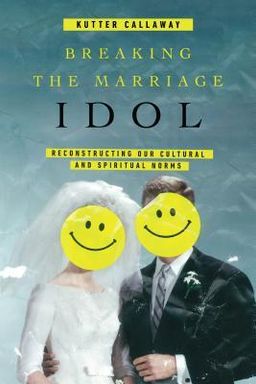
Breaking the Marriage Idol cover

Breaking the Marriage Idol

by Kutter Callaway

Should all Christians be married? Kutter Callaway considers why marriage, which is a blessing from God, shouldn't be expected or required of all Christians. Through an examination of Scripture, cultural analysis, and personal accounts, he reflects on how our narratives have limited our understanding of marriage and obscured our view of the life-giving and kingdom-serving roles of single people in the church.

From Marriage Idol to Kingdom Vocation

What if your church’s assumptions about sex, singleness, and marriage have been quietly scripted by Disney, pop radio, and reality TV? In this book, Kutter Callaway argues that contemporary Christians have baptized a cultural romance myth into a quasi-gospel, turning marriage into an unquestioned norm and singleness into a problem to be solved. He proposes a theological reorientation: treat marriage as one vocation among many, retrieve singleness and celibacy as honored callings, and practice chastity as a communal discipline that orders desire toward the kingdom of God rather than private fulfillment.

The problem beneath your programming

From childhood storybooks (Richard Scarry’s Mister and Mistress Mouse) to Disney princess arcs (Snow White, Cinderella, Ariel, Belle, Rapunzel, Anna and Elsa), you absorb the same conclusion: single equals lack, marriage equals completion. Taylor Swift’s early songs (“Love Story”) echo the princess telos, while later tracks (“Blank Space”) normalize serial monogamy. The Bachelor/Bachelorette turns soul‑mate search into a consumer spectacle with staged scarcity and market logic. Callaway reads these as cultural catechisms—narratives that function like premarital counselors, shaping what you expect from intimacy before you ever open a Bible.

How church life mirrors the myth

Inside evangelical spaces, three internal scripts reinforce the same norm: purity culture promises great sex as a marriage reward (True Love Waits, Silver Ring Thing), the princess paradigm (Eldredge, Dobson) genders desire around rescue and romance, and Christian courtship (Joshua Harris) reframes dating as a perilous detour on the way to “the one.” Ministries sort you into matchmaking pipelines, weddings receive abundant ritual, and singles are relegated to the kids’ table—literally, as Jennifer Graffius recounts, or figuratively in leadership searches. The result is pastoral thinness: sex gets policed or promised, marriage gets idolized, and singleness becomes purgatory.

A biblical reframe you may have missed

Callaway rereads Scripture with three lenses: description, prescription, and metaphor. Patriarchal stories describe messy, culturally bound arrangements (polygyny, concubinage) that advance God’s promise but don’t prescribe a timeless marital blueprint. Legal prescriptions (Exodus, Deuteronomy) pursue justice for the vulnerable—widows, captives, women in precarious economies—rather than codify an ideal family form. Marriage imagery, especially in the prophets and Song of Songs, becomes theological metaphor more than a universal sociological norm. Genesis 1–2 centers human relationality (’adam made male and female; an ’ezer who corresponds) rather than issuing a cosmic wedding license. In the New Testament, Jesus declares marriage belongs to this age—“in the resurrection they neither marry nor are given in marriage”—while honoring its covenant weight; Paul elevates celibacy as a gift and treats sex as non‑essential to human fullness (1 Cor 7).

The constructive turn: order desire around the kingdom

Chastity, for Callaway, is not prudish abstinence but communal ordering of love. Your body and longings belong to Christ’s body; practices like mutual authority (1 Cor 7:4) and shared seasons of abstinence (1 Cor 7:5) train desire toward fidelity, generosity, and prayer. Marriage becomes a Spirit-summoned kingdom event oriented by justice (Ruth and Boaz’s repair of Naomi’s vulnerability), generosity (C.S. Lewis marrying Joy Davidman for sanctuary and care), forgiveness (a non‑trivial habit that does not excuse abuse), and hospitality (turning marital life toward the church, as Tommy Givens preaches with his “cord of three”). Singleness and celibacy become positive vocations where the Spirit redirects eros toward beauty, worship, friendship, and mission (Sarah Coakley, James K. A. Smith; see Taizé’s contemplative rhythms and the Regina Laudis abbey’s corporate song).

Practices that change people, not just opinions

Because desire follows ritual and imagination, the book leans into practices: covenant‑friendship rites, public vows of celibacy, desegregated ministries, leadership parity for singles, and wedding liturgies that publicly emphasize communal responsibility over romantic spectacle. The aim is structural repentance: reform sermons, sex education, hiring, and pastoral care so single and married Christians become mutual givers, not segmented consumers of a romance ideal.

Thesis in a sentence

“Change the stories you tell, the rituals you perform, and the structures you build—and the body of Christ will be free to honor marriage without idolizing it and to bless singleness without pathologizing it.”

(Note: The book’s cultural analysis sits alongside theologians and philosophers like John Caputo on the event of love, Sarah Coakley on desire’s sanctification, and James K. A. Smith on how liturgies shape the heart; film references like The Lobster underscore how our options have been caricatured as either sentimental marriage idolatry or sterile autonomy.)


How Culture Catechizes Desire

Callaway treats popular culture as data—artifacts that rehearse the deepest myths you carry into the sanctuary. Disney’s evolving princess canon trains children to associate beauty and completion with romantic rescue. Taylor Swift’s catalog maps a journey from fairy‑tale fusion (“Love Story”) to the choreography of high‑intensity, disposable relationships (“Blank Space”). The Bachelor industrializes the soul‑mate myth as a televised marketplace, with elimination rituals that mimic consumer choice and scarcity.

He calls these cultural stories “norms”—unspoken rules that organize desire and practice. They don’t merely reflect your aspirations; they script them. When you sing along enough times or binge an entire season, you internalize a playbook for longing, waiting, and breaking up. These scripts seep into church life not because churches love pop culture but because churches share the same air—sermons and ministries then “baptize” the pattern with Bible verses and spiritual language.

Evangelical echoes: purity, princess, courtship

Inside many congregations, three internal narratives resound. Purity culture promises a future payoff (“great sex in marriage”) if you can just wait—True Love Waits and Silver Ring Thing operationalize abstinence as transaction. The princess paradigm, popularized by John and Stasi Eldredge and James Dobson, genders fulfillment around being rescued (women) and rescuing (men). Christian courtship, epitomized by Joshua Harris’s I Kissed Dating Goodbye, presents dating as hazard and marriage as the only safe telos.

The upshot is the “marriage norm”: singleness becomes a non‑option or a waiting room. Ministries for singles morph into matchmaking services; weddings receive elaborate rites, while lifelong single vocations receive none. Leaders implicitly measure maturity by marital status. Even pastoral counseling often presumes marriage will heal loneliness or sexual confusion, leaving divorcees and trauma survivors with thin support when the myth fails.

The human cost in plain view

Callaway intersperses vignettes so you can’t stay theoretical. Jennifer Graffius gets seated with children because she is single. Lindy Williams hears messages that reduce her to desirability; she feels she “takes up space” that should belong to couples. Debi Yu names being “queer” to church categories as a single woman in ministry. Sarey Martin recounts the pain of marriage to an addicted spouse and how the idol made her community minimize her suffering. Michael Beardslee, once harsh toward a friend’s premarital sex, discovers how purity rhetoric left him without resources when he himself needed grace.

Resisting the catechism

You resist cultural catechesis not by boycotting media but by naming its myths and re‑narrating desire. Swap matchmaking “singles ministries” for communities of mutual care. Teach that chastity applies to everyone—married and single—not just to teens on a retreat. Tell saints’ stories that elevate alternative paths (Henri Nouwen’s celibate friendship, Dolores Hart’s Benedictine vow, Dietrich Bonhoeffer’s costly fidelity to vocation). Curate weddings and testimonies that turn couples toward the body of Christ rather than inward.

Cultural framing, named

“Disney, Swift, and The Bachelor embody the mythic underpinnings of contemporary culture—deep structures that both mirror who we are and offer models by which we might live.”

(Note: The book does not demonize artists; it analyzes how stories form habits. This mirrors James K. A. Smith’s claim that we are liturgical animals—our loves are trained by repeated practices, whether in church or at the mall.)


Scripture Beyond the Marriage Idol

When you open the Bible with the marriage norm already in place, you will find what you expect. Callaway slows you down with a simple but crucial distinction: biblical descriptions, prescriptions, and metaphors do different work. Confusing them turns cultural preferences into divine mandates. Reread the text on its own terms, and you discover that Scripture honors marriage yet refuses to make it the universal human calling.

First Testament: people, law, and poetry

Patriarchal stories are descriptive: Abraham, Jacob, David—each advances God’s promise through arrangements we would never prescribe today (polygyny, concubinage, levirate duty). These narratives attest to God’s faithfulness within a patriarchal world, not to a timeless design pattern for family life. Prescriptions appear in legal collections (Exodus 21; Deuteronomy 21 and 25), where the law curbs exploitation and provides for the vulnerable—widows, captives, and those without male protection. This is justice work, not marital idealism. Then the metaphors: prophets and poets deploy marriage imagery to illuminate covenant fidelity (Hosea’s painful sign‑act; Isaiah’s faithful husband; Song of Songs celebrating erotic delight). Marriage here is a theological symbol, not an anthropological measuring stick.

Genesis 1–2 without the cultural filter

Genesis 1 names humanity (’adam) as male and female bearers of God’s image; Genesis 2 dramatizes that the human is “not good” alone and receives an ’ezer—a strong, corresponding helper (a word also used of God). Notably absent are the Hebrew terms for husband and wife in these opening songs. The text is anthropological and communal, not a wedding manual. It affirms that you are made for relation, but it doesn’t collapse that relation into one exclusive script.

New Testament: the age to come interrupts

Jesus dislodges the idol when he answers the Sadducees: “In the resurrection they neither marry nor are given in marriage” (Lk 20). Marriage belongs to this age; the coming age relativizes it. He also blesses “eunuchs for the sake of the kingdom” (Mt 19:12), making non‑marriage a legitimate, even commendable, path. Paul urges Corinthian believers to consider celibacy a gift that frees them for undivided devotion (1 Cor 7). He honors marriage and mutuality (1 Cor 7:3–5) while insisting that genital sex is not essential to human flourishing. This was countercultural then—and remains so now.

Pastoral consequence: parity, not hierarchy

If Scripture accords dignity to both marriage and singleness, your church should too. Stop treating singleness as limbo; stop assuming marriage cures loneliness. Build communities where vocation—not status—organizes ministries, rites, and leadership. Let weddings be rich sacraments without becoming the standard by which every life is measured. Let celibate vocations receive public blessing and visible structures of support, just as married life receives showers, counseling, and anniversary rituals.

Paul’s arresting realism

“I wish that everyone were as I am... but each has his own gift from God” (1 Cor 7:7). Gifts differ; vocations vary; the body needs them all.

(Note: Callaway engages scholars who expose how we have over‑read certain texts and under‑read others; compare David T. Lamb on Old Testament sexuality and James K. A. Smith on how our interpretive habits are themselves formed by cultural liturgies.)


Chastity and Kingdom Marriage

If your first association with chastity is “no sex until marriage,” you’re thinking too small. The book reframes chastity as a communal discipline that orders all your desires—bodily, emotional, and social—toward the flourishing of Christ’s body. Within that frame, marriage is not a private fulfillment project but a Spirit‑called vocation oriented to justice, generosity, forgiveness, hospitality, and love.

Chastity: a shared way of life

Paul anchors chastity in reciprocity and prayerful self‑giving: “The husband does not have authority over his own body, but the wife does; likewise the wife...” (1 Cor 7:4). Mutual authority subverts domination; shared seasons of abstinence for prayer (1 Cor 7:5) prioritize communal discernment over impulsivity. Chastity, then, isn’t repression; it’s training desire to be a gift. Claire Crisp’s “Cold Feet” vignette shows how church narratives shape what spouses think they owe each other; good teaching on mutual submission (Eph 5:21) reshapes those expectations toward reciprocity rather than duty‑coercion.

Marriage as a kingdom event

Borrowing John Caputo’s “event” language, the book casts marriage as a Spirit‑summoned happening that reorients love toward God’s kingdom. The vocation includes at least four habits:

  • Justice. Ruth and Boaz’s union repairs Naomi’s material precarity. Today, you might ask, “Who does our marriage enable us to serve?”
  • Generosity. C.S. Lewis’s marriage to Joy Davidman, in part to secure refuge for her and her children, models gift over ledger‑keeping.
  • Forgiveness. Marriage trains daily mercy—non‑trivial apologies, restitution, and re‑trusting—without sanctifying abuse (Hosea provides symbolism; Jesus sets the cadence: seventy times seven).
  • Hospitality. Tommy Givens’s homily pictures marriage turning outward to the church—“a cord of three” where the community upholds the couple and the couple opens their home.

Ethical bounds and pastoral prudence

The call to forgive never commands enduring ongoing harm. The book is explicit: safety, justice, and truthful accountability set boundaries. Forgiveness as a marital practice concerns the daily work of reconciliation, not the tolerance of abuse. Communities must therefore build pastoral pathways that include confession, consequences, therapy, and, when needed, separation.

If you lead or mentor

Preach mutual submission (Eph 5:21) before you quote spousal duties. Normalize short, agreed fasts from sex for prayer. Coach couples to make hospitality part of their rule of life: shared meals with single friends, respite care, and mission teams that mix marital statuses. Frame premarital counseling around kingdom questions: “How will our union serve justice, model generosity, practice forgiveness, and extend hospitality?”

Provocative claim

“Marriage is not ultimately about romantic love at all, but the right ordering of our desires—so that the kingdom Jesus inaugurated orients all our loves and affections.”

(Note: This vision resonates with Augustine’s ordo amoris and contemporary retrievals of virtue as habit; it also answers modern loneliness by turning couples outward, resisting the privatized dyad that starves friendships and fragments congregations.)


Singleness as Spirit-Shaped Vocation

Against the marriage‑as‑default script, the book honors singleness and celibacy as full, beautiful vocations. You are a desiring creature whose longings need not be muted to be holy; they can be redirected—by the Spirit—toward beauty, prayer, friendship, and justice. This is not stoic denial; it’s re‑enchanted desire.

Desire as fuel, not enemy

Drawing on James K. A. Smith’s account of humans as lovers and Sarah Coakley’s theology of desire, Callaway insists: eros can be transfigured. Celibacy is not the absence of passion but the redirection of passion. William Dyrness’s attention to beauty helps here—art, worship, and creation become sites where longing finds real consolation, not mere distraction.

Beauty and the practices that sustain you

Joshua Beckett narrates how a Taizé brother counseled him to “open yourself up to beauty.” In communities like Taizé (and the Benedictine abbey of Regina Laudis), corporate song, liturgy, and shared aesthetic labor channel erotic energy toward God. The nuns describe their vow as a spousal commitment to Jesus; choir becomes embodied eros—a profound, communal alternative to genital sex as the sole outlet of desire.

Examples that rewire your imagination

Colton Simmons’s mentor, Pritch, lives a generous celibate life, pouring into families and friendships. Henri Nouwen’s celibate vocation forged deep, non‑possessive bonds. These lives contradict the stereotype that singleness equals isolation. The New Testament’s own vocabulary—unmarried, virgins, widows, eunuchs—signals dignity and mission rather than a demographic box to be moved out of.

Liturgies and structures for longevity

If singleness is a vocation, the church must offer scaffolding: public vows of celibacy (for a season or life), covenant‑friendship rites, and practical support for housing, health, and holiday belonging. Worship should include lament for ache and longing—not to pathologize desire, but to name it before God. Singles should be fully eligible for leadership, preaching, and pastoral roles; parity in visibility tells a new story.

Headline worth keeping

“The Bible talks about the unmarried, eunuchs, widows, and virgins—not the modern autonomous ‘singles’—and the New Testament grants celibacy dignity and an eternal orientation.”

(Note: This reframing aligns with the early church’s high valuation of virginity and with contemporary voices like Wesley Hill, who articulate celibacy as friendship‑rich discipleship rather than deprivation.)


Practices That Change Desire

You cannot argue a community into new desires; you must perform them. The book’s most practical contribution is a portfolio of rituals, arts, and reforms that retrain how people love. Change the stories you tell, the ceremonies you stage, and the structures you inhabit, and new possibilities for chastity, marriage, and singleness will emerge.

Art rewires eros

Communities like Regina Laudis show how corporate singing and disciplined artistry become embodied, erotic expression that satisfies longing without centering genital sex. In your setting, elevate music, visual art, dance, and theater as legitimate channels of desire toward God and neighbor. Beauty is not decor; it is moral formation.

New rites for new bonds

Create public rituals that bless non‑spousal covenants: two friends pledging lifelong mutual care; a household adopting a single person into its family rule; ceremonies marking a season of celibacy for mission or discernment. Such rites make real obligations visible, shifting caregiving and belonging from the marital dyad to the whole church.

Redesign weddings as public discipleship

Treat weddings as kingdom theater. Center vows of hospitality, justice, and forgiveness; include congregational promises and intercessions; preach Tommy Givens’s “cord of three” vision. Avoid the cinematic, couple‑centered spectacle that rehearses consumer romance more than Christian covenant. Your city should leave the service knowing that this couple belongs to the church—and the church to them.

Structures that match theology

Reform sermons and storytellers: invite single preachers and testimonies; preach regularly about singleness as discipleship. Replace purity‑program quick fixes with a curriculum of chastity for all ages and states: desire as gift, mutual authority, friendship ethics, seasons of abstinence, pornography recovery as communal healing, and marital sex as hospitality to the spouse. Desegregate ministries so mission teams and small groups mix statuses by design. Hire single pastors to correct structural bias.

First steps and measurements

Pilot a covenant‑friendship ritual; commission an artist‑in‑residence to curate worship aesthetics; redesign one wedding liturgy around the kingdom event; run a single‑preacher series. Measure culture shift by listening: Do single people feel seen in sermons? Are married households facing outward in hospitality? Do pastoral searches treat marital status as neutral?

Core insight

“Art and ritual are not adornments; they are primary means by which communities reorder desire and train bodies.”

(Note: This practical turn echoes James K. A. Smith’s liturgical anthropology and aligns with organizational change wisdom: structures sustain what sermons start. As the book repeats, compassionate theology won’t stick without institutional courage.)

Dig Deeper

Get personalized prompts to apply these lessons to your life and deepen your understanding.

Go Deeper

Get the Full Experience

Download Insight Books for AI-powered reflections, quizzes, and more.