
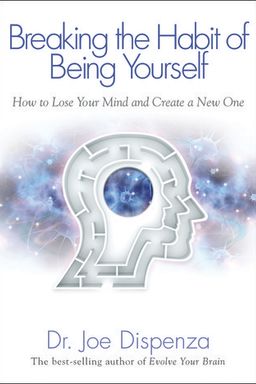
Breaking The Habit of Being Yourself cover

Breaking The Habit of Being Yourself

by Joe Dispenza

Breaking the Habit of Being Yourself reveals how to tap into your mind’s immense potential to transform your life. By breaking free from limiting beliefs and negative patterns, you gain control over your destiny. Learn practical tools like meditation and visualization to rewire your brain, improve well-being, and manifest your desired reality.

Breaking the Habit of Being Yourself

Why do you keep living the same patterns even when you want change? Dr. Joe Dispenza’s central argument in Breaking the Habit of Being Yourself is that your reality reflects your identity — and your identity is built from thought, emotion, and habit loops encoded into your brain and body. To become someone new, you must literally rewire and recondition yourself to think, feel, and act beyond old memories. This book reveals how consciousness interacts with the quantum field to turn internal transformations into external changes.

From Quantum Physics to Personal Power

Dispenza bridges quantum physics and neuroscience to show how your focused attention participates in creating reality. At the subatomic level, energy exists as infinite waves of possibility until observed; your consciousness collapses one potential into matter. Where you place attention, energy organizes itself. You’re not merely watching life happen — you’re co-creating it. The book uses the observer effect and quantum field concepts to illustrate how any version of your future already exists as information waiting to be chosen by your awareness.

Mind–Body Chemistry: How You Become Your Thoughts

Your thoughts trigger emotions that translate into chemistry — neurotransmitters, peptides, and hormones — which the body memorizes. Over time, your physical system becomes addicted to the feelings that match familiar thoughts. By adulthood, roughly 95 percent of your mind operates automatically, running on those programs. You might consciously desire change, but your body’s chemical memory pulls you back. Dispenza calls this reversal the moment when "the body becomes the mind." Real transformation requires interrupting that reflex so the body learns to feel new emotional states.

Heart–Mind Coherence: The Signal You Send to Reality

Thoughts alone are electrical impulses; feelings are magnetic energy. Together they form your electromagnetic signature — the broadcast the quantum field responds to. Experiments such as Glen Rein’s DNA study showed that when subjects combined clear intention with elevated emotion (love, gratitude), strands of DNA changed shape. When either part was missing, nothing happened. Aligning your mind and heart creates coherence: a laser-like focus that draws matching outcomes from the field. This is the skill of becoming intentional rather than reactive.

Moving Beyond Environment, Body, and Time

You normally define yourself by three things — your environment, your body, and linear time. In survival mode, these dominate your awareness and trap you in past-based behaviors. Dispenza explains that creation begins when you transcend those anchors. Meditation and mental rehearsal allow you to detach from sensory input (environment), bodily cravings (body), and anxious thinking (time). In this timeless, purely conscious state — what he calls becoming "no body, no thing, no time" — you connect with an intelligence that reorganizes outcomes without the stress-driven effort of control.

Closing the Identity Gap

Every person lives between two selves: the outer persona (how you appear) and the inner state (how you actually feel). The larger that gap, the more energy you waste maintaining an act. Midlife often exposes the gap when external achievements no longer compensate for inner emptiness. Dr. Joe recounts how he stepped away from fame after What the BLEEP Do We Know!? to meditate for six months, shedding the persona others expected and reconnecting with joy. The lesson is that healing requires honesty with your inner state — not more external novelty.

From Theory to Practice: Meditation as the Laboratory

Meditation is the daily practice of reprogramming. When you quiet the analytical neocortex and access the subconscious, you can unmemorize emotions, rewire neural circuits, and teach the body to experience new feelings. Techniques like the body-part induction or water-rising imagery help you enter Alpha or Theta brain states where these changes happen. Through repetition, your electromagnetic signature shifts, and external events start mirroring your inner work. Dispenza presents meditation as the true laboratory of transformation — a tool to become familiar with your old programs and design new ones.

The Book’s Promise: Create from the Inside Out

By combining quantum principles with neuroscience, psychology, and practical meditation, Dispenza offers a process to "break the habit of being yourself." You learn to think greater than your environment, unmemorize old emotions, align thought and feeling in coherence, and rehearse a new identity until it becomes automatic. When that happens, your biology, behavior, and external circumstances reorganize around the new you. The science may stretch traditional boundaries, but the essence is clear: conscious attention changes reality — and your greatest power is learning to use it deliberately.


The Quantum Field and Observer Effect

Dr. Joe Dispenza begins at the foundation of quantum theory: at the smallest scales of nature, particles exist only as probabilities until observed. Your mind, through focused attention, participates in the collapse of those probabilities into concrete reality. This is not metaphor — it’s a conceptual stage for understanding how consciousness interacts with energy. To change your life, you must first accept that your thoughts have measurable effects at the energetic level.

Energy Becomes Matter Through Attention

Quantum experiments show that electrons behave like waves until measured; then they appear as particles. Dispenza extrapolates this to personal life. Each moment holds infinite potential versions of you. When you focus clear attention on one version — a healthier, abundant, more creative self — you cause that probability to take form. Your attention is creative measurement. (Note: Deepak Chopra’s Quantum Healing explores similar mind–matter implications.)

Nonlocality and Entanglement: You Are Connected

Quantum entanglement reveals that two particles can influence each other instantaneously, regardless of distance. Dispenza applies this to consciousness: your present self and your future self are entangled. When you emotionally inhabit your desired future now, you resonate with that potential in the field. This explains why intention experiments sometimes appear retrocausal, such as the Leibovici prayer study where intentions seemed to affect past medical outcomes — evidence that consciousness transcends linear time.

Practical Implications

  • You are an observer: When you consistently direct attention toward an intention, you increase its probability of manifesting.
  • Possibility precedes manifestation: The field contains all potential realities; your consciousness chooses which one becomes experience.
  • You are connected beyond space and time: Your thoughts and emotions resonate nonlocally, influencing future outcomes through entanglement.

Accepting that mind and matter are linked changes how you approach life. You stop seeing reality as fixed and become aware that attention and emotion reorganize energy into matter. That shift lays the foundation for all subsequent practices in the book.


Thoughts and Feelings in Coherence

Thought and emotion are the two halves of creation. Dispenza explains that the brain is electrical — it sends signals — and the heart is magnetic — it draws experiences. Only when they align do you send a coherent electromagnetic message to the quantum field. This section teaches you to synchronize your mental intention and heartfelt emotion.

Why Coherence Matters

If your thoughts and emotions conflict, your field signal becomes static. Thinking "success" while feeling "fear" sends mixed instructions to reality. Coherence means the message is unified. Dispenza uses lasers as analogy: waves in phase amplify energy exponentially; out-of-phase waves cancel each other. The same principle applies to your personal electromagnetic field — coherence focuses power.

Experiments and Evidence

HeartMath and Glen Rein’s DNA studies demonstrated that coherent emotion changes biological matter. When trained subjects combined intention with love and gratitude, DNA helices altered conformation; without emotional coherence, nothing happened. The grandmother anecdote reveals the opposite: her loving thoughts were undermined by guilt, producing an incoherent signature that reinforced misfortune. Emotional coherence is measurable and practical.

Practicing Gratitude Before Receiving

The book urges you to feel gratitude for outcomes before they appear. This act tricks the body into believing the future is present, triggering genetic and hormonal shifts consistent with that new reality. Practicing this daily teaches your nervous system to sustain coherence long enough for reality to respond.

In sum, coherence is the skill of aligning thought and feeling. It’s the transition from wishing to creating. Every meditation, intention-setting exercise, or mental rehearsal in the book builds on this principle to ensure your inner signal is clear, strong, and in-phase with your desired future.


Overcoming the Body and Environment

Your physical world constantly reaffirms who you’ve been. Each morning the same surroundings trigger the same brain circuits, leading to the same emotions and behaviors. Dispenza insists that genuine change begins when you become greater than your environment, body, and time — the three constraints of survival consciousness.

Your Brain as a Record of the Past

Neural circuits are historical. Hebb’s law — "neurons that fire together wire together" — explains why repetition cements identity. If you repeat the same emotional patterns, you sustain the same personality. To reinvent yourself, you must stop rehearsing the past. Dispenza cites studies showing that imagined actions (like mentally practicing piano scales) activate the same neural pathways as physical performance, demonstrating how you can rewire without external input.

The Body’s Chemical Memory

Over years, your body becomes addicted to familiar emotional chemicals. When you stop feeding the old feelings — guilt, anger, victimhood — the body protests. You interpret withdrawal symptoms as proof you should resume the old behavior, but it’s actually the body resisting psychological change. Dispenza’s story of Bill, who overcame melanoma by releasing resentment, illustrates how altering emotion can change biology.

Mental Rehearsal & New Circuits

You can outpace environment by imagining new experiences vividly and repeatedly until they feel familiar. The brain doesn't distinguish between real and intensely remembered events; it wires accordingly. Through meditation and rehearsal, you install new neural networks that correspond to a future that the body will follow automatically.

Transformation demands living mentally in a world that hasn’t yet shown up physically. You learn to produce emotions independent of environment — gratitude instead of stress, wonder instead of fear. Eventually, your external life reorganizes to match the coherent internal signature you’ve been practicing.


The Shift from Survival to Creation

Most people spend their lives in survival mode — reactive, time-bound, and driven by stress chemistry. Dispenza defines survival as being dominated by environment, body, and linear time. Creation begins when you transcend these and live from consciousness itself. The shift moves you from controlling outcomes to trusting a larger intelligence.

Life in Survival

Under stress, the body enters high-Beta brain states (22–50 Hz), fragmenting coherence and narrowing awareness. You identify with the body, cling to external circumstances, and lose creativity. Chronic stress drives gene expression toward disease and numbs emotional range. This is the habitual state most adults occupy, making change difficult.

Life in Creation

Creation requires relaxing into Alpha or Theta states where subconscious programs can be rewritten. You detach from sensory input and become "no body, no thing, no time." From this expanded awareness, elevated emotions such as love and gratitude flow naturally. You stop forcing results and allow a greater mind to organize the path. Gandhi’s and Joan of Arc’s visions are cited as historical examples of individuals embodying futures beyond their environments.

Closing the Identity Gap

The book emphasizes reducing the distance between how you appear and who you feel you are. The greater this gap, the more exhausted and disconnected you become. Experiencing midlife awakening — when the outer world can no longer mask inner emptiness — is not failure; it’s an opportunity to shift from survival to creation. You begin living as your authentic signal instead of adapting to external validation.

Choosing creation over survival means generating coherence from within. You align intention, emotion, and consciousness until you feel whole, independent of environment or circumstance. Then creation unfolds effortlessly, and your reality confirms the new frequency you’re living.


Meditation and Reprogramming

Meditation is the central tool for transformation in Dispenza’s model. Its purpose is not to escape life but to reprogram your subconscious, accessing and changing the automatic circuits that make you who you are. You learn to become familiar with your internal operating system — observing, unlearning, and reinstalling new patterns of thought and emotion.

How Meditation Works

Meditation lowers your brain waves from Beta into Alpha or Theta, where subconscious material becomes accessible. When the analytical mind quiets, you bypass conscious resistance and begin altering the programs that produce habits. Tibetan translations of "to meditate" mean "to become familiar with" — exactly the skill Dispenza teaches: sustained awareness of your own reactions until they lose unconscious power.

Induction and Practice

The body-part and water-rising inductions help direct attention inward and relax sensory input. As practice deepens, the nervous system entrains to coherence; energy previously trapped in old emotions becomes available for creative use. Dispenza likens this liberated energy to raw electricity powering new life patterns. Joy and physiological healing often follow. Over time, meditation creates lasting coherence even outside the practice session — supported by research on monks whose brains remained harmonized after meditation.

Four-Week Transformation Plan

The book concludes with a structured program: Week 1, induction to slow waves; Week 2, recognize and surrender old emotions; Week 3, observe and redirect habitual thoughts (the "Change!" technique); and Week 4, create and rehearse new identity through sensory imagination. Each week builds on the last to install a new subconscious operating system. Consistency and emotional coherence are key.

Meditation becomes your daily laboratory where quantum theory meets biology. As you unmemorize old states and repeatedly embody new emotions, your body learns to follow the mind. The external world, via quantum feedback, reorganizes to mirror the frequency of the self you’ve been practicing.

Dig Deeper

Get personalized prompts to apply these lessons to your life and deepen your understanding.

Go Deeper

Get the Full Experience

Download Insight Books for AI-powered reflections, quizzes, and more.