
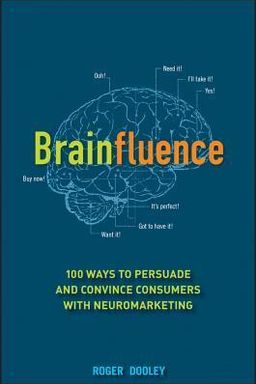
Brainfluence cover

Brainfluence

by Roger Dooley

Brainfluence delves into the psychology of consumer decisions, offering 100 neuromarketing strategies to persuade and delight customers. Learn to harness subconscious triggers, from sensory engagement to loyalty rewards, to enhance sales and customer satisfaction.

How to Sell to the Brain, Not the Buyer

Why do most marketing campaigns fail to connect, even when the message seems rational? Roger Dooley’s Brainfluence: 100 Ways to Persuade and Convince Consumers with Neuromarketing offers a striking answer: because most marketers are speaking to the wrong part of the brain. Dooley argues that up to 95% of consumer decisions are made in the subconscious mind—the emotional, automatic system that governs behavior long before logic kicks in. If you want to truly influence buyers, you have to address what their subconscious wants, not just what their conscious minds can explain.

Dooley brings together neuroscience, behavioral economics, and classic consumer psychology to show how every business—from global brands to small local shops—can make smarter decisions by understanding how our brains really behave. Using lessons from brain scans, behavioral experiments, and marketing case studies, he distills complex science into clear, practical strategies to help businesses sell more effectively, ethically, and efficiently.

The Science of Neuromarketing

Neuromarketing blends neuroscience and marketing to uncover how people decide what to buy. Traditional research—surveys, focus groups, interviews—asks people to report their preferences, but the problem is that people often don’t know why they choose what they choose. As Dooley explains, brain scans reveal that the pain of paying is processed in the same region of the brain as physical pain, and that something as simple as a decimal point or an image can powerfully alter purchase behavior. By "opening the black box" of the subconscious, neuromarketing allows brands to target emotional triggers that drive loyalty and sales.

From Rational Appeals to Emotional Triggers

Dooley’s central message is that marketers must stop selling to the 5% of the customer’s rational brain and instead design experiences that resonate with the 95% that operates automatically. When you present endless features, stats, and cost-benefit analysis, you’re speaking to the conscious mind—the part that rarely makes the final call. Successful marketing taps emotion, imagination, and trust. Facts can justify decisions after the fact, but feelings make them happen.

Throughout the book, Dooley illustrates this idea with vivid examples. One neuroimaging study showed that people’s brains experience genuine pleasure when they believe they’re drinking expensive wine—even if it’s the same cheap bottle. Another experiment revealed that restaurant menus without dollar signs led diners to spend more. The power of emotion and perception far outweighs logic or precision in price.

Brainfluence Broken Down: What You’ll Learn

Dooley organizes his 100 ideas into 14 sections that apply brain science to every aspect of business—pricing, product design, sensory experiences, branding, loyalty, persuasion, sales, writing, and digital behavior. For instance:

  • In Price and Product Brainfluence, you learn how to reduce the “pain of paying” through bundling, anchoring, and decoys.
  • In Sensory Brainfluence, he unpacks how smell, sound, and touch influence emotions and memories—and why a single scent can create lifelong brand loyalty.
  • In Brainfluence Branding, he shows how consistency, community, passion, and even having an “enemy” can strengthen brand identity and customer connection.

Later sections explore how trust is built through small actions, like apologies and handwritten notes; how storytelling and simple language activate different parts of the brain; and how digital experiences—from websites to emails—can use psychological cues to win faster engagement and loyalty.

Why This Matters for You

At its heart, Brainfluence answers the modern marketer’s dilemma: how to do better marketing with less money. The answer lies not in more resources, but in smarter design—understanding that your customers are emotional beings first and rational beings second. Dooley’s framework helps leaders, entrepreneurs, and marketers of any skill level design offers, content, and experiences that align with how the human brain naturally works.

“Marketing smarter doesn’t just mean using your brain—it means using your customer’s brain too.”

Across hundreds of studies, Dooley demonstrates that small tweaks—a font, a smell, a price ending, or even where you put your logo—can drastically change consumer behavior. Whether you’re managing an ad campaign or designing a coffee shop experience, every detail speaks to the subconscious. The marketer’s job is to learn that language—and speak it fluently.


Minimize the Pain of Paying

Why does it physically hurt to spend money? Using neuroeconomic studies, Dooley explains that paying for something activates the same brain areas associated with physical pain. That’s why your brain winces a little every time you hand over cash or see your bank balance decrease. Understanding this can transform pricing and product strategy: if buying causes discomfort, then successful marketers must find ways to dull the pain of paying.

The Neuroscience of Pricing Pain

One major study by Carnegie Mellon and Stanford researchers used fMRI scans to show that consumers reject purchases when those pain centers light up too strongly. Interestingly, paying with credit cards activated those regions far less than paying with cash—confirming what economists have observed for decades: swiping a card feels painless compared to parting with paper bills.

Marketing strategies can ease this pain in several ways. Bundling products together masks individual costs, so customers can’t easily tie pain to any specific item. Subscription or flat-rate models, such as Netflix or cruise packages, feel better than multiple micro-payments. The key, Dooley writes, is to create a psychologically smooth transaction where the pleasure of ownership outweighs the twinge of cost.

Anchoring and Decoy Pricing

Dooley draws heavily on Dan Ariely’s research in *Predictably Irrational* to explain how the brain anchors prices and compares value. When you see a $1,000 TV next to a $2,500 TV, the cheaper one suddenly feels like a deal—even if $1,000 is more than you planned to spend. This “anchoring effect” can work unknowingly on everything from software subscriptions to sushi rolls.

Adding a decoy—an intentionally less attractive option—can push customers toward your preferred choice. The Economist famously offered three subscription options: online-only for $59, print-only for $125, and both for $125. Nobody bought the middle option, but its presence doubled sales of the premium package. (Ariely’s experiment showed this exact result, and Dooley names it one of the smartest examples of behavioral pricing ever used.)

Emotional Context: More Than the Number

Customers don’t judge fairness by math—they judge by emotion and context. People pay $5 for a Starbucks latte not because it’s rationally worth that price, but because the experience rewires what “fair” means. In one study cited by Dooley, participants were willing to pay twice as much for a beer from a luxury hotel compared to one from a dingy store. You’re not selling price—you’re selling the emotional context that defines it.

“Pricing creates emotion as much as it reflects value. When you lower pain, you raise pleasure.”

Dooley also warns against using excessive discounts for high-end brands. Experiments show that when people believe a wine or luxury product costs more, they experience more pleasure—literally, their brains show stronger activity in reward centers. Over-discounting can reduce that perceived value and even change how good the product feels.

Whether you run a bakery or a tech firm, Dooley’s lesson is clear: price is never just a number. It’s a message to your customer’s brain—and their nervous system reads it faster than logic ever can.


The Science of the Senses

Have you ever walked into a bakery and felt hungry even if you weren’t before? That’s sensory marketing at work. Dooley’s section on multi-sensory branding explores how every sense—sight, sound, smell, taste, and touch—communicates directly with the brain’s emotional centers. Unlike words or logic, sensory experiences bypass rational analysis entirely, creating “fast-lane” feelings of desire, memory, and loyalty.

Smell: The Shortcut to Memory

Of all the senses, Dooley argues, smell is the most powerful branding tool. Martin Lindstrom (in Brand Sense) estimated that 75% of our emotions are produced by scent. Singapore Airlines, for example, infuses its cabins with a signature fragrance called “Stefan Floridian Waters.” Starbucks carefully designs store aromas so coffee—not sandwiches—dominates. Even Nike found that participants in scented rooms rated shoes as higher quality. These consistent olfactory cues build unconscious familiarity that strengthens brand memory for years.

Sound: Music and Memory

Dooley highlights that sound shapes how we perceive time and value. Slow background music can make customers linger longer (and spend more), while a jingle or tone—like Nextel’s walkie-talkie chirp or United Airlines’ use of Gershwin’s *Rhapsody in Blue*—cements emotional recognition. Muzak, once derided as “elevator music,” reinvented itself as an audio branding powerhouse, customizing soundtracks to match brand personalities.

Touch, Taste, and Texture

The sense of touch shapes perception more than most marketers realize. A soft chair makes prospects more agreeable; a heavier clipboard makes information feel more serious. Even encouraging customers to hold an item—for example, an Apple product at its glass-walled store—triggers a feeling of “psychological ownership” that drives purchase intent. (Psychologist Joann Peck calls this the mere-touch effect.) Meanwhile, restaurants that describe foods vividly—“tangy Vermont cheddar,” “nutty, smooth grain bread”—sell up to 27% more meals.

“When you engage more senses, you own more brain space.”

The sensory story isn’t just luxury-brand fluff. Even small tweaks—like adding a pleasant scent, simplifying sound environments, or giving customers something physical to touch—can dramatically amplify emotional connection. The human brain evolved to make sense of the world through sensation, and the brands that understand this primal truth capture attention that no ad copy ever could.


Build Brands That Feel Human

Why do some brands spark fierce devotion while others fade into obscurity? Dooley argues that the most successful brands build emotional consistency—they make people feel the same way every time they see, hear, or experience them. From the rhythm of a logo tone to the tone of a clerk’s smile, every interaction “wires the brain” through repetition and reinforcement. As neuroscientist Carla Shatz said, “Neurons that fire together wire together.”

Consistency Over Cleverness

Each brand experience creates small neural associations. When repeated consistently, those connections harden into loyalty. Coca-Cola’s use of red, the curve of its bottle, and even its association with holidays all trigger rapid emotion. Dooley notes that Marlboro’s color, cowboy image, and race cars once produced craving activity in smokers’ brains even without the company’s name. Consistency—across visual, auditory, and contextual cues—creates recognition strong enough to bypass conscious thought.

Tribe, Passion, and the Power of Enemies

Drawing on social identity theory, Dooley suggests that great brands don’t just sell—they form tribes. Apple’s long history of pitching itself against “PC people” (from the 1984 ad to the Mac vs. PC campaign) gave its community a common enemy. This “us vs. them” framing taps humanity’s deep evolutionary instinct to belong to a group. At the same time, brands like Etsy and Harley-Davidson generate evangelism by fostering community passion rather than corporate messaging.

Hiring passionate employees also matters. Customers unconsciously read energy and enthusiasm through facial expressions, voice tone, and body language. Dooley calls this “neuro-emotional transfer”: when people sense belief, they mirror it. As Kate Newlin observes in *Passion Brands*, it’s not enough for a brand to have fans—it must hire believers.

Trust and Loyalty

Trust, like brand loyalty, is built neuron by neuron through repetition. Paul Zak’s work with oxytocin (the “trust hormone”) shows that people who feel trusted behave more ethically and generously. That’s why simple actions—sincere apologies, small debts honored, giving customers a loyalty head start—can cement bonds that no promotion can buy. Dooley highlights that loyalty programs aren't just transactional—they exploit the goal-gradient effect: customers speed up as they get closer to rewards, even if progress is partly an illusion (like pre-stamped coffee cards).

“Your brand is a memory, not a message. Build consistency, inspire passion, and let your tribe do the talking.”

For Dooley, branding is ultimately about human behavior—not just colors, logos, or slogans. It’s about aligning identity, emotion, and experience so that your customers' brains can say, almost instinctively, “This feels right.”


Persuasion in Person

When humans meet face-to-face, our brains exchange far more than words. Eye contact, body language, micro-expressions—all stimulate emotional parts of the brain that influence trust and decision making. Dooley’s chapters on in-person persuasion make neuroscience practical: small gestures—how you shake hands, where you sit, whether you smile—can determine whether people buy or believe you.

Smiles, Touch, and Warmth

Dooley cites UC San Diego research showing that even subliminal flashes of smiling faces increased how much participants were willing to pay for a drink. Touch has similar neurological power: a firm handshake boosts oxytocin, the neurotransmitter of trust. Sitting someone in a soft chair makes them more flexible in negotiations. Offering a warm beverage (literally) makes others judge you as a warmer person and more trustworthy. These physical cues work faster than any rational appeal.

Flattery and Familiarity

Flattery, even when recognized as insincere, can still leave a positive subconscious impression, according to researchers Elaine Chan and Jaideep Sengupta. Dooley encourages “ethical flattery”—comments based in truth, like praising a client’s insight or initiative. Similarly, employing familiar patterns or faces helps create instant ease; our brains love predictability and social cues that indicate safety.

Confidence and Social Proof

Confidence, Dooley notes, sells more powerfully than accuracy. Just as financial broadcaster Jim Cramer commands attention through his passionate certainty, confident body language signals competence even when details are fuzzy. Mirror neurons make people “catch” that confidence, which is why skilled salespeople stand tall, smile, and speak decisively. Add in small social proof—other customers’ positive outcomes or community validation—and your persuasion power multiplies.

“Every gesture talks to the brain. Make sure your body says what your brand means.”

Whether it’s in a boardroom, a fundraiser, or a coffee meeting, Dooley’s message is simple: attention and trust aren’t won by words alone. They’re built neuron by neuron, through warmth, physical presence, and consistent emotional cues.


Words that Stick in the Brain

What makes one ad line unforgettable while another vanishes instantly? Dooley’s section on Brainfluence Copywriting translates neural responses into writing tactics. The right word can activate emotional centers in milliseconds; the wrong one can flatline your message. Effective copy doesn’t just inform—it surprises, simplifies, and engages the imagination.

Surprise the Brain

Our brains love patterns—and they love breaking them even more. Studies of hippocampal activity show that when a pattern is disrupted unexpectedly, the brain fires more intensely. Dooley suggests using unexpected endings in familiar phrases or unusual word choices (“a stitch in time saves money”) to jolt readers into paying attention.

Keep It Simple, Make It Visual

People read with their senses, not their logic. Simple, vivid adjectives create neural simulations of experience—“freshly cracked eggs,” “hand-toasted grain”—that feel real in the brain’s motor and sensory cortices. Similarly, simple fonts and short sentences improve fluency, increasing trust and motivation. Cognitive psychology shows that hard-to-read text leads readers to overestimate difficulty and back away from the task (“If it’s hard to read, it must be hard to do”).

Triggering Emotion: The Magic Words

Two words dominate the subconscious—FREE and NEW. “Free” appeals to our loss aversion circuitry—our brains panic at the thought of missing a no-cost gain. “New” activates dopamine-rich reward centers, explaining why even old products rebranded as new feel irresistible. This is the “infovore instinct” at work: humans crave novelty and information as if it were food for the brain. (Neuroscientist Irving Biederman coined this concept, calling information a “cognitive snack.”)

“Simple words engage. Surprising words linger. Emotional words sell.”

In Dooley’s world, words themselves are sensory products. When used with rhythm, imagery, and emotional weight, they leave cortical footprints. Whether you’re writing an email, tagline, or tweet, the rule is the same: keep it vivid, human, and surprising enough that the brain can’t look away.


Design for Digital Brains

Digital platforms are powerful laboratories for neuromarketing because every click, scroll, and purchase reveals what captures attention—or loses it. Dooley’s final sections apply neuroscience to web design and online persuasion. The principles are simple: first impressions matter, simplicity sells, and emotion clicks faster than logic.

The 50-Millisecond Test

Carleton University researchers found that users form an aesthetic judgment about a website in just 50 milliseconds—a blink. That snap judgment then colors everything else through confirmation bias. If the site looks polished and inviting, users forgive flaws; if not, even helpful content can’t win them back. Dooley translates this into action: clean layouts, symmetrical design, balanced color, and high-contrast elements tap the brain’s appreciation for the “golden ratio”—a proportion mathematically linked to our sense of beauty since the Parthenon.

Emotion and Reciprocity Online

On websites, reciprocity beats reward. One Italian study found that when visitors received valuable information before being asked for their email, twice as many shared their data. Giving first triggers a cooperative impulse that’s encoded deep in our social wiring. Dooley encourages brands to replace “paywalls” with “trust walls”—share value freely, then ask. He contrasts this with Amazon’s “scarcity triggers”: “Only 3 left in stock” uses urgency to push action without coercion.

Designing for Emotion

From high-engagement “rich media” pages to storytelling ads like Google’s minimalist “Parisian Love,” emotional storytelling proves more memorable than high-budget visuals. Emotional ads outperform rational ones in profitability by nearly 2-to-1, according to UK data cited by Dooley. The takeaway: whether on a homepage or a video, start with feelings, not facts.

“The web may run on code—but humans still navigate with emotion.”

Dooley’s closing challenge is simple yet profound: see your website not as a technical system but as a sensory and emotional environment. Every pixel, word, and click is a conversation with the brain. Designing for cognitive comfort and emotional engagement is the neuro-age version of customer service.

Dig Deeper

Get personalized prompts to apply these lessons to your life and deepen your understanding.

Go Deeper

Get the Full Experience

Download Insight Books for AI-powered reflections, quizzes, and more.