
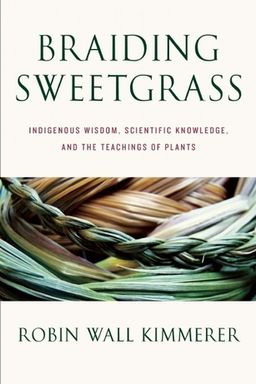
Braiding Sweetgrass cover

Braiding Sweetgrass

by Robin Wall Kimmerer

Braiding Sweetgrass eloquently weaves together indigenous wisdom and scientific knowledge to reveal the deep connections between humans and nature. Robin Wall Kimmerer''s insightful narrative guides readers in cultivating a sustainable, reciprocal relationship with the Earth, emphasizing gratitude and respect. As environmental challenges escalate, this book offers timeless lessons for creating a harmonious and thriving world for future generations.

Braiding Science, Story, and Reciprocity

How can you rebuild a broken relationship with the living world? Robin Wall Kimmerer asks that question throughout Braiding Sweetgrass, proposing that healing comes from learning to braid together three strands of knowledge: scientific understanding, Indigenous wisdom, and personal narrative. The braid itself—made of sweetgrass—is the book’s main metaphor and method. Science gives precision; story gives purpose; the self offers accountability. When twisted together, they form a way of knowing grounded in reciprocity, not dominance.

The core argument

Kimmerer contends that modern ecological crisis springs from a cultural amnesia—a forgetting that the Earth is full of gifts. Western science, though powerful in describing mechanisms, often excludes spirit, gratitude, and moral responsibility. In contrast, Indigenous teachings remind you that the world’s abundance is sustained by mutual generosity: plants, animals, and waters offer themselves, and humans must respond with thanks and care. The book therefore asks you not only to learn how the world works but to learn what it asks of you.

A braid as method

The braid of sweetgrass models how different kinds of knowledge can intertwine. Science provides data and insight—tree physiology, hydrology, mycorrhizae networks. Story provides context—Skywoman’s creation, Nanabozho’s teachings, the Honorable Harvest. Personal narrative connects experience—Kimmerer as Potawatomi scientist navigating academic skepticism while honoring ceremony. Together they form a living epistemology: rigorous and relational. You hold the grass like you hold theory, practice, and ethics simultaneously, one hand steadying while the other weaves.

"It is an intertwining of science, spirit, and story."

The braid becomes both symbol and tool for repairing ecological and cultural relationships.

What the braid asks of you

Kimmerer’s preface teaches reciprocity through a simple gesture: two people braiding together. One holds tension, the other moves. Both contribute equally. That act becomes an epistemological stance—learning as co-creation rather than extraction. The book encourages you to combine scientific accuracy with Indigenous ethics, to design experiments as dialogues with the land, and to interpret data with gratitude. When you hold knowledge like a braid, you shift questions from “How does it work?” to “What does it need?” and “What should I give back?”

Why reciprocity heals

Reciprocity is the medicine for ecological grief. It transforms science from separation to participation. In practice, that may mean cultivating sweetgrass, restoring salmon estuaries, or teaching students to pay attention to the land instead of merely collecting data. Gratitude is not sentimentalism—it’s methodology. When you approach Earth as a teacher and kin, knowledge ceases to be sterile and becomes moral. The braid therefore stands as invitation: reweave your intellect, emotion, and duty until knowing itself sustains life.


Skywoman and the Original Instructions

The story of Skywoman is the genesis of Kimmerer’s worldview. It tells of a woman falling from the Skyworld, rescued by geese, supported by Turtle, and spreading seeds upon mud—a moment when generosity, cooperation, and creation converge. In this narrative, Earth is born from kindness, not conquest. The Skywoman myth contrasts sharply with Western cosmology of exile and dominion (Eve expelled from Eden). This difference creates divergent ethics: reciprocity versus extraction.

Living the Original Instructions

The Original Instructions are the moral compass given in the story. They are not laws but guidelines for balance: take only what is given, give thanks, and ensure that all beings thrive together. Skywoman’s question—“What will I give in return?”—anchors Kimmerer’s ethic. You are asked to become “indigenous to place,” not through lineage alone but through stewardship—tending gardens, passing on names, teaching gratitude. To do so is to weave ceremony and ecology into daily life.

A reorientation of thought

When you carry Skywoman’s teachings into modern contexts—ecology labs, restoration projects, households—you begin to revalue relationship. You stop asking, “What can I take?” and begin asking, “How shall I give back?” The story turns ecological management into covenant. Through it, Kimmerer bridges cosmology and practice, reminding you that becoming indigenous to place means claiming responsibility for future generations as co-creators with the Earth itself.


The Honorable Harvest and Gift Economy

Central to Kimmerer’s ethical framework is the concept of the Honorable Harvest—the way of taking that keeps the world abundant. It blends Indigenous ethics with ecological insight: every act of harvest must be done with respect, restraint, and gratitude. Paired with the idea of a gift economy, it forms a vision of sustainable exchange within the living world.

Rules for Taking

The Honorable Harvest teaches you to ask permission, take only what you need, never take the first or last, and always give thanks. Whether gathering wild leeks or cutting black ash for baskets, the practice creates reciprocity between species. You are part of a web, not a buyer in a market. Even gifting ceremonies, like the Onondaga Thanksgiving Address, instill awareness that gratitude is civic responsibility, repeated daily until “our minds are one.”

Gifts versus commodities

Sweetgrass and strawberries illustrate this divide. A gift carries relationship; a commodity carries price. When wild berries are given, they bond you to giver and place; when sold, they lose soul. The sweetgrass economy exists outside capitalism—it circulates among ceremonies and community. Kimmerer urges you to expel markets from sacred spaces and restore the circulation of giving.

Bringing ethics into everyday exchange

In the grocery store, Kimmerer tests whether the Honorable Harvest can survive commercialization. Wild leeks behind plastic become symbols of disconnection. Her response—replanting them in woodlands—is reparative economy in action. You can adapt similar gestures: buy ethically, share surpluses, cultivate gratitude. The lesson is simple: wherever markets fail to sustain relationship, practice the Honorable Harvest to keep abundance alive.


The Grammar of Animacy

Language shapes how you perceive life. In Potawatomi, the world is animate: plants, rivers, and stones are addressed as beings. Kimmerer calls this linguistic worldview the “grammar of animacy.” Where English says “it,” Potawatomi says “who.” This subtle shift transforms environmental ethics into kinship.

Linguistic patterns of respect

Potawatomi verbs make everything alive—“to be a bay,” “to be a maple.” Because the language demands relational verbs, speakers habitually treat nature as subject, not object. This grammar encourages careful behavior: asking a river before drawing water, honoring trees before cutting. As Indigenous languages erode, these habits vanish, replaced by a utilitarian world view.

Reclaiming language, reclaiming relationship

Kimmerer recounts gatherings of elders where only nine fluent speakers remain. Their laughter in untranslated jokes captures untranslatable belonging. She begins learning by labeling home objects with Potawatomi words—small but profound acts of restoration. You can do likewise: greet local places by name, learn Indigenous words, replace objectifying vocabulary with honoring speech. Through grammar, you begin to see the world as a community of persons, not a collection of resources.


Ecological Lessons from Trees and Grasses

Kimmerer turns ecological phenomena—pecan groves, sweetgrass meadows, black ash swamps—into moral teachers. Each reveals that ecosystems thrive through cooperation and reciprocity. Trees talk, grasses respond to respectful harvest, and baskets hold memory. Nature teaches relationship by form and function.

The council of pecans and mycorrhizal unity

In the “Council of Pecans,” mast fruiting becomes allegory for social cooperation. Trees synchronize reproduction through fungal networks—mutual generosity ensures survival. Human communities mirror that pattern: division leads to decline, unity yields resilience. You can learn from the forest how generosity sustains collective flourishing.

Mishkos Kenomagwen: co-produced science

Through Lena the basket maker and Laurie the scientist, sweetgrass experiments prove that respectful harvest invigorates growth. Traditional knowledge and modern research converge. The plants themselves “answer by the way they live.” Science here becomes conversation, not conquest—partnership among people, plants, and measurement.

Black Ash Basketry

In black ash swamps, Kimmerer and the Pigeon family show that underharvesting can harm forests. Cutting trees opens light gaps that renew saplings. Craft and ecology merge: makers sustain regeneration. Yet invasive species like emerald ash borer threaten that bond, demanding restoration through cultural practice and seed stewardship. Making a basket thus becomes sacred reciprocity—holding thirty years of tree life responsibly in your hands.


Ceremony, Restoration, and Teaching

Ceremony is the interface between gratitude and action. At Cascade Head, ritual burning called salmon home and maintained seaside prairies; at Kanatsiohareke, planting sweetgrass renewed culture severed by Carlisle School assimilation. Ceremonial practice is not superstition—it is ecological engineering that shapes human accountability.

Ceremony in landscape restoration

When paired with science, ceremony becomes restoration. Fire and ritual maintain biodiversity and invite salmon’s return. Modern projects restoring wetlands and estuaries combine hydrological models and renewed ceremonies to rebuild both ecosystems and communities. This is biocultural restoration—a fusion that ensures ecological repair and cultural continuity.

Teaching through presence

Kimmerer’s field teaching shows how education must move beyond data. Premed students in the Smokies learn more from singing “Amazing Grace” to the land than from lists of species. At Cranberry Lake, building wigwams and harvesting cattails becomes ceremony in action—work that unites knowledge and gratitude. When educators lead from presence and humility, the land becomes co-teacher.

Restoring language and life

At Kanatsiohareke, rows of sweetgrass planted “for seven generations” embody recovery from Carlisle’s trauma. Restoration becomes cultural revival: reviving language, ceremony, and livelihoods together. You learn that ecosystems and cultures co-regenerate; tending one restores the other. Ceremony and teaching thus intertwine to transmit ethics of gratitude across generations.


Mutualism and the Windigo Parable

The book closes with two lessons in survival: the quiet persistence of lichens and the dire warning of Windigo. Lichens, symbiotic partnerships of fungus and alga, exemplify cooperation under scarcity—each species thriving by mutual aid. Windigo, by contrast, is the monster of consumption, devouring endlessly until self-destruction. Together they form a moral contrast: life thrives through reciprocity and perishes through greed.

Lichens as mentors in endurance

Rock tripe (Umbilicaria) colonizes bare stone, surviving droughts and centuries. It teaches resilience and partnership. Ecologically, lichens generate soil; ethically, they teach cooperation. The fungus and alga choose union when conditions demand sharing. Kimmerer invites you to emulate their patience: thrive by interdependence, not acquisition.

Windigo as warning

Windigo stories diagnose society’s fever for endless growth. Modern equivalents appear in strip mines, polluted lakes, and consumer excess. The cure is ceremony and gratitude—the social equivalents of ecological negative feedback. Through “One Bowl, One Spoon” teachings and Seventh Fire prophecy, communities recover balance by reviving reciprocity.

Feeding gratitude, not hunger

You can resist Windigo’s appetite by practicing generosity, supporting commons stewardship, and taking joy in shared plenty. The Seventh Fire vision calls people to rebuild relationships torn by greed—to become keepers of spark (shkitagen) who nourish abundance instead of craving. The lesson is timeless: survival depends not on consuming more, but on giving again.

Dig Deeper

Get personalized prompts to apply these lessons to your life and deepen your understanding.

Go Deeper

Get the Full Experience

Download Insight Books for AI-powered reflections, quizzes, and more.