
Idea 1
Faith, Identity, and the Cost of Erasure
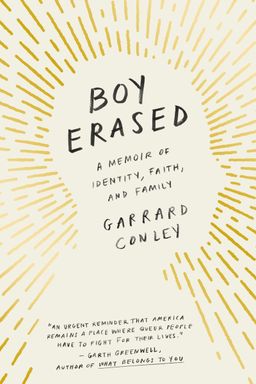
What happens when the story you’re born into no longer fits the person you become? In Boy Erased, Garrard Conley wrestles with that question through the true story of his youth in the American South, where faith, family, and sexuality collided in painful and transformative ways. Raised by Missionary Baptist parents—his father a preacher, his mother the model of Southern devotion—Conley grew up believing that salvation required perfection. But when he was outed as gay in college, that same devotion turned into a campaign to erase who he was. His memoir is a study not only of ex-gay therapy but also of what it means to love and survive within systems that demand your silence.
At its heart, Boy Erased explores the contest between inherited faith and self-discovery. Conley argues that the real sin is not being gay but believing that one must be destroyed to be loved. The book recounts his enrollment in Love in Action (LIA), one of the country’s most notorious ex-gay programs, and reveals how the scars of such conversion efforts reach far beyond the therapy room. Yet the memoir is equally about the emotional terrain of family—the tenderness of a mother who tries to reconcile doctrine with love, and the silence of a father too afraid to face complexity. The tension between literal faith and figurative truth—between the Bible’s absolutes and the ambiguity of human experience—drives the book’s central conflict.
Between God and Self
Conley’s story invites you to examine your own definitions of faith. Can belief survive if it asks you to annihilate part of yourself? Much like the spiritual memoirs of Augustine or Thomas Merton, Conley’s narrative begins with confession but ends with a radical rethinking of grace. Early chapters depict him kneeling in Arkansas churches, echoing the literal-minded verses of his father’s sermons. Each verse promised clarity, but each sermon hid unspoken tensions—between love and judgment, body and soul, parent and child. By adulthood, Conley’s prayers have turned fearful, his relationship with God warped by doctrines that equate purity with heterosexuality. This shift marks one of the central insights of Boy Erased: when faith becomes a tool of conformity, it no longer connects you with the divine but with institutional control.
Love in Action and the Mechanics of Control
When Conley’s parents discover his sexuality, they turn to Love in Action, a real organization that promises to “cure” gay people through repentance and behavioral reconditioning. Inside the program, shame is formalized. Participants attend daily “moral inventories,” chart “sinful genealogies,” and memorize doctrines that collapse addiction, abuse, and desire into one pathology. The staff preaches that through obedience, God will purge sin; defiance means damnation. Conley reveals the psychological violence of these rituals—the stripping away of agency, the forced public confessions, the requirement to script one’s identity as an ongoing failure. The irony, though, is that conformity only deepens doubt. As he submits to each rule, his thoughts become more chaotic; the clearer the institution’s language, the murkier his inner life becomes. That confusion, he realizes, is not a moral weakness but an act of survival.
Here the memoir becomes a modern echo of George Orwell’s 1984 and Foucault’s analyses of discipline. The moral bureaucracy of LIA—its charts, handbooks, and jargon—offers the illusion of order while breeding despair. Conley’s narrative structure mirrors this collapse: sequences of instruction blur into fragments of memory, as if the self is being erased not just spiritually but linguistically. “All else is distraction,” the counselors repeat. But the story, as Conley writes it, insists that distraction—imagination, reading, storytelling—is precisely what saves him. Writing becomes a counter-litany, a way to reclaim the voice that ex-gay logic tried to silence.
Mother, Father, and the Hope of Forgiveness
If Boy Erased were only an exposé of conversion therapy, it would risk despair. Instead, its power lies in the fragile empathy between Conley and his parents. His mother, Martha, is torn between fear and love—pressured by pastors but driven by maternal instinct to rescue her son. Over time she becomes his ally, acknowledging that saving her child means disobeying her church. His father, a preacher who once dreamed of leading thousands to Christ, embodies the South’s tragic conflict: he wants redemption but cannot imagine faith without control. The climax of the memoir—when Conley flees Love in Action and his mother drives him away from its gates—marks not victory but survival. The path to reconciliation remains uncertain, but it opens a space where grace might finally mean acceptance instead of erasure.
Why This Story Matters Today
Conley’s memoir extends far beyond his personal past. Around the world, religious and political movements still frame queerness as curable, a stance that weaponizes scripture against empathy. The book asks: what would happen if we believed that faith could include doubt, or that holiness could coexist with queerness? By narrating his trauma without vilifying every believer, Conley builds a bridge between worlds—a rare acknowledgment that cruelty often comes from love twisted by fear. This nuance elevates Boy Erased from witness testimony to moral philosophy. Ultimately, Conley contends that redemption is not found in repentance for who you are but in recognizing the humanity in those who tried to change you. For anyone who has ever questioned whether love and truth can coexist, Boy Erased offers a hard-won answer: only when honesty replaces shame can either survive.