
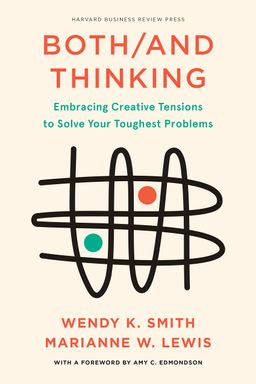
BothAnd Thinking cover

BothAnd Thinking

by Wendy K Smith, Marianne W Lewis

Both/And Thinking offers a revolutionary framework for decision-making. By shifting from an either/or to a both/and mindset, discover how to transform tough choices into opportunities. Learn to balance priorities and drive innovation without sacrifices.

The Paradox Lens: Seeing Contradiction as a Source of Insight

What if the dilemmas that frustrate you most in organizations were not puzzles to solve but energies to harness? The central argument of this volume, edited by Wendy K. Smith, Marianne Lewis, and Jonathan Schad, is that paradox is an enduring feature of organizing—the simultaneous presence of contradictions that are interdependent and persistent. Understanding paradox means rejecting either/or thinking and embracing both/and logic: opposing forces that depend on one another for vitality.

Across chapters—from philosophical theory to practical toolkits—the book builds a meta-theory around this idea. Paradox lives in the contradictions of human cognition, institutional design, and representation. It shapes how organizations innovate, sustain, and govern. By the end, you see paradox not as a managerial flaw but as the pulse of organizational life: a tension that, when understood, becomes a dynamic resource for learning, creativity, and transformation.

Core Definition and Distinctions

A paradox, as Smith and Lewis define it, is a persistent contradiction between interdependent elements. It differs from dilemmas (which end when you choose one pole) or dialectics (which seek synthesis). Paradoxes persist—they recur, morph, and drive cycles of stability and change. You see this in tensions between exploration and exploitation, stability and adaptation, or flexibility and control. Instead of choosing, you learn to sustain and balance both poles over time.

(Note: This both/and framing emerges from earlier thinkers—Benson, Poole & Van de Ven—but Smith and Lewis institutionalized it as the dominant lens in organizational theory.)

Philosophical Roots: From Logic to Eastern Wisdom

Jonathan Schad traces paradox theory back to Zeno’s puzzles, Aristotle’s law of non-contradiction, and Gödel’s logical paradoxes, showing how Western logic wrestled with contradiction as either error or proof of systemic limits. Eastern philosophies, by contrast, accepted paradox as natural harmony—Taoism’s yin-yang, Confucian balance, and Buddhism’s middle way all treat contradiction as correlative, not opposed. This cross-cultural synthesis grounds the modern paradox perspective: it teaches you to see unity in opposition, process in seeming conflict, and both sides as necessary conditions of wholeness.

Emotional and Cognitive Dimensions

Paradox is not purely intellectual—it’s emotional. Jarrett and Vince’s psychoanalytic lens exposes how anxiety, projection, and defense mechanisms (e.g., splitting or scapegoating) shape how leaders and groups enact paradox. You feel paradox before you understand it; fear often drives avoidance. Cognitive researchers like Keller and Chen show how antonymic categories (e.g., novel/useful, autonomous/controlled) prime you to see oppositions as mutually exclusive. To manage paradox well, you must cultivate metacognition—awareness of your own mental frames and the ability to reframe when opposites collide.

This emotional–cognitive synthesis is critical: paradox management means both emotional containment and cognitive flexibility—skills taught to individuals, teams, and organizations alike.

Language, Representation, and the Problem of Otherness

Several chapters (Holt & Zundel; Chia & Nayak; Cooper) reveal that paradox begins in the way language cuts the world into categories. Every label—individual, collective, stability, change—creates an excluded Other that silently co-defines it. Organizing is therefore a paradoxical act: by stabilizing practice into names and routines, you produce the very tensions you later confront. The Eastern–Western juxtaposition (Heraclitus and Lao Tzu) reinforces that paradox isn’t accidental; it’s structural to sensemaking. If you grasp this, you design representations more humbly and think in “tendencies” and “flows” rather than rigid binaries.

From Dialectics to Practice and Power

Dialectical thinkers like Hegel, Marx, and Adorno remind you that contradiction is the engine of change—but synthesis can liberate or dominate. Critical Management Studies expands this insight: paradoxes are political. Power decides which pole wins, whose logic becomes “common sense,” and whose contradictions remain hidden. Institutional paradoxes like Georgetown’s slavery legacy or Cambridge’s class rituals show that moral contradictions persist at societal scales, and confronting them requires temporal and normative reflexivity. Likewise, gender studies expose paradoxes of visibility and merit that structures reproduce even as they seek equality. Understanding paradox therefore means seeing both system power and human complexity.

Practical Translation and the Turn to Praxis

Paradox thinking moves from abstraction to action when you engage routines, rhetoric, and leadership. Practice theory chapters stress micro-actions: humor in meetings, metaphors in speech, and artifacts in routines as ways people make and manage tension. James March reframes modern paradoxes of rationality, performance, and meaning, urging leaders to accept “productive hypocrisy”—balancing plumbing and poetry. Finally, PACT polarity mapping (Charleston’s case) translates paradox into a toolkit: map poles, define upsides/downsides, monitor drift, and leverage both continuity and transformation. These methods bring paradox management into daily practice and public governance.

In the end, this volume teaches a profound reorientation: the mature organization—and the mature scholar—does not eliminate contradiction. It lives within it productively. From cognitive reframing to emotional literacy, from philosophical humility to practical mapping, you learn to hold tension as energy. Paradox, far from disorder, becomes the grammar of becoming—the continuous interplay through which organizations, and you, evolve.


Philosophical and Linguistic Roots

To understand paradox deeply, you trace its philosophical lineage. Jonathan Schad’s meta-theoretical work bridges logic, dialectics, and Eastern thought. Zeno’s and Gödel’s logical paradoxes showed internal contradictions in rational systems. Aristotle codified the law of non-contradiction—a law paradox thinkers question. Eastern philosophies meanwhile dissolve that law: Taoist yin-yang and Buddhist middle way see dualities as complementary, not adversarial. Hegel’s dialectic adds motion—contradiction as the motor of becoming—and Marx grounds that motion in material and social relations. This lineage builds the intellectual foundation for modern paradox theory.

Language and Representation

Robin Holt and Mike Zundel remind you that paradox arises from the map-territory error: when language freezes living process into labels. The moment you name “innovation,” you carve away its failures, making absence a silent companion. Bateson’s “process syntax” suggests ways of writing and diagramming that retain movement—using arcs and brackets rather than boxes. Even metaphors shape what you consider possible: calling strategy a “journey” invites exploration, while calling it “war” invites winners and losers. Language, then, is both the mirror and the maker of paradox.

(Parenthetical note: This insight parallels Wittgenstein and Whitehead, who warned that language’s structure limits what can be thought. Paradox helps you sense those limits.)

Otherness and Becoming

Robert Chia, Ajit Nayak, and Barry Cooper extend this into ontology. Every attempt to name or organize produces an “Other”—what your concept excludes. To say “stability” invokes “change”; to say “order” creates “disorder.” These excluded residues return as paradox. Process philosophers (James, Bergson, Whitehead) suggest shifting from a worldview of Being (fixed categories) to one of Becoming (continuous flow). When you think in “becoming,” paradox no longer shocks you; it merely marks the coexistence of tendencies in motion. That stance underpins modern processual research in organization studies.

East and West in Dialogue

East–West traditions show two languages for holding paradox. Heraclitus’s fragments (“in opposition there is agreement”) and Lao Tzu’s poetic ambiguity converge on one truth: contradiction is constitutive. François Jullien’s reading of Chinese thought highlights linguistic practices of suggestive, context-dependent meaning—reading what is unsaid. Combined, these traditions teach two habits: use paradoxical phrasing to loosen categories (Heraclitus), and attend to silence and relational flow (Lao Tzu). For leadership and scholarship, this means learning to think contextually, relationally, and poetically as much as analytically.

Every chapter translating these roots into practice—Holt & Zundel’s syntax, Chia’s Otherness, Smith & Lewis’s both/and framing—converges on one conviction: paradox is not an error in language or logic but life’s default grammar. Your work is to speak and act in ways that honor that grammar.


Mind, Emotion, and the Experience of Tension

Paradox starts in perception. Joshua Keller and Erica Chen’s “cognitive road map” explains how your mind constructs opposites: by sorting the world into categories and antonyms. Exploration vs. exploitation, novel vs. useful—all rely on antonymic templates. When one object fits both sides, you experience paradox. That perception triggers affect (anxiety, curiosity) and cognition (reframing or avoidance). Effective paradox thinking thus depends on metacognition—your awareness of how you create categories and how emotions bias your reasoning.

Affective Undercurrents

Jarrett and Vince’s psychoanalytic perspective deepens this by revealing unconscious responses. Paradox arouses anxiety because it threatens coherence: how can you be both autonomous and controlled? Leaders often defend through splitting (“us–them”), projection, or avoidance. Groups create social defenses (Bion’s dependency and fight/flight patterns) that sustain paradox rather than resolve it. Recognizing these defenses allows leaders to contain anxiety instead of amplifying it. The skill is not eliminating emotion but giving it a name and space.

Metacognition and Culture

Cognitive and cultural studies show that not all minds organize paradox the same way. Western analytic cultures emphasize exclusivity; East Asian holistic cultures emphasize interdependence. Keller and Chen call this “cultural metacognition”—awareness of how your culture trains you to slice reality. You can practice reframing through analogies, mindfulness, and attention-switching—skills that Miron-Spektor proves expand creative capacity. The goal is to perceive contradiction without panic and to reason both/and without collapse.

Combined, psychoanalytic and cognitive insights position paradox management as a triad of awareness, emotion regulation, and reframing. You first notice tension, then keep emotional equilibrium, then redefine the frame so both poles can coexist productively.


Dialectics, Power, and Institutional Contradictions

Dialectical reasoning transforms the study of paradox from static balance to dynamic evolution. Stewart Clegg and Miguel Pina e Cunha trace this to Hegel’s thesis–antithesis–synthesis pattern: contradiction drives motion. In organizations, this means conflicting logics provoke adaptation. Pixar’s creative tensions or Toyota’s balance of standardization and kaizen exemplify dialectical vitality. Yet following Adorno’s warning, not all syntheses are emancipatory—some produce domination. Power always shapes which pole narrates “progress.”

Critical Management and Moral Fault Lines

Critical Management Studies (van Bommel & Spicer) applies paradox to uncover ideological contradictions: meritocracy vs. inequality, emancipation vs. control. Institutions sustain paradoxes to preserve legitimacy—Georgetown’s slavery sale to save the university; Cambridge’s rituals that promise class mobility but reinforce hierarchy. These institutional paradoxes persist across time because memory and forgetting are political acts. Understanding them requires tracing how narratives justify contradictions and whose interests they serve.

Normative and Gender Dimensions

Moral paradoxes appear in economies of worth—where market, civic, and green values clash—and in gender studies, where empowerment and conformity collide. Boltanski and Thévenot’s framework shows how orders of worth produce fragile compromises (“composite objects” like CSR standards). Feminist theorists expose double binds—be assertive yet likable, visible yet safe—that organization structures perpetuate. Recognizing these paradoxes allows you to design policies that acknowledge ambivalence rather than masking bias.

Dialectics plus critical theory teach a clear lesson: paradox is not only cognitive or emotional—it’s political. Who frames the poles, who benefits from balance, and who bears the cost of contradiction define whether paradox fuels learning or reproduces power.


Creativity, Ambidexterity, and Paradoxical Leadership

At the core of innovation lies a paradox: you must be both novel and useful. Miron-Spektor and Erez call this the creativity paradox. Novelty demands divergence; usefulness demands convergence. The best ideas integrate both. Experiments show that teaching paradoxical frames (“be imaginative and practical”) boosts creativity more than emphasizing one side. Dual Pathway models (De Dreu, Nijstad) add that flexibility and persistence are complementary cognitive routes—each needs the other.

Leadership in Tension

Leaders of creative and ambidextrous organizations confront constant push–pull between exploration and exploitation. Research on paradoxical leadership (Rosing, Frese & Bausch) and ambidexterity (Tushman & O’Reilly; Birkinshaw & Gibson) shows three viable pathways: structural separation (different units), contextual integration (shared behaviors), and sequential alternation (time-based shifts). Each requires leaders who can oscillate between empowerment and discipline, looseness and structure. Mainemelis’s studies reveal that paradoxical leaders legitimize both exploration and control, fostering trust amid tension.

(Practical note: GSK’s shift from structural to contextual ambidexterity illustrates path-breaking change when environments evolve.)

Psychological and Social Processes

Creativity research shows you can design routines that manage paradox dynamically: rotate attention, mix goal types (learning and performance), and use priming examples that combine novelty and familiarity. Emotional ambivalence—curiosity mixed with doubt—predicts better creative output than certainty. Leaders cultivate such ambivalence safely by modeling humility and inquiry. March’s idea of “technologies of foolishness” captures this: create spaces for experimentation without premature judgment.

Ultimately, paradoxical leadership means performing balance as art rather than formula—what March called elegance, the tightrope between plumbing (execution) and poetry (meaning). You learn to orchestrate contradiction, not eliminate it.


Systemic Paradoxes: Sustainability, Time, and Circularity

When you scale paradox to systems, three arenas stand out: sustainability, time, and feedback. Sustainability paradoxes arise from part–whole and short–long tensions. Acting locally may harm the global, and pursuing quarterly profit may erode future viability. Firms like Patagonia and Walmart show how embracing paradox—commerce and conservation—creates new narratives that motivate change. Leaders who frame paradox openly can channel moral tension into innovation rather than denial.

Temporal Complexity

Time itself contains paradox. Organizations juggle clock time (objective, scheduled) and event time (subjective, processual), short-term responsiveness and long-term investment. Smith and Lewis argue for temporal ambidexterity—aligning both rhythms. Routines mix temporal scaffolds: deadlines for coherence and open windows for learning. The paradox lens reveals that speed and patience, immediacy and depth, can reinforce each other when managed consciously.

Circular Feedback and Learning Loops

Organizational circularity reframes cause and effect as loops. Reinforcing loops create virtuous or vicious spirals; balancing loops stabilize. Weick’s enactment theory explains how actions generate the environments that later constrain them. Recognizing loops lets you intervene systemically—adjust measurements, cultures, or narratives before feedback traps form. Senge’s “limits to growth” and “shifting the burden” archetypes illustrate how easy fixes breed long-term paradoxes. Maintaining successful loops requires mindfulness, psychological safety, and small adaptive experiments.

(Note: These systemic perspectives connect paradox theory to complexity science and sustainability research, showing paradox as an emergent system property, not a managerial anomaly.) Together they emphasize humility: progress depends on learning to live within interdependent cycles of cause, time, and value.


From Research to Education and Practice

The book closes by translating paradox theory into research method, pedagogy, and civic action. Methodologically, good paradox research requires explicitness: show the four features—contradiction, interdependence, simultaneity, persistence—and specify whether you project or elicit paradox from participants. Multi-level, multi-modal designs strengthen validity, using interviews, observations, and artifacts to triangulate. Reflexivity—acknowledging your role in constructing paradox—is essential.

Teaching as Transformation

In education, paradox functions as a threshold concept. Once students grasp both/and thinking, they can’t unsee it. Knight and Paroutis’s MBA capstone immerses learners in real exploration–exploitation tensions, blending design (creativity) and strategy (discipline). Reflection turns experience into irreversible insight: understanding that ambiguity is not failure. Teachers design learning like paradox itself—oscillating between openness and constraint, theory and practice.

Bridging Academia and Practice

Similarly, the supposed gap between scholars and practitioners is a productive duality. Following Schön and Evered & Louis, “inquiry from the inside” values practice as a site of knowledge creation. Scholar–practitioners act as translators and connectors, turning paradox into shared language across worlds. The Charleston case exemplifies this translation: Margaret Seidler and Chief Mullen used the Polarity Approach for Continuity and Transformation (PACT) to balance enforcement and community trust, mapping both poles, actions, and warning signs. It scaled to city governance, proving paradox thinking can rebuild civic systems.

For researchers, teachers, and leaders alike, the legacy is clear: paradox is not a theory to memorize—it is a practice to inhabit. Whether in analysis, classroom, or city hall, the art lies in making contradiction conscious, shared, and constructive.

Dig Deeper

Get personalized prompts to apply these lessons to your life and deepen your understanding.

Go Deeper

Get the Full Experience

Download Insight Books for AI-powered reflections, quizzes, and more.