
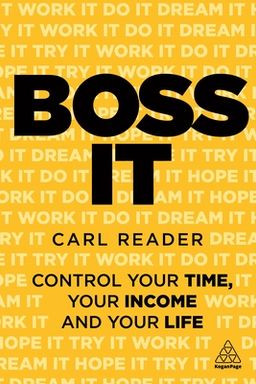
Boss It cover

Boss It

by Carl Reader

Boss It is the ultimate guide for aspiring entrepreneurs, combining practical advice and motivation to transform dreams into real businesses. Learn how to manage time, income, and life effectively, while building a sustainable and scalable business.

Boss It: Building a Business That Serves Your Life

Have you ever dreamed of being your own boss—of finally taking control of your time, your income, and your life? In Boss It, Carl Reader argues that entrepreneurship isn’t about flashy success or Silicon Valley buzzwords; it’s about building a business that works for you. Reader, a seasoned entrepreneur and business adviser, contends that anyone can start and grow a thriving business if they approach it with honesty, planning, and confidence. His mission is to demystify business ownership and show that while it’s hard work, it’s not complicated.

At its core, the book is built around a deceptively simple four-part model—Dream it, Plan it, Do it, Scale it. These four stages guide readers from the earliest spark of an idea all the way to building a self-sustaining, scalable enterprise. As Reader reminds us, most people fail not because of bad ideas, but because they get stuck in one phase, either dreaming without acting or doing without reviewing. Boss It gives you a practical roadmap to balance vision with action, passion with process.

Dream It: The Vision Comes First

The journey begins with dreaming big—and truly understanding why you want to start a business. Reader challenges readers to define success on their own terms, stripping away borrowed ideals of wealth or status. Are you in it for freedom, legacy, purpose, or creativity? By questioning these motives, you clarify what you want your business—and your life—to look like. He notes that entrepreneurs typically fall into one of several categories: passionate creators driven by love for their craft, freedom seekers craving independence, legacy builders motivated by long-term impact, and struggling survivors doing what they must to stay afloat. Knowing your type shapes how you’ll build and sustain your company.

Plan It: Turning Vision Into Strategy

After dreaming comes structure. Reader contrasts the hopeful idealism of the dream stage with the discipline needed for planning. Using tools like the SWOT (Strengths, Weaknesses, Opportunities, Threats) and PESTLE (Political, Economic, Social, Technological, Legal, Environmental) analyses, you assess your environment and prepare for reality. He insists that most valuable plans are not the ones written to please investors—they’re the ones written to make sense to you. The process of mapping out your market, setting timelines, and creating contingencies (what he calls “Plan B, C, and D”) forces you to think ahead and avoid being blindsided by circumstance. Planning, for Reader, is as much about thinking clearly as it is about writing documents.

Do It: Taking Action With Systems

Execution is where most entrepreneurs stumble. Reader warns of “creative avoidance”—the tendency to stay busy planning, posting on social media, or designing logos instead of actually doing the hard work of selling. To move forward, he stresses the importance of getting systems and processes in place early. By defining how you handle marketing, operations, customer service, and finances, you stop relying on memory or adrenaline to keep things running. Clear systems transform late-night chaos into structured growth.

This stage also includes raising funds, choosing the right business structure, setting up tools like accounting software and CRM systems, and finding those crucial first customers. Reader demystifies topics that intimidate beginners—like the difference between debt and equity funding—by presenting them in plain English. His mantra: don’t chase the glamour of investor TV shows; focus on what’s right for your business.

Scale It: Building a Self-Sustaining Company

Scaling, the final stage, is about transforming your business from a one-person hustle into an independently operating enterprise. Reader calls this the moment when your business works for you instead of the other way around. Scaling has five key models: the vision, the growth model, the financial model, the staffing model, and the leadership model. These are the essential building blocks of a business that grows strategically rather than accidentally.

Each model demands a mindset shift. You move from being the technician (doing the work) to being the leader (setting the culture and direction). You learn how to hire not just for skills but for attitude, how to finance growth responsibly, how to build teams and culture deliberately, and how to lead from the top without micromanaging. Borrowing lessons from leaders like Maslow, Herzberg, and The E-Myth’s Michael Gerber, Reader blends psychology with management practicalities.

Why It Matters

Reader wrote Boss It during a time when millions were rethinking work itself. In a post-pandemic, gig-driven economy, many crave autonomy but feel daunted by entrepreneurship. This book’s power lies in its humanity: it doesn’t idolize hustle culture but reframes business ownership as self-empowerment. Reader shows that true success is not about escape—from jobs or bosses—but about building something on your own terms. With approachable language, grounded stories, and simple but profound frameworks, Boss It gives you both the permission and the process to take control of your future.


Dream It: Redefining Success and Motivation

Carl Reader begins by stripping away the illusions surrounding entrepreneurship. Becoming your own boss isn’t about overnight wealth or internet fame—it’s about gaining control and crafting a life aligned with your personal definition of success. Reader asks you a simple yet provocative question: why do you want to start a business? Your honest answer, he argues, will shape every decision ahead.

Facing Reality Before Chasing Dreams

Reader calls this stage a wake-up moment. He outlines “five realities” that every founder confronts: you won’t immediately escape the rat race, things rarely go to plan, you’ll be pushed beyond your comfort zone, you’ll work harder than ever, and your personal and professional worlds will merge. Far from discouraging, these truths prepare you for the resilience entrepreneurship requires. He emphasizes that optimism is essential—but blind optimism is not. A robust dream lives alongside practical worry.

The Power of Motivation and Mindset

Motivation, Reader explains, is deeply personal. Some people are driven by the “carrot,” chasing goals and rewards; others are motivated by the “stick,” avoiding pain and failure. Recognizing which pattern drives you helps in setting meaningful goals. He also distinguishes between internal validation—finding satisfaction in self-progress—and external validation—seeking confirmation from others. Neither is wrong; both are tools for self-awareness. Combining your motivational style with honest reflection turns vague ambitions into committed actions.

Dreaming Big, But Dreaming for Yourself

Once you’ve grounded yourself, Reader invites you to dream expansively but authentically. Too many entrepreneurs, he says, borrow their dreams from others: they chase someone else’s status symbols—a luxury car, a million-dollar valuation—instead of goals that resonate with their values. He encourages readers to envision not only income goals but also lifestyle outcomes: time freedom, creative fulfillment, community impact. When your goals align with your values, they become sustainable rather than performative. That alignment, he argues, is the foundation of long-term motivation.

The Dream–Plan–Do–Review Cycle

To turn inspiration into progress, Reader introduces his simple yet powerful framework: Dream, Plan, Do, Review. You begin by designing the dream; translate it into a plan; act on it consistently; and then review what worked and what didn’t. Every business failure he’s witnessed, he claims, breaks down in one or more of these areas. This looping model ensures that growth is intentional, not accidental. It also mirrors Michael Gerber’s E-Myth triad of the entrepreneur (dreamer), the manager (planner), and the technician (doer)—but with an added focus on self-assessment and iteration.

“Dream It” isn’t just a pep talk; it’s a reality check wrapped in hope. It teaches that clarity precedes courage. Before writing a business plan or finding funding, you must define what success looks like—for you, not for society. Otherwise, as Reader warns, you risk building a business that becomes your new boss instead of your liberation.


Plan It: Turning Ideas into a Realistic Blueprint

Once your dream takes shape, planning transforms it from inspiration into a structured path. Reader insists that a plan is not a fancy document written for investors but a practical roadmap for you. Many would-be entrepreneurs, he notes, misuse planning either to procrastinate (“endless reworking”) or to justify unrealistic optimism. The true purpose of planning is clarity, not performance.

Beyond the Business Plan

A strong plan doesn’t start with spreadsheets—it starts with writing. Reader suggests thinking through qualitative aspects first: the story of your business, who you are, who your team is, what problem you’re solving, and why your idea matters. Only then do you translate those words into numbers: forecasts, cash flow projections, and sensitivity analyses. This approach ensures that you’re planning your actions rather than just your results.

Sensitivity Analysis and “What If” Thinking

Reader introduces the idea of sensitivity analysis—thinking through multiple “Plan Bs.” For each major assumption (like sales, expenses, or timing), he encourages you to ask: What if this takes longer? What if revenue drops 20%? What’s my backup? Running these scenarios helps you avoid panic when challenges arise. As he quips, “Instagram quotes say ‘no Plan B’; real entrepreneurs have plans B through D.”

Market and Competitor Research

Good plans rely on understanding both your audience and your rivals. Using focus groups, online observation, and interviews, Reader explains how to test product-market fit. He distinguishes between quantitative (numbers-based) and qualitative (emotional and behavioral) research. When analyzing competitors, he warns against arrogance: don’t dismiss what others do well. Even McDonald’s, he notes (referencing the film The Founder), succeeded not from superior taste but from systems efficiency. Know your competitors not to copy them, but to refine what makes your business distinct.

Frameworks for Thinking Clearly

Two analysis tools—SWOT and PESTLE—anchor your thinking. SWOT clarifies internal strengths and weaknesses versus external opportunities and threats. PESTLE forces you to consider external forces: political, economic, social, technological, legal, and environmental. Using both helps you anticipate changes instead of reacting to them. Planning, Reader emphasizes, is less about predicting the future and more about managing change intelligently.

From Document to Roadmap

Finally, your plan becomes a roadmap. Reader shows this through his fictional example, “Super Administration Services,” where a founder maps out milestones month by month—building systems, launching operations, securing funds, expanding services. By writing out dependencies (“this must happen before that”), you create accountability. It’s how big visions become executable projects. In Reader’s words, “The plan isn’t the PDF—it’s the process.”

Through planning, dreams meet reality. But rather than dulling creativity, structure liberates it. Once you know exactly what needs to happen next, you stop hesitating and start building.


Do It: Building Systems, Structure and Momentum

The “Do It” phase marks the messy middle of entrepreneurship—the shift from theory to execution. Reader describes this stage as a juggling act: you’re managing customers, cash flow, and countless details all at once. Without systems, even early success can collapse under chaos. He compares running a business without documented processes to juggling crystal and rubber balls—drop the wrong one, and something shatters.

Why Systems Matter

Reader distinguishes between systems (big-picture frameworks) and processes (the step-by-step tasks that make them work). Systems provide stability; processes ensure consistency. Together they free you from firefighting mode. He encourages entrepreneurs to see processes not as bureaucracy but as freedom: freedom from forgetting steps, losing customers, or relying on memory. Practical examples include creating checklists for client onboarding or documenting how customer inquiries are handled.

Measuring What Matters

Every system should have a single key performance indicator (KPI) that signals success. Reader breaks them down simply: for finance, track profit, gross margin, and overheads; for staff, track engagement and turnover; for operations, measure throughput and error rates; for marketing, monitor lead sources and pipeline value. The danger is measuring everything and focusing on nothing. Simplicity wins.

Documenting Processes

To make processes teachable, Reader advocates using checklists and flowcharts before fancy software. He gives an example process—handling a customer support request—that includes steps like acknowledging receipt, logging it in a CRM, following up, and creating a knowledge base entry. Even this simple exercise often reveals opportunities for automation (e.g., email templates, ticketing systems). The rule: write it down before you digitize it.

The Operations Manual: Your Business Bible

Eventually, all processes live inside an operations manual—a dynamic guide to running your company. Reader likens it to a wiki or intranet containing every procedure, from opening the office to managing clients. In franchises like McDonald’s, he notes, the manual is what creates consistency at scale. Your small business deserves the same rigor, even if it’s just you for now. A living manual turns tacit knowledge into transferable assets.

Reader’s advice here echoes classic productivity thinkers like David Allen (Getting Things Done): systems don’t stifle creativity—they protect it. Once you document routine work, your mental energy can focus on innovation and relationships. “Do It,” then, is about building habits that make success repeatable, not accidental.


Find Customers and Build Sustainable Marketing

Reader moves next to the lifeblood of any business: finding and keeping customers. He insists that marketing isn’t mysterious—it’s about understanding people, not algorithms. At the heart of this is your customer avatar: a deep, almost cinematic picture of your ideal client’s wants, habits, and personality. By answering his long list of quirky questions (“What car do they drive? What’s their neighbor’s wedding outfit?”), you learn to think like your market, not just sell to it.

Choosing Your Niche

Reader tackles the perennial “should I niche down?” debate. His answer is pragmatic: yes, you should define a target market, but that doesn’t mean excluding anyone. Like Waitrose versus Poundland, every brand targets with clarity but still serves any paying customer. Knowing your niche clarifies tone, design, and experience.

Direct vs. Indirect Marketing

He distinguishes direct marketing (actions linked to immediate sales, like paid ads) from indirect marketing (credibility builders like branding or PR). Most small businesses, he says, err by focusing entirely on one. A stylish logo won’t sell if no one sees it; but aggressive ads without a professional presence feel untrustworthy. The trick is balance—ensure every marketing tactic has a measurable goal and a brand layer to support it.

Marketing Options, Simplified

Reader surveys both traditional and digital methods: SEO, paid search, social media (organic and paid), influencer campaigns, PR, networking, events, and direct mail. His key message: no method is dead if it works. He even cites old-fashioned direct mail as a 2008 success story when everyone else shifted to email. The real value comes from testing, tracking, and refining. He redefines modern marketing as H2H—human to human—because people buy from people, not platforms.

Creating a Marketing Plan

Marketing plans should be simple: a table listing each monthly campaign, its cost, planned outcomes, and return on investment. Reader’s example of a leaflet drop tracks actual spend against profit, exposing hidden costs like design and distribution. He warns that a plan unused is worse than none at all—clarity only helps if you apply it. By treating marketing as an organized experiment, you replace guesswork with learning.

For Reader, marketing is action tied to empathy. Talk to real humans, measure results, and adapt. In a noisy world, the quiet consistency of understanding your customers beats flashy gimmicks every time.


Raising Funds and Managing Cash

No matter how inspired your vision, Reader insists, cash flow determines survival. He demystifies the funding landscape in plain language, contrasting debt (borrowing money you repay with interest) and equity (selling ownership in exchange for investment). Each has trade-offs: debt preserves control but adds pressure; equity shares risk but dilutes ownership. The right choice depends on your temperament and business model.

Forms of Debt Funding

He outlines several types: conventional bank loans and overdrafts, invoice and stock financing (unlocking working capital), leasing for equipment, and peer-to-peer (P2P) lending, which often carries higher rates due to risk. Reader stresses that “good debt” funds growth assets—machinery, marketing, systems—while “bad debt” funds luxury or unsustainable spending.

Paths to Equity Funding

Equity ranges from simple arrangements (a parent investing for 25% ownership) to venture capital rounds requiring global scalability. Reader contrasts TV depictions like Shark Tank with reality: most equity deals are quiet partnerships built on trust and clear contracts. He introduces key documents like shareholder agreements covering dividends, voting rights, and exit terms—reminding readers always to seek legal advice before signing anything.

Preparing a Winning Business Plan

To secure funding, you need a concise, human-readable plan: a mix of storytelling (“who we are, what we believe”) and numbers (profit and loss, cash flow, balance sheet forecasts). Reader explains what funders look for: banks seek repayment ability; investors seek scalability and alignment. Tailor your pitch to what each values. Know your financials fluently—nothing kills credibility faster than blank stares at your own margin numbers.

The Big Day

When meeting potential funders, Reader’s advice feels almost parental: be early, be prepared, and dress respectfully. Own your numbers, present confidently, and don’t jump at the first offer. He warns that “a personal banking relationship won’t sway a business loan,” reinforcing his central message: professionalism and clarity beat connections. Above all, borrow or sell equity only under terms that serve both your business and your peace of mind.

His tone throughout is pragmatic and empathetic. Money is a means, not the mission. The entrepreneur’s goal is not endless fundraising—it’s building a stable foundation that funds freedom.


Scaling and the Five Models of Growth

Reader dedicates the book’s final section to what he calls the “scaling jigsaw”: transforming your business into one that grows without breaking. Scaling, he stresses, is not mandatory—it’s optional. But if you choose it, do it consciously. Each model—vision, growth, funding, staffing, and leadership—forms an interlocking piece of a sustainable enterprise.

Vision Model

Vision answers why you’re scaling at all. Reader asks probing questions: What difference do you want to make? Are you scaling for impact, for sale, or for lifestyle? Clarity prevents burnout and misalignment with investors or staff. A mismatched vision, he notes, destroys more businesses than bad strategy does.

Growth Model

There are multiple growth paths—organic (steady customer expansion), strategic partnerships, franchising, mergers and acquisitions. Each carries distinct risks and rewards. For example, franchising trades direct control for rapid reach; acquisitions generate market share but can import cultural problems. Success depends on choosing the model that fits your industry and personality, not fashion.

Funding Model

At scale, Reader revisits funding with more sophistication: convertible notes, mezzanine finance, crowdfunding, and later-stage venture rounds (Series A–C). His Amazon case study illustrates the logic of reinvesting rather than seeking profit too soon. For high-growth companies, “losses” are often investments in market dominance. But for lifestyle businesses, sustainable cash flow might be the better win. The key is aligning capital with control.

Staffing Model

Scaling means adding people thoughtfully. Reader guides owners through building an organization chart of the future—even if many roles remain vacant for now. Draft role descriptions before you hire; plan cultural fit before skill requirements. He emphasizes hiring for attitude, not résumé, and identifying when to outsource versus hire. As the team grows, management systems and appraisals become your new processes to document.

Leadership Model

Ultimately, leadership sustains what systems start. Quoting the saying “culture eats strategy for breakfast,” Reader teaches leaders to design culture intentionally. Culture, he clarifies, is not beanbags or ping pong tables; it’s shared identity, values, management style, and decision-making norms. He narrates how at his own firm (d&t) they built values like “Professional, Caring, Passionate, Innovative” into every process—from hiring to innovation reviews. Leadership, in his view, means setting direction and then getting out of the way.

Scaling, he concludes, is about trust—trusting your team, your systems, and your own growth. True success is measured not by how big you get, but by how free you become.


Leading and Letting Go

In his final reflections, Reader turns personal. After building his business and mentoring others, he faced his own test: stepping back. In “From CEO to Chair,” he describes transitioning from daily control to strategic guidance. This shift, he admits, was harder than founding the business itself.

Making Yourself Redundant—On Purpose

Real leadership, Reader discovers, means empowering others to lead—and resisting the urge to rescind authority when they decide differently. He warns founders against undermining their boards or managers, even when they disagree. “Unless the cost of their decision is a million-pound risk, stay silent,” he advises. Ego, not incompetence, is often the silent killer of maturing companies.

Creating Distance to Enable Growth

Reader describes the deliberate distance a founder must create after scaling: no bypassing the chain of command, no casual “end runs” around managers, no overriding team culture. It’s psychological as much as structural—founders must detach from identity as “the doer” and embrace the role of steward. His honesty about the loneliness of letting go adds depth rarely found in business manuals.

Serving, Not Steering

In his chairman role, Reader reframes leadership as service. His job now is to mentor executives, create long-term vision, form external partnerships, and “find seeds for others to plant.” True fulfillment, he realizes, comes not from clinging to power but from watching others flourish. It’s a completion of the book’s opening promise: controlling your time and life by building systems so effective that you’re no longer the bottleneck.

Reader’s journey—from technician to entrepreneur to leader—embodies the full Boss It philosophy. Freedom, in the end, is achieved not through control but through trust.

Dig Deeper

Get personalized prompts to apply these lessons to your life and deepen your understanding.

Go Deeper

Get the Full Experience

Download Insight Books for AI-powered reflections, quizzes, and more.