
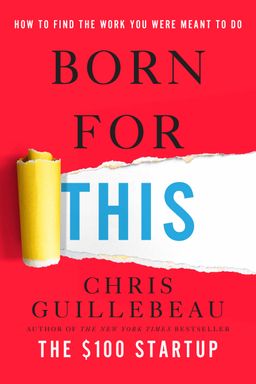
Born For This cover

Born For This

by Chris Guillebeau

Born For This guides you to discover the career of your dreams by aligning your passions and skills for financial success. Learn how to navigate non-traditional career paths, conquer fears, and create fulfilling work while maintaining stability. Transform your career and life with strategies that inspire growth and innovation.

Finding the Work You Were Born to Do

What if loving your work didn’t have to mean sacrificing financial security—or vice versa? In Born for This, Chris Guillebeau argues that you don’t have to choose between passion and paycheck, joy and stability. His central claim is simple yet profound: you can design a career that feels like you’ve won the “career lottery” by finding the intersection between what you love, what pays the bills, and what you do best. That sweet spot, he says, is where you’ll find the work you were born to do.

Guillebeau—a lifelong traveler, entrepreneur, and author of The $100 Startup—offers stories, strategies, and tools to help you escape the wrong career, take smart risks, and ultimately create a life that combines freedom, meaning, and income. Whether you dream of promotion in a corporate job, starting a business, or juggling multiple interests, the book invites you to stop settling for mediocrity and start living intentionally.

Rethinking the Career Lottery

Many of us believe that finding a dream job depends on luck—like hitting a career jackpot. But Guillebeau flips this script. He shows that while the real lottery is random, the career lottery is not. You increase your odds by learning what matters most to you and taking systematic steps to align joy, money, and flow. Real career winners, he writes, don’t follow conventional scripts—they create their own. They challenge assumptions about what “real jobs” should look like and craft paths that reflect both who they are and what they value.

He introduces a set of new terms to describe this shift. Escapology is the art of exiting a job that doesn’t meet your needs. Serially resetting means intentionally changing course every few years to stay aligned with growth. And side hustling is earning money from passion projects apart from your primary job. Together, these ideas form a new language for career independence.

The Joy-Money-Flow Model

At the heart of Born for This is the Joy-Money-Flow Model. Guillebeau proposes that work satisfaction comes from balancing three non-negotiables: joy (work that makes you happy), money (sustainable income), and flow (activities that fully engage your skills). A career that meets only one or two of these criteria might keep you afloat, but it won’t make you thrive. He explains that people often tolerate one imbalance—like joyless work that pays well—but long-term success demands finding all three.

Through stories like Angela May, an engineer who left corporate drudgery to design sustainable products, and Steve Harper, a production manager who rebuilt his burned-out life with better boundaries, Guillebeau shows this model in motion. You don’t need a lucky break; you just need to understand your equation for joy, money, and flow—and then rearrange your professional life around it.

Flipping the Career Script

Traditional career advice teaches us to climb corporate ladders, stick to one niche, and never give up. But Guillebeau contends that those scripts are outdated. The modern path calls for experimentation, side projects, and periodic reinvention. Instead of “working your way up,” he says, “level up”—build new skills, reimagine your role, and make deliberate transitions that bring you closer to your best work.

He argues that success today isn’t about seniority or specialization—it’s about adaptability. People like Leon Adato, who turned a tech role into his dream position as a “head geek” at SolarWinds, and Sam Hunter, who reinvented herself from an IT professional to a thriving quilt-pattern designer, embody what Guillebeau calls career escapology: choosing freedom through skill mastery and creative independence.

Why This Matters Now

We live in a time when traditional job security has vanished, yet opportunities for self-designed work have never been greater. Guillebeau recognizes this paradox and positions his book as a survival guide for the new economy. His stories—drawn from entrepreneurs, employees, and artists in dozens of fields—illustrate that meaningful, well-paid work is available to anyone willing to think strategically, experiment, and persist.

Ultimately, Born for This isn’t about chasing a single destiny—it’s about designing a career ecosystem where passion and practicality coexist. Whether you’re escaping your cubicle, reimagining your current role, or juggling multiple interests, the takeaway is clear: you don’t have to settle or suffer. You can, as Guillebeau challenges you to, create the work you were meant to do.


The Joy-Money-Flow Equation

Imagine waking up excited for work, knowing that what you do brings you joy, supports your bank account, and taps into your natural abilities. That’s what Chris Guillebeau calls the Joy-Money-Flow trifecta—the center of gravity for a fulfilled career. Unlike typical “follow your passion” advice, this model emphasizes equilibrium: joy fuels your motivation, money provides stability, and flow ensures mastery. If one element is missing, you’ll likely end up stressed, broke, or bored.

Joy: The Spark That Keeps You Going

Joy is the emotional resonance of meaningful work—the feeling that what you do matters and delights you. It doesn’t mean every moment is fun (there’s still bookkeeping), but it means the core of your job excites you. For engineer Angela May, joy wasn’t in oil-and-gas engineering but in sustainable design. When she traded her uninspiring corporate job for product development that reduced waste and improved lives, she discovered renewed purpose without sacrificing income.

Money: The Oxygen of Your Career

Guillebeau doesn’t romanticize passion at the expense of practicality. “Economic imperative” matters: bills need paying, and stress from scarcity kills creativity. The perfect career supports your desired lifestyle—even if that means redefining what “enough” means. As he notes, many people think they have passion problems when they actually have money problems. Solving income stability first often unlocks freedom to explore deeper meaning.

Flow: Doing What You’re Exceptionally Good At

Flow is the often-overlooked pillar—what makes your work feel effortless and absorbing. It’s when hours vanish because you’re immersed in your strength zone. For author and entrepreneur Chris himself, flow showed up in writing, travel, and connecting dots between business models and personal freedom. Flow overlaps with the concept that psychologist Mihaly Csikszentmihalyi made famous, but here it’s practical: focus on what others find difficult but you find natural, and you’ve found your leverage point.

Finding Your Intersection

Guillebeau offers a tool to map your current state. If your work is joyful but doesn’t pay, you have a hobby. If it pays but drains your spirit, you have a job. If you’re skilled but unfulfilled or unpaid, you have frustration. The zone of all three—joy, money, and flow—is the “career lottery” ticket. Most people move toward it incrementally through reflection, feedback, and experimentation rather than dramatic leaps.

He closes this model with a reminder: balance shifts over time. Life stages, financial needs, and passions evolve. Regularly re-evaluating your balance ensures you stay aligned. As one engineer in the book put it, “Finding my dream job isn’t one-and-done—it’s a continuous process of rebuilding the mix.”


Flipping the Script on Work

For decades, we’ve been told to climb corporate ladders, specialize narrowly, and stick out tough jobs for security. Chris Guillebeau challenges these outdated scripts head-on. In his view, “playing by the rules” is exactly what keeps people trapped in passionless work. To find meaningful success, you have to rewrite the script—experiment, adapt, and define success on your own terms.

Outdated Scripts and Their Replacements

  • Old Script #1: Work up the hierarchy until you reach the corner office.
    Revised: Create your own version of leadership and lifestyle—even in smaller roles, if they fit your life better.
  • Old Script #2: Pick one niche and never switch.
    Revised: Diversify skills; the most interesting people are often “multipotentialites.”
  • Old Script #3: If you miss one opportunity, it’s gone forever.
    Revised: Opportunities are like buses—another one always comes, as Richard Branson says.
  • Old Script #4: Work means 40 hours a week, in an office, during fixed hours.
    Revised: The right work happens anywhere, at any pace, when results—not hours—define value.

Leveling Up, Not Settling Down

For Guillebeau, “flipping the script” means breaking incrementalism. A small raise or perk won’t fix a broken job. Instead, aim to level up: take transformative action that permanently changes your trajectory. He uses the metaphor of winning the “career lottery” through deliberate experiments—side hustles, new projects, networking—that create leverage for the next leap.

Think Like a Janitor, Not a CEO

Guillebeau argues against mimicking icons like Elon Musk or Steve Jobs. Instead, think like the janitor—the person who understands how everything functions and connects. The janitor adjusts, innovates, and solves real problems from the ground up. That mindset, not big vision alone, allows you to change your environment instead of being ruled by it. It’s practical entrepreneurship inside any career.

Ultimately, flipping the script means permission. You can remix your job, redefine success, and build a unique career architecture that prioritizes meaning over convention. As Guillebeau reminds, “You don’t have to work your way up—you can work your way across, around, or out.”


Smart Risk Taking and Career Insurance

Taking risks doesn't mean leaping blindly. Guillebeau teaches a calculated approach—learning from casinos and entrepreneurs who beat the odds by improving their position. He reframes luck as something you design: by combining good decisions, backup plans, and a diverse safety net, you can pursue bold moves without fear of ruin.

Plan A, Then Plans B–Z

Vanessa Van Edwards’s story captures this mindset. Instead of waiting for referrals, she cold-pitched Creative Live with a subject line—“Here’s how I’ll make you a lot of money”—and got her dream collaboration. But her smart twist was having backup plans. If her pitch failed, she’d use her network next. Her “if this, then that” method ensured progress, not paralysis. Backup plans don’t make you timid; they make you unbreakable.

Career Insurance for the Brave

To take bigger swings, secure your foundation. Guillebeau’s formula for career insurance includes three musts: diversify income, spend less than you earn, and treat relationships as assets. By having multiple income streams (side hustles, savings, and strong professional relationships), you free yourself to take risks that others fear.

The Right Way to Bet on Yourself

In the Bellagio Casino, Guillebeau placed an $81 bet on red to test his theory about odds. He won $50—small gain, big lesson. Like career risk, the point wasn’t gambling but structure: bet wisely, limit losses, and celebrate wins. “Luck favors those who prepare,” he writes. The smartest way to “beat the house” of conventional employment is not to avoid risk but to engineer it in your favor.

This mindset aligns with entrepreneurial thinkers like Nassim Taleb, who advocate for “antifragility”: build a system that grows from volatility rather than collapses under it. Guillebeau’s answer—career insurance—turns uncertainty into opportunity, letting you take leaps with a net, not off a cliff.


Mastering the Art of Skill Transformation

Guillebeau warns that escaping a bad job requires more than quitting—it demands retooling the skills you already have and learning ones that make you irreplaceable. Everyone is an expert in something, he writes, even if they don’t realize it. The trick is to identify, repackage, and continually enhance those capabilities to build new opportunities.

Hard and Soft Skills

He differentiates between hard skills—job-specific abilities like coding, design, or engineering—and soft skills such as communication, negotiation, and follow-through. The latter, he argues, are the ultimate career power tools. Citing comedian Steve Martin’s motto, “Be so good they can’t ignore you,” Guillebeau reminds us that persistence, competency, and reliability often open doors faster than sheer genius.

Case Studies in Reskilling

Daniel Vlcek’s story embodies this principle. Fired from a Colorado property management company over a trivial disagreement, he built a new firm using the same skill set—maintenance, organization, and customer care—but redesigned around freedom and flexibility. His success stemmed from skill transfer, not starting from zero. Similarly, a self-taught yoga instructor in the book mastered teaching by watching DVDs and practicing—proof that learning can be self-driven if you care enough to apply it.

Resign Your Job Every Year

To keep evolving, Guillebeau suggests a radical ritual: “resign” every year—literally or metaphorically. Commit to quitting unless the current role still excites and challenges you. This practice forces continual reflection and prevents you from sleepwalking through your career. As he puts it, people stay stuck not because they fail once, but because they stop growing afterward.

In essence, every career step—whether promotion, pivot, or side hustle—should be a deliberate act of skill innovation. The more adaptable your abilities, the more control you’ll have over your work—and your freedom.


Building and Monetizing Side Hustles

Side hustles are Guillebeau’s favorite tool for freedom: small experiments that generate income, teach new skills, and test ideas without quitting your job. He insists that everyone—employees and entrepreneurs alike—should earn at least one stream of independent income. It’s career insurance, creative outlet, and laboratory rolled into one.

Why Side Hustles Matter

Side hustles aren’t about “working more.” They’re about working differently. They help you diversify income, validate business ideas, and rediscover autonomy. When you get paid separately from your employer—whether from selling crafts, consulting, or digital products—you start thinking like an owner, not an employee. That mindset shift often leads to greater opportunities down the road.

Types of Side Hustles

  • Sell something: Like Amber, a nurse who earns $450/month via Etsy fabric art sales.
  • Provide a service: Like Harry Campbell, the Uber driver who built The Rideshare Guy blog into a consulting business.
  • Be a middleman: Affiliate marketers connect buyers and sellers (Marie Forleo’s B-School and Amazon affiliates are examples).
  • Join sharing platforms: From renting rooms on Airbnb to completing errands via TaskRabbit, micro-entrepreneurs earn flexible cash through access-based marketplaces.

From Side Gig to Full-Time Freedom

Guillebeau outlines a 19-day hustle plan and even a 24-hour “micro-product” test to move ideas from concept to cash quickly. The goal: win small, fail fast, and learn cheaply. Benny Hsu’s story of making $101,971 selling T-shirts through Facebook proves it works—after 21 failed designs, his 22nd paid off big.

The lesson is scalability: once a project consistently earns while you sleep, you’ve built leverage. And even if a side hustle never becomes full-time, it adds resilience. As one reader put it, “Having something I made put money in my account gave me confidence and hope.”


Becoming Indispensable at Work

Not everyone wants to quit their job, and Guillebeau acknowledges that. In fact, he argues the best employees think like entrepreneurs. The “self-employed employee” designs freedom within an organization by becoming indispensable—creating so much value that flexibility follows them. Leon Adato’s story illustrates this: he turned a tech role at SolarWinds into his dream job by aligning his strengths with company goals and continually innovating his responsibilities.

Four Strategies to Become Indispensable

  • Keep the trains running: Take ownership of consistency and follow-through even when leaders don’t.
  • Eliminate rent-seeking: Cut busywork that doesn’t add value; measure success by outcomes, not appearance.
  • Advance company goals beyond your role: Tie personal performance directly to the mission and bottom line.
  • Adapt fast: When your job risks obsolescence, reinvent it before someone else does.

Sabbaticals, Boundaries, and Proof of Concept

Even if you stay in one company, you can transform your work by designing short “sabbaticals”—temporary projects, rotations, or rest periods that reinvigorate your creativity. At Google, Rachael O’Meara took a three-month unpaid break and returned to a new, more fulfilling role. Similarly, entrepreneur-employee Chiara Cokieng retrofitted her consulting experience into analytics for a startup by simply doing the work first—providing proof of concept before getting the position.

The takeaway: freedom at work belongs to those who continually prove their worth. Build your case, create value, and ask for what supports both you and the mission. When you show initiative, authority stops being granted and starts being assumed.


Do More Than One Thing—The Multipod Life

What if you’re not built to specialize? Guillebeau embraces people with many interests—the multipotentialites, or “multipods.” Rather than viewing eclectic passions as confusion, he sees them as creative advantage. The future, he suggests, belongs to multipods who use varied skills to solve complex problems and design integrated lives.

Multipod Models of Work

  • Umbrella Model: Unite multiple interests under one theme (like a sustainability consultant who’s also an educator).
  • Parallel Model: Handle distinct roles simultaneously, like the police officer who also teaches yoga.
  • Supportive Job Model: Keep one stable role to fund passion projects (Einstein did this as a patent clerk).
  • Serial Model: Rotate through jobs and side hustles seasonally; finish one mission, begin another.

Workshifting, Not Multitasking

True multipods don’t multitask—they workshift: focus on one thing deeply, then shift attention fully to the next. Whether you use calendar-based scheduling like Elon Musk or seasonal cycles like a Canadian landscaper who writes in winter, the secret is intentional alternation. This keeps energy high and mediocrity low.

Permission to Refuse the Box

For people like Devin Gadulet, who’s moved from antique dealer to poker player to travel writer, variety is vitality. Guillebeau urges readers to ignore anyone insisting you “pick one passion.” Life is long and work evolves. Multipods thrive because they continually cross-pollinate ideas. “You don’t need to find your one true calling,” he writes. “You can create a calling that fits all your truths.”


Knowing When to Quit and When to Pivot

“Never give up” might sound inspiring, but Chris Guillebeau calls it dangerous advice. The smartest winners know when to walk away. Whether you’re an athlete like Lewis Howes transitioning from sports to entrepreneurship or Michael Jordan returning from baseball to basketball, giving up at the right time is a strength, not a failure.

Selective Quitting as Strategy

Quitting well means understanding your opportunity costs. If something isn’t working and you don’t enjoy it, it’s time to stop. If it’s working but joyless, or joyful but unsustainable, start building an exit plan. Guillebeau calls this “career detox”—regularly shedding obligations and habits that drain time or yield diminishing returns.

Fight FOMO, Ignore Sunk Costs

Fear of missing out and sunk-cost fallacy keep us stuck. His grocery line analogy nails it: just because you’ve spent time in one line doesn’t mean it’s the best one. Step into the new line when a better opportunity opens. Likewise, quitting early on low-stakes projects accelerates learning; delaying only deepens regret.

Reset in Five-Year Missions

Inspired by Spotify founder Daniel Ek, Guillebeau advocates “five-year missions.” Every few years, reassess: are you still growing, learning, and excited? If not, pivot. Time-bound commitments prevent lifelong drift and encourage renewal. Winners, he insists, “give up all the time—just not on themselves.”

The final idea of Born for This is liberation: you can quit jobs, projects, or even dreams without guilt if they no longer serve your joy, money, and flow. Letting go, paradoxically, is the surest path to keep winning your career lottery.

Dig Deeper

Get personalized prompts to apply these lessons to your life and deepen your understanding.

Go Deeper

Get the Full Experience

Download Insight Books for AI-powered reflections, quizzes, and more.