
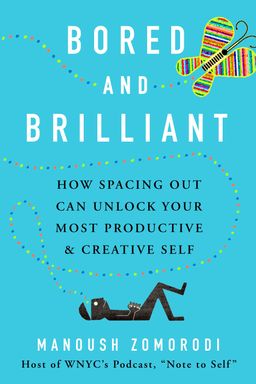
Bored and Brilliant cover

Bored and Brilliant

by Manoush Zomorodi

Bored and Brilliant reveals how embracing boredom in a world full of digital distractions can unlock your creative potential. By understanding the power of unplugging, this book offers actionable strategies to enhance creativity, productivity, and mental well-being, helping you navigate modern technology''s challenges.

Boredom as a Gateway to Brilliance

When was the last time you felt truly bored—and didn’t immediately reach for your phone? In Bored and Brilliant, Manoush Zomorodi asks this question to challenge the way we live in our hyperconnected world. She argues that boredom isn’t a curse but a powerful catalyst for creativity, reflection, and personal growth. Our fear of boredom, amplified by technology’s constant stimulation, is robbing us of the mental space our brains need for deep thinking and ingenuity.

Zomorodi contends that being bored allows the mind’s “default mode network” to activate—a part of the brain responsible for daydreaming, autobiographical planning, and creativity. When we quiet external stimuli, our brains wander productively, forming new connections and insights that define human originality. Yet, in the era of smartphones, this essential mental activity has been drowned out by notifications and endless scrolling. The author’s central claim is audacious but resonant: if we want to be truly brilliant, we must first relearn how to be bored.

During her own creative burnout as a journalist and mother, Zomorodi discovered that her best ideas came when she slowed down—during long, tech-free walks pushing a stroller under the Brooklyn sun. That personal revelation inspired her to create The Bored and Brilliant Project, a week-long challenge that helped thousands (from executives to high school students) recalibrate their relationship to technology. Her goal wasn’t to promote digital abstinence, but to question how we use our devices, balancing productivity with peace and creativity.

The Case Against Constant Stimulation

Our screens have become surrogates for thought. They fill every idle moment—waiting for coffee, standing in line, commuting to work—leaving no room for the mind to wander. Neuroscientists explain that during these periods of distraction, we silence our brain’s reflective functions. Instead of nourishing imagination, we’re training our minds to crave the dopamine hits that accompany every notification, text, or social media ‘like.’

In the post-industrial and digital age, efficiency and connection have replaced contemplation. Zomorodi highlights how society has pathologized boredom, treating it as an ailment to be ‘cured’ with entertainment. Yet researchers like Dr. Sandi Mann and Dr. Jonathan Smallwood (from the University of York) prove the opposite: unknown ideas emerge when we let ourselves “space out.” In her view, boredom isn’t mere inactivity—it’s the birthplace of reflection, empathy, and innovation.

From Smartphones to Self-Awareness

Zomorodi’s discovery led to a profound question: can we modify our tech habits to rediscover brilliance? Through seven structured challenges, she guides readers to observe their phone use, keep devices out of sight while in motion, abstain from taking photos, delete habit-forming apps, take digital ‘fakecations,’ and engage in mindful observation. Each task dismantles a layer of technological dependency and reawakens boredom’s creative potential. Participants in her experiment reduced their phone usage, felt more focused, and reconnected with the world around them—even if only by a few minutes a day.

“You have to let yourself be bored to be brilliant.” —Manoush Zomorodi

Rediscovering the Human Imagination

The book connects boredom to profound neurological and philosophical truths. When our minds wander, the default mode network lights up—a system linked to imagination, memory, and moral reasoning. It’s the same mechanism that allowed artists like J.R.R. Tolkien to dream up The Hobbit during a moment of tedium, or Steve Jobs to believe “having nothing to do can be wonderful.” Zomorodi wants you to see boredom as a fertile ground for brilliance, not something to avoid.

In a world that prizes hyper-efficiency, Bored and Brilliant offers a countercultural manifesto: reclaim your downtime. Doing “nothing” is not wasting time—it’s feeding your mind. The author urges you to step back, unplug, and allow your thoughts to percolate. Importantly, the book isn’t anti-technology—it’s about redefining our relationship to it. The goal isn’t to reject innovation but to engage with it consciously, transforming technology from a master into a servant.

Why It Matters Today

The implications of Zomorodi’s argument extend beyond personal productivity. Schools, workplaces, and entire economies depend on creativity, yet they often sabotage it through constant connection. Studies she cites—from the Bank of England to Columbia Business School—show that innovation, emotional intelligence, and deep thinking falter when we’re perpetually distracted. Boredom, weirdly enough, is an antidote to this crisis. It invites solitude, curiosity, and empathy—the building blocks for both emotional health and original thought.

Taken together, Bored and Brilliant is less about retreating from the digital world than about re-entering it with awareness. It’s a call to build tolerance for tedium, cultivate wonder, and rediscover the imaginative power that lies dormant beneath notifications. Zomorodi’s message is urgent yet hopeful: boredom is not emptiness—it’s the doorway to brilliance. If you want to think deeper, feel better, and create more, start by doing nothing at all.


What Boredom Really Does to Your Brain

What if boredom is actually your brain’s secret performance enhancer? In Bored and Brilliant, Zomorodi reveals the neuroscience behind mind-wandering and challenges our cultural fixation on busyness. Far from being idle, boredom activates brain regions that connect memories, emotions, and imagination—forming the foundation for creativity.

The Default Mode Network

Neuroscientist Marcus Raichle discovered the brain’s “default mode network” (DMN)—the system that hums when you’re not focused on any task. Instead of powering down, your brain uses nearly 95% as much energy as when deeply concentrating. During boredom, the DMN helps you connect past experiences with future scenarios, imagine possibilities, and even process social and emotional understanding. Jonathan Smallwood of the University of York describes mind-wandering as “the crux of what makes humans different from less complicated animals.”

Mind-Wandering and Creativity

Dr. Sandi Mann’s experiments illustrate boredom’s power. Her participants copied numbers from a phone book—a task purposely dull—before performing creativity tests. Those who endured the most boring version produced the most inventive ideas, even turning paper cups into earrings or musical instruments. Mann concluded that boredom sparks creativity by forcing your mind to wander and connect disparate ideas. When your surroundings fail to stimulate you, your imagination compensates.

The Right Kind of Daydreaming

Not all daydreams are equal. Psychologist Jerome Singer defined three types: poor attention control (anxious distraction), guilty-dysphoric (negative rumination), and positive-constructive (optimistic imagination). Zomorodi argues that healthy boredom activates the positive-constructive kind, where the mind plays freely and plans ahead. This “autobiographical planning” lets you imagine future goals and design steps toward them. In contrast, technology-driven overstimulation keeps you locked in poor attention or guilty loops, depriving you of clarity.

“When your brain wanders, you’re not wasting time. You’re connecting the dots of your life story.”

Balancing Wandering and Focus

Too much daydreaming can tip into unhappiness. Harvard researchers Matthew Killingsworth and Daniel Gilbert discovered that people whose minds frequently wander are less happy—but only when their thoughts turn negative. The trick, Zomorodi explains, is intention: use mind-wandering as reflection, not escapism. She compares boredom to smartphones—it’s neither good nor bad; its effects depend on how you use it. Channel the wandering toward creative insight, not regret or anxiety.

Your Brain Needs Boredom

Boredom helps regulate your goals. Philosopher Andreas Elpidorou calls it a “regulatory state,” pushing you away from meaningless tasks toward more fulfilling ones. Without boredom, you’d stay trapped in mediocrity because nothing would signal you to change course. The discomfort you feel when you’re bored is actually evolution’s way of keeping you aligned with your deeper values. Zomorodi reframes boredom not as a void, but as a compass pointing you toward brilliance.


Digital Overload and Its Discontents

Modern life has turned our brains into overstimulated machines. Zomorodi’s chapter on digital overload exposes how smartphones hijack our attention and reshape our mental habits. Drawing on psychology, neuroscience, and vivid stories—from pedestrians texting through red lights to adults losing the ability to read books—she paints a picture of cognitive chaos.

The Dopamine Trap

Our phones exploit dopamine, the neurotransmitter of anticipation. Scott Barry Kaufman calls dopamine “the mother of invention” because it fuels curiosity and risk-taking. Yet apps use it against us. Every ping or ‘like’ triggers a mini rush, making social media as addictive as gambling. Golden Krishna, a UX designer, notes wryly that only drug dealers and technologists call their customers “users.”

From Addiction to ADHD

The story of Cynan Clucas—a British digital executive diagnosed with adult ADHD—illustrates how technology mimics cognitive disorders. Clucas outsourced his mind to apps, calendars, and smartphones until his focus collapsed. Psychologist Michael Pietrus explains that excessive screen time impairs executive functioning, the “orchestra conductor” of the brain. While digital use doesn’t cause ADHD, it can emulate its symptoms: forgetfulness, distraction, and poor time management.

The Shocking Study

University of Virginia psychologist Tim Wilson asked students to sit alone for fifteen minutes with nothing but their thoughts—and the option to self-administer electric shocks. Many chose pain over boredom. Zomorodi uses this unsettling experiment to show how intolerant we’ve become of silence. In a world of infinite distractions, solitude feels unbearable.

Losing the Ability to Read Deeply

The internet doesn’t just steal time—it rewires comprehension. Washington Post journalist Mike Rosenwald discovered he could no longer focus on long-form stories, skimming pages like Twitter feeds. Cognitive neuroscientist Maryanne Wolf confirmed that digital reading changes the brain’s physiology. Kindle readers retain less chronology and detail than those reading print. Without deep reading, our capacity for empathy and critical thought erodes—a pattern mirrored in Naomi Baron’s research, where 92% of students prefer paper books for comprehension.

Regaining Control

Zomorodi’s advice begins with self-observation—Challenge One in her program. By measuring your “pickups” and minutes of phone use, you surface unconscious habits. Awareness precedes regulation. Digital mindfulness asks you to track—not judge—your behavior, transforming technology from a compulsive companion back into a tool. When you see your stats—often over 100 pickups a day—you understand the magnitude of your digital addiction. Only then can you begin to reclaim your focus, creativity, and calm.


Reconnecting in a Disconnected World

What does your phone do to your relationships? Zomorodi explores how digital presence erodes empathy, attention, and genuine conversation. Drawing on MIT sociologist Sherry Turkle’s Reclaiming Conversation, she argues that constant connectivity diminishes our capacity for real connection.

The iPhone Effect

A 2014 Virginia Tech study revealed that even the mere presence of a phone—silenced, face-down—reduces empathy between conversational partners. When a device sits on the table, people share less, laugh less, and listen poorly. If you want superior conversations, simply remove the phone from view. Zomorodi likens it to clearing emotional static so we can truly hear one another.

Texting vs. Talking

Turkle uncovered a cultural fear of unedited speech. Teens told her they preferred texting because “in conversation, you can’t control what you’re going to say.” Email and messaging let us curate ourselves—polished but distant. As conversation declines, empathy and creativity shrink. One student’s “Rule of Three” captures this perfectly: she only checks her phone when three others in her group have their heads up, ensuring connection continues.

Contemplative Computing

Dr. Alex Soojung-Kim Pang, author of The Distraction Addiction, suggests retraining our devices like unruly children. Turn off nonessential notifications, assign custom ringtones for emergencies, and resist “phantom gadget syndrome”—feeling vibrations that don’t exist. He encourages mindful breathing and meditative awareness as digital hygiene. As Buddhist monks told him, distraction doesn’t come from technology—it comes from within. Awareness restores control.

Challenge Two: Keep Devices Out of Reach

One of the most powerful exercises in Bored and Brilliant is simply putting your phone away while in motion—during commutes, errands, or walks. As participants discovered, this small act led to surprising insight: they noticed architecture, weather, and even strangers’ smiles. Empathy and attention return when we face the world unmediated. Technology can connect us, but only when we occasionally disconnect from it.


Photography, Memory, and Presence

Are your photos helping you remember—or making you forget? Zomorodi’s deep dive into photography reveals how smartphones alter how we experience life. In the quest to capture every moment, we risk losing the memory itself.

The Photo-Taking Impairment Effect

Psychologist Linda Henkel discovered that taking photos diminishes recall. When participants photographed museum art, they remembered fewer details than those who just looked. Henkel calls it the “photo-taking impairment effect”—outsourcing memory to technology. The brain disengages once the camera captures the experience. Zomorodi asks: when your device remembers everything, what will your mind remember?

Performance over Presence

Social media transforms photography from memory to broadcast. UCLA’s Lauren Sherman found that teens’ reward centers light up when viewing heavily liked Instagram photos—even their own. Validation replaces reflection. We edit, stage, and post our lives instead of living them. Philosopher Sherry Turkle warns that children feel ignored when parents favor photos over conversation: “Dad, stop Googling. Mom, stop checking your phone.”

Learning to See Again

The antidote is simple: spend a day without taking photos. This challenge transforms how you perceive the world. One Bored and Brilliant listener, Vanessa Herald, resisted photographing her car stuck in a snowy ditch and instead wrote about it—turning anxiety into creativity. Another found liberation in resisting constant snapshots of her toddler. As Zomorodi observes, “No one will ‘like’ what happens in your mind—but you will.”

Zoom into Memory

Henkel’s follow-up research showed that zooming in on details preserves memory because it forces attention. Focusing intentionally—on a brushstroke, a petal, or a smile—mirrors the mental attentiveness photography once required. In short, it isn’t about abandoning images but reclaiming the act of observing. By seeing deeply instead of snapping reflexively, you transform photography from distraction into discovery.


Escaping the App Trap

If you’ve ever lost hours to a game or feed you meant to check “for a minute,” you know the app trap. Zomorodi exposes the psychology and business behind our digital compulsions, showing how design ethics—and self-awareness—can break the cycle.

How Apps Hack the Mind

Apps are built on behavioral engineering. Tristan Harris, former Google Design Ethicist, calls it “a race to the bottom of the brain stem.” Companies measure success by engagement—the more time you spend, the more valuable you are. UX designer Golden Krishna laments that analytics reward clicks, not joy. It’s why “habit-forming” has replaced “problem-solving” in Silicon Valley’s design vocabulary.

Two Dots and the Cheesecake Effect

Zomorodi confesses her obsession with the puzzle game Two Dots. Its creator, David Hohusen, explained how scarcity keeps players hooked: once you lose five lives, you must wait—or pay. That enforced pause makes return irresistible, the way forbidden cheesecake seems sweeter. This intermittent reward loop mirrors how social media keeps us scrolling, always chasing the next dopamine hit.

Addiction or Habit?

Psychologists like Nir Eyal distinguish addiction (“can’t stop though harmful”) from habit (“easy but adjustable”). While most people can self-correct, 2–5% cannot. Eyal advocates labeling apps with “use and abuse” warnings—akin to health advisories for food or alcohol. Zomorodi pushes further: make your own labels by asking, “Does this serve me or hurt me?”

The Psychology of Progress

Many games exploit the “endowed progress effect”—showing you’re nearly finished to keep you playing. LinkedIn profiles, Candy Crush levels, and inbox badges all weaponize incomplete achievements. Awareness is the first step to breaking their pull. When you pause to ask why you’re checking your phone, you weaken the loop.

Challenge Four: Delete That App

Nothing clarifies digital dependence like deletion. Participants who removed their most-used apps—from Instagram to Sudoku—reported anxiety, then relief. They filled empty time with conversation, creativity, and rest. The hardest task became the most liberating. Zomorodi admits she still battles relapse but frames quitting as an ongoing experiment, not moral warfare. The lesson? Choose consciousness over compulsion.


Making Space for Deep Work and Solitude

What if true productivity requires unplugging? Zomorodi translates Cal Newport’s concept of “deep work” and Susan Cain’s celebration of solitude into practical guidance for anyone seeking clarity in an age of digital distraction.

Deep Work vs. Constant Connection

Boston Consulting Group’s 2004 experiment proved that disconnecting boosts collaboration. Teams forced to take midweek tech-free breaks communicated better, solved problems faster, and avoided burnout. Zomorodi calls these breaks “fakecations”—intentional absences that replenish focus. Yet, as Columbia’s Malia Mason warns, blurred work-life boundaries make sustained concentration nearly impossible. Technology keeps us chasing false productivity—emails, updates, multitasking—while real creativity languishes.

The Case for Solitude

Susan Cain’s Quiet argues that introverts thrive through reflection, not chatter. Zomorodi extends this idea: solitude fuels innovation. Amazon’s Jeff Bezos begins meetings with silent memo reading; Steve Wozniak credits isolation for inventing Apple’s first computer. Contrary to society’s worship of teamwork, she contends that independent thought is creativity’s crucible.

Silent Spaces

Seeking her own sanctuary, Zomorodi joined the Brooklyn Writers Space—a no-talking zone where silence safeguards concentration. In this modern monasterial setting, progress came in four-hour bursts, proving that productivity thrives on quiet. Real work emerges not from noise but from boredom’s fertile stillness.

Challenge Five: Take a Fakecation

Step away from your inbox for a set block of time—an hour, an afternoon, or a day—and post an away message. Zomorodi’s readers crafted witty ones like “More face time, less Facebook.” This small gesture signals respect for attention and models boundaries for peers. As one participant put it, “I read paper papers, hung out with a friend, and finally slept well.” Silence is the new productivity hack.


Reclaiming Wonder and Observation

If boredom birthed creativity, wonder sustains it. Zomorodi’s penultimate step, “Observe Something Else,” teaches the art of noticing—the foundation of both mindfulness and imagination. Drawing on futurist Rita King’s notion of “un-inventable details,” she invites you to rediscover curiosity in the ordinary.

The Discipline of Noticing

Instead of skimming life through screens, she asks you to pause in public space—a park, a café, a sidewalk—and observe. King, a futurist hired by movie studios to imagine future societies, trains her creativity by recording snippets of real life. For her, being “radically present” births imagination. The lesson? You don’t need a crystal ball to see the future—just open eyes to the moment.

The Transforming Power of Attention

One listener noticed for the first time a twenty-year-old postcard of an Indigenous portrait on her wall. Research led her to artist Arthur Shilling, whose expressive brushstrokes inspired her own art. Another noticed commuters’ faces, sunlight patterns, and strangers rehearsing conversations. Observation breeds empathy, creativity, and awe—the very qualities social media dulls.

Challenge Six: Observe Something Else

Spend time simply watching—without documenting or judging. Write, sketch, or reflect afterward. As Joan Didion advised, keep a notebook of “bits of the mind’s string too short to use.” The act of noticing transforms boredom into awakening. As Rita King puts it, “A day of jotting down un-inventable details will make your brain feel different—better.”

Reclaiming the Childlike Gaze

Children notice everything—the color of clouds, the rhythm of a friend’s laugh. Adults replace wonder with efficiency. Zomorodi challenges you to reclaim wonder, not by regressing, but by practicing presence. By looking up from your device, you rediscover the miracle of being alive.


The Bored and Brilliant Transformation

The book’s final act ties everything together, showing boredom’s transformation into insight, creativity, and calm. Zomorodi’s seventh challenge—“Get Bored”—asks you to face a problem you’ve avoided and think it through while deliberately doing nothing.

From Discomfort to Discovery

Participants began by watching water boil or writing zeros on paper—a ritual of enforced tedium. Then, free from distraction, they explored challenges like career change or messy kitchens. Out of boredom emerged clarity: one solved organization chaos with new systems; another realized motherhood was a process, not a binary choice. Silence revealed solutions no app could offer.

Group Awakening

Over twenty thousand people joined the first challenge, reducing phone time by six minutes per day—a small but symbolic shift. More importantly, 70% reported renewed capacity to think and 90% felt confident they could change digital habits. Professors assigned it to students to teach presence; executives used it to prevent burnout. One participant said, “I feel like I awakened from mental hibernation.”

Living Smarter in the Digital Age

Zomorodi emphasizes that Bored and Brilliant is not a digital detox. It’s a guide to living consciously with technology. The goal isn’t abstinence but equilibrium—making gadgets serve rather than govern. Citing philosopher Epictetus, she reminds us, “If one oversteps the bounds of moderation, the greatest pleasures cease to please.” Some technologies enhance life; others drain it. Recognizing the difference is modern wisdom.

Brilliance Reclaimed

Ultimately, boredom grants freedom—the power to reflect, plan, and create. As Marina Abramović told Zomorodi, “When you hand away your phone, you’re not disconnected; you’re finally connected to yourself.” The book ends not with rejection but with reunion—between technology and humanity, silence and creativity, self and world. In the quiet that follows boredom, brilliance blooms.

Dig Deeper

Get personalized prompts to apply these lessons to your life and deepen your understanding.

Go Deeper

Get the Full Experience

Download Insight Books for AI-powered reflections, quizzes, and more.