
Idea 1
Riding the Exponential Wave
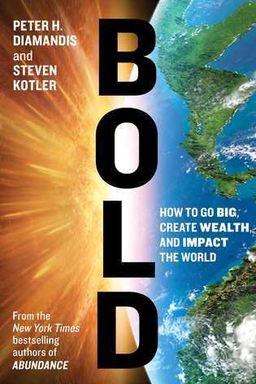
How can small teams with modest resources reshape industries once dominated by global giants? In Bold, Peter Diamandis and Steven Kotler argue that the future belongs to those who understand and harness exponential change — a pattern of technological progress where growth doubles repeatedly, producing both massive upheaval and opportunity. The book is a field manual for entrepreneurs, innovators, and leaders who want to build, fund, and scale bold ideas in a world accelerating beyond linear logic.
Diamandis offers a full-stack framework: first, he explains how exponential technologies progress through six predictable stages — from being digitized to becoming democratized. Then he explores how new organizational models, like Exponential Organizations and crowd-powered platforms, allow small groups to achieve impact once reserved for corporations or nations. Finally, he examines the mindset and tactics — skunk works, flow states, audacious goals, and incentive prizes — that help individuals and teams ride these exponential curves instead of being crushed by them.
Exponential Technologies and the Six Ds
Exponential change breaks our intuition: humans predict linearly, but technology doubles in power on predictable timelines. Diamandis captures this evolution with the Six Ds: Digitalization → Deception → Disruption → Demonetization → Dematerialization → Democratization. When a process becomes digital — for instance, film becoming pixels or currency becoming data — it jumps onto the exponential curve. Early doubling periods are deceptive, but each one compounds until the impact becomes disruptive. Photography’s shift from film to smartphones, or Skype’s transformation of expensive calls into free global conversation, illustrate how exponential change destroys old economics and opens new frontiers.
Platforms and Organizational Reinvention
To exploit exponentials, organizations must evolve too. Linear corporations grow with factories and headcount, while Exponential Organizations (ExOs) scale through networks, AI, automation, and community engagement. Instagram built a billion-dollar company with thirteen employees by leveraging smartphones and cloud infrastructure; Airbnb and Uber scaled hospitality and transport without owning rooms or cars. As Salim Ismail (author of Exponential Organizations) framed it, impact now scales through access and orchestration, not ownership. Diamandis emphasizes that these companies focus on KPIs like network effects, retention, and viral coefficients — measures of exponential reach rather than input effort.
Mindset for the Exponential Age
Exponential growth is not purely technological. It requires an exponential mindset — one of experimentation, audacious ambition, and relentless iteration. Diamandis traces this back to Kelly Johnson’s Lockheed Skunk Works, which achieved breakthroughs by isolating empowered micro-teams. He combines that model with psychology from Mihaly Csikszentmihalyi’s Flow research and Daniel Pink’s trilogy of autonomy, mastery, and purpose, urging entrepreneurs to design environments that trigger focus and intrinsic drive. The result: rapid feedback cycles, purposeful risk, and high engagement around 10× goals.
The Power of Crowds and Communities
Technology has networked billions of minds. Crowdsourcing and crowdfunding allow you to tap that collective intelligence, capital, and creativity. From Freelancer’s global talent markets to Tongal’s video-production contests and Pebble’s record-breaking Kickstarter, Diamandis shows that you can now prototype, test, and fund ideas without traditional institutions. He expands this to community-building: DIY science platforms like Galaxy Zoo, manufacturing efforts like Local Motors, and algorithmic leagues like TopCoder all demonstrate how reputation and shared identity can replace money as motivators in peer-to-peer innovation.
Incentive Prizes and Market Catalysts
Finally, Diamandis returns to his own playbook: the XPRIZE model. Prizes like the Ansari XPRIZE or Wendy Schmidt Oil Cleanup Challenge prove that targeted incentive competitions can mobilize global talent and investment far beyond their cash purses. By defining clear, measurable goals and launching with “super-credibility,” you ignite industries rather than just fund projects. Prizes, like exponential companies, are about designing conditions where innovation becomes inevitable.
In essence: Bold is a manifesto for exponential optimism. It invites you to think audaciously, organize differently, and build movements that scale through people and platforms rather than bureaucracy and linear planning.
By mastering exponentials — technological, organizational, and psychological — you can ride the transformation that’s reshaping every industry. The choice, Diamandis suggests, is simple: be disrupted, or be bold enough to drive the disruption yourself.