
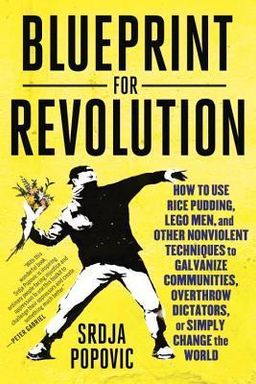
Blueprint for Revolution cover

Blueprint for Revolution

by Srdja Popovic and Matthew Miller

Blueprint for Revolution is a guide to launching a successful social movement. Using historical anecdotes, the book illustrates nonviolent techniques to fight oppression, apply political pressure, and inspire change. Learn how humor, strategic battles, and compelling visions can overthrow dictators and galvanize communities.

Building a Blueprint for Nonviolent Change

What if you could spark meaningful change or even topple an unjust system without ever throwing a punch? In Blueprint for Revolution, Serbian activist Srdja Popović, with Matthew Miller, argues that revolutions don’t have to bleed—they can laugh, dance, and outsmart dictators instead. Drawing from his experience leading Otpor!, the nonviolent student movement that ended Slobodan Milošević’s regime, Popović offers a playbook for how ordinary people can organize cleverly, joyfully, and effectively to change their world.

Popović’s core argument is that successful nonviolent change doesn’t arise from random protest or rage. It requires a clear plan, a unifying vision, creativity rooted in humor, and an understanding of how power truly operates. His approach—borne out of real battles with police, propaganda, and fear—is neither academic nor utopian. It’s pragmatic optimism: the conviction that laughter, planning, and unity can dismantle oppression faster than any weapon.

From Belgrade to Tahrir Square: Creative Change in Action

Popović opens with gritty realism and comic irony. He recounts how, as a student in Serbia under Milošević, he learned that people power means finding courage through creativity. Otpor!’s protests—often involving barrels painted with the dictator’s face and labeled “Smash him for a dinar”—turned fear into laughter. This comic defiance inspired copycat movements in Georgia’s Rose Revolution, Ukraine’s Orange Revolution, and Egypt’s Tahrir Square uprising.

But these weren’t accidents. They were products of Popović’s philosophy: that smart activists don’t just mobilize emotion—they plan campaigns like strategists. They research their opponent’s weaknesses. They choose battles that can be won. And they use small victories to build the confidence and momentum that lead to systemic change.

The Architecture of Nonviolent Strategy

The “blueprint” in the title refers to a repeatable architecture for successful movements. Like a good engineer, Popović walks through crucial components: dream big but start small, construct a vision of tomorrow that resonates with everyone, build pressure by shaking the pillars of power that sustain authority, use humor as a weapon to mock fear, and make oppression backfire by exposing its absurdity.

Each principle is grounded in real examples—from Israeli activists using cottage cheese to protest inequality to Maldivian dissidents uniting citizens with rice pudding. The stories make a serious point: social change happens when ordinary citizens make injustice personal, fun, and impossible to ignore.

A Manual for Modern Movements

Popović’s lessons span continents and causes, illustrating how to organize collective action in a digital age often paralyzed by cynicism. The book reads like a fusion of Gene Sharp’s nonviolence theory and a marketer’s playbook for mass mobilization. You’ll learn how to turn apathy into engagement, fear into laughter, and fragmented frustration into a shared vision. He even borrows insights from pop culture, quoting Tolkien’s idea that ‘even the smallest creature can change the course of the future.’

Why This Blueprint Matters

In an age of polarization and protest fatigue, Blueprint for Revolution is both practical and hopeful. It refutes cynicism by showing that revolutions aren’t born of rage but of intelligent, creative persistence. Popović’s greatest contribution is his insistence that change is not the realm of heroes or elites but of “hobbits” — regular people who care enough to act. Whether you want to reform your HOA board or shake a regime, this blueprint teaches the same essential truth: power is never absolute, and organizing is always more powerful than outrage.

Across its eleven chapters, the book moves from theory to tactic, from punk bands mocking dictators to monks defying armies. Popović’s message is unmistakable: revolutions succeed when they’re funny, disciplined, and inclusive—and when they finish what they start. This is not just a history of resistance; it’s a how-to guide for anyone ready to build their own revolution of joy.


Dream Big, Start Small

Popović insists that every great revolution begins not with grand speeches or sweeping ideologies but with small, winnable battles. His mantra, “dream big, start small,” captures the logic of effective activism: people join movements that succeed, not those that shout.

The Cottage Cheese Revolution

In 2011 Israel, the price of cottage cheese doubled after the government lifted subsidies. Enter Itzik Alrov, a religious insurance salesman. Rather than railing against capitalism or inequality, he started a modest Facebook group urging a nationwide cottage cheese boycott. Within weeks, followers swelled from dozens to over 100,000. The simple ask—stop buying cheese—was concrete and relatable. Soon, prices dropped, executives resigned, and a broader movement for social justice was born.

This, Popović shows, is how you build momentum. (Jonathan Kozol said the same: “Pick battles big enough to matter but small enough to win.”) Once people feel victory is possible, they’ll take on larger fights. The Israeli cheese boycott led directly to mass protests for affordable housing—proof that small wins can fuel systemic change.

Gandhi’s Salt March and Harvey Milk’s Dog Poop

The strategy isn’t new. Gandhi understood that ordinary Indians couldn’t rally around abstract independence slogans, but everyone needed salt. By protesting the British salt tax, he united millions in a simple, moral act of defiance. Likewise, Harvey Milk learned to win San Francisco’s heart not by demanding gay rights immediately but by solving a universal nuisance—dog poop in city parks. Once he cleaned up the streets, people saw him as a capable doer—and listened when he spoke about equality.

Both examples show why tackling everyday frustrations builds trust. Movements succeed when they focus on what people already care about instead of lecturing them about what they should.

Finding Your Winnable Fight

Popović teaches activists to imagine a “line of division”—a napkin sketch separating the many and the few. Put yourself and as much of the public as possible on one side; leave only the “evil bastards,” as he jokingly calls them, on the other. The more universally relatable your issue, the stronger your side grows. If everyone loves cottage cheese and hates unfair prices, your coalition writes itself.

In essence, you build credibility by delivering small victories that touch people’s daily lives. Then, when the time comes for bigger fights, they’ll trust you to lead them. “Start with rice pudding or cheese,” Popović quips, “and you end up with democracy.”


Creating a Vision of Tomorrow

Popović argues that movements without a clear image of the future they’re fighting for are doomed to collapse. Hope drives action, but it must be specific. He calls this a vision of tomorrow—an inspiring, concrete picture of how life could look after victory.

Rice Pudding and Democracy in the Maldives

To illustrate, Popović describes how Maldivian dissidents toppled a 30-year dictatorship not with violence but with dessert. Under dictator Gayoom, protests were banned—but no one could ban rice pudding parties. Activists used public cookouts to gather people safely, turning shared sweetness into solidarity. Later, with help from CANVAS trainers, they expanded that symbolism into a nationwide movement promoting pensions, healthcare, and housing—their vision of tomorrow for a fairer Maldives.

The lesson: symbols and visions must connect to ordinary dreams. Freedom alone is too abstract; financial stability or dignity are tangible motivators.

Listening to People’s Real Needs

Popović recounts how a Maldivian activist, Imran Zahir, discovered old villagers staring blankly at the sea—the “living statues” of poverty. That moment defined their goal: social programs for the elderly. Like Serbia’s grandmothers banging pots against Milošević, the poor and aged became allies once the movement promised to respect their dignity. People join causes that reflect their lived experience, not elites’ theories.

(Note: This echoes Saul Alinsky’s Rules for Radicals, which urged organizers to start from the world as it is, not as they wish it to be.)

Designing an Inclusive Tomorrow

A vision of tomorrow should unite unlikely allies—teachers and police, elders and youth—by addressing everyone’s hope for respect and security. Popović advises activists to ask each group, “What do you need most?” Then incorporate those desires into the movement’s promise. Only when the future feels personal will people risk the present. As he writes, “You can’t sell revolution. You can sell a better tomorrow.”


Understanding the Pillars of Power

Revolutions don’t conquer power—they pull its supports away. Popović adapts political scientist Gene Sharp’s idea that every regime stands on “pillars” such as the economy, media, military, and religion. Remove their support, and the structure collapses under its own weight.

Mapping the Dictator’s Dependencies

During a training with Syrian activists, Popović realized their challenge wasn’t courage—it was focus. They wanted to fight Assad everywhere at once. Instead, he guided them to target one pillar: the business elite. By protesting at Assad-linked hotels or convincing foreign brands to drop Syrian franchises, they could choke the regime’s cash flow. You can’t fund bombs when the hotel brand pulls its licensing deal.

He compared dictators to brands. Assad, like Coca-Cola, sells a product—fear wrapped in nationalism. If activists become a better brand offering dignity and humor, consumers will switch. Understanding power as marketing, not mysticism, makes resistance strategic rather than sacrificial.

Shaking vs. Attacking

Popović warns against “attacking the pillar head-on.” You don’t fight soldiers—you win over their loyalty by offering them safety and respect. In Otpor!’s Serbia, subtle shifts mattered: when police began quietly refusing orders to beat students, the regime was already finished. The movement didn’t break the army; it simply pulled it away from Milošević’s side.

From Power to Parody

The secret, he teaches, is to make power look absurd. Tactics from Turkey’s “kiss-in” protests to Syrian Ping-Pong ball stunts turned fear into laughter—and laughter into liberation. When you understand which pillars support your oppressor, you stop swinging wildly and start unscrewing the bolts. As Popović puts it, “We didn’t fight Milošević—we made him irrelevant.”


Laugh Your Way to Victory

The beating heart of Popović’s philosophy is laughtivism—the use of humor as both shield and sword. Dictators thrive on fear, so laughter breaks their spell. As Mark Twain said, “Against the assault of laughter nothing can stand.”

The Barrel that Mocked a Dictator

One of Otpor!’s earliest actions involved a barrel painted with Milošević’s face and labeled “Smash his face for a dinar.” Passersby lined up to take turns hitting it. When police arrived, they faced a dilemma: arrest the people or the barrel. They chose the barrel—and overnight became a national punchline. The stunt demystified the regime and made activism cool.

Comedy as Strategy, Not Prank

Popović catalogs global examples: Polish citizens walking their TVs in wheelbarrows to mock Communist propaganda, Iranian women sneaking into soccer stadiums disguised as men, Siberian activists staging toy protests when human gatherings were banned. Each used humor to trap authorities in lose-lose scenarios. If police crack down, they look ridiculous; if they ignore it, the laughter spreads.

Why Humor Works

Humor lowers risk and invites participation. People too scared to attend a violent protest may gladly join one that feels fun. It also rewires emotional culture: instead of righteous anger, laughter invites courage. Popović argues that humor’s cool factor—its shareability—builds movements faster than ideology ever could. (Compare this to Hannah Gadsby’s point that humor disarms power by controlling the punchline.)

Smart laughs, Popović reminds us, are rebellion in disguise. They show that the protesters, not the police, own the narrative. When citizens are laughing, fear evaporates—and dictators lose their script.


Turning Oppression Into Backfire

Repression is a dictator’s default. But Popović shows how activists can use it against them. When played right, every arrest, beating, or censorship act becomes free advertising for your cause. This jujitsu of power, drawn from both Gene Sharp and Popović’s own experience, is called “backfire.”

From Beatings to Black T-Shirts

Otpor!’s Plan B turned fear into fame. Members studied what happened during arrests so new recruits knew exactly what to expect—a psychological vaccine against terror. Jail time even became a badge of honor, marked by black shirts reserved for those arrested over ten times. By making arrest a status symbol, they stripped the regime’s weapon of its bite.

The Tools of Ridicule

Popović recounts a story from Subotica, where activists plastered the town with posters calling a brutal cop “a bully” and listing his phone number. Ostracized by his neighbors, the officer softened overnight. Shame, not confrontation, dissolved his cruelty. The chapter shows how community reputation can neutralize brute force faster than fists ever could.

Other cases—Burma’s monks massacred into martyrdom, Pussy Riot humbling Putin, Egyptian martyrs like Khaled Said—prove that oppressive violence often fuels a stronger backlash when movements respond with dignity instead of rage.

Raise the Cost of Injustice

“Every act of oppression is a budget question,” Popović notes. The more attention or sympathy your movement gains, the higher the dictator must pay to maintain control—via bribes, censorship, or global disgrace. If you make oppression expensive, systems collapse under their own contradictions. Make them hit you—and smile while the cameras roll.


The Power of Unity, Planning, and Nonviolence

Near the end of the book, Popović condenses three pillars that hold every successful movement together: unity, planning, and nonviolent discipline. Each amplifies the others. Lose one, and the whole struggle wobbles.

Unity: Creating One Voice

Dictators thrive by dividing the opposition. Movements win when they merge factions under one simple message. Otpor!’s slogan “He’s Finished” united nineteen Serbian opposition parties. By contrast, Belarus’s fragmented parties and Egypt’s divided post-revolution politics show what happens when coalitions splinter.

Unity also crosses cultures and religions: in Tahrir Square, Christians protected Muslims during prayers; Muslims guarded Christians during services. Physical acts of solidarity create emotional loyalty.

Planning: Strategy Before Protest

Popović leans on lessons from Colonel Bob Helvey and Gene Sharp, who taught activists to plan revolutions like military operations. Define your “goose egg”—the true objective (e.g., democracy, not just ousting a dictator). Use inverse sequence planning: start from success and work backward step by step. Momentum, timing, and adaptability separate chaos from triumph. (“Even the Fellowship of the Ring,” he jokes, “had a plan.”)

Nonviolence as Weapon

Violence, Popović cautions, plays into the dictator’s hands. Drawing on data from Erica Chenoweth and Maria Stephan, he reports that nonviolent movements succeed twice as often as armed ones and produce more stable democracies. Violence consolidates fear; humor and discipline expand empathy. Nonviolence isn’t moral weakness—it’s strategic superiority.

When unity, discipline, and smart planning combine, ordinary citizens can achieve extraordinary feats. These are the blueprints not just for revolution, but for any fight worth winning.

Dig Deeper

Get personalized prompts to apply these lessons to your life and deepen your understanding.

Go Deeper

Get the Full Experience

Download Insight Books for AI-powered reflections, quizzes, and more.