
Idea 1
Creating Blue Oceans in a Sea of Competition
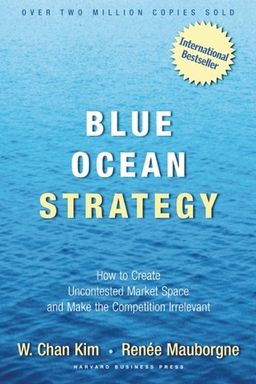
Have you ever felt stuck competing where everyone else is fighting for the same customers, in the same ways, with the same ideas? In Blue Ocean Strategy, W. Chan Kim and Renée Mauborgne challenge one of the most deeply ingrained assumptions of business—that success comes from beating rivals. Instead, they argue that the key to lasting growth lies in creating new markets where competition becomes irrelevant. These wide-open, uncontested spaces are what they call “blue oceans.”
Kim and Mauborgne contrast these blue oceans with “red oceans,” the traditional markets where competitors fight tooth and nail for shrinking demand. Red oceans are crowded, bloody, and exhausting. Blue oceans, by contrast, represent untapped market space, fresh demand, and rapid, profitable growth. But how do you get there? The authors contend that through value innovation—offering a leap in value for customers and your company—you can reconstruct market boundaries instead of competing within them. The book provides not only the theory behind this idea but also practical frameworks, tools, and real-world examples to make this transformation achievable for any organization.
The Central Idea: Value Innovation
Value innovation sits at the heart of blue ocean thinking. It means breaking the trade-off between differentiation and low cost that dominates conventional strategy. Companies in red oceans typically choose: either create high-value products at high cost, like luxury cars, or pursue cost-leadership with minimal differentiation, like budget airlines. But Kim and Mauborgne argue you can achieve both. By simultaneously pursuing differentiation and low cost, you create a leap in buyer value and open new market space where competitors become irrelevant.
Take Cirque du Soleil, one of the book’s signature examples. Instead of competing with traditional circus acts, it blended the spectacle of theater and the thrill of the circus, replacing expensive animal acts and star performers with dazzling artistry and story-driven performances. The result? A completely new form of live entertainment appealing to adults willing to pay several times the price of a traditional circus—a true blue ocean move.
From Competing to Creating
The authors show that industry boundaries aren’t fixed; they can be reshaped. Companies often treat their market structure as static, using tools like Porter’s Five Forces to predict competitive pressures. But markets are human constructs, shaped by actions and imagination. Kim and Mauborgne’s research across 150 strategic moves from 1880 to 2000 revealed that firms of all sizes—whether start-ups or incumbents—created blue oceans by reconstructing boundaries rather than accepting them. They did so by focusing on buyers, not competitors, and by asking fresh questions:
- Which factors have we accepted simply because the industry does?
- What factors can we eliminate, reduce, raise, or create to reshape value?
- How can we appeal to noncustomers instead of fighting for existing ones?
Their answer culminates in tangible tools like the strategy canvas and the four actions framework, helping managers visualize their industry’s playing field and map where they can depart from accepted norms. These tools make innovation systematic, not random—a major difference from what Joseph Schumpeter called “creative chaos.” (In contrast to Schumpeter’s idea of creative destruction, Kim and Mauborgne champion nondestructive creation: new industries and demand built without obliterating the old.)
Why Blue Oceans Matter Now
Originally published in 2005 and updated in 2015, the book’s ideas became even more relevant in a hyperglobalized, digitized world. Today, competition intensifies as more markets saturate and technology accelerates imitation. Emerging economies like China and India bring millions of new players, increasing supply faster than demand. In this crowded landscape, improving at the margins isn’t enough. Organizations—from corporations to nonprofits to governments—need to create new demand rather than fight for old customers. That’s where the blue ocean approach shines: it gives leaders a roadmap to innovation that doesn’t rely on luck or endless R&D spending.
The Book’s Journey and Impact
Kim and Mauborgne’s research originated at INSEAD and evolved into a global movement. The term “blue ocean” entered everyday business vocabulary, spawning thousands of success stories—from small entrepreneurs to global corporations and even governments. Malaysia built a national transformation program around it; Samsung integrated it into its Value Innovation Program; and nonprofits used it to design scalable social impact at low cost.
Throughout this summary, we’ll examine how to apply the book’s core frameworks, including reconstructing market boundaries, focusing on the big picture over numbers, reaching beyond existing demand, getting the strategic sequence right, and executing with trust and alignment. Together, they form a systematic blueprint for creating, capturing, and sustaining blue oceans in any industry.
In essence: Stop competing over shrinking slices of existing markets. Instead, create your own ocean—where you define the rules, set the price, and swim alone. Once you learn how to reconstruct the game itself, competition ceases to matter, and opportunity widens beyond measure.