
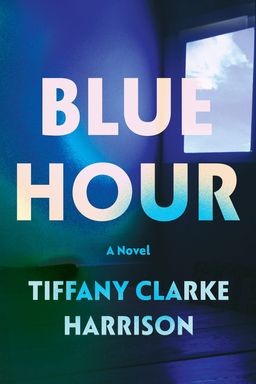
Blue Hour cover

Blue Hour

by Tiffany Clarke Harrison

Blue Hour is a poignant novel exploring the challenges and resilience of a multiracial mother-to-be amidst personal loss and racial violence. As she navigates her identity and hopes for the future, her journey offers a deeply moving exploration of love, creativity, and the courage to embrace motherhood in uncertain times.

Motherhood, Grief, and Art in the Aftermath of Violence

How can you love in a world that keeps reminding you that love is dangerous? Tiffany Clarke Harrison’s Blue Hour asks this unsettling question through the fragmented, lyrical voice of a biracial woman struggling to define motherhood, marriage, and selfhood against a backdrop of racial violence and personal loss. The novel operates in the twilight space—the “blue hour”—between hope and despair, beauty and brutality, creation and destruction. Harrison’s protagonist confronts miscarriage, grief, infertility, systemic racism, and the quiet violence embedded in intimate spaces. Her world teeters between therapy sessions, creative work, protests, and quotidian acts of survival. The narrative’s blend of prose and memory turns womanhood and art into acts of confession and endurance.

The Confession of an Artist

Early in the novel, Harrison quotes James Baldwin: “All art is a kind of confession.” This is the organizing principle of Blue Hour. Through the protagonist’s letters, therapy sessions, and interior monologues, Harrison reveals how art becomes both a wound and a weapon—a way to process trauma and name what patriarchy and racism render unspeakable. The main character’s photography—her darkrooms, her obsession with memory, her students—serves as a metaphor for visibility itself: what is exposed, what is burned into the image, what remains hidden in shadow.

By anchoring the story in the collective trauma of police shootings and the personal grief of miscarriage, Harrison suggests that “to create” in America as a Black or biracial woman is to wage war against erasure. The act of developing a photograph becomes indistinguishable from developing one’s self: immersion in chemicals, distortion, illumination, the emergence of shape and meaning from darkness.

Love Under Siege

At the heart of the novel is a complicated marriage. The narrator marries Asher, a Jewish tie designer and boutique owner, with whom she shares both tenderness and alienation. Their love story begins in artistic proximity—the mutual observation of beauty and risk—but corrodes under the pressure of repeated loss: several pregnancies that end in blood, exhaustion, and silence. Harrison situates their intimacy amid the constant drone of violence against Black bodies in America, a reminder that private despair cannot be disentangled from public terror. The protagonist’s womb becomes a metaphor for the body politic—one that rejects life because the world itself is hostile to it.

Asher’s presence oscillates between supportive partner and oblivious outsider. His whiteness, maleness, and optimism form an emotional divide between them, exposing the limits of love in a structurally unequal world. His longing for a child contrasts with her growing refusal to bring a Black child into a violent society. In this sense, their marriage dramatizes the tension many couples face when love meets political and bodily reality.

Motherhood as Vulnerability

Harrison’s meditations on motherhood cut deeper than biology or sentimentalism. To her protagonist, pregnancy is an act that exposes the wreckage of self—the stretching of body and psyche to accommodate both possibility and destruction. Her miscarriage scenes are described in raw sensory detail, an unfiltered acknowledgment of how grief manifests physically. Later, her eventual childbirth does not erase pain or fear; it redefines them. The novel asks whether motherhood can exist as an act of faith when the world refuses to protect mothers or their children.

In that sense, Blue Hour joins works like Toni Morrison’s Beloved and Rachel Cusk’s A Life’s Work, exploring how women’s bodies become battlegrounds for both love and history. Motherhood here is not sanctified—it is survival, rebellion, and mercy in a system that commodifies and endangers it.

The Political Body and the American Landscape

Woven throughout are vignettes of racial violence: a young student, Noah, shot by police; protests turned riots; the terror of bringing a Black child into a country built on anti-Blackness. Harrison blends the intimate (a heartbeat on a sonogram) with the collective (heartbeat stopped by a bullet) to interrogate the value of life in America. The protagonist’s art project documenting grieving mothers mirrors Harrison’s own narrative project—using personal pain as testimony and political witness.

As the protagonist debates the ethics of creation—of photographs, of children, of stories—she engages with the same paradox that artists of color often face: how to expose trauma without exploiting it, how to represent pain without perpetuating violence. Blue Hour insists that storytelling itself can be an abolitionist act, one that keeps the dead present and illuminates what oppressive systems demand we forget.

Healing and the Return to the Body

The novel’s structure mirrors therapy—the cyclical revisiting of memories, dreams, and confessions until language itself becomes a form of reconstruction. The sessions with her therapist reveal the long road from dissociation (“I feel dismembered”) to acknowledgment (“I deserve her. I deserve a family”). Healing, for Harrison’s narrator, is not transcendence but embodiment—the choice to live inside one’s pain and still create. The birth of her daughter, Bijou, at the novel’s end, becomes both conclusion and beginning: an affirmation that love and art can coexist even in the ruins of systemic brutality.

Ultimately, Blue Hour is a contemporary elegy—a mosaic of memory, art, and resistance. It dares you to look at pain the way a photographer looks at light: as something that defines, distorts, and gives meaning to everything it touches.


The Fragmented Voice of Trauma

Harrison structures Blue Hour as a collage of therapy sessions, flashbacks, and lyrical digressions. The voice is fragmented because trauma itself fractures time and speech. The protagonist’s thoughts dart between her marriage, her miscarriages, her students, and her grief. This disruption makes the novel feel like an intimate confession overheard through broken glass—raw, elliptical, and deeply human.

Language as Body

Whenever the narrator speaks of loss, her language becomes visceral. Her body “vomits anguish”; her blood “rejects” her. The sentence rhythm mirrors the contractions of childbirth and the spasms of panic. Through this voice, Harrison transforms emotion into embodiment—her words bleed and pulse, refusing the sterilized narratives of polite grief often demanded of women.

This fragmentation recalls the narrators of Jenny Offill’s Dept. of Speculation or Claudia Rankine’s Citizen, who also navigate short, breathless fragments to convey dislocation. Yet Harrison’s approach feels distinctly corporeal: every word aches with the memory of miscarriage and survival.

The Confessional Space

In her therapy sessions, the protagonist confronts her therapist’s urging to feel instead of intellectualize. Emotion here is both threat and salvation. “You can’t outrun emotion,” the therapist says, highlighting how suppression perpetuates suffering. The confessional framework anchors her spiraling inner life, offering the reader a mirror for our own avoidance of pain.

By breaking linear storytelling, Harrison rejects the idea that healing has a straight path. Instead, she portrays recovery as recurrence—a return to the wound until the body learns how to hold it differently.


Intersectional Identity and the Question of Belonging

Harrison’s narrator carries Haitian, Japanese, and Black American heritage—a mosaic of bones, languages, and cultural burdens. Her mixed-race identity complicates her sense of belonging, especially in predominantly white or monoracial spaces. As a child, she’s asked, “What are you anyway?”—a question that shadows her into adulthood and motherhood.

Inheritance and Dispossession

The protagonist’s family history reveals layered generational trauma: a Japanese grandmother who was ostracized, Haitian and African ancestors erased by migration and racism, and parents who died in a car crash rescuing her from jail. Each identity is a ghost she must make peace with. Her art becomes an archive against disappearance.

Harrison exposes the cost of hybridity: constant translation of self in every room, a form of performance that drains. Belonging becomes less about community and more about survival within overlapping systems of exclusion.

Marrying Across Worlds

Asher’s whiteness and Jewish background add another dimension. Their wedding, attended by his disapproving mother, signifies cultural collision; their love tests whether intimacy can transcend racial hierarchies. In moments of tenderness, identity feels irrelevant, but every tragedy—Noah’s shooting, anti-Black violence—reasserts its weight. The protagonist’s refusal to “bring a kid into this” is an act of racial consciousness, not coldness, a survival instinct in a racist society.

Harrison positions intersectionality not as diversity’s buzzword, but as a field of tension where love, rage, and identity coexist. It’s a reminder that to live at multiple intersections is to be both target and testimony.


Art as Healing, Witness, and Rebellion

Art, particularly photography, is the protagonist’s way of mapping chaos. She teaches photography in a mobile darkroom, guiding students like Noah—her most talented pupil, later shot by police. Her camera captures both beauty and brutality, turning image-making into grieving ritual. Developing film becomes a ritual of resurrection: submersion, agitation, emergence.

The Camera as Mirror

Her photographs are never neutral—they ask what it means to look ethically. When she photographs grieving mothers for her documentary, she grapples with the morality of making art from tragedy. Noah’s photo of a girl jumping rope haunts her; its innocence reminds her what violence steals. By photographing others’ losses, she confronts her own, using the lens to navigate empathy without voyeurism.

Documenting the Undocumented

Harrison threads through each image the history of Black visual representation—from Carrie Mae Weems’s interrogations of visibility to Gordon Parks’s insistence that photography can liberate. Like them, the narrator uses art to reclaim stories America erases. When she photographs mothers of slain children, we see art transmute sorrow into endurance. “Tell the truth,” she tells her students; truth becomes her creative and moral commandment.

Photography here is activism disguised as mourning—a visual argument that grief itself is a form of resistance.


Marriage as Collision and Mirror

Marriage in Blue Hour is less romance and more experiment—a space where love collides with race, gender, and grief. Asher and the narrator are drawn together by art, yet undone by the asymmetric burdens they carry. Every conversation about children becomes a referendum on privilege and survival. While he sees family as completion, she perceives it as repetition of pain.

Desire vs. Despair

Their physical connection—tender, erotic, desperate—often punctuates moments of loss. Sex becomes communication when language fails. Yet even in intimacy, she remains fragmented, haunted by prior lovers and miscarriages. Harrison renders marriage as a cinematic cut: tenderness bleeding into trauma, silence echoing louder than speech. The couple’s arguments reveal not only emotional exhaustion but ideological impasse—between naïve hope and scarred realism.

The Art of Staying

Despite betrayal, near-separation, and resentment, they keep orbiting each other. Their love survives not because it is pure but because it is chosen from within brokenness. When their eventual child, Bijou, is born, the marriage doesn’t resolve—it redefines itself. Harrison suggests that permanence in love isn’t about overcoming fracture, but learning to coexist with it, the way film grain gives depth to an image.


Survival of Black Motherhood

Every pregnancy in Blue Hour exists under the shadow of police lights. From Noah’s shooting to headlines of slain children, the act of carrying life becomes an act of protest. The protagonist asks repeatedly whether she can bear to bring a Black child into such a world. Her eventual motherhood is therefore radical—an insistence on existing despite erasure.

Loss as Continuum

She loses a baby called Ellis, delivers her stillborn in a bathtub scene that is both devastating and transcendent. She buries Ellis, then photographs the small body as proof of existence. Later, with Bijou’s birth, grief and love coexist; motherhood doesn’t overwrite mourning. Harrison portrays pregnancy not as miracle but as confrontation with mortality. The protagonist’s body holds generations of trauma, political and personal.

This framing echoes Black feminist thinkers like Audre Lorde, who saw reproductive choice as both power and peril. In each contraction, Harrison reminds you that legacy and loss are intertwined; to mother a Black child is to teach them survival before speech.


Violence, Protest, and the Collective Body

Harrison situates her personal narrative in a national one. The novel’s protests mirror real footage of Black Lives Matter marches: chanting crowds, tear gas, rubber bullets. These scenes reveal how collective grief transforms into collective movement, and how trauma can galvanize resistance. The protagonist documents these events with her camera, even as she fears becoming part of the statistics she memorializes.

From Witness to Participant

At first, she hides behind the lens. Photography feels like protection, a distance between herself and violence. But as the story progresses, she realizes that documentation is participation. When she intervenes to photograph Noah’s mother and later women in grief, she transforms from observer to archivist of justice.

In doing so, Harrison reclaims the Black female gaze from both invisibility and exploitation. The lens becomes a weapon against forgetting. As one protester says indirectly through her work: “We barely protect ourselves.” That ambiguity—the simultaneous vulnerability and defiance—makes Blue Hour both elegy and rallying cry.


The Path Toward Healing and Self-Forgiveness

The final act of Blue Hour is not about redemption but about choice—the decision to live with one’s pain without letting it dictate the future. Through her therapist’s persistent prompting (“How did it feel, in your body?”), the protagonist learns to stop narrating and start feeling. Her journey evolves from guilt (“I kill them all”) to grace (“I deserve her”). Healing manifests through slow embodiment and acceptance rather than closure.

Sisterhood and Reconnection

Her eventual reconciliation with her sister Viola symbolizes this growth. Viola—once judgmental and sanctimonious—returns to care for her after a breakdown. In sisterhood, the protagonist finds a version of maternal love she once lost. They reenter each other’s lives with humor, anger, and tenderness, illustrating that forgiveness is a process of mutual becoming. This renewed bond grounds her enough to face motherhood anew.

By the novel’s end, with Bijou’s arrival and the protagonist’s quiet recording of her baby’s sounds, Harrison allows a fragile peace to emerge. Healing isn’t the absence of pain—it’s the courage to hold joy in the same hand.


Storytelling as Continuation, Not Resolution

In its final pages, Blue Hour loops back to the beginning: the act of telling. Through narrative, therapy, and photography, the protagonist structures chaos into coherence. Yet Harrison deliberately avoids tidy closure. The birth of Bijou doesn’t erase systemic racism or domestic cracks—it reframes them. When the protagonist visits Noah’s mother for her documentary, the circle of storytelling completes: one woman who lost, one who finally kept, each reflecting the other’s endurance.

Harrison ends not with triumph, but continuation. The narrator’s declaration—“I deserve her”—is both affirmation and vow to live. In the “blue hour” between night and day, despair and recovery, she claims authorship over her story. By speaking her pain aloud, she ensures it cannot be buried again.

Key Reflection

Harrison implies that survival itself is a creative act—that telling the truth, even when fragmented, is how you convert loss into legacy. The story never ends; it develops, like film, in the light we dare to let in.

Dig Deeper

Get personalized prompts to apply these lessons to your life and deepen your understanding.

Go Deeper

Get the Full Experience

Download Insight Books for AI-powered reflections, quizzes, and more.