
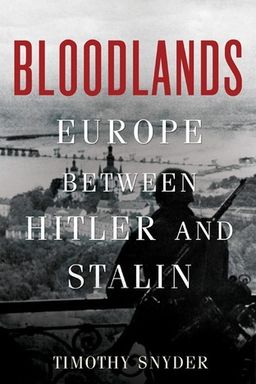
Bloodlands cover

Bloodlands

by Timothy Snyder

In Bloodlands, Timothy Snyder reveals the grim tale of Eastern Europe caught between Nazi Germany and Soviet Russia. This profound historical account uncovers the ruthless policies, mass atrocities, and relentless suffering endured by millions during World War II, shedding light on a pivotal yet often overlooked aspect of 20th-century history.

The Bloodlands: When Ideologies Turned to Atrocities

Have you ever thought about what happens when two totalitarian powers—nations united not by cooperation but by cruelty—turn their people and their neighbors into fuel for ideology? In *Bloodlands* (a term coined by historian Timothy Snyder), we learn of the horrific stretch of land between Nazi Germany and Stalin’s Soviet Union where, from the 1930s to the 1940s, tens of millions of people died not in battle, but from policies deliberately designed to starve, punish, and erase them. This book relentlessly documents those tragedies, not to fetishize horror, but to show how modern states, claiming progress or purity, can engineer mass death on an inconceivable scale.

Snyder argues that the bloodlands—the regions of Eastern Europe encompassing today’s Ukraine, Belarus, Poland, and the Baltic states—carry a terrifying legacy that challenges how we think about evil. Stalin’s collectivization and terror, followed by Hitler’s extermination policies, transformed these lands into a killing field twice over. The story is not simply about two regimes acting independently; it’s about how their actions fed, mirrored, and reinforced one another. Both leaders sought to control populations and territory at any human cost.

The Context of Catastrophe

To understand these events, think of Eastern Europe during the early 20th century as a pressure chamber. The Russian Empire’s collapse, World War I’s devastation, and economic collapse set the stage for radical solutions. Stalin’s dream of socialist modernization and Hitler’s obsession with racial conquest each promised renewal through destruction. These regimes believed in reshaping the world from above—by engineering society like a machine, regardless of human suffering beneath it.

Stalin wanted to transform an agrarian Soviet Union into an industrial power through ruthless collectivization and forced modernization, while Hitler sought to expand Aryan living space by enslaving or exterminating the peoples of Eastern Europe. In their wake, entire societies were erased, language and culture suppressed, and families annihilated.

The Human Cost of Policies

Between Stalin’s famine in Ukraine and Hitler’s Final Solution, nearly 14 million civilians in the bloodlands were deliberately murdered by policy. Thousands of villages turned to ash. Entire classes and ethnicities—the kulaks, Polish intellectuals, Soviet peasants, Jewish families—were targeted. Snyder’s analysis transcends borders: it shows that genocide was not an aberration in either system, but central to how both governments operated.

When Stalin’s forced collectivization starved millions in Ukraine in 1932–33, he claimed it was a necessary sacrifice for the socialist future. When Hitler enslaved and exterminated Slavs and Jews, he declared it a step toward racial salvation. Each saw Eastern Europe as experimental land—where humanity could be undone and remade.

Parallel Tyrannies and Competing Myths

The book urges you to see these as interlocking systems of terror rather than separate tragedies. After all, the Molotov-Ribbentrop Pact of 1939—where Hitler and Stalin agreed to divide Poland—wasn’t an accident of politics. It was a temporary alliance between two totalitarian projects that feared and mirrored each other. When Germany invaded from the west and the Soviet Union struck from the east, Poland’s sovereignty was erased in weeks. Civilians suffered grotesquely at the hands of both regimes: mass executions, deportations, and cultural annihilation followed.

To the Nazis, these lands were raw material for racial purification. To the Soviets, they were instruments for class struggle and national security. The result? A belt of perpetual suffering, where wars overlapped and peace never came.

Why the Bloodlands Still Matter

You might wonder: why revisit such horror? The answer lies in the danger of forgetting. The bloodlands remind us that atrocities begin with ideas—visions of a better world imposed by force. When leaders treat lives as obstacles to ideology, when propaganda erases human empathy, and when neighboring powers justify cruelty by comparison (“the other side is worse”), the descent into mass murder becomes almost procedural.

Understanding the bloodlands—Stalin’s famines, Hitler’s genocides, and the fate of Poles, Jews, Ukrainians, and countless others—forces us to rethink modern evil. It shows that progress, when weaponized by power, can produce industrial slaughter, and that ordinary people, caught between empires, become targets simply for existing.

In this exploration, you’ll trace how each policy of extermination evolved—from the collectivization famine to the Holocaust’s gas chambers, from Poland’s double invasion to postwar deportations. You’ll see how the bloodlands became a canvas of state violence, where nationalist dreams and socialist dogma killed indiscriminately. Most importantly, you’ll grasp how the moral lessons of this region—about manipulation, obedience, and survival—resonate far beyond its borders.


Stalin’s Collectivization and the Manufactured Famine

In the early 1930s, Stalin prioritized industrialization over human life, believing that collectivized farming would fuel Russia’s transformation. But by dismantling private agriculture, he destroyed the nation’s food supply. Farmers were forced onto collective farms where their work was mechanized yet poorly managed; machinery broke down, yields plummeted, and the state seized any remaining grain to meet production quotas.

The Logic of Control

Stalin’s aim was not merely economic—it was political domination. The kulaks, or wealthier peasants, became scapegoats for resistance. Anyone who owned livestock or a decent barn could be branded a kulak and deported or shot. By 1933, millions of peasants faced starvation, especially in Ukraine, where the Holodomor famine took 3.3 million lives. Stalin still exported grain abroad, denying famine victims the food they had grown with their own hands.

The famine was not a natural disaster but a political weapon. Seed grain, livestock, even kitchen gardens were confiscated. Those caught hiding food were sent to labor camps. The policy sought to break the backbone of peasant autonomy and resistance—a grim precursor to later Soviet actions across Eastern Europe.

“The famine killed to consolidate power,” Snyder writes, “and through hunger, Stalin made peasants dependent on the Soviet state.”


Dekulakization and the Politics of Terror

During Stalin’s efforts to eliminate class enemies, the campaign of dekulakization unleashed another tragedy. From 1929 to 1932, people labeled as 'kulaks'—often ordinary workers—were arrested, exiled, or shot. It didn’t matter if they were guilty of resistance; what mattered was fulfilling quotas for repression. Stalin institutionalized paranoia: if enemies didn’t exist, they had to be invented.

Expanding the Enemy List

The terror spread to ethnic minorities. Poles, Latvians, Lithuanians, and Estonians were accused of espionage. During “national cleansing” operations, close to 274,000 people were killed. Soviet Poles suffered especially—85,000 were executed between 1937 and 1938. These were preemptive massacres, meant to destroy groups Stalin imagined might threaten his regime.

Dekulakization, in essence, was population engineering—a method of purging social and ethnic identities under the guise of progress. By the time Stalin’s Great Terror ended, terror itself had become an administrative policy, codified and routinized.


Hitler and Stalin Divide Poland

The invasion of Poland in 1939 marked the start of World War II and the convergence of two tyrannies. The Molotov–Ribbentrop Pact allowed Hitler to strike from the west and Stalin from the east. For ordinary Poles, there was no sanctuary—only shifting occupiers trading death tolls. German troops justified atrocities by calling Poles subhuman, while Soviets treated them as class enemies.

Two Occupiers, One Victim

Both regimes targeted Poland’s elites—its officers, clergy, and intellectuals—to cripple resistance. The NKVD deported thousands to Siberia; the Germans executed community leaders in public to spread fear. Poland’s landscape became a graveyard of ideologies, its people crushed between competing visions of empire.

This joint occupation showcases the bloodlands’ essence: a region defined not by borders, but by suffering that flowed seamlessly from one regime to another. When one occupier withdrew, the other stepped in to destroy what remained of society.


Dehumanization Under Nazi Rule

Under Nazi occupation, dehumanization became state doctrine. Jews were forced into ghettos—sealed neighborhoods like Warsaw, where 60,000 perished from hunger and disease by 1941. The Nazis marked Jews with yellow stars, confiscated property, and cut them off from sustenance. Polish elites were also murdered en masse: professors, priests, and teachers targeted for leadership potential.

Public Horror as Policy

Unlike Stalin’s secretive killings, Hitler’s strategy often relied on public spectacles of terror. Executions were carried out openly to instill fear. The Nazis’ bureaucratic precision—lists, quotas, deportation schedules—turned genocide into an administrative routine. This fusion of technology and ideology was both modern and medieval in its cruelty.

By turning dehumanization into regulation, the Nazis normalized barbarity. Each murder was signed, scheduled, and tallied—proof that elimination could coexist with efficiency.


The Final Solution: From Deportation to Extermination

Initially, Nazi Germany explored deporting Jewish populations—mad schemes like sending them to Madagascar or Siberia—but as the war dragged on and logistics collapsed, annihilation replaced relocation. By 1942, extermination camps were operational in occupied Poland. Treblinka, Belzec, and Sobibor became factories of death, built not for labor but for systematic killing.

Industrialized Murder

Here, policy met technology. Victims were transported by rail, stripped of belongings, and executed within hours of arrival. Roughly six million Jews perished, one million at Treblinka alone. This was genocide by design—an evolution from administrative deportations to total extermination, reflecting the Nazi belief that certain people had no right to exist even as slaves.

“The goal was not conquest but vacancy,” Snyder notes, “to leave behind a landscape purified of people.”


Resistance and Suppression in the Bloodlands

Against such overwhelming terror, resistance was almost impossible. Poles, Jews, and Balts all faced annihilation for rebellion. The Jewish uprising in the Warsaw Ghetto in 1943 showed unimaginable courage: a fight with scarce weapons against Nazi forces. Yet Himmler ordered the ghetto’s destruction—13,000 were killed, the rest deported to camps.

Caught Between Two Masters

For many in Eastern Europe, rebellion was a death sentence either way. Opposing the Nazis risked bringing back Soviet occupation; cooperating risked guilt and retribution. Even when partisans fought bravely, as in the 1944 Warsaw Uprising, Soviet forces nearby refused to assist—proving Stalin’s goal wasn’t liberation but domination.

Resistance showed human dignity, but its suppression underscored the futility of hope in a land abandoned by both East and West.


Aftermath and the Continuing Terror of Deportation

Even after Germany’s surrender in 1945, the bloodlands bled on. Stalin’s Soviet Union continued the logic of ethnic cleansing and relocation, now under the justification of security and reconstruction. Millions of Germans, Poles, and Ukrainians were uprooted and deported. For many, peace brought new chains instead of freedom.

Redrawing Humanity’s Map

At Potsdam, Allied leaders sanctioned population transfers that would displace millions. Stalin deported entire communities from annexed regions to Siberia, aiming for a homogeneous empire easier to control. Between 1943 and 1947, an estimated 1.4 million people died from violence, starvation, or exposure during forced deportations.

The book closes this cycle with a chilling truth: though borders changed and flags fell, the tools of oppression—deportation, surveillance, forced labor—survived. The bloodlands’ story didn’t end with war; it transformed into Cold War repression.

Dig Deeper

Get personalized prompts to apply these lessons to your life and deepen your understanding.

Go Deeper

Get the Full Experience

Download Insight Books for AI-powered reflections, quizzes, and more.