
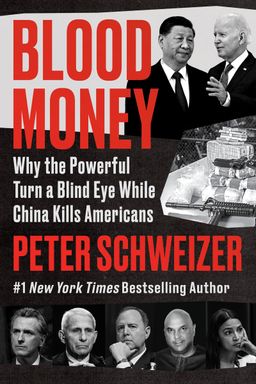
Blood Money cover

Blood Money

by Peter Schweizer

The author of “Red-Handed” depicts a scheme involving the Chinese Communist Party’s covert operations in America.

War Without Fighting

How can you be under attack when there are no tanks at your borders? In this book, Peter Schweizer argues that the Chinese Communist Party (CCP) wages a form of "unrestricted warfare" against the United States—an integrated, state-directed campaign that uses economic pressure, synthetic opioids, illicit weapons parts, influence operations, algorithmic platforms, and pandemic-era manipulation to weaken American society without conventional combat. The core claim is blunt: Beijing operationalizes Sun Tzu’s maxim—“to subdue the enemy without fighting”—by targeting your soft underbelly: social trust, public health, political cohesion, and youth culture.

Schweizer contends that you can only grasp the pattern if you zoom out from isolated scandals or crises. The fentanyl epidemic, surges of illegal gun components, TikTok’s grip on Gen Z attention, curated narratives about Covid-19, and the penetration of ports and politics by state-linked tycoons may look like separate issues. The book argues they are parts of one strategy: asymmetric pressure that accumulates damage while preserving plausible deniability (a CCP doctrine sometimes summarized as "borrowing a knife to kill").

What “unrestricted” really means

Unrestricted warfare abandons the old boundary between war and peace. Military texts studied by the People’s Liberation Army (PLA) and political organs like the United Front Work Department elevate non-kinetic tools to primary weapons. That includes drug flows (fentanyl precursors from Shijiazhuang and Wuhan routed through Manzanillo and Mexican cartels), illicit weapons parts (auto sears and suppressors sourced from online Chinese marketplaces), influence through front groups and wealthy patrons (e.g., Roy Singham’s network funding CODEPINK and media outlets), and cultural platforms (ByteDance’s TikTok operating as a precision persuasion engine). Each vector on its own looks like crime, commerce, or culture. Together, they erode your society’s resilience.

The hybrid state–criminal ecosystem

A striking foundation of the book is the described symbiosis between the CCP and triads. Schweizer highlights a tacit pact dating to Deng Xiaoping’s era with Hong Kong tycoons Li Ka-shing and Henry Fok: demonstrate patriotism, keep the nastiest work offshore, and you’ll enjoy protection and opportunity. The result, he argues, is a hybrid ecosystem where triads help move money, chemicals, and influence while enjoying access to state-linked vehicles (e.g., CPPCC seats, roles in entities like CITIC). Ports operated by firms such as Hutchison become chokepoints that can facilitate or frustrate law enforcement. You experience the downstream effects locally—as overdose deaths, rising automatic gunfire, and money-laundering channels that outpace standard policing.

Cognitive warfare, algorithms, and culture

Schweizer frames the information domain as a battlefield. United Front groups "borrow mouths to speak" by funding or aligning with domestic voices—from student associations to radical organizers—so messages that serve Beijing’s interests look homegrown. TikTok supercharges this by personalizing feeds at scale. The company’s Party committee, ties to Chinese institutions (e.g., the Beijing Academy of Artificial Intelligence), and documented moderation on sensitive topics create governance risks. For you or your kids, the app’s design (short loops, dopamine-driven engagement) trains attention in ways that make repeated narratives stick, while Douyin (the China-only version) reportedly curates more educational content and imposes stricter youth limits. The asymmetry is not accidental; it’s strategic.

Pandemic manipulation and policy diffusion

The book’s pandemic chapters show how concealment and curated narratives translate into geopolitical leverage. In January 2020, Chinese authorities ordered labs to destroy samples and downplayed human-to-human transmission, even as import data reveal massive PPE stockpiling. United Front networks vacuumed masks globally while Western governments—misled by public claims—shipped supplies to China. When lockdowns later swept the West, Schweizer highlights how China’s staged WHO visits, media praise, and the Imperial College model (anchored in Chinese-reported successes) helped normalize unprecedented restrictions. Whether you supported or opposed those policies, the process reveals how staged impressions can steer democratic decision-making in a crisis.

Key Idea

The campaign works because it is cumulative, asymmetric, and deniable: criminal partners hide state intent, tech platforms mask editorial choices as algorithms, and elites with business entanglements mute political will.

What this means for you

You feel this strategy in concrete ways: a teen transfixed by TikTok’s feed; a city block scarred by overdoses; a news cycle shaped by astroturfed narratives; a hospital scrambling for PPE because a supplier rerouted shipments under political pressure. Schweizer’s arc moves from doctrine to practice—triad-state fusion, fentanyl pipelines, illicit weapons parts, influence networks, pandemic-era manipulation—and then to the obstacle he calls "willful blindness": elite financial incentives that stall or blunt response. (Note: Readers of Mark Galeotti’s work on "hybrid war" or Thomas Rid’s analysis of disinformation will recognize the multi-domain blending here.)

In the pages that follow, you see how each vector operates, who runs it, and why familiar tools—criminal enforcement, public diplomacy, platform self-policing—often fail when the state itself enables the system. The practical takeaway is unsettling but empowering: if you understand the pattern, you can demand targeted transparency, supply-chain hardening, conflict-of-interest rules with teeth, and algorithmic accountability. Those aren’t just policy preferences; they’re defenses in a war designed to make you doubt one exists.


State–Triad Fusion

Schweizer depicts a pragmatic alliance between the CCP and criminal syndicates that blurs the line between statecraft and organized crime. You may picture triads as outlaws in Hong Kong cinema, but the book argues they are embedded in official structures and commercial vehicles that project Chinese influence worldwide. This state–triad fusion, he contends, undergirds fentanyl pipelines, money laundering, covert operations, and port control—making standard law-enforcement approaches inadequate.

The 1980s pact that set the stage

A central scene is a reported 1982 arrangement involving Deng Xiaoping and tycoons Li Ka-shing and Henry Fok. The understanding: show patriotic loyalty and keep the dirtiest operations offshore, and the party-state will open doors. That bargain, Schweizer says, delivered three strategic benefits: access to capital and international markets; plausible deniability for illicit activities (from drugs to smuggling); and an operational network the United Front could tap for influence operations abroad.

You see the alliance in personnel flows. Triad-adjacent businessmen show up on consultative bodies like the CPPCC; party-linked conglomerates such as CITIC incorporate private allies; and regions like Fujian (where Xi Jinping spent formative years) tolerate or protect syndicate activity. The symbolism matters: it signals to entrepreneurs and gang leaders that patriotism and profit can align under the party’s umbrella.

Ports, terminals, and the logistics choke points

Control of infrastructure amplifies the model. Companies linked to Li Ka-shing—particularly Hutchison—operate port terminals globally, including Manzanillo in Mexico, a hub the book connects to fentanyl precursor shipments. When you route chemicals through such nodes, seizures become exceptions rather than rules, and plausible deniability improves. Even partial ownership or operational roles in airports and terminals grant leverage at scale (Note: port geopolitics echoes debates around China’s roles in Piraeus, Djibouti, and Panama).

Consider how this shifts your threat landscape. If a sovereign state tolerates or coordinates with criminal logistics, interdiction is no longer just a customs challenge—it’s a geopolitical question. No single raid can alter a pipeline built on political protection, shell companies, and far-flung warehouses.

Money laundering and banking channels

The book catalogs mirror transactions, Chinese banking corridors, and trade-based schemes that wash proceeds from opioids and contraband. Triads and cartel partners can move dollars into renminbi via underground bankers, then settle accounts locally. You don’t see the smuggling; you see luxury real estate booms, sudden wire transfers, and small import-export firms with suspicious volumes. When state-linked financiers look away—or benefit—enforcement feels like sand in a tide.

Personalities anchor the narrative: United Bamboo Gang’s Zhang Anle (“White Wolf”), CEFC’s Ye Jianming (who mixes ties to Western politicians with Chinese elite politics), and fixers like Ng Lap Seng (embroiled in 1990s U.S. fundraising controversies). Each story illustrates the same function: hybrid actors straddling legitimate business, politics, and crime, giving Beijing options beyond embassies and PLA uniforms.

Operational consequences for you

When triads become de facto arms of foreign policy, police departments in Chicago, Houston, or Boston aren’t just fighting gangs; they’re confronting a supply chain with sovereign backing. That’s why fentanyl precursors keep arriving despite annual seizures, why illicit parts slip past customs under labels like "machine components," and why prosecutions often net middlemen rather than architects. If you want to disrupt harm, Schweizer implies, you must acknowledge and target the enabling political structures—sanction port operators complicit in patterns of abuse, probe United Front-aligned business networks, and hold banks liable for willful ignorance.

Key Idea

The distinction between "crime" and "state" collapses when political protection, logistics, and financing connect syndicates to national strategy—turning local overdoses and shootings into symptoms of geopolitical design.

(Parenthetical note: Students of Russian "power vertical" models or Iran’s IRGC-linked black markets will recognize a similar hybridization of state and illicit enterprise; Schweizer argues China’s version is larger, more global, and more enmeshed with Western finance.) The takeaway for you is practical: scrutinize ownership behind critical infrastructure and demand conflict-of-interest disclosure for public contracts. In a world of state–triad fusion, transparency is not a nice-to-have; it’s first-line defense.


Non‑Kinetic Weapons

Schweizer groups fentanyl, illicit gun components, and cyber operations as "weapons" in an unrestricted campaign, because they inflict casualties, magnify violence, and sap public trust—without triggering a formal military response. You experience their effects in emergency rooms, police reports, and strained local budgets rather than on a battlefield. The supply chains—and their deniability—run through Chinese firms, triads, and cartel partners.

Fentanyl: a synthetic strategic weapon

The book traces a pipeline from Chinese chemical producers (in Shijiazhuang and Wuhan) to Mexican ports like Manzanillo, where precursors feed labs often staffed by Chinese chemists. Chinese-made pill presses churn out counterfeit pills, and triads partner with the Sinaloa and CJNG cartels to move product north. Leaked DHS and DEA documents, large seizures (e.g., 23 tons at Manzanillo in 2019), and cases like the Zheng network and Bin Wang’s Woburn warehouse illustrate scale and method. The logic is asymmetric: hundreds of kilograms of precursors translate into mass casualties—more than 67,000 American fentanyl deaths in 2021—while Beijing claims transnational crime is beyond its control.

Money laundering completes the loop. Underground bankers in China and the U.S. settle accounts via mirror transactions and commodity trades, routing funds through Chinese banks and shell firms. Communications infrastructure like Phantom Secure (with servers in Hong Kong) previously gave cartels hardened channels. Each layer increases deniability and reduces the chance that you’ll ever see a politically significant kingpin in court.

Illicit gun components: cheap switches, lethal streets

A tiny auto sear—called a "Glock switch"—converts a common handgun into a machine pistol. Schweizer shows how Chinese sellers advertised these parts openly on English-language sites (CBTForce.com, Made-in-China, Alibaba, Wish), and how, when scrutiny rose, sellers misdeclared shipments or rerouted via Mexico. Law-enforcement data and ShotSpotter reports indicate a spike in automatic gunfire across U.S. cities from 2019 to 2021. Meanwhile, tens of thousands of illegal suppressors from China, mislabeled as "cans" or "machinery," slipped through ports.

The policy debate often fixates on domestic gun laws, but Schweizer argues a foreign-supply problem worsens violence. If you live in a city coping with surging shootings, the difference between a semi-automatic handgun and one converted to full-auto is the difference between sporadic shots and spray fire that endangers bystanders and first responders alike.

Cyber theft and pandemic fraud

The cyber chapter complements the physical flow of drugs and parts. U.S. indictments describe Chinese-linked hackers (including APT41) targeting vaccine researchers and siphoning Covid-relief funds via fraudulent SBA loans. The pattern repeats: exploit open systems during crisis, monetize chaos, and harvest intellectual property. You don’t just lose data; you lose time to market for lifesaving treatments and watch public trust erode as fraud scandals spread.

Key Idea

Small, deniable inputs—grams of precursor chemicals, a $30 metal switch, a credential-stuffing script—can generate outsized social damage when scaled through global supply chains and weak oversight.

(Note: This mirrors insights from modern counterterrorism and organized-crime studies—logistics and finance are the true centers of gravity.) Schweizer’s prescription is to treat non-kinetic vectors as national-security issues. That means sanctions on entities that export pill presses and illegal parts, joint operations targeting money-movement networks, and port audits tied to ownership transparency. For you, it means asking local leaders not only what they’re doing about guns and drugs on the streets, but what they’re doing upstream—about suppliers, shippers, and bankers who make those streets lethal.


Cognitive Warfare

If you think influence is just about spies and paid ads, Schweizer asks you to look wider. He describes a three-layered cognitive campaign: centralized state media shaping narratives; United Front networks mobilizing diaspora groups and sympathetic organizations; and covert online operations amplifying division. The goal isn’t persuasion in the classical sense—it’s to make you doubt institutions, distrust neighbors, and prefer policy choices that hobble your society’s cohesion.

United Front: borrowing mouths to speak

The CCP’s United Front Work Department specializes in co-opting non-party actors to carry party messages. In the book, that includes U.S.-based groups like the Chinese Progressive Association, Qiao Collective, and various student associations. During the pandemic’s early phase, United Front-linked networks organized a global PPE sweep—collecting masks from retail shelves in Australia, Canada, and beyond to ship home. Xinhua then celebrated "patriots" across five continents, illustrating both scale and coordination.

The same networks intersect with activism. Schweizer highlights Roy Singham, a software entrepreneur who relocated to China and funded the People’s Forum, BreakThrough News, and groups like CODEPINK and PSL. He argues this funding ecosystem promoted anti-U.S. and pro-Beijing narratives, supplied organizers and media capacity, and intersected with groups that played roles in the 2020 protest wave (the book references FRSO/PSL and Chinese-linked research centers tracking events). Even if you agree with a cause, you should know who pays for the megaphone.

Cross‑ideological disruption

Beijing’s method, Schweizer says, is opportunistic: cultivate voices on the Left and the Right if they fracture consensus. The book mentions Guo Wengui and alliances that inflamed polarized media spaces (e.g., the War Room ecosystem), demonstrating that cognitive warfare is not partisan; it’s anti-cohesion. When Twitter purged about 170,000 accounts linked to Chinese influence campaigns in 2020, it revealed scale, not scope—because what stays up often matters more than what comes down.

Staged validation and narrative laundering

Narratives don’t just appear; they’re laundered through prestigious institutions. During Covid, WHO delegations carefully guided by Chinese officials returned with favorable assessments, which were then cited by Western health leaders. Major outlets—the Washington Post, the New Yorker, the Lancet, the New York Times—published pieces praising China’s control, giving talking points a sheen of science. You as a citizen experience this as a "consensus" that makes dissent taboo and policy alternatives unsayable.

Key Idea

Influence at scale is less about overt propaganda and more about curating what seems normal, respectable, and safe to say—especially in moments of crisis.

(Parenthetical note: The pattern resembles Soviet-era "active measures" analyzed by Thomas Rid, updated with platform dynamics.) Schweizer’s practical advice centers on sunlight: transparency around foreign funding for NGOs, student groups, and media; robust disclosures for think tanks and academic partnerships; and skepticism toward organizations that resist donor transparency. For you, a quick test is simple: if an advocacy group refuses to reveal whether foreign-linked donors fund it, treat its messaging as strategic—not just civic.


Algorithmic Soft Power

TikTok isn’t just an app; in Schweizer’s telling, it’s a precision persuasion system embedded in a corporate structure aligned with Chinese state priorities. If you or your kids scroll the For You Page, you’re feeding data into an engine optimized to capture attention, shape preferences, and curate what feels true. The controversy is less about any one video and more about the invisible logic that decides which ten clips you see next.

Party ties and organizational control

ByteDance, TikTok’s parent, has a Communist Party committee—headed by Zhang Fuping—and links to Chinese state media through employee pipelines. It co-founded the Beijing Academy of Artificial Intelligence and, according to reporting cited in the book, implemented moderation policies that censored topics like Hong Kong protests and Tiananmen. Governance matters: if an algorithm is a black box and the company’s chain of command includes party organs, your trust should be conditional at best.

Schweizer underscores data-access risks. Internal leaks and admissions by TikTok Australia suggest repeated access to U.S. user data from China. While TikTok touts localization and independent oversight plans, the book argues source-code control and algorithmic tuning remain leverage points. In China, regulators classify advanced recommendation engines as "sensitive" technologies—not toys.

Cognitive effects and asymmetry

Clinicians have described "TikTok tics" and attention fragmentation in heavy users. Whether or not you accept every claim, the platform’s short-form, rapid-reward loops likely condition attention away from long-form tasks like reading and analysis. Meanwhile, Douyin—the China-only version—allegedly favors educational content and imposes stricter youth limits. That asymmetry looks less like market variance and more like strategy: export distraction, keep discipline at home.

Culturally, TikTok sits beside Tencent games and Chinese-backed Hollywood co-productions that, Schweizer argues, normalize favorable narratives and elide sensitive topics. Chinese strategists explicitly recommend using entertainment to "cut off historical memory"—a chilling phrase if you care about civic education.

Lobbying, investors, and policy hesitation

The book outlines a dense web of U.S. investors and advisors—Sequoia, Carlyle stakes in ByteDance; Hollywood figures (e.g., Jeffrey Katzenberg) with China ties—who complicate efforts to regulate or restrict TikTok. The Biden administration replaced rather than enforced Trump’s ban framework; Congress debates continue; states bar TikTok on government devices. You, meanwhile, confront a daily dilemma: your kids love the app; your civics class struggles to hold attention; and your news diet bends toward algorithmic trends.

Key Idea

An algorithm you cannot inspect—and that a foreign state can plausibly influence—is a national-security system by another name.

(Note: Shoshana Zuboff’s "Surveillance Capitalism" critiques Big Tech generally; Schweizer adds the national-strategy layer specific to CCP-linked firms.) Practical steps for you include demanding algorithmic transparency, age-appropriate defaults, and data localization with independent code escrow; pushing schools to teach attention hygiene; and backing disclosure rules that surface foreign equity stakes in platforms that dominate youth culture. Culture is not neutral terrain; it’s contested ground where norms and loyalties are shaped one swipe at a time.


Pandemic Power Plays

Schweizer argues that China’s early Covid-19 actions—concealment, data manipulation, and orchestrated messaging—created both material advantages and narrative leverage. Whether you believe the virus emerged naturally or via a lab accident, the book’s claim is that Beijing used the crisis to accumulate supplies, shape Western responses, and present authoritarian control as a model.

Concealment and PPE stockpiling

On January 3, 2020, China’s CDC privately downplayed human-to-human transmission, even as the National Health Commission ordered labs to destroy samples. By January 14, the WHO echoed reassurances that limited the perceived risk. Meanwhile, a DHS memo documented dramatic trade shifts: China’s imports of masks up 278 percent, gowns up 72 percent, gloves up 32 percent; exports plunged simultaneously. United Front networks then scoured global retail shelves for PPE—Australia intercepted massive consignments; Canada reported private jets filled with supplies. By late February, roughly two billion masks had reportedly been shipped to China.

Western governments, seeking goodwill and misled by public statements, sent their own stockpiles to China. President Trump thanked Xi; the U.S. sent 17 tons of gear. As shortages bit, Beijing’s control over supplies yielded leverage. Secretary Pompeo later recounted warnings from Xi tying accountability talk to PPE access. California signed a no-bid deal with BYD that delivered substandard masks at first—illustrating how scarcity forces bad bargains that you and frontline workers bear.

Shaping lockdowns and global narrative

The second act was narrative. Imperial College’s Neil Ferguson projected catastrophic deaths without "suppression" and cited Chinese success. WHO delegations—like the one including Dr. Clifford Lane, an assistant to Dr. Fauci—were curated by Chinese officials and returned praising China’s measures. Italy adopted draconian lockdowns with Chinese advisors on-site, breaking a policy taboo and creating a domino effect. Major Western media amplified the success story, creating social pressure that made dissent suspect—despite older CDC guidance favoring targeted isolation over mass quarantines.

You lived the consequences: closed schools and businesses, broken routines, and a polarized debate over tradeoffs. Schweizer’s concern isn’t that leaders sought to save lives; it’s that their decisions leaned on curated data, staged validations, and a model later criticized as "one of the most wrong" by experts like Johan Giesecke. In that light, the policy diffusion looks less like science and more like informational control in a crisis.

The origins fog

Parallel to response debates ran a fight over the virus’s origin. The book details how prominent voices discouraged lab-leak inquiry early (to protect "international harmony"), while Peter Daszak orchestrated a Lancet letter branding lab-origin ideas "conspiracy theories" despite EcoHealth’s funding ties to the Wuhan Institute of Virology (WIV). The WHO then restricted its mission’s scope and chose Daszak as the U.S. member; unsurprisingly, it declared a lab leak "extremely unlikely" after a constrained visit. For you, this meant prolonged uncertainty and mistrust in public health—and a missed chance to fix biosafety gaps.

Key Idea

By manipulating information and logistics in the pandemic’s opening act, Beijing gained material leverage and exported a policy template that reshaped how your community lived, worked, and learned.

(Parenthetical note: This view challenges more benign interpretations of early missteps; readers should weigh it alongside official inquiries and independent investigations.) Schweizer’s practical lesson is structural: build supply-chain redundancy for medical goods; harden international transparency norms with penalties; and keep crisis modeling independent from adversary-supplied data. In the next pandemic, those choices may decide whether your hospital has masks—and whether your city locks down based on curated optics.


Labs, GOF, Oversight

The origins dispute isn’t just forensic; it’s a wake-up call about governance for high-risk research. Schweizer connects lab safety lapses, gain-of-function (GOF) experimentation, and institutional conflicts of interest to show how a legitimate scientific enterprise can drift into unacceptable societal risk—especially when transparency is constrained by politics.

The evidence tangle

Early in 2020, virologist Ian Lipkin warned Anthony Fauci about the "nightmare of circumstantial evidence" around WIV: the world’s leading bat coronavirus lab in the same city as the first outbreak. Yet public messaging from Fauci and NIH director Francis Collins discouraged blame. Peter Daszak coordinated a Lancet letter condemning lab-origin theories as conspiracies, while downplaying his own financial ties to WIV. Later emails revealed efforts to obscure that role—a classic appearance-of-interest problem that, for you, means the public debate started skewed.

GOF research: preparedness vs. peril

GOF aims to anticipate threats by modifying pathogens. In 2015, WIV’s Shi Zhengli and UNC’s Ralph Baric published a paper demonstrating that a novel spike protein enabled human cell infection—work they admitted might be "too risky" to continue. In 2018, EcoHealth, WIV, and UNC proposed to DARPA inserting furin cleavage sites to boost infectivity in bat coronaviruses; DARPA rejected it over GOF concerns. Schweizer reports that related experiments continued under NIH-funded projects. Even if legal under U.S. rules at the time, the proximity to a later outbreak raises profound policy questions.

Add to this WIV safety signals: 2018 State Department cables warned of undertrained staff; China has a history of lab escapes (SARS in 2004) and a 2019 brucellosis incident that sickened 65 workers. WIV leadership acknowledged maintenance and funding shortfalls. You don’t need a conspiracy to worry; you need a mismatch between experiment risk and biosafety culture.

Secrecy, military links, and file deletion

Schweizer notes CCP structures inside WIV (Party and discipline-inspection committees) and military collaborations that complicate civilian oversight. He also cites contracts with U.S. partners allowing deletion of "secret files" on request—an eyebrow-raising provision given norms of scientific record-keeping. When Chinese authorities ordered destruction of early samples and withheld lab logs from WHO requests, they ensured that, to this day, you have an unresolved origin story.

Key Idea

High-consequence biology requires governance that survives politics: transparent funding, independent safety audits, and bans on secrecy clauses that let partners purge inconvenient records.

(Note: Many scientists defend GOF under strict safeguards; Schweizer’s critique targets real-world execution and oversight.) For you, the policy implications are straightforward: implement red-team reviews for GOF proposals; require international labs receiving U.S. funds to meet externally verified safety standards; and mandate open data practices with legal penalties for destruction of public-health evidence. Whether SARS-CoV-2 was natural or lab-derived, the system that left you guessing needs reform.


Willful Blindness

Why don’t obvious problems get fixed? Schweizer’s blunt answer is "willful blindness": U.S. elites—politicians, financiers, celebrities—are entangled with Chinese money and deals, creating incentives to downplay CCP-linked harms. You pay the price—through overdoses, unsafe streets, and captured narratives—while well-connected figures warn that tough action would "disrupt" the relationship.

The web of entanglements

The book catalogs examples across politics and business. Hunter Biden’s ties to CEFC’s Ye Jianming come under scrutiny; Li Ka-shing’s Hutchison operates key ports while enjoying backing from Western financiers like Goldman Sachs and BlackRock; venture firms such as Sequoia and Carlyle invest in ByteDance; Hollywood donors (e.g., Jeffrey Katzenberg) have stakes in China-facing entertainment. Roy Singham’s philanthropy funds U.S. activist and media groups that often echo CCP-friendly frames. Each tie may be legal; collectively, they create a chilling effect on policy resolve.

When Congress confronts rising auto sear imports, hearings focus on domestic gun debates rather than cross-border suppliers. When fentanyl kills tens of thousands, negotiations with Beijing yield statements but not durable declines in precursor flows. When TikTok’s risks surface, lobbying and cultural headwinds slow decisive action. You can see the pattern: arguments for patience and engagement outrun enforcement and accountability.

How blindness mutates into policy failure

Blindness is not passive; it’s self-protective. A governor signs a no-bid PPE deal with a Chinese firm because faster optics matter; an agency hesitates to sanction a port operator for fear of supply-chain blowback; a think tank avoids tough reports to keep funders warm. These decisions compound over time. For you, that looks like endless pilot programs and task forces—while fentanyl deaths set new records and TikTok tightens its grip on attention.

Accountability as strategy

Schweizer argues that transparency and conflict-of-interest rules are not moral luxuries—they are strategic necessities in an unrestricted-war context. Practical steps include foreign-agent-style disclosures for NGOs and universities receiving Chinese-linked money; public registries of beneficial ownership for firms controlling critical infrastructure; clawbacks and penalties for platforms or suppliers that mislabel exports (e.g., suppressors, auto sears, pill presses); and sanctions on individuals and entities that launder proceeds for cartels and triads via Chinese banking channels.

Key Idea

Follow the money is not a cliché here; it’s the only way to realign elite incentives with public safety and national security.

(Parenthetical note: This complements broader anti-corruption frameworks advocated by scholars like Sarah Chayes.) Ultimately, Schweizer’s indictment is less about individual villains and more about a system that rewards silence. If you want change, he suggests, demand sunlight and consequences where it hurts—boardrooms, donor rolls, and procurement ledgers. That’s where an adversary’s unrestricted warfare finds its most dependable allies.

Dig Deeper

Get personalized prompts to apply these lessons to your life and deepen your understanding.

Go Deeper

Get the Full Experience

Download Insight Books for AI-powered reflections, quizzes, and more.