
Idea 1
Technology, Rural Life, and the Human Future
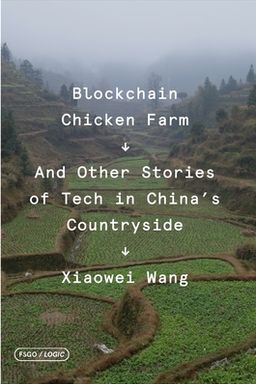
What if the future of technology isn’t in the glittering cities we see on screens, but in muddy rural villages where blockchain tracks chickens and farmers livestream their crops? In Blockchain Chicken Farm, Xiaowei Wang asks how technology reshapes rural China—and, by extension, the human story of progress. Through field travels across farms, factories, and data centers, Wang reveals that the countryside doesn’t just depend on technology; it feeds the global technological system we live in. Beneath the neon and algorithm, this book wrestles with what it means to be human when our lives are measured by data and advanced by machines.
Wang’s core argument is that understanding technology’s global power requires seeing what happens in its rural roots. Whether through blockchain used to mediate food trust, AI farms that raise pigs, or drone entrepreneurs soaring over rice paddies, rural China becomes both laboratory and mirror—a place where social order, economic ambition, and digital capitalism collide. Technology claims to liberate us, but Wang contends that it also binds us more tightly to systems of surveillance, inequality, and fantasy. To grasp the human future in technological progress, we must look not at Silicon Valley’s utopias but at the countryside: the ghosts, the farmers, and the chickens that make progress possible.
The Forgotten Center of Globalization
Wang challenges the metronormativity—the belief that all meaningful life and progress exist in cities. Rural China has long been treated as archaic, backward, and disposable. Yet it powers the world’s digital infrastructure, from rare earth mines that build phone chips to agricultural villages that produce data for artificial intelligence models. When we talk about globalization, we imagine the “cloud” hovering above us, but the cloud has dirt beneath it—the land and labor of people who remain invisible in the global supply chain.
Through sensory, personal storytelling, Wang interweaves family history and political reality. Famine, hunger, and political campaigns haunt the villages she explores: reminders that modern China’s technological rise rests on a historical memory of control and sacrifice. Her ninety-year-old great-uncle once lived through famine and revolution, now scrolling through WeChat—the intimate fusion of past suffering and present digital comfort.
Rural Revitalization and Digital Dreams
The Chinese government’s “Rural Revitalization” program becomes Wang’s lens for the emerging rural-tech order. Blockchain and AI are not just urban luxuries—they’re tools of economic planning in villages. Farmers are encouraged to use mobile payments, build data-driven food businesses, and cast their crops into the digital marketplace. But behind this optimism lies a deeper paradox: technology appears to offer freedom and modernization, yet it produces new dependencies, surveillance, and social inequality. Rural reality becomes a metaphor for digital life everywhere—an uneasy negotiation between empowerment and exploitation.
You see this contradiction when Wang visits the blockchain chicken farm, where every step a chicken takes is recorded for authenticity. The charm of blockchain transparency hides a new kind of control. Freedom in data becomes submission to the machine. Wang compares this logic to Thomas Hobbes’s view of humanity as selfish, requiring authoritarian systems of discipline and order. Blockchain thus mirrors the fear within governments and corporations—the fear that people cannot be trusted, replaced instead by surveillance and algorithms.
Beyond Progress and Prediction
Throughout the book, Wang invites you to question the story of progress itself. Engineers often believe technology simply solves problems, but she shows it perpetuates cycles of inequality and ecological destruction. In Chinese AI farms, pigs are monitored by algorithms for efficiency. Yet this optimization creates fragility, new diseases, and a loss of meaning in human labor. The promise of AI—to make farming rational and perfect—turns life into data. Wang reminds us that farming, coding, and living all demand commitment to uncertainty. As philosopher Sylvia Wynter notes, “what it means to be human” has always been a construct—redefined by those in power. Wang builds on this, revealing how the modern ideal of the rational, optimized life erases the messy, embodied, emotional parts of existence.
By returning us to the countryside, Wang reframes questions for any reader living amidst screens and algorithms: Who writes the fictions of progress? Who benefits from them? And how do we reimagine a life beyond prediction, beyond the logic of optimization? The book ultimately becomes a meditation on living with technology instead of under it. The fate of rural China uncovers the fate of us all—entangled between control and freedom, the physical and digital, the local and global. The challenge Wang leaves you with is simple and profound: to see, in every technological promise, the ghosts of the human labor and longing that made it.