
Idea 1
Blockchain and the Promise of the Distributed Future
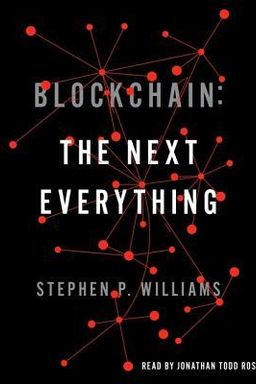
What would a world without gatekeepers, bankers, or bureaucracies look like—a world where ordinary people could verify truth, exchange value, and collaborate without needing to ask permission? In Blockchain: The Next Everything, journalist and entrepreneur Stephen P. Williams argues that blockchain, a deceptively simple digital ledger system, offers not just a new technology but an entirely new way of organizing society. Williams contends that blockchain provides a framework for radical transparency, distributed trust, and individual empowerment, enabling new economies, governance models, and even cultural forms that bypass traditional hierarchies.
In his deeply reported, often humorous exploration, Williams travels from New York’s blockchain meetups to Shanghai, from digital art lofts to African villages, revealing blockchain’s strange blend of techno-utopianism, social activism, and speculative finance. He argues that, like the early Internet, blockchain is currently misunderstood by most people—it’s a “ship not seen,” invisible to those unprepared to recognize its potential. Yet it could eventually underpin everything from global identity systems and voting platforms to decentralized art markets and energy grids. The big idea is that blockchain isn’t just about money; it’s about creating a new distributed order for everything.
A Technology Born from Distrust
Williams begins by demystifying blockchain’s origins. He recounts how the mysterious figure Satoshi Nakamoto introduced Bitcoin in 2008 as a peer-to-peer system to exchange money without banks. Bitcoin was powered by blockchain, an immutable chain of digital blocks that record every transaction in transparent, verifiable form. Unlike traditional ledgers, blockchain doesn’t rely on any single authority; its records are collectively maintained by a distributed network of computers (“nodes”). Each node holds the same ledger, and consensus algorithms such as proof of work or proof of stake verify that all participants agree on what happened. The result is digital trust created by code rather than by institutions.
Williams contrasts this structure with the centralized social order most of us are born into. Historically, we’ve depended on hierarchical intermediaries—banks to declare our wealth, governments to certify our identity, and corporations to control markets and information. Blockchain eliminates the need for these middle agents. By embedding trust directly into the algorithmic infrastructure, it potentially makes transactions “trustless”—not because people are untrustworthy, but because the system itself enforces honesty.
Beyond Money: A Cultural and Social Revolution
For Williams, the most exciting aspect of blockchain lies beyond cryptocurrency. He describes how artists, activists, and innovators are using blockchain as a creative platform. In New York, for example, he attends a blockchain-art meetup where digital artists create “rare” pixelated artworks like Cryptopunks or CryptoKitties—digital collectibles whose value comes from verified provenance on the chain. He sees how blockchain makes even intangible creations (like music or memes) provably unique, disrupting ideas of ownership and copyright. This same technology could also help Congolese miners track ethically sourced minerals or enable refugees to maintain a secure digital identity that no government can erase.
These stories reveal blockchain as both a culture and a philosophy. It’s not just a technical system; it’s a collective paradigm shift that invites us to rethink power, privacy, and participation. Williams likens distributed networks to natural systems—ant colonies, murmuring starlings, and forest mycorrhizal webs—where order emerges from collaboration rather than command. Such decentralized cooperation could transform economies and politics, leading to an age of “crypto enlightenment” (a phrase borrowed from theorist Melanie Swan at Purdue University). The book therefore positions blockchain as part of a continuum of human innovation, from double-entry bookkeeping to the Internet, each designed to expand collective trust and accountability.
The Promise—and Paradox—of Radical Transparency
Williams acknowledges that blockchain’s strengths—its permanence, transparency, and openness—are also its risks. Once data enters the chain, it can’t be changed; garbage in, garbage forever. He warns that blockchain’s immutability is only as reliable as the truth of the data entered and the reputation of those who verify it. He also wrestles with environmental concerns: Bitcoin’s proof of work protocol consumes more energy than some nations. Still, he suggests that new models like proof of stake and hashgraph consensus may reconcile decentralization with sustainability. The energy problem, he argues, is solvable; the moral problem—who gets to encode truth—is more complex.
Despite these contradictions, Williams insists that blockchain represents a necessary evolution. In a time of corporate surveillance capitalism, political distrust, and rising inequality, it offers a way to reassert individual sovereignty over data, identity, and value. Whether it fulfills this promise depends on our choices: blockchain, like the Internet before it, can be harnessed by monopolies or by communities. Williams calls for vigilance, creativity, and ethical imagination as we code our future.
Why Blockchain Matters to You
Williams’s central point is that blockchain will soon operate beneath almost everything you do—whether you notice it or not. Just as we use the web daily without knowing how IP addresses work, millions will soon interact with blockchain layers through everyday apps. Voting securely from your phone, tracing your food’s origin, renting your car to strangers via smart contracts, or earning tokens for sustainable habits could all become seamless blockchain experiences. In this new distributed world, you’ll own your identity and data, decide what to share, and potentially earn value directly from your participation in digital life.
In the following key ideas, we’ll explore how Williams dissects blockchain’s components—ledgers, decentralization, cryptography, and smart contracts—and how he imagines their consequences for industries like art, finance, energy, and governance. We’ll see why blockchain could destroy secrecy, rewire capitalism, and even redefine what it means to be human in the digital age. Whether blockchain becomes our next enlightenment or our next Segway, Williams urges you not to look away from the approaching “ship not seen.” Because this time, the invisible vessel might carry the blueprint for the next phase of civilization.