
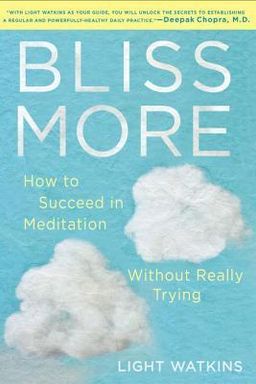
Bliss More cover

Bliss More

by Light Watkins

Bliss More reveals how to transform meditation into a pleasurable, effortless experience. Light Watkins shares practical strategies to fit meditation into your busy life, helping you achieve serenity and mindfulness without stress. Discover how to let go, embrace your thoughts, and use a Settling Sound to find tranquility and intuition in your daily practice.

Meditation Made E.A.S.Y.: Light Watkins's Path to Everyday Bliss

Have you ever sat down to meditate, determined to find inner peace, only to end up wrestling with boredom, frustration, or a tornado of thoughts? In Bliss More: How to Succeed in Meditation Without Really Trying, teacher Light Watkins argues that meditation doesn’t have to be difficult or mystical. In fact, if it feels arduous or confusing, you’re probably trying too hard. Watkins contends that the secret to successful meditation lies in releasing effort—not adding more of it. Real bliss, he says, is an effortless by-product of relaxation, curiosity, and acceptance, not intense concentration or ascetic stillness.

Drawing from two decades of practice and his training in Vedic meditation under Maharishi Mahesh Yogi’s lineage, Watkins redefines meditation for modern householders—busy people with jobs, relationships, and bills, not monks cloistered in Himalayan caves. He frames meditation as a life tool for adapting to stress, building resilience, and cultivating joy. The book’s structure reflects this dual focus: Part One teaches how to meditate enjoyably with his E.A.S.Y. technique; Part Two reveals why meditation transforms your life beyond the cushion.

From Struggle to Simplicity

Watkins begins by acknowledging a truth most beginners feel but rarely admit—meditation often seems like torture. His own story mirrors this: years of cross-legged suffering, rigid postures, and mental self-criticism left him disillusioned. He tried candle-gazing, guided meditations, Hare Krishna sessions, and even vibrational New Age music, but found only pain and impatience. The breakthrough came when he met his teacher, known as MV—a down-to-earth disciple of Maharishi Mahesh Yogi—who taught him that meditation works best when you do less. The revelation that effort obstructs rather than promotes inner calm changed everything. From that point, Watkins’s life and teaching pivoted on one principle: meditation should feel natural, restorative, and even fun.

Householders, Not Monks

A major theme of Bliss More is shedding the “monk stereotype.” Westerners often think meditation requires back-breaking postures, austere silence, and an impossible level of concentration. Watkins divides meditators into two historical archetypes: sannyasas (renunciates who dedicate life to spiritual liberation) and grihasthas (householders who meditate while living normal worldly lives). For householders, perfection isn’t the goal—comfort is. He quips that you should sit for meditation as you would for binge-watching TV: supported, cozy, and relaxed. The mind settles when the body settles; discomfort only fuels mental restlessness. This perspective restores meditation from an act of discipline to an act of kindness.

The E.A.S.Y. Revolution

Watkins introduces his signature E.A.S.Y. meditation method—four principles that make meditation effortless and rewarding: Embrace all thoughts, AcceptSurrenderYield

Why It Matters

Behind Watkins’s technique is a philosophy of adaptability and inner evolution. He shows that daily meditation fuels resilience, empathy, and productivity—skills essential in a noisy modern world. His real aim isn’t just teaching you to meditate; it’s teaching you how to transform daily life into a meditation in motion. Through the process, meditation develops what psychologists call “meta-awareness”—the ability to observe thoughts and feelings without identifying with them. Watkins compares this to using a treadmill for the mind: it trains it to be less reactive and more adaptable.

In essence, Bliss More reframes meditation not as an escape from life but as a way to show up in life more fully. Watkins’s conversational warmth and practical wisdom demystify an ancient spiritual science, distilling it into 20-minute daily doses of joy. Whether you’re a skeptical beginner or a weary overachiever, he offers a path toward mental clarity and emotional freedom through ease, not effort. His premise is delightfully paradoxical: the less you try to meditate, the more meditation works for you.


The Power of Comfort

Light Watkins begins his practical philosophy with the simplest—and most radical—instruction: get comfortable. Forget cross-legged discipline. Forget the idea that silence equals success. Comfort, he insists, is not indulgence but the foundation of a productive meditation practice. As he learned from his teacher MV, when the body rests, the mind can settle naturally. If you sit stiffly, you’re locking yourself into a physical struggle that mirrors mental resistance.

Why Comfort Changes Everything

Watkins contrasts the monk’s approach—where austerity purifies the spirit—with the householder’s reality. You have jobs, bills, families, and phones buzzing. You don’t need enlightenment on a mountaintop; you need peace between meetings. That’s why comfort is not optional—it’s biological. Physical exertion increases mental activity, which interferes with meditation’s settling process. A straight spine and rigid posture make your mind race; a supported back and relaxed limbs slow mental chatter. So he proposes the golden standard: sit as you do when binge-watching your favorite show, with back support, legs extended, and blanket if needed.

No More “Position Shaming”

Watkins introduces the term position shaming to describe how yoga culture and Instagram have distorted meditation. Perfect posture has become a measure of spiritual success, but Watkins calls this harmful. Meditation is an internal experience, not a photo opportunity. If your body feels good, your meditation will work; if you’re distracted by pain, it won’t. With humor, he invites yoga teachers to abandon the lotus pose and sit on couches instead. His motto: “Sit like you’re binge-watching TV.” The goal is sustainability—if it’s not fun, it’s not sustainable (a point echoed by author Pam Grout in her praise for the book).

Real People, Real Places

Another myth Watkins dismantles is that you need a serene environment to meditate effectively. Fancy altars, cliffside views, sunset beaches—all lovely, but impractical. Real meditation happens in bus seats, parked cars, and noisy living rooms. Meditation, he says, creates its own quiet inside you. When you stop chasing the “perfect scene,” you make your practice portable—and portability leads to consistency. The more comfortable you are, the more often you’ll meditate, which builds the habit and deepens the results.

Watkins’s Comfort Principle

“It’s not that you should sit comfortably when meditating—it’s that you need to sit comfortably to meditate with success.”

For Watkins, the art of sitting comfortably symbolizes the greater theme: stop trying to look enlightened and start feeling at ease. Comfort paves the road from struggle to surrender, turning meditation from spiritual performance into genuine rest.


All Thoughts Matter

If you’ve ever tried to “quiet your mind” and failed, Light Watkins wants you to know: that failure is actually success. In one of the book’s most liberating insights, he insists that all thoughts matter. Meditation isn’t an exercise in suppression; it’s an invitation to dance with the mind’s chaos. He even turns a famous psychological experiment into proof.

The Polar Bear Effect

Watkins asks readers to think—or not think—about polar bears for thirty seconds, referencing a study by Fyodor Dostoevsky and Harvard psychologist Daniel Wegner. Inevitably, the moment you try not to think of polar bears, that’s all you can think about. The moral? Suppression intensifies obsession. Watkins concludes that mental distractions aren’t signs of weakness but of normal human mechanics. Trying to silence thoughts just makes more noise.

Embracing the Busy Mind

Instead of fighting thoughts, Watkins teaches you to reframe them. He compares meditation to swimming: if you resist the water, you’ll drown; if you move with the current, you glide effortlessly. Thoughts are like waves. The more you relax, the more naturally they flow. Busy minds are not broken—they are simply active treadmills waiting to be switched from frantic motion to steady rhythm. Meditation provides that rhythm.

This reframing dissolves the “monkey mind” myth. Every human experiences thousands of thoughts daily; meditation isn’t about eliminating them but making peace with them. The shift from control to acceptance unlocks what Watkins calls the settled mind—the moment thoughts loosen and silence emerges by itself.

From Focus to Flow

Watkins critiques traditional advice like “witness your thoughts” or “let go,” which require mental effort. By contrast, his E.A.S.Y. framework eliminates focus altogether. Instead of demanding stillness, you allow it to happen. This is echoed by neuroscientists studying “default mode” networks—mental wandering precedes creative insight. Meditation, therefore, isn’t controlling thought but leveraging it for transformation.

“Meditation is never about stopping your thoughts—just as swimming is never about stopping the water.”

By granting every thought—pleasant, random, or disturbing—a seat at the table, you transform meditation from conflict into communion. In accepting all thoughts, you paradoxically experience the bliss of none.


The E.A.S.Y. Method

The E.A.S.Y. method forms the practical heart of Watkins’s teaching. Representing Embrace, Accept, Surrender, and Yield, it’s the antidote to meditation dogma. The acronym provides simple cues that make sitting daily something you look forward to rather than dread. It dismantles years of overthinking meditation into four liberating attitudes.

E – Embrace

To embrace means to allow everything—noise, emotion, sleepiness, joy, sadness, and distraction—to coexist naturally. In the same way a mother hugs her child regardless of mood, you hug every thought. This openness accelerates relaxation because your brain stops fighting reality. The paradox: the less discrimination you use, the faster peace arrives.

A – Accept

Acceptance is extending the hug one step further. When you meditate, whatever happens is precisely what should happen. Watkins urges readers to drop the imaginary scoreboard—there are no “good” or “bad” meditations. Every session counts as success because it trains the nervous system to respond to life’s chaos with equanimity.

S – Surrender

Surrender targets expectations. Many people think meditation should feel serene every time. Watkins reminds you that clunky experiences are normal signs of stress release. When you surrender the need for control, you cultivate what psychologists call “radical acceptance.” Life stops being an enemy; it becomes a teacher. Real progress is letting go of the outcome.

Y – Yield

Yielding is the final layer. It means softening resistance in real time—turning from “focusing” to “floating.” When sounds, sensations, or emotions surface, yield instead of fighting. Watkins warns that society trains us in the opposite direction; we’re told success requires effort. Meditation flips the cultural rulebook: the more you yield, the deeper you go.

Together, these four principles create a psychological safety net. They allow you to experience the natural descent from surface awareness to the settled mind without manipulating your thoughts. Watkins likens it to learning freestyle swimming—freedom is found in fluidity, not rigidity. Once ingrained, the E.A.S.Y. mindset infiltrates everyday life, helping you stay calm during traffic, deadlines, or emotional storms. Meditation stops being something you “do”; it becomes how you are.


The Settling Sound: Ah-Hum

Every meditation technique needs an anchor, and Watkins’s version is deceptively simple: the sound “ah-hum.” Pronounced softly, it acts as a universal Settling Sound—a vibration that calms the mind from the inside out. He warns that not all mantras are equal; each works like a specific medicine. “Ah-hum” is chosen for its vibrational quality rather than its meaning (“I am” in Sanskrit).

Why Sound Works

Watkins refers to both Vedic tradition and modern science. Vedic seers discovered thousands of years ago that repeating certain syllables influences consciousness. In parallel, Japanese researcher Masaru Emoto and physicist studies on sympathetic vibration show how sound can reorganize molecular structures. Likewise, the gentle repetition of “ah-hum” reorganizes scattered thoughts into calm coherence. You don’t chant or force it; you whisper it mentally like a lullaby.

How to Use It

To practice, sit comfortably and close your eyes. Passively think “ah-hum,” allowing it to fade when your attention drifts. When you remember, simply start again. The fading is not failure—it signals your mind settling. You can meditate ten to twenty minutes once or twice daily. Like tuning an instrument, regular repetition strengthens mental resonance until silence itself becomes audible.

Proof in Repetition

Watkins’s students describe how this practice moves them from anxiety to deep rest. Some fall asleep; others experience dreamlike imagery or timeless gaps. He calls these “settled mind zones.” Forgetfulness—losing track of time or sound—is a positive symptom. You come out feeling light, clear, and refreshed, what he describes as a “bubble bath for the mind.” By combining vibration with E.A.S.Y., meditation no longer requires willpower; it becomes an enjoyable daily ritual.

Meditation creates quiet inside, not outside. When you allow “ah-hum” to disappear, you meet the silence that was waiting all along.


The Exchange Principle

One of Watkins’s most surprising lessons is that commitment amplifies results—and nothing builds commitment faster than an exchange. Drawing from his initiation into Vedic training, he encourages every meditator to give something meaningful in return for the practice. Not as payment, but as symbolic energy exchange that activates integrity and seriousness.

Why Giving Transforms

When Watkins learned with MV, he was asked to contribute one week’s salary as a “gurudakshina,” or teacher’s gift. For him, that meant $400—nearly half his savings—but the act changed how he valued meditation. The pinch strengthened his commitment to daily practice. He later witnessed the same pattern in students who made personal exchanges—whether donating money, volunteering, or creating art—their consistency and enthusiasm multiplied.

In modern terms, the Exchange Principle is behavioral psychology: we value what we invest in. Free lessons breed apathy; investment motivates discipline. Giving something meaningful signals to your subconscious that you’re serious about transformation. Watkins invites readers to choose their own exchange—money, time, service—something that “stings a little.” This symbolic offering becomes fuel for devotion.

Real Examples

He recounts stories of students who cooked meals for the homeless, volunteered at schools, or donated earnings. Even his teenage nephew used $50 to make sandwiches for people living on the streets. Each act linked spiritual growth with compassion. Watkins argues that these exchanges complete the meditation cycle by grounding inward peace in outward generosity. They also help overcome procrastination: once you’ve invested, you show up.

Ultimately, the Exchange Principle teaches that meditation’s success isn’t just measured by inner calm but by the integrity you cultivate through giving. In a world obsessed with getting, giving paradoxically helps you receive—a richer, more blissful life.


Stress Release and the Science of Rest

Watkins connects the experience of meditation with physical healing. Referencing research by Dr. Herbert Benson of Harvard Medical School, he explains how meditation induces the relaxation response—a physiological state opposite the fight-or-flight reaction. Benson’s studies on Transcendental Meditation showed decreased heart rate, lower blood pressure, and deeper rest than sleep itself. Watkins’s E.A.S.Y. approach, grounded in similar principles, becomes a modern health technology for stress reduction.

How the Body Heals Through Rest

During meditation, your mind settles and your body gets a rest more profound than sleep. That rest triggers detoxification—stored stress begins to release. Watkins describes odd sensations like twitching, tears, heat, or racing heart. He calls these signs of “laundering” the body. Stress leaves as emotional residue or physical tension. Over time, this cleansing results in better sleep, stronger immunity, and emotional stability.

Stories from the Field

The book includes vivid case studies: Otto, the insomniac who could only sleep on buses, reclaimed restful nights after learning meditation; Cole, a young basketball coach with hypertension, lowered his blood pressure without medication; and George, a playwright whose chronic foot pain vanished after consistent practice. Watkins cautions against viewing meditation as medical cure, but their stories illustrate how deep rest unlocks natural healing mechanisms.

Stress as Stored Experience

Watkins likens stress to dirty water in a drain—it clogs the system until you pour in something powerful, like meditation, which clears blockages. Emotional memories act like triggers, reactivating the body’s old defense responses. Through consistent rest, those triggers dissolve. The result is greater adaptability: you stop overreacting, start responding.

“High-quality rest leads to the release of stress. If stress is a cockroach, meditation is the can of Raid.”

Physiologically, Watkins’s model harmonizes East and West—ancient mantras meet modern science. Meditation becomes not just a mental escape but a biological reset button, making the everyday householder as resilient as any renunciate.


Adaptability and Bliss in Daily Life

By the end of Bliss More, Watkins circles back to his ultimate goal: helping you live more blissfully outside meditation. He shows that the ultimate indicator of progress isn’t how quiet your mind becomes on the cushion, but how adaptable you become in real life. Adaptability—responding creatively to change—is the true metric of inner freedom.

Real-World Proof of Inner Change

He relays stories of students like Jennifer, an artist who remained calm after being insulted by a stranger; Janice, a realtor whose newfound empathy healed a long-standing feud; and Charlie, a professor who forgave his brother’s suicide after years of bitterness. Each case underscores meditation’s quiet alchemy—transforming reactivity into reflection, anger into compassion.

From Reaction to Response

Watkins compares meditation’s maturation to the moment you stop taking offenses personally. Rather than “fight or flee,” you pause, see the bigger picture, and act with grace. He frames this as “nature’s rejection is nature’s protection”: when life doesn’t go your way, it might be redirecting you toward something better. This mindset turns setbacks into synchronicities.

Mindfulness Beyond Effort

Watkins redefines mindfulness as a by-product of meditation, not its technique. True mindfulness isn’t forced awareness of every breath or strawberry; it’s spontaneous presence—the flow state athletes or artists know well. You can’t be mindful by trying to be mindful, he jokes. Mindfulness arises naturally as meditation dissolves stress, freeing intuition and clarity. Over time, you “see around the corner,” sensing opportunities before they appear.

For Watkins, this adaptability culminates in bliss: the deep knowing that life unfolds perfectly when you surrender control. Meditation becomes not a way to escape reality but to embrace it with open eyes. Doing less, you accomplish more. And, in his final encouragement, the world changes when individuals embody bliss. “If we want a peaceful world,” he writes, “the people must be peaceful.”

Dig Deeper

Get personalized prompts to apply these lessons to your life and deepen your understanding.

Go Deeper

Get the Full Experience

Download Insight Books for AI-powered reflections, quizzes, and more.