
Idea 1
Bearing Witness to Black Saturday
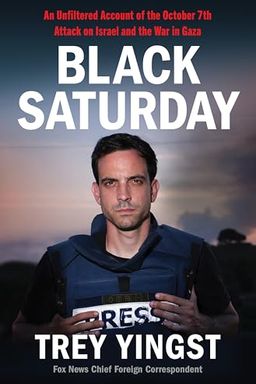
What do you do when the story you’re covering becomes a moment that changes a nation—and changes you? In Black Saturday, Trey Yingst argues that to understand the Israel–Hamas war, you must look through two lenses at once: the raw, on-the-ground reality of October 7, 2023 and its aftermath, and the parallel battle to control truth in the fog of war. He contends that journalism at its best demands proximity, empathy, and restraint—especially when the world is primed to share, misread, and weaponize images in seconds. The result is a gripping, first-person chronicle that doubles as a field manual for making sense of violent conflict in a hyperconnected era.
Across this account, you walk alongside Yingst and his team—from the first sirens in Tel Aviv and a harrowing drive south, to triage scenes outside Sderot and embeds with Israeli units pushing into Gaza. The book braids three storylines: the surprise Hamas assault and the massacre that followed; Israel’s evolving military and political response; and the human toll on civilians, soldiers, hostages, and the journalists tasked with telling their stories. Along the way, it interrogates viral claims (the Gaza hospital explosion, “beheaded babies,” evacuation blockades), documents wrenching choices (what to show on TV, when to hold back), and reveals how trauma shadows even the most seasoned correspondents (recurring nightmares, sensory flashbacks, and coping routines).
A Day No One Saw Coming
October 7 unfolds like a thriller with no safe exit: a producer’s 7:03 a.m. call; rocket streaks over Tel Aviv; a decision to head for Sderot; then a makeshift evacuation point where wounded civilians and soldiers pour in, many with bullet wounds rather than shrapnel. The realization lands: the border has been breached in dozens of places, and the IDF is not yet on scene. From there, Yingst records live as gunfights erupt, ambulances jam the road, and mothers lift limp children into waiting stretchers. He meets Ziv, an off-duty Be’eri resident who first tries to stop the cameras, then—upon seeing Trey’s photo with Benny Gantz—becomes a source, reciting names of kibbutzim under attack.
The book’s narrative method matters: rather than argue abstractly, Yingst shows you scenes—and the human beings inside them. A bearded officer dies on the pavement as paramedics pace in frustration. An Israeli policewoman, Corporal Mali Shoshana, battles rooftop attackers at the Sderot station, tossing a live grenade back down a stairwell and radioing a farewell to her son when she believes she’ll die. Meanwhile, texts from Gaza (from Nael, a longtime fixer turned U.S. resident visiting his parents) reveal a second vantage point: ER corridors at Shifa flooding with gunshot victims; one whispered report of an Israeli hostage appearing inside the hospital; later, bombarded neighborhoods and sleepless families trying to calculate survival.
The War in Two Theaters: Streets and Screens
If this book were only a dispatch from the front, it would already be urgent. But it insists you also reckon with the information war. Rumors and claims spiral as fast as rockets. Did Israel strike the al-Ahli hospital, killing hundreds? Yingst audits the evidence: no large crater; blast patterns matching a misfired rocket; video timestamps and metadata from a border soldier; still, a death toll he refuses to guess at. Were babies beheaded in Kfar Aza? A local TV report cites a soldier; days later, rescuers confirm brutal mutilations but not the viral number. Were Gazans blocked from evacuating? Yingst gathers a Hamas official’s denial, counters with audio and drone video of armed men turning civilians back, and keeps the record open where facts are incomplete. (For comparison, Peter Pomerantsev’s work on propaganda, or Janine di Giovanni’s on war ethics, highlight similar tensions.)
Why This Matters to You
You live in the blast radius of instant content. This book gives you habits to stay human: verify before you share, resist the seduction of total certainty, and hold two painful truths at once. Hamas committed a mass atrocity; thousands of Gazan civilians—men, women, and children—have also suffered, been displaced, or killed by Israel’s response. You meet specific people on both sides: Chen from Kfar Aza who watched militants kill her husband and eldest daughter, then resolved to protect her remaining children in tunnels and safe houses; Dr. Abdelwahab Abu Warda, a Gaza City surgeon who runs out of anesthesia and still operates; Mohammed Al Aloul, the journalist-father who loses four children in Al-Maghazi; and reservists like Lt. Col. Gilad Pasternak, who spends weeks fighting block by block and still calls families when IDF mistakes cost hostage lives.
Expect to learn how the first hours of failure shaped everything that followed; why Israel’s leadership (Defense Minister Yoav Gallant, Chief of Staff Herzi Halevi, and a divided cabinet) struggled over timing, fronts, and the ground war; how evacuation orders collided with logistics, fear, and militant enforcement; how hostages shifted diplomacy and battlefield choices; and what it costs a reporter to keep showing up. The through-line is clear: clarity comes from specificity, and empathy requires proximity. If you want to be an informed citizen and a better consumer of wartime media, Black Saturday is a tough, necessary guide.
A Core Claim
“Two things can be true at once: the October 7 massacre was horrific; and innocent Palestinian lives must be protected.”